Failure mode 1: ICP variance and fuzzy targeting sink an AI SDR
ICP variance sinks an AI SDR because the model faithfully contacts whoever you put on the list, including the wrong people. With reply rates already low, per Belkins (2025) at 5.8% for 2024, every mistargeted contact is a wasted send that drags the average further down. A fuzzy ideal customer profile turns automation into high-speed spray, not precision outreach.
Picture the replies landing in your inbox. "We don't do that." "Wrong department." "Please remove me." They skew negative or off-topic. Meetings booked stay near zero even as send volume climbs, and your best-fit accounts barely show up in the pipeline at all. The cause sits upstream, in a definition problem. When "our ICP" lives in three people's heads as three different pictures, the list inherits all three. The AI doesn't pick the best one. It scales the disagreement.
Why fuzzy targeting happens
Most ICP drift starts quietly. A founder defines the early ICP from gut and a handful of deals. Then the team bolts on adjacent segments without retesting fit. The data source widens, a bought list here, a scraped one there, and suddenly the AI is emailing a blur. Precision matters more now, not less, because buyer behavior gives you almost no room. According to Gartner (2023), B2B buyers spend only about 17% of their total buying time meeting with potential suppliers, and that thin slice is split across every vendor they weigh. Aim at the wrong person and you've spent your one narrow window on someone who was never going to buy. Spend it on enough wrong people and you've spent the quarter.
The fix: tighten and test the ICP
Treat the ICP as a hypothesis you can falsify, not a belief you defend. Pull your last 20 to 30 closed-won deals. Find the firmographic and behavioral traits they share, and write them down as hard filters: industry, size, role, and a trigger that signals timing. Then have the AI send only to contacts that pass every filter, measure reply and meeting rates against the old broad list, and keep tightening. Narrow and accurate beats broad and fuzzy almost every time.
Run the math on what fuzzy targeting actually costs you. Illustrative modeled example (industry-based scenario, not a real client): picture an AI SDR sending to a list that's roughly 30% mistargeted. That wastes about 3 of every 10 sequences before a single word gets read, and it drags the blended reply rate below the Belkins (2025) 5.8% baseline toward break-even or worse. Now trim the list to only contacts that match every ICP filter. The same AI, the same copy, the same send volume, suddenly looks like it "started working." Nothing changed but the aim. That's the whole secret to failure mode one, and it costs you nothing but the discipline to send less.
Citation capsule: Targeting is where AI SDRs fail first: a fuzzy ICP sends automated outreach to the wrong people at scale. Buyers also spend only about 17% of their buying time with suppliers, per Gartner (2023), and that window splits across every vendor. Aim wrong and you burn it. Tightening the ICP to traits shared by closed-won deals is the highest-impact fix.

Related reading: the common ICP and targeting mistakes that quietly waste outbound spend.
Failure mode 2: Does dirty CRM data ruin AI outreach?
Yes, dirty CRM data ruins AI outreach, often more than bad targeting does. Bad emails bounce, duplicates double-message the same person, and missing fields break personalization. An AI SDR can't personalize a record that has no first name, and it can't reach a contact whose email is three jobs out of date. Against a 5.8% reply baseline, per Belkins (2025), data rot is pure subtraction.
This is where the real damage lives, because it compounds in three places at once. First, deliverability: high bounce rates from stale addresses tell mailbox providers you're hammering a dead list, which sinks your sender reputation and lands even your good emails in spam. Second, credibility: a duplicate or wrong-name message looks careless and burns trust on the first touch, the one touch you can't get back. Third, measurement: when records are messy, you can't tell whether a low reply rate is a targeting problem or a data problem. So you fix the wrong thing, change five variables, and learn nothing.
The three kinds of dirty data that hurt most
Not all data problems weigh the same. These three do the heaviest damage to automated outreach:
- Invalid and stale emails. They bounce, spike your bounce rate, and erode the domain reputation every future send depends on.
- Duplicate contacts. The same person gets messaged twice, or by two sequences at once, which reads as spam and triggers complaints.
- Missing or wrong fields. Empty first-name, company, or role fields break personalization and force the AI into generic, lower-converting copy.
The fix: clean before you scale
Run a validation and dedup pass before the AI sends a single email. Verify addresses through a validation service, merge duplicates, and either fill or suppress records missing the fields your personalization relies on. Then set a maintenance cadence so decay doesn't creep back in. This work isn't glamorous. It's also the cheapest reply-rate gain available to you. We've found that a few hours of cleanup usually beats weeks of subject-line tweaking, and it isn't close.
In our experience standing up outbound for small teams, dirty data is where "the AI failed" verdicts almost always trace back to. Owners expect the breakthrough to live in clever copy or a smarter model. It actually lives in the unglamorous work of making sure each record is a real, reachable person with a correct email and a filled-in name. The fastest turnaround we see comes not from new tech, but from validating the list the existing tech is already pointed at. The tool was never broken. The fuel was.
Citation capsule: Dirty CRM data ruins AI outreach by causing bounces, duplicate sends, and broken personalization. Stale addresses spike bounce rates and damage sender reputation, while empty fields force the model into generic copy. The fix is cheap and underused: validating and deduplicating the list before a single send is usually the largest reply-rate gain a team can make in an afternoon.
Go deeper: how to keep CRM data clean for AI-driven outreach, including the maintenance cadence that stops decay.
Failure mode 3: Why is weak messaging the third reason AI SDRs fail?
Weak messaging is the third failure mode because even a perfect list with clean data won't book meetings if the message gives no reason to reply. According to Belkins (2025), the average B2B cold email reply rate fell to 5.8% in 2024 from 6.8% the year before, and generic, feature-led copy sits at the bottom of that range. The reply-to-meeting step is where most automated programs quietly leak.
There are two distinct conversion gaps here, and teams confuse them constantly. The first is no reply at all, usually a relevance or subject-line problem. The second is replies that never become meetings, usually a weak call to action or slow follow-up. Track each step separately. A healthy reply rate sitting on top of a dead reply-to-meeting rate points to a message-and-follow-up problem, not a list problem. Until you measure that second step, "the AI isn't booking" is a guess dressed up as a diagnosis. (Hold that second gap in mind. We close it at the end.)
Why AI-written copy goes weak
AI is great at fluent and terrible at specific, unless you steer it hard. Left alone, it produces grammatically perfect, utterly generic messages that read like every other automated email in the inbox. Buyers have learned to skip them on sight. And the bar keeps rising, because of how people buy now. According to Forrester (2026), 94% of B2B buyers report using AI during their buying process, so they're researching, comparing, and pattern-matching faster than ever. A vague pitch loses to a buyer who already has the answers.
The fix: specific, signal-anchored messages and fast follow-up
Make the message about the buyer's situation, not your feature list. Anchor each send to a real signal, a role, a trigger, a recent event, open with the most relevant line, and ask for one small, clear next step. Then move fast on every reply. According to Harvard Business Review (2011), contacting a web lead within 5 minutes makes a firm about 21 times more likely to qualify it than waiting 30 minutes, and roughly 100 times more likely to connect at all. Your copy earns the interest. Speed converts it. Wait an hour and you're emailing a cooling lead who's already on a call with someone faster.
The reply-to-meeting gap is where most teams misdiagnose their AI SDR, and the mistake is expensive. They see a low meeting count, assume the targeting is wrong, and rebuild the list from scratch. But if replies are coming in and meetings aren't, the list is fine. The message and the follow-up are the leak. We've found that splitting the funnel into two measured steps, reply rate and reply-to-meeting rate, points straight at the real fix. It also saves teams from tearing down the one part of the machine that was already working.
Citation capsule: Weak messaging is the third reason AI SDRs fail: generic, feature-led copy earns no reply, and slow follow-up loses the replies it does earn. Buyers research harder than ever, with 94% using AI in the buying process per Forrester (2026), so vague pitches lose. Per Harvard Business Review (2011), contacting a lead within 5 minutes makes a firm about 21x more likely to qualify it. Specificity plus speed fixes both gaps.

See the mechanics: how a read-only control layer flags the replies routing drops before they go cold.
Diagnostic checklist: Which failure mode is killing your numbers?
Diagnose before you fix, because the three failure modes need different repairs and look nearly identical from a distance. The fastest way to name the culprit is to read your own funnel metrics against the symptoms below. Buyers spend only about 17% of their buying time with suppliers, per Gartner (2023), so you have almost no margin to fix the wrong thing twice. Match your numbers to the table first, then move.
| Symptom you see | Likely failure mode | What to check | The fix |
|---|---|---|---|
| Replies are negative or "wrong person" | ICP variance / fuzzy targeting | Do contacts match closed-won traits? | Tighten ICP to hard filters; resend |
| High bounce rate, emails in spam | Dirty CRM data | Bounce rate, list age, duplicate count | Validate emails, dedup, fill fields |
| Personalization looks generic or broken | Dirty CRM data | Are name, company, role fields filled? | Backfill or suppress incomplete records |
| Few replies, but list looks right | Weak messaging | Subject lines, opening line, relevance | Rewrite around buyer signal and value |
| Replies come in, meetings don't | Weak conversion / slow follow-up | Reply-to-meeting rate, response speed | Clear single CTA; respond within minutes |
| Everything's "fine" but volume is high | Multiple modes compounding | Split funnel into measured steps | Fix highest-leakage step first |
Read the table top to bottom against your last 30 days. If two rows fit, you have more than one problem, which is normal: targeting, data, and messaging compound on each other. Fix the highest-leakage step first, remeasure, then move to the next. Resist the urge to rebuild everything at once. Do that and you'll lose the signal about what actually moved the number, which leaves you exactly where you started, just poorer.
The most expensive mistake here isn't any single failure mode. It's misattribution. Teams that can't tell a data problem from a targeting problem from a messaging problem end up "fixing" all three at once, change five variables, and learn nothing. We've found that the teams who recover fastest are the ones who isolate one step, change one thing, and read the result, even when it feels slower in the moment. Slow and sure beats fast and blind.
Citation capsule: Diagnose AI SDR failure by matching funnel symptoms to a cause: negative replies point to targeting, high bounces to dirty data, and replies-without-meetings to weak messaging or slow follow-up. Speed is part of the read, too: per Harvard Business Review (2011), responding within 5 minutes makes a firm about 21x more likely to qualify a reply. Isolate one step, change one variable, and remeasure.
Put numbers on it: estimate the pipeline impact of fixing targeting, data, and messaging with the outbound calculator.
How SkoreFlow de-risks an AI SDR rollout
SkoreFlow de-risks an AI SDR rollout by catching the leaks before you scale sends. Our HubSpot Outbound Orchestration is a read-only control layer that monitors post-assignment state, SLA breaches, orphaned leads, and routing trust inside your existing HubSpot portal. According to Salesforce (2024), 83% of sales teams using AI saw revenue growth versus 66% without it. We surface your first routing leak in 24 to 48 hours, with no stack changes.
Remember the reply-to-meeting gap we flagged earlier? This is where it closes. A dashboard tells you a number looks bad and leaves you to guess why. We don't stop at the report. We catch the dead lead and show you exactly where the routing broke, the hot reply that came in and then sat unassigned while it cooled. The service is built for HubSpot-first agencies, RevOps consultancies, and B2B service teams who already feel the leak but can't see it. In a representative portal, that means surfacing roughly 47 orphaned leads, cutting speed-to-lead from about 340 minutes to 8, and pulling missed-SLA rates from around 62% down to 4%. Treat those figures as illustrative benchmarks, not a single named client's result.
Pricing runs from $297/mo (Starter, 1 portal, up to 5,000 contacts) to $597/mo (Growth, RevOps tiers, Slack and Teams alerts) to $997/mo (Agency, up to 10 client portals). The guarantee is plain: we catch a real routing leak in 48 hours, or you get a full refund. So the only thing you can lose is the leak. Outreach stays TCPA-aware, and your numbers, clients, and data stay private. The method is open. Your pipeline isn't.
The case for getting this right is the same data running through this whole article. Cold reply rates are falling, per Belkins (2025). Buyers research alone and with AI, per Forrester (2026). AI-using sales teams grow faster, per Salesforce (2024). And adoption is still early at the smallest firms, which is the part most owners miss. According to the U.S. Census Bureau (2026), overall AI use among US businesses sat between 17% and 20% in late 2025 to mid-2026. Doing this well now, while most of your competitors are still spraying and praying, is a real edge.
Illustrative example (industry-based scenario, not a real client): picture an AI SDR sending to a list that's roughly 30% mistargeted, built on a stale, deduped-but-not-validated database, routing replies into a portal where leads sit unassigned. It wastes about 3 of every 10 sequences on the wrong people, bounces on stale addresses, and lets hot replies go orphaned, dragging the blended reply rate below the Belkins (2025) 5.8% baseline. Now fix the aim, validate the data, rewrite the message around a real signal, and route every reply. The same tool converts. Layer in speed: contacting replies within 5 minutes makes the team about 21x more likely to qualify, per Harvard Business Review (2011). Plug your own volumes into the calculator to model your number.
Citation capsule: SkoreFlow de-risks an AI SDR rollout with a read-only HubSpot control layer that surfaces orphaned leads, SLA breaches, and broken routing, finding the first leak in 24 to 48 hours with no stack changes. The rationale is direct: according to Salesforce (2024), 83% of sales teams using AI saw revenue growth versus 66% without it, and AI use among US businesses still sits at just 17% to 20%, per the U.S. Census Bureau (2026), so doing this well now is a real edge.

See it in context: how HubSpot Outbound Orchestration catches orphaned leads and broken routing.
The bottom line: fix the aim, not the tool
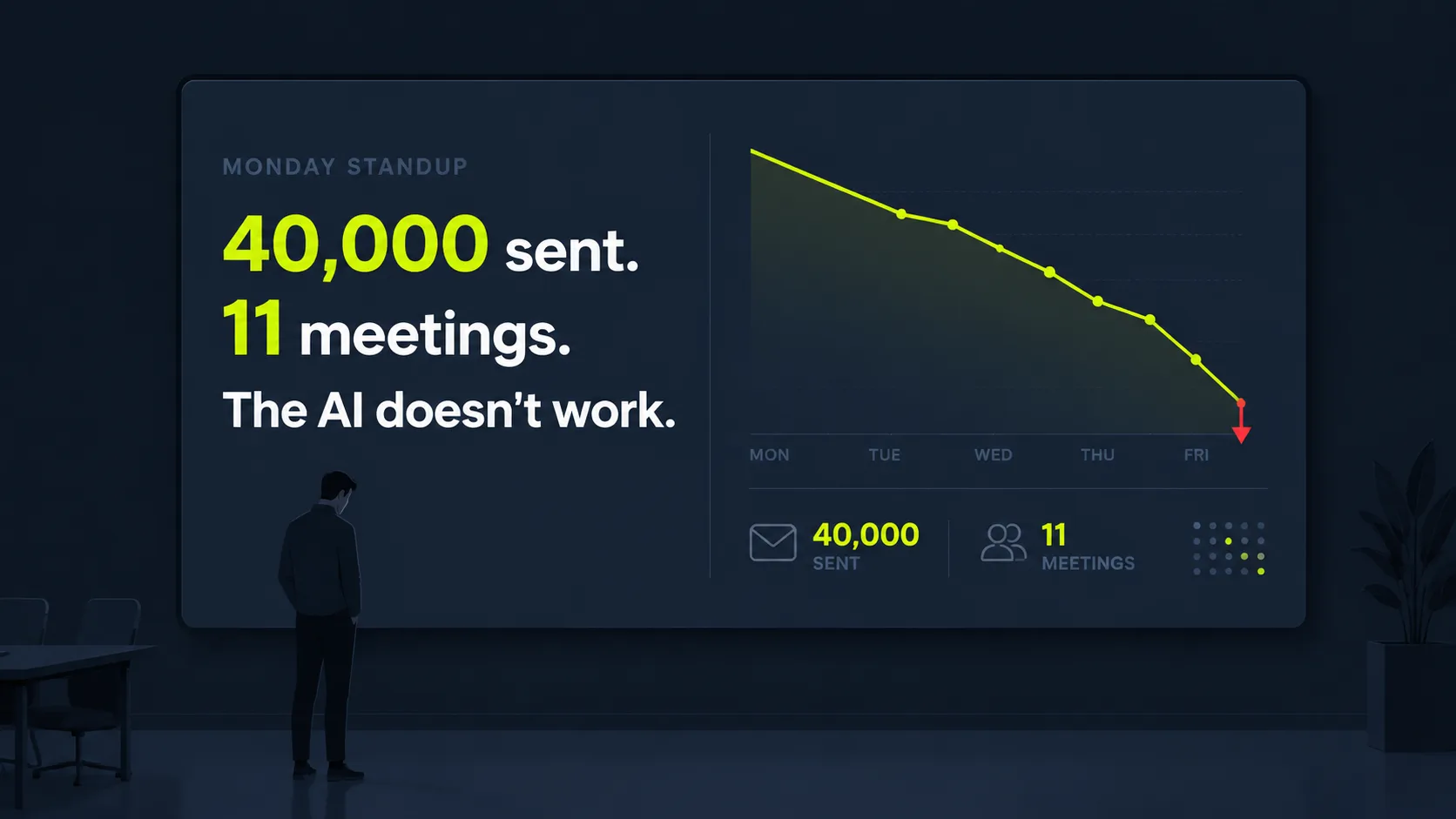
Go back to that Monday standup. The forty thousand sends, the eleven meetings, the verdict that the AI doesn't work. The model was almost never the problem. The three real causes are a fuzzy ICP, dirty CRM data, and weak messaging that doesn't convert replies into meetings, and all three are fixable without changing a single tool. Diagnose first: match your funnel symptoms to the table, isolate the highest-leakage step, change one variable, and remeasure. With cold email reply rates at 5.8%, per Belkins (2025), you can't afford to fix the wrong thing.
Tighten the targeting to traits your best customers share. Validate and dedup the data before you scale. Write specific, signal-anchored copy with fast follow-up. Do that, and the AI you were ready to fire next Monday starts booking instead. Want to find which failure mode is costing you? Model your numbers in the outbound calculator, or book a free 20-minute, no-pressure session and we'll find your first dead lead, the orphaned reply your routing quietly dropped. We surface it in 48 hours or you owe us nothing, so the worst case is a free diagnosis.
Next steps: model the pipeline impact of fixing targeting and data in the outbound calculator, or read how HubSpot Outbound Orchestration catches orphaned leads in 48 hours.
Written and reviewed by Maksim Skorokhod, Founder of SkoreFlow, who builds AI answering and outreach automation for small service businesses. Last reviewed: 2026-06-07.