How does Ruby Receptionist pricing compare to flat-rate AI?
Ruby uses a per-minute plan model, while AI alternatives charge a flat monthly rate. Ruby's published plans run $250/mo for 50 minutes, $395/mo for 100 minutes, $720/mo for 200 minutes, and $1,725/mo for 500 minutes, per Ruby (2026). That works out to roughly $3.45 to $5.00 per receptionist-minute. AI receptionist tiers, by contrast, start near $95/month with no minute meter, per Smith.ai (2026).
Now, that trap we mentioned. It's not the sticker price. It's the meter behind it. Per-minute plans charge you most on your busiest days, when call volume and your bill spike together. Think about when your phone actually rings off the hook. A heat wave for an HVAC shop. A January cold snap for a plumber. That's exactly when calls surge, and exactly when metered minutes cost the most. So the plan punishes you for the demand you spent years building. A flat AI plan stays flat whether you take 50 calls or 500 in a month.
Compare the two on cost model and structure side by side.
| Pricing factor | Ruby (live) | Flat-rate AI alternative |
|---|---|---|
| Model | Per-minute plans | Flat monthly, no meter |
| Entry price | $250/mo for 50 min, per Ruby (2026) | From ~$95/mo, per Smith.ai (2026) |
| Top published plan | $1,725/mo for 500 min, per Ruby (2026) | Flat tier, no minute cap |
| Effective per-minute | ~$3.45-$5.00/min, per Ruby (2026) | No per-minute charge |
| Busy-week behavior | Bill spikes with call volume | Bill stays flat |
| Market reference | Human services $300-$2,000+/mo, per CloudTalk (2025) | AI services $50-$300/mo, per CloudTalk (2025) |
Owners compare headline prices, but the meter is the part that bites. We've found the plan that looks cheapest in a slow month is often the one that hurts most in a busy one. Per-minute billing inflates the bill on the exact weeks a service business takes the most calls, which is the worst possible time to ration a receptionist. So the question stops being "which monthly price is lower" and becomes "which model bills me more the harder my phone works."
Citation capsule: Ruby's live receptionist plans run $250/month for 50 minutes to $1,725/month for 500 minutes, roughly $3.45-$5.00 per minute, per Ruby (2026). Flat-rate AI alternatives start near $95/month with no per-minute meter, per Smith.ai (2026). Across the market, AI services run $50-$300/month versus $300-$2,000+/month for human services, per CloudTalk (2025).
For the full math, read our breakdown of live versus AI call answering costs.
Books jobs or just takes messages: which handles a service caller better?
A flat-rate AI alternative is more likely to book the job, while Ruby leans toward capturing details and taking a message for your team to act on. For a service business, that one gap decides revenue. The reason is blunt: fewer than 3% of callers pushed to voicemail leave a message, per Invoca (2024). A message you have to chase is worth far less than an appointment already on the calendar.
Picture the difference on your desk Monday morning. One pile is pink message slips: name, number, "called about water heater." The other is a schedule with the slot already filled, address validated, urgency flagged. Same callers. Two completely different mornings. One is a list of phone tag you still have to win. The other is work that's already yours.
A service-business call has structure a generic message can't hold. The caller has a job type (no hot water, breaker tripping, AC not cooling), a service address, an urgency level, and a scheduling need. An AI agent built for trades runs a structured script: it identifies the job, captures the address, flags emergencies, and books the slot directly into your scheduler. A live message-taker captures what the caller volunteers, then hands you a callback to make later.
Speed compounds the difference, and the numbers here are stark. Firms that respond to a lead within five minutes are 21 times more likely to qualify it than firms that wait 30 minutes, and roughly 100 times more likely to make contact, per Harvard Business Review (2011, foundational study). The pattern still holds: a later large-scale analysis found conversion roughly 8 times higher when a lead is engaged inside five minutes, per InsideSales/XANT (2021). A booked appointment skips the callback window entirely. A message keeps the clock running while a competitor answers.
Walk through what each model does with a real service call.
- Identify the job. AI runs a trade-specific script to pin down the issue; a live agent records what's described in free text.
- Capture the address. Both can take it, but AI validates it against your service area automatically.
- Flag urgency. AI routes a "no heat in winter" call as an emergency per your rules; message-taking depends on the agent's brief.
- Book or message. AI writes the appointment into your calendar; a live service typically takes a message for you to schedule.
- Confirm. AI texts the caller a confirmation; a message-based handoff leaves confirmation to you.
In our experience setting these up for trades, the message-versus-booking line is where owners lose the most. A neat call summary feels productive. It feels like progress. But run it down the chain: a summary is a to-do, a to-do is a callback, a callback is a window, and a window is time the caller spends dialing the next plumber. By the time you ring back, the job may already be on someone else's truck. Booking on the call closes the loop while intent is highest, and intent at 11pm with water on the floor doesn't come around twice.
Citation capsule: A flat-rate AI receptionist books service jobs directly into the scheduler, while a live service like Ruby typically takes a message to act on later. Booking matters because fewer than 3% of callers sent to voicemail leave a message, per Invoca (2024), and firms responding within five minutes are 21 times more likely to qualify a lead, per Harvard Business Review (2011).

See exactly how the missed-call recovery voice agent captures and books service calls end to end.
Does an AI alternative cover after-hours and speed-to-answer better?
A 24/7 AI agent answers instantly day or night, while Ruby's coverage and capacity are bounded by staffed agents and hold queues. For service businesses, the after-hours window is too big to wave off. Locksmiths receive 34% of their calls after 5pm plus another 8% before 9am, and restaurants receive 51% of their calls after 5pm, per BrightLocal (2019). A flat AI agent covers that window without paying a person to sit through the night.
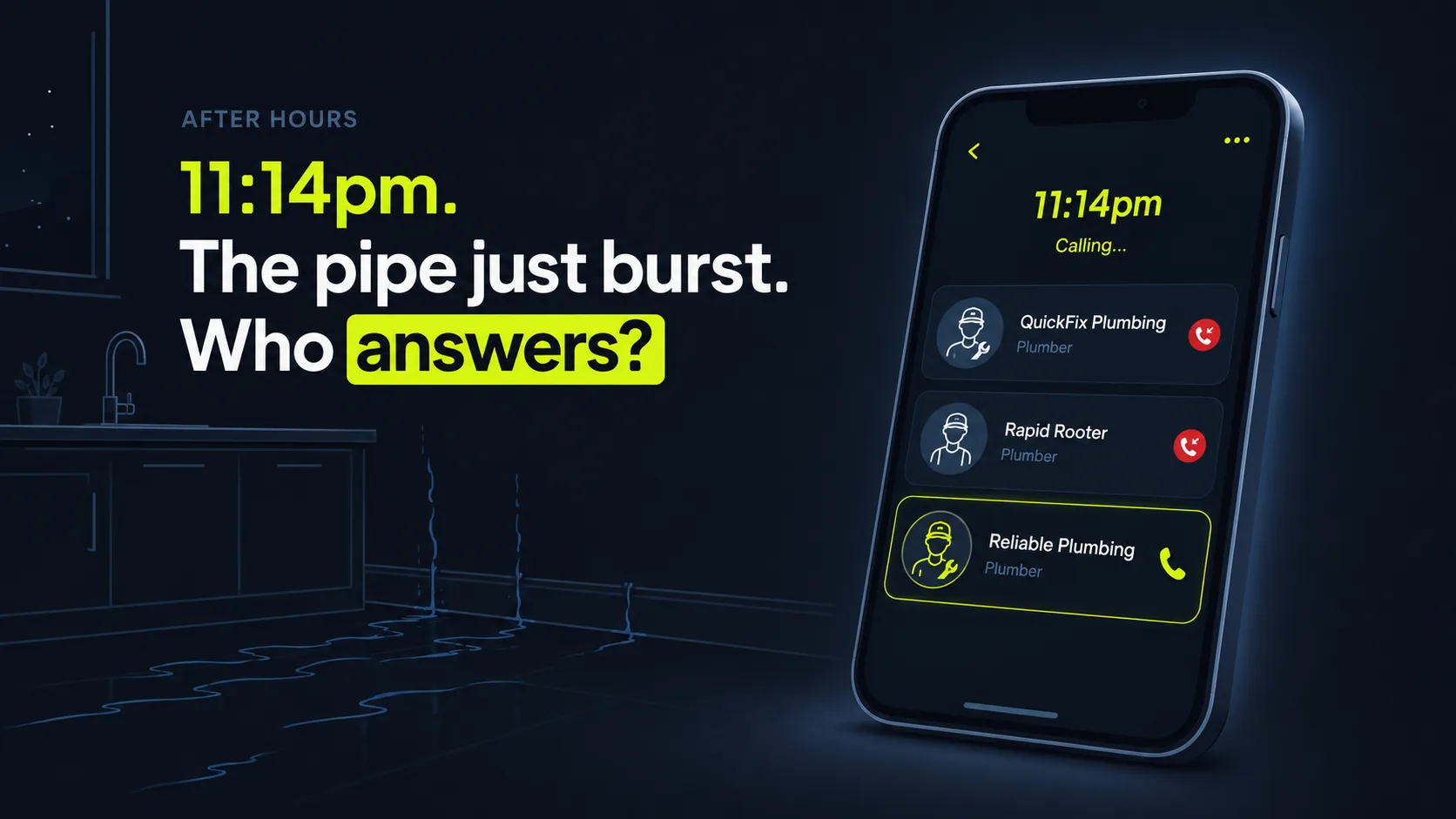
Go back to that 11:14pm pipe. The homeowner is not going to wait until 8am to reach you, and a recorded greeting won't hold them. An AI agent picks up on the first ring and handles unlimited simultaneous calls, so nobody lands in a hold queue during a rush. That matters because 75% of callers hang up after eight or more minutes on hold, per Nextiva (2025). A live desk, even a good one, has finite seats. When three emergency calls hit at once, two of them wait or drop. Which two can you afford to lose?
Emergency service calls raise the stakes further, and the math is unforgiving. A burst pipe or a dead furnace at 11pm is a high-intent, high-value job, and it won't keep until morning. An always-on AI alternative answers it, prices it, flags it as urgent, and either books the first available slot or escalates to your on-call tech. Voicemail recovers almost none of that demand, and the caller is already dialing the next number before your greeting finishes.
| After-hours factor | Ruby (live) | Flat-rate AI alternative |
|---|---|---|
| Coverage window | Business hours / staffed after-hours desk | 24/7, every night and weekend |
| Speed-to-answer | First-ring when staffed; possible hold queue | First-ring, no hold |
| Simultaneous calls | Limited by staffed agents | Unlimited concurrent calls |
| Emergency handling | Message or transfer per brief | Books or escalates to on-call tech |
| After-hours demand it captures | Bounded by staffing | Captures the 34%+ that arrives off-hours, per BrightLocal (2019) |
Citation capsule: A 24/7 AI receptionist answers every call on the first ring with no hold queue, while a live service is bounded by staffed seats. This matters because locksmiths get 34% of calls after 5pm plus 8% before 9am, per BrightLocal (2019), and 75% of callers hang up after eight minutes on hold, per Nextiva (2025).
Learn how 24/7 after-hours answering captures the calls you sleep through → Missed Calls Recovery.
When is Ruby the better fit, and when is an AI alternative better?
Ruby is the better fit when a live human voice on every call is non-negotiable, while a flat-rate AI alternative is better for service businesses that prioritize cost, after-hours coverage, and booked jobs. And here's the honest part most vendors skip: a lot of callers still want a human. 64% of customers would prefer companies didn't use AI in customer service, per Gartner (2024), and the top concern is that AI makes it harder to reach a person. That's the case for AI that sounds natural and escalates on request, not AI that traps callers in a loop.
Choose Ruby when:
- You want a real person answering every single call, full stop.
- Your call volume is low and predictable, so per-minute minutes won't spike.
- Your calls are conversational and open-ended more than they are transactional bookings.
- Brand warmth on the phone matters more to you than booking on the call.
- You don't need true 24/7 coverage or unlimited simultaneous answering.
Choose a flat-rate AI alternative when:
- You want every call answered, priced, and booked, not just messaged.
- Your volume is spiky, so a per-minute meter would punish busy weeks.
- You need genuine 24/7 and weekend coverage for emergency service calls.
- Simultaneous calls during a rush can't be allowed to hold or drop.
- You want predictable, flat monthly cost regardless of call volume.
So the sharper frame isn't Ruby or AI. It's where the human belongs. An AI alternative that escalates on request gives you both ends of that. The agent books the routine jobs and covers the nights at a flat cost. A person steps in for the calls that genuinely need judgment. You stop paying a per-minute premium for the booking calls a script handles perfectly, and you keep a human exactly where a human earns their keep.
Citation capsule: Ruby fits owners who want a human voice on every call with low, predictable volume. A flat-rate AI alternative fits service businesses needing 24/7 coverage, unlimited simultaneous answering, and on-call booking. Since 64% of customers prefer companies didn't use AI, per Gartner (2024), the strongest fit is AI that sounds natural and escalates to a person on request.

New to the category? Start with missed-call recovery explained for service businesses.
Where does SkoreFlow fit as a Ruby alternative for trades?
SkoreFlow's Missed Calls Recovery is a flat-rate AI agent built specifically for trades intake and scheduling, which makes it a direct alternative to Ruby for service businesses that want booked jobs, not just messages. It answers in 0.4 seconds, filters spam, qualifies the caller, and books the estimate into your scheduler. The plans are flat monthly, from $197/mo (Starter) to $397/mo (Professional) and $697/mo (Enterprise), with no per-minute meter, so a busy week doesn't inflate the bill.
The trades focus is the whole point, and it's the SkoreFlow vs Ruby line in one sentence: an answering service like Ruby takes a message and leaves you to call back, while SkoreFlow books the job on the call. SkoreFlow is TCPA-aware, goes live in 48 hours, and writes bookings straight into ServiceTitan, Jobber, Housecall Pro, or Google Calendar. And because phone calls are the top-rated lead source for 66% of SMBs, ahead of forms, in-person, and email, per BIA/Kelsey (2014, still the most-cited benchmark), booking every one of those high-intent calls is where the return lives.
Illustrative example (industry-based scenario, not a real client): Picture a 6-tech HVAC shop taking about 120 calls a month. On a Ruby-style 200-minute plan at $720/mo, busy weeks can push past the included minutes into per-minute overage of roughly $3.45-$5.00/min, per Ruby (2026). On a flat SkoreFlow Professional plan at $397/mo, that same surge costs nothing extra. Representative SkoreFlow benchmarks for a setup like this run near a 94% answer rate against the roughly 38% a busy front desk hits, with a shop of this size recovering on the order of $14,200 a month in jobs that would otherwise have gone to voicemail. Those figures are illustrative scenario models, not a specific customer result. With only 37.8% of small-business calls answered live, per 411 Locals (2016, directional), and 27% of home-services calls still going unanswered, per Invoca (2024), recovering even a handful of those 120 calls into booked jobs typically dwarfs a flat AI subscription. Run your own numbers with the calculator below.
You keep your existing number, and you keep your scheduling tool. SkoreFlow forwards from your current line and writes bookings into the calendar you already use, so the switch from Ruby doesn't disrupt how callers reach you or how your techs see the day. No new number to print. No migration weekend. And the offer carries its own risk reversal: 5 booked jobs in 30 days or your setup fee is refunded. You're not betting on a promise, you're testing it against your own phone for a month.
Estimate your lost revenue with the Missed Call Revenue Calculator.
Citation capsule: SkoreFlow's Missed Calls Recovery is a flat-rate AI agent for trades intake and scheduling, a direct Ruby alternative that books jobs rather than taking messages. Plans run $197-$697/mo with no per-minute meter, it goes live in 48 hours, and it's backed by a 5-booked-jobs-in-30-days-or-setup-refund guarantee. Phone calls are the top-rated lead source for 66% of SMBs, per BIA/Kelsey (2014).

The bottom line: pick the model that books the job
Go back to 11:14pm and the water on the kitchen floor. That call is either a job on your schedule by morning or a story about the one that got away. The data points one way for service businesses. Only about 37.8% of small-business calls are answered live, fewer than 3% of voicemail callers leave a message, and phone calls are the top-rated lead source for two-thirds of SMBs. The best Ruby Receptionist alternative is the one that answers fast, covers after-hours, and books the job, not the one that simply takes a message at a per-minute rate.
For most trades shops in 2026, that means a flat-rate AI agent that books appointments and escalates to a human when needed, with Ruby reserved for owners who want a live voice on every call and have low, predictable volume. Want to see what your unanswered calls are actually costing you, in real dollars, this month? Book a Free Call Audit. It's a 20-minute, no-pressure session where we map where jobs are slipping and what capturing them would be worth. No meter, no migration, and a setup fee you get back if 5 jobs don't land in 30 days.
Ready to act? Book a Free Call Audit → Missed Calls Recovery, or estimate lost revenue with the Missed Call Revenue Calculator first.
Written by Maksim Skorokhod, Founder of SkoreFlow, who builds AI answering and voice automation for small service businesses. Pricing figures verified against vendor pages and fact-checked by the SkoreFlow editorial team. Last updated: 2026-06-07.