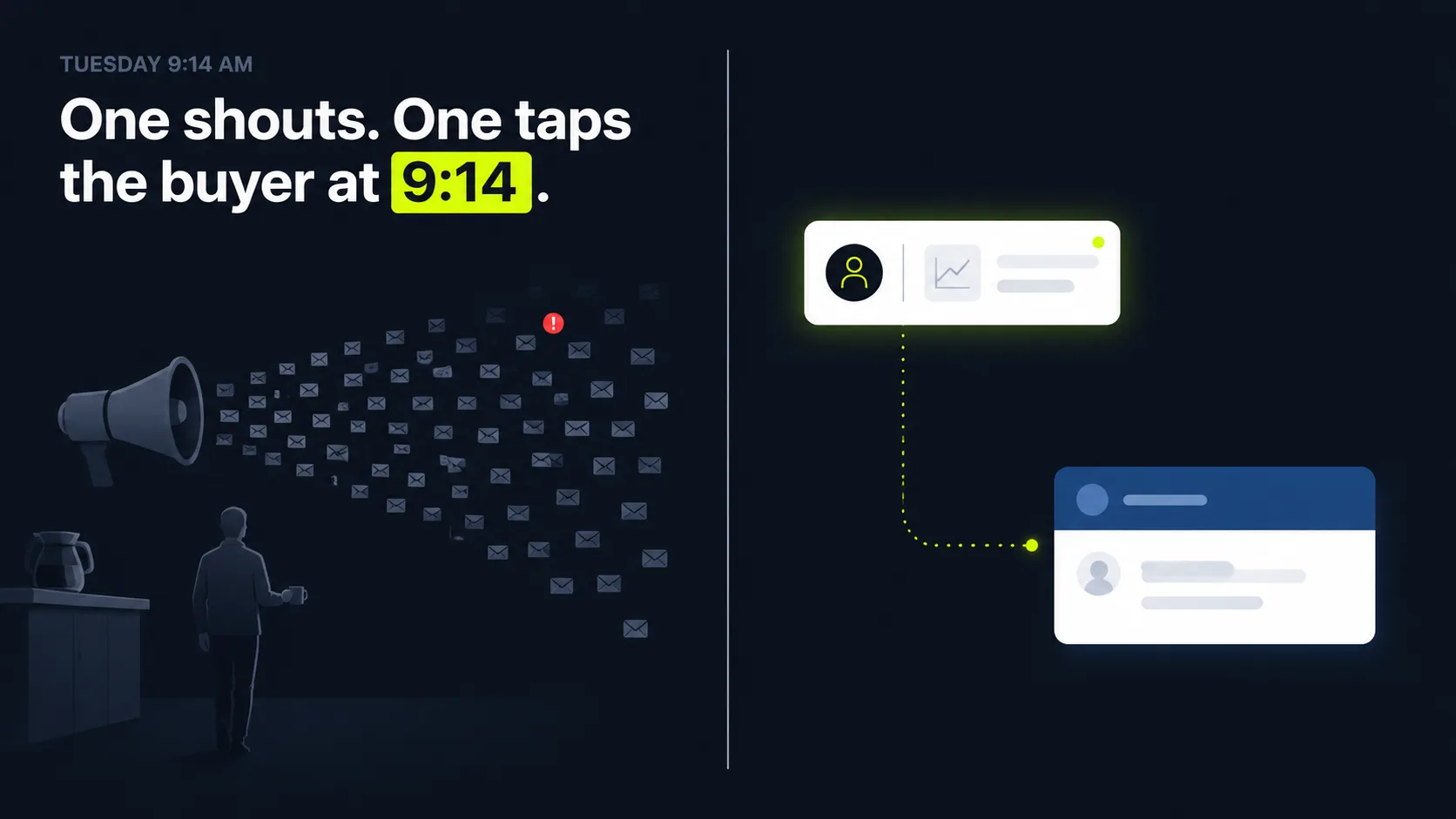
Quick-verdict decision table: triggers vs cold blasts
Start with the short version before the detail. According to Belkins (2025), cold email reply rates are sliding year over year, while trigger-based sends fire only when a buyer signals interest. The table below maps each approach to the job it actually does well, so you can place your own team in seconds.
| Factor | Cold email blast | Trigger-based outreach |
|---|---|---|
| Core job | Maximize reach across a cold list | Reach buyers at the moment of intent |
| Who gets contacted | Everyone on the list | Only contacts who hit a signal |
| Reply rate | Lower; fights a falling baseline | Higher; timed to interest |
| Deliverability risk | Higher; high volume to cold inboxes | Lower; low volume, relevant sends |
| CRM data needed | Minimal; a list will do | Clean records plus signal tracking |
| Cost per meeting | High; many sends per reply | Lower; fewer, better-timed sends |
| Best for | Broad coverage of a cold market | Quality pipeline from warm intent |
Use this as a first cut. If your goal is booked meetings from people already showing interest, the right column fits. If you need to seed awareness across a large, cold market, the left column still has a place. The sections below back each row with data.
A single signal rarely closes on its own. See how multi-channel follow-up extends a trigger across email, SMS, and call once a buyer raises their hand.
Do trigger-based emails beat cold blasts on reply and meeting rates?
Yes, in most cases, because relevance and timing lift replies far above a cold baseline. According to Belkins (2025), the average B2B cold email reply rate was just 5.8% in 2024, down from 6.8% in 2023. A trigger fires only when a contact shows intent, so the same effort lands on a much warmer audience and turns more of it into conversations.
The mechanism is timing. A buyer who just visited your pricing page or asked a question is in-market right now, and speed compounds that advantage. According to Harvard Business Review (2011), contacting a web lead within 5 minutes makes a firm about 21 times more likely to qualify it than waiting 30 minutes, and roughly 100 times more likely to make contact at all. A blast can't do that. It runs on a calendar, not on the buyer's behavior. A trigger answers the moment intent appears.
A modeled example you can sanity-check
Consider an honest, industry-based scenario, not a real client result. Picture a team sending 2,000 cold emails a month at the Belkins (2025) reply benchmark of roughly 5.8%. That models about 116 replies, most of them low-intent. Now redirect the same effort to 300 trigger-based sends fired on real signals at a 6% reply rate, and you model about 18 replies, but from people actively in-market.
Fewer raw replies. Far higher intent. A much better meeting-to-send ratio. The win lands in the rep's calendar: a week spent talking to buyers instead of fielding "why did you email me" from strangers. The point isn't the exact figures. It's the shape of the trade, volume versus intent.
Citation capsule: Trigger-based emails beat cold blasts on reply quality because they message buyers at the moment of intent. According to Belkins (2025), the average B2B cold email reply rate fell to 5.8% in 2024 from 6.8% in 2023, and per Harvard Business Review (2011), contacting a lead within 5 minutes makes a firm about 21x more likely to qualify it.

The bigger win comes from sequencing. Learn to extend a single trigger into a multi-step, multi-channel follow-up so one reply turns into a booked meeting.
How do deliverability and domain risk compare?
Trigger-based outreach carries far less domain risk than a cold blast because it sends low volume to relevant, engaged contacts. Mailbox providers judge your reputation on engagement: opens, replies, and the absence of spam complaints. A blast to thousands of cold inboxes invites bounces and complaints that drag your sender score down. A trigger sends a relevant message to someone who just acted, which is exactly the engagement signal inboxes reward.
The buyer-behavior backdrop makes this worse for blasts. Most of the buying journey now happens without you in the room. According to Gartner (2023), B2B buyers spend only about 17% of their total buying time meeting with potential suppliers, and that slice is split across every vendor they consider. Blasting more cold email at people who aren't looking burns reputation for almost no return. Triggered sends concentrate your limited, reputation-sensitive volume on the moments that actually matter.
Why volume hurts your domain
Three forces punish high-volume cold sending. First, cold lists carry stale and invalid addresses, so bounce rates climb and providers flag the domain. Second, irrelevant mail to disengaged people draws spam complaints, the single fastest way to wreck a sender reputation. Third, sudden volume spikes look like spam behavior to filtering systems. A trigger-based program sidesteps all three: small batches, real relevance, and steady, predictable sending that providers learn to trust.
Owners tend to underprice this. The cheapest-looking outreach is often the most expensive to your domain. A blast feels free because the marginal cost of one more send is near zero. The bill arrives later, quietly, when inbox placement collapses and even your good, warm emails start landing in spam, the invoice reminders and renewal notes included. We've found that teams who treat sending reputation as a depleting asset, spent carefully on relevant triggers, keep their inbox placement healthy far longer than teams chasing volume. The blast doesn't just convert poorly. It taxes every future email you send.
Citation capsule: Trigger-based outreach carries less deliverability risk than cold blasts because it sends low, relevant volume that mailbox providers reward. The backdrop favors restraint: according to Gartner (2023), B2B buyers spend only about 17% of their buying time with potential suppliers, so high-volume cold email reaches mostly disengaged inboxes and erodes sender reputation.

Curious what that reputation buys you? Use the AI Outreach ROI Calculator to estimate the value of timely follow-up against your own send volume.
What setup effort and CRM data do triggers require?
Trigger-based outreach needs more setup than a blast because it depends on clean CRM records and reliable signal tracking. A blast can launch from a purchased list in an afternoon. A trigger needs three things wired together: accurate contact data, a source of buyer signals (web visits, form fills, job changes, renewal dates), and an automation that maps each signal to the right message. The payoff is durable, but the on-ramp is real.
Most teams are already moving this direction, which lowers the barrier. According to Salesforce (2024), 81% of sales teams are either experimenting with (40%) or have fully implemented (41%) AI, and the tooling to detect and act on signals now sits inside mainstream CRMs. Adoption is still early at the smallest companies, though. According to the U.S. Census Bureau (2026), overall AI use among US businesses sat between 17% and 20% in late 2025 to mid-2026, with the smallest firms well below larger ones, so a small team willing to do the unglamorous work first can still gain an edge.
What "ready to run triggers" looks like
You can stage this. A practical setup follows a clear order:
- Clean the core data. Deduplicate contacts and fix the fields a trigger relies on, like email, company, and lifecycle stage.
- Connect a signal source. Wire up website tracking, form submissions, or a data feed for events like job changes and renewals.
- Map signals to messages. Decide which signal fires which message, and to whom, so timing matches intent.
- Set guardrails. Add suppression rules, send caps, and a clear human-handoff point for high-value replies.
- Measure and tune. Track reply and meeting rates per trigger, then cut the weak signals and double down on the strong ones.
In our experience standing up signal-driven outreach for small teams, the data cleanup is where projects stall, not the automation itself. Owners expect the hard part to be the clever sequence logic. It's actually the dull, necessary work of making sure a "pricing page visit" maps to a real, reachable person with a correct email and a sensible lifecycle stage. We've found that a few hours spent deduplicating and fixing fields up front does more for reply rates than any amount of subject-line tweaking later.
Citation capsule: Trigger-based outreach requires clean CRM data and signal tracking, more setup than a cold blast that runs off a list. The capability is mainstream: according to Salesforce (2024), 81% of sales teams are experimenting with or have fully implemented AI, putting signal-detection tooling inside the CRMs most teams already use.
Once your data is ready, the next risk is leakage. See how orchestration monitors CRM routing and flags orphaned leads so triggered leads reach a rep fast.
When is trigger-based better, and when does a cold campaign still make sense?
Trigger-based outreach is better wherever intent data exists and meeting quality matters; a cold campaign still makes sense when you need broad reach into a market that hasn't met you yet. The deciding question is whether you have signals to act on. Buyer behavior leans toward the triggered, self-serve model. According to Gartner (2025), 61% of B2B buyers say they would prefer a rep-free buying experience, which rewards outreach that arrives only when the buyer invites it.
Use the two lists below to place your team. They're written as decision triggers, not vague pros and cons.
When trigger-based outreach is better
- You have real intent signals. Website tracking, form fills, product usage, or renewal dates you can act on.
- Each meeting is worth real money. High-value deals where one well-timed reply pays for the whole program.
- Your domain reputation matters. Any team that also runs important transactional or warm email worth protecting.
- Speed is your edge. Markets where the first relevant response wins, which speed-to-lead data strongly favors, per Harvard Business Review (2011).
- Buyers research before talking. When prospects self-educate, as most now do with AI in hand, per Forrester (2026).
When a cold campaign still makes sense
- You're entering a brand-new market. No signals exist yet, so you need to create first contact at scale.
- You have a precise, well-targeted list. A narrow, accurate cold list can outperform a broad triggered net.
- Awareness is the goal, not the meeting. Seeding a name across a category before demand exists.
- Your offer is genuinely novel. When buyers cannot search for what they do not know exists, you may have to reach out cold.
- You're testing a new segment. A controlled cold campaign is a cheap way to learn whether a market responds at all.
There's a real trend to weigh on both sides: buyers now run their own research, often with AI alongside them. According to Forrester (2026), 94% of B2B buyers report using AI during their buying process. That makes a generic blast easier to ignore and a relevant, well-timed trigger more valuable, because it meets buyers in the self-directed motion they already prefer.
Citation capsule: Trigger-based outreach is better where intent signals exist and meetings are valuable; a cold campaign still fits new markets with no signals and awareness goals. Buyer behavior favors triggers: according to Gartner (2025), 61% of B2B buyers prefer a rep-free buying experience, rewarding outreach that arrives only when the buyer signals interest.
Not sure which column fits your numbers? The AI Outreach ROI Calculator estimates meetings booked from timely, signal-driven follow-up so you can compare both motions side by side.
How does SkoreFlow keep signal-driven outreach from leaking?
SkoreFlow runs a read-only control layer that watches what happens to leads after HubSpot routes them, catching orphaned leads, SLA breaches, and broken handoffs before they cost you meetings. We don't replace your stack or send for you. We monitor post-assignment state and surface the trigger-based leads that fell through, so the timing advantage you built actually reaches a rep. According to Belkins (2025), reply rates are falling, which makes every signal you do earn worth protecting.
This is the second screen from the top of the piece, the pricing-page alert, made real. That advantage evaporates the instant the lead sits unassigned. A pricing-page visit ignored for two days is no better than a cold blast, and it cost more to earn. In a representative HubSpot portal, SkoreFlow typically surfaces around 47 orphaned leads and helps cut speed-to-lead from roughly 340 minutes to about 8, with missed SLAs dropping from 62% to near 4%. Those are illustrative benchmark figures, not a specific customer result. The point holds either way: speed compounds. Per Harvard Business Review (2011), contacting a lead within 5 minutes makes a team about 21x more likely to qualify it.
This is built for HubSpot-first agencies, RevOps teams, and B2B service teams, not enterprise theater. Setup is read-only with no stack changes, and the control layer finds its first routing leak in 24 to 48 hours. The guarantee is plain: catch a real routing leak within 48 hours or get a full refund. Plans run from $297/mo (Starter, one portal) to $997/mo (Agency, up to ten client portals), with a $997 to $3,997 setup band. [CONFIRM] the current pricing before quoting it to a prospect. The first step costs nothing: Find Your First Dead Lead with a free audit and see, within a day or two, exactly which signals are leaking.
Citation capsule: SkoreFlow runs a read-only control layer over HubSpot that catches orphaned leads, SLA breaches, and routing failures, surfacing roughly 47 orphaned leads per portal in a representative scenario. The rationale is direct: according to Belkins (2025), cold email reply rates fell to 5.8% in 2024, so the few signal-driven leads you earn are worth protecting, and per Harvard Business Review (2011), a 5-minute response makes a team about 21x more likely to qualify.
Want the mechanics behind this? See how HubSpot Outbound Orchestration monitors routing and surfaces dead leads inside your CRM.
The bottom line: volume reaches more, triggers convert more
The trigger-versus-blast choice comes down to one question: do you have buyer signals to act on? If you do, trigger-based outreach converts more, protects your domain, and books better meetings by reaching people at the moment of intent. If you don't, a focused cold campaign still earns its place for awareness and first contact in a market that hasn't met you. With cold reply rates at 5.8%, per Belkins (2025), pure volume is fighting a falling tide.
For most teams with any intent data, the smart move is to shift effort from spray-and-pray volume toward fewer, signal-driven sends, then keep a small cold motion for genuinely new markets. One caveat carries the whole argument: the alert is only worth something if a rep answers it before the buyer moves on. Want to see what timely, triggered follow-up could book for you? Model meetings with the AI Outreach ROI Calculator, or read how HubSpot Outbound Orchestration catches leads that slip after routing to plan the fix. Either way, Find Your First Dead Lead with a free, no-pressure audit, and we'll show you which signals are leaking before they reach a rep.
Written and reviewed by Maksim Skorokhod, Founder of SkoreFlow, who builds AI answering and outreach automation for small service businesses. Last reviewed: 2026-06-07.