Book a Free Audit
Case study

An Austin plumbing company recovered 91% of missed calls and $7,200/mo.

Call Recovery case study. Plumbing, Austin, TX, Growth. Result: 91% calls recovered.

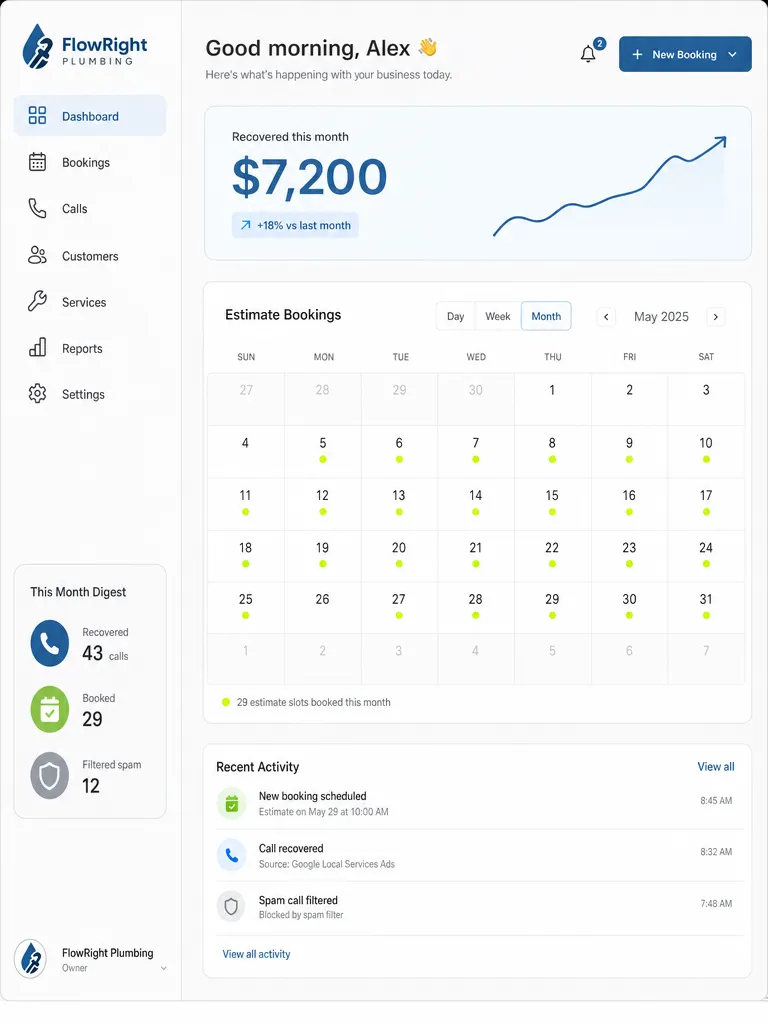
Call recovery dashboard showing recovered missed calls and booked plumbing jobs for an Austin company.
Before and after

An Austin plumbing company recovered 91% of missed calls and $7,200/mo.

Plumbing / Austin, TX / Growth

An Austin plumbing company

Plumbing, Austin, TX, Growth. Primary workflow: Call Recovery. Payback: 11 days.

Before
  • 47 missed calls/mo
  • 38 min callback delay
  • $9,400 lost/mo
After
  • 91% calls recovered
  • 8 sec response time
  • 29 booked jobs/mo
91%
calls recovered
8 sec
response time
29
booked jobs/mo
I used to see a missed call and think, there goes another $2k. Now I check my calendar and the estimate is already booked.An Austin plumbing company ยท Plumbing, Austin, TX

Why this leak mattered

Plumbing, Austin, TX, Growth had a measurable call recovery problem. I used to see a missed call and think, there goes another $2k. Now I check my calendar and the estimate is already booked.

Baseline signals included 47 missed calls/mo, 38 min callback delay, $9,400 lost/mo.

The workflow stayed narrow: capture the leak, qualify the next step, and push the useful handoff back to the business. That keeps the case measurable instead of turning it into a broad transformation project.

For this page, the related workflow is Call Recovery.

Do not copy this workflow blindly if the team cannot name the leak, does not know the current baseline, or cannot define the rules for a clean handoff. In that case, start with a short audit before automation.

How to read this case

The case evidence is kept in crawlable HTML: client context, baseline, result, workflow, related service, and update date. Treat the numbers as a scoped operating snapshot for this workflow, not as a universal guarantee.

Source: SkoreFlow service and case evidence.

Client context: Plumbing, Austin, TX, Growth.

Baseline: Baseline signals included 47 missed calls/mo, 38 min callback delay, $9,400 lost/mo.

Result: After-state signals included 91% calls recovered, 8 sec response time, 29 booked jobs/mo.

Primary workflow: Call Recovery.

Evidence limit: This is a scoped operating snapshot for the listed workflow, not a universal guarantee.

Published: 2026-05-21. Updated: 2026-06-09.

Next step

Want results like this?

Book a free audit and we will map where your first automation should start.

Frequently asked questions

What was the main result in this Call Recovery case?
An Austin plumbing company recovered 91% of missed calls and $7,200/mo. is summarized by 91% calls recovered. I used to see a missed call and think, there goes another $2k. Now I check my calendar and the estimate is already booked.
What evidence is shown on the page?
Baseline signals included 47 missed calls/mo, 38 min callback delay, $9,400 lost/mo. After-state signals included 91% calls recovered, 8 sec response time, 29 booked jobs/mo. The table keeps the before and after signals in HTML so the result can be extracted without reading an image.
Who is this workflow most relevant for?
This pattern is most relevant for operators with a similar call recovery leak, a measurable baseline, and a handoff that can be described with clear rules.
When is this not the right first workflow?
It is not the right first move when the business cannot define the leak, cannot measure the baseline, or needs a full process rebuild before a narrow recovery workflow can be tested.
Where should the reader go next?
The related service page explains the workflow behind the case: https://skoreflow.com/callrecovery/.