Quick verdict: AI vs voicemail vs call center after hours
For most service businesses, an AI answering service is the strongest after-hours option because it books the job instead of taking a message, and a missed call rarely calls back: roughly 80% of callers sent to voicemail hang up without leaving one, attributed to Forbes via destinationCRM (2014). Voicemail is the cheapest and the leakiest. A call center sits in between.
Here's what each option quietly asks of your caller. Voicemail asks the caller to do the work: leave a message, then wait for a callback that may never come. A call center puts a live human on the line, but that person usually relays a message rather than booking into your system, and bills you for the minutes. An AI voice agent answers on the first ring, runs your trade's script, books the slot, and escalates a true emergency to your on-call tech. One finishes the job. Two hand you homework. The three-way decision, at a glance:
| Factor | Voicemail | Call center | AI answering service |
|---|---|---|---|
| Typical cost | Free / included | ~$1.50-$1.75/min, per AnswerConnect (2025), up to ~$3.45-$5.00/min on Ruby's plans, per Ruby (2026) | Flat $50-$300/mo, per CloudTalk (2025) |
| What it does with the call | Takes a message (if any) | Takes a message, relays it | Books the appointment |
| Capture rate | Low; ~80% hang up without a message, attributed to Forbes via destinationCRM (2014) | Medium; live answer, message relay | High; answers and books every call |
| Speed to answer | Instant to machine; slow human follow-up | Variable; can hold during overflow | Instant; answers on first ring |
| Emergency routing | None | Yes, per scripted protocol | Yes, urgent transfer to on-call |
| Simultaneous calls | Unlimited (but no booking) | Limited by agents on shift | Unlimited |
Owners compare these three on price first. Price is the wrong axis. What matters is what happens to the call. Voicemail and a call center both end the same way most nights, with a message you have to chase. We've found that the chase is where jobs die. By the time you ring back the next morning, the caller already dialed the next number on Google, and someone else booked her in. AI is the only option of the three that finishes the transaction while the caller is still on the line and still wants you.
Citation capsule: For after-hours calls, an AI answering service books the appointment, voicemail loses it, and a call center relays a message. The difference is decisive because roughly 80% of callers sent to voicemail hang up without leaving one, attributed to Forbes via destinationCRM (2014), and AI answering runs a flat $50-$300 a month versus per-minute call-center billing, per CloudTalk (2025).

| Option | Monthly cost | Capture | Speed to answer |
|---|---|---|---|
| Voicemail | Free | Low (~80% hang up) | Instant to machine, slow human follow-up |
| Call center | Per-minute, ~$1.50-$5.00 | Medium (live, message relay) | Variable, can hold |
| AI answering | Flat $50-$300/mo | High (answers and books) | Instant, first ring |
Related reading: how a voice agent answers and books every call.
How much does each after-hours option cost?
After-hours costs split three ways: voicemail is free, a live call center bills per minute, and AI charges a flat $50-$300 a month, per CloudTalk (2025). Live per-minute rates start around $1.50-$1.75, per AnswerConnect (2025), and reach roughly $3.45-$5.00 once you compute Ruby's published plans by included minute, per Ruby (2026). The cheapest option on paper, voicemail, is usually the most expensive in lost jobs.
Voicemail's price tag is zero. That's exactly why it looks attractive, and exactly why it leaks. You pay nothing per call, but you also book nothing per call. A call center charges for live human time, and that meter never sleeps. AnswerConnect benchmarks basic live answering near $1.50-$1.75 a minute, per AnswerConnect (2025), while Posh lists overage at $1.90-$2.30 a minute, per Posh (2026), and Ruby's plans work out to roughly $3.45-$5.00 per included minute, per Ruby (2026). That meter climbs fastest on busy after-hours stretches, the exact nights you can least afford a surprise invoice. AI answering breaks that link. A flat plan in the $50-$300 band, per CloudTalk (2025), costs the same whether you take 10 after-hours calls or 100, with published AI plans starting near $95/month, per Smith.ai (2026).
After-hours cost compared
Roughly, this is what each option costs once you account for what it actually does with the call. Treat these as starting bands, not quotes.
| Option | Direct cost | Hidden cost |
|---|---|---|
| Voicemail | $0, per your phone plan | Lost jobs: ~80% of callers hang up without a message, attributed to Forbes via destinationCRM (2014) |
| Call center | ~$1.50-$1.75/min, per AnswerConnect (2025); up to ~$3.45-$5.00/min, per Ruby (2026) | Meter spikes on busy nights; messages still need a callback |
| AI answering | Flat $50-$300/mo, per CloudTalk (2025) | Some callers prefer a human; needs clean handoff |
In our experience, the free option is the one that quietly costs the most. Picture the owner's logic: a $0 voicemail line on one side, a real per-minute or monthly invoice for answering on the other. The free choice feels safe. It feels responsible. But the lost-job cost never lands on a statement, so it stays invisible, month after month, until you sit down and actually count the after-hours calls that went nowhere. Do the math once and the number hits hard. It's almost always bigger than the answering bill, and it's been bleeding the whole time.
Citation capsule: After-hours answering costs split three ways: voicemail is free, AI answering charges a flat $50-$300 a month, per CloudTalk (2025), and live receptionists run roughly $3.45-$5.00 per minute, computed from Ruby's published plans, per Ruby (2026). Voicemail's hidden cost is lost jobs, because 95% of people say texting beats voicemail, per a Nuance survey via destinationCRM (2014), so most callers never leave one.
For a deeper breakdown, see our full answering-service pricing guide by model.
Which option actually books the job after hours?
The capture rate is where the three options separate hardest: AI books the appointment, a call center relays a message, and voicemail usually captures nothing, because fewer than 3% of callers sent to voicemail leave a message, per Invoca (2024). Most after-hours callers will not talk to a machine.
Start with the behavior, because the numbers are blunt. Roughly 80% of callers sent to voicemail hang up without leaving a message, attributed to Forbes via destinationCRM (2014), and 95% of people say texting is more convenient than voicemail, per a Nuance survey reported by destinationCRM (2014). Callers don't want to leave a message. They want an answer. And that preference is brutal for service businesses, because phone calls are the top-rated lead source for 66% of SMBs, ahead of forms, in-person, and email, per BIA/Kelsey (2014). Your best leads call. Your best leads hang up on machines. That's the worst possible matchup.
A call center improves on voicemail by putting a human on the line, but here's where it stops short: most relay a message rather than booking into your calendar or field-service software. That still leaves a callback gap, and in that gap the caller books elsewhere. An AI voice agent closes the gap by finishing the booking live. It answers, qualifies, and drops the appointment straight into your system while the caller still wants you. The gap it closes is wide even during business hours: 27% of calls to home-services businesses go unanswered, per Invoca (2024). An option that answers and books every after-hours call recovers the revenue the other two let slip out the back door.
Citation capsule: Phone calls are the top-rated lead source for 66% of SMBs, ahead of forms and email, per BIA/Kelsey (2014), so the matchup of high-intent callers and voicemail is brutal. AI answering books the job, a call center relays a message, and voicemail captures almost nothing: fewer than 3% of callers sent to voicemail leave one, per Invoca (2024).

Related reading: why after-hours calls slip away and how to catch them.
How fast does each option answer, and can it route emergencies?
Speed and emergency routing decide after-hours outcomes: AI answers on the first ring and can transfer urgent calls instantly, a call center answers live but can put callers on hold, and voicemail answers a machine while real follow-up waits hours. Speed matters because 5-minute responders are 21 times more likely to qualify a lead than 30-minute responders, per HBR (2011).
After-hours callers have no patience, and the data proves it. Over half of callers hang up after up to eight minutes on hold, and 56% immediately try another channel after a missed response window, while 28% abandon entirely, per Nextiva (2025). Watch how each option fails the clock. Voicemail answers instantly with a machine, then the human callback lags until the next business day, by which point the job is gone. A call center answers live, yet during an after-hours overflow it can stack callers on hold, where they drop one by one. An AI agent answers every call at once, no hold queue, no busy signal, because it handles unlimited simultaneous calls.
Emergency routing after hours
Routing a true emergency to a human is the piece owners worry about most, and it's the piece I get asked about on nearly every call. It's also where a configured AI agent and a good call center both beat voicemail cold. Each one handles an urgent after-hours call differently.
- Voicemail. No routing. The emergency sits in an inbox until someone checks it, which after hours can mean morning.
- Call center. A live agent follows your protocol and patches genuine emergencies to your on-call person, though overflow holds can delay non-priority calls.
- AI answering service. The agent identifies an urgent keyword or scenario, books routine jobs itself, and transfers true emergencies straight to your on-call tech, day or night.
So here's the thing most "AI vs human" debates miss entirely. The strongest after-hours setup isn't AI instead of a human. It's AI plus a human handoff. Consumer skepticism is real and worth respecting: 64% of customers would prefer companies didn't use AI in customer service, per Gartner (2024), and the top concern is that it gets harder to reach a person. An AI agent that books the routine 90% and instantly transfers the urgent 10% answers that objection directly, because it adds a human at the exact moment a human matters most.
Citation capsule: AI answers on the first ring and transfers true emergencies instantly, while voicemail leaves urgent calls unrouted until business hours. Speed is decisive: 5-minute responders are 21 times more likely to qualify a lead than 30-minute responders, per HBR (2011), and 56% of callers try another channel after a missed window, per Nextiva (2025).
| Option | Time to live follow-up | Abandonment risk |
|---|---|---|
| Voicemail | Hours to next business day | High; ~80% never leave a message |
| Call center | Live, but holds during overflow | 54% hang up after up to 8 minutes on hold |
| AI answering | Instant, first ring | None; unlimited simultaneous calls |
Related reading: how urgent transfer and on-call routing works.
When is voicemail enough, when does a call center fit, and when does AI win?
Voicemail is enough for low-stakes, low-volume off-hours; a call center fits when you need a live human voice and scripted triage; AI wins when you want booked jobs and after-hours demand is real. That demand is real for most service trades: restaurants receive 51% of their calls after 5pm, per BrightLocal (2019).
The right answer depends on your call mix, your trade, and what you actually want to happen at 9pm. Be honest with yourself here. Some businesses genuinely don't need after-hours booking. Many more do, and are quietly losing jobs to a beep every single night. Local businesses receive 94% of their Google Business Profile calls Monday to Friday, but weekend and evening shares spike by industry, with locksmiths taking a large share before 9am or after 5pm, per BrightLocal (2019). Match the option to your reality using the three lists below.
When voicemail is enough
- Your after-hours call volume is genuinely tiny and rarely urgent.
- Your customers expect next-day callbacks and tolerate them.
- You have no on-call staff and no appointments to book overnight.
When a call center fits
- You want a live human voice on every after-hours call.
- Your calls need nuanced, scripted triage a person handles best.
- Your after-hours volume is low enough that per-minute billing stays affordable.
When AI wins
- You want after-hours calls booked, not just messaged, and a missed call usually means a lost job.
- Your trade sees heavy evening or weekend demand, per BrightLocal (2019).
- You want predictable flat pricing plus instant emergency transfer to your on-call tech.
Illustrative example (industry-based scenario, not a real client): Picture a 6-tech HVAC shop fielding about 25 after-hours calls a week. On voicemail, with fewer than 3% leaving a message, per Invoca (2024), nearly all of those calls vanish into the dark. Now suppose a flat AI agent recovers even 40% of them into booked work, roughly 10 jobs a week. At an average HVAC repair ticket near $1,205 in 2025, per Housecall Pro (2025), that's about $12,000 a week in recovered work, set against a flat $50-$300/month AI plan, per CloudTalk (2025). The plan costs less than a single recovered job. Run your own numbers with the calculator below.
Citation capsule: Voicemail fits low-stakes, low-volume off-hours; a call center fits when you need live human triage; AI wins when you want booked jobs and after-hours demand is real. That demand is real for most trades: restaurants get 51% of calls after 5pm and locksmiths a large share outside 9-to-5, per BrightLocal (2019).
For the numbers, see how much after-hours answering costs.
How does SkoreFlow handle after-hours calls?
SkoreFlow's Missed Calls Recovery agent answers after-hours calls in 0.4 seconds, qualifies the caller, and books the estimate, rather than taking a message. It books jobs, not messages, and that's the whole point: 56% of callers immediately try another channel after a missed response window, per Nextiva (2025), so a booked call beats a relayed one every time.
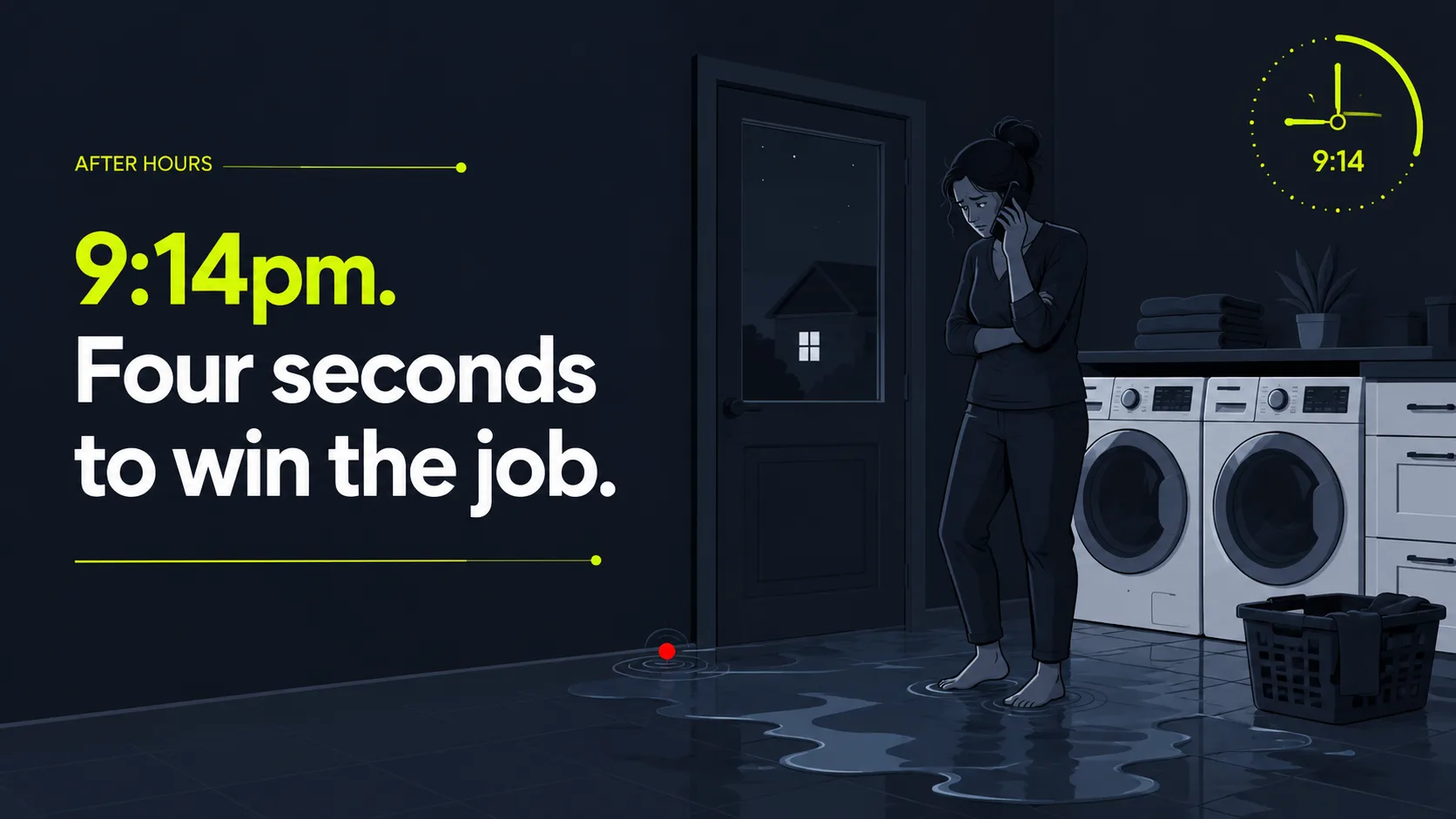
Remember the homeowner standing in the water at 9:14pm? This is the ending where the job is yours. The agent runs day or night, filters spam, and answers on the first ring. It uses a script built for your trade and books the appointment straight into ServiceTitan, Jobber, Housecall Pro, or Google Calendar, rather than leaving you a callback list to chase at 7am. That's the difference from a service like Ruby, which answers live but takes a message and leaves you to call back. When a caller has a genuine emergency, a burst pipe, no heat in January, the agent recognizes the urgency and patches them straight to your on-call person. That AI-plus-human handoff answers the most common objection head-on, because 64% of customers would prefer companies didn't use AI in service, per Gartner (2024), and the top worry is not reaching a human.
You keep your existing number and pay one predictable, flat monthly figure, with plans from $197/mo (Starter), $397/mo (Professional), to $697/mo (Enterprise), whether the after-hours phone rings 10 times or 100. The setup is TCPA-aware, integrates with your trade software, and you go live in 48 hours. The guarantee is concrete: 5 booked jobs in 30 days or your setup is refunded, so you carry none of the risk. That flat price matters most on your busiest nights, when per-minute call-center billing, from about $1.50-$1.75 a minute, per AnswerConnect (2025), up to roughly $5.00 a minute on Ruby's plans, per Ruby (2026), spikes exactly when call volume peaks. Want to see where your break-even lands? Run the numbers in the calculator, or book a free call audit and we'll map what your after-hours calls are worth in a no-pressure 20-minute call.
Citation capsule: SkoreFlow's Missed Calls Recovery agent answers after-hours calls in 0.4 seconds and books the job into ServiceTitan, Jobber, Housecall Pro, or Google Calendar instead of taking a message, on flat plans from $197/mo and live in 48 hours. It books rather than messages because 56% of callers try another channel after a missed window, per Nextiva (2025), and pairs AI with human handoff because 64% of customers prefer companies didn't use AI in service, per Gartner (2024).
Try it yourself: estimate your after-hours recovery and break-even.
The bottom line: book the call, don't lose it
After hours, the three options end very differently. Voicemail is free but leaky, a call center relays a message and bills per minute, and AI answers instantly and books the job. The deciding fact is simple: 5-minute responders are 21 times more likely to qualify a lead than 30-minute responders, per HBR (2011), so a missed after-hours call is usually a lost job, not a delayed one. The water on that laundry-room floor doesn't wait, and neither does your caller.
For most small service businesses in 2026, a flat-priced AI voice agent that books appointments and transfers true emergencies to an on-call person delivers the most recovered revenue per dollar, with a call center reserved for owners who want a live human on every call and can absorb the per-minute rate. Voicemail still fits the rare business with tiny, non-urgent off-hours volume. Want to know what your after-hours calls are worth? Run the numbers in the calculator, or book a free call audit and we'll map your recovery in a no-pressure 20-minute call. No retainer, no obligation, and you keep the audit either way.
Next step: estimate your after-hours recovery or book your free call audit.
Written and reviewed by Maksim Skorokhod, Founder of SkoreFlow, who builds AI answering and voice automation for small service businesses. Last reviewed: 2026-06-07.