Definitions
What is an answering service?
An answering service is a phone-answering solution, staffed by live agents or an AI voice agent, that picks up your inbound calls when you can't. It captures caller details, answers routine questions, and either books an appointment or takes a message to route to your team. Many owners pair one with missed-call recovery so after-hours and overflow calls never slip away.
What is an answering service pricing model?
An answering service pricing model is the method a provider uses to bill you: per minute of talk time, per call answered, or a flat monthly subscription. The model determines whether your bill stays predictable or rises with your call volume.
What are the answering service pricing models (per-minute vs per-call vs flat monthly)?
Answering services bill three ways: per minute, per call, or flat monthly. Industry-aggregated rates run $0.25-$2.25 per minute, $0.99-$11 per call, and monthly plans of $25-$150 (basic), $50-$300 (AI), or $300-$2,000+ (human), per CloudTalk (2025). The model, not the headline price, decides what you actually pay.
Most owners miss this part. Each model quietly rewards one call pattern and punishes the rest. Per-minute billing charges for talk time, so a quick "are you open Saturday?" costs pennies while a chatty customer drains dollars. Per-call billing charges one flat fee per answered call, which feels tidy until a busy day stacks up forty answered calls and forty fees. Flat monthly gives you a set price no matter how many calls land, which is exactly why AI answering tends to use it. Here is how the three line up side by side.
| Pricing model | How you're billed | Typical range (2026) | Best when | Watch out for |
|---|---|---|---|---|
| Per-minute | Per minute of agent talk time | $0.25-$2.25/min, per CloudTalk (2025); live ~$1.50-$1.75/min, per AnswerConnect (2025) | Low volume, short calls | Long or many calls inflate the bill fast |
| Per-call | Flat fee per answered call | $0.99-$11/call, per CloudTalk (2025) | Predictable per-call budgeting | High call counts add up regardless of length |
| Flat monthly | Fixed monthly subscription | AI $50-$300/mo; human $300-$2,000+/mo, per CloudTalk (2025) | Busy or unpredictable volume | Included-minute caps can trigger overage |
So why do smart owners still get burned? They stare at the per-minute rate and miss what actually bites: variance. A metered plan doesn't just cost more on a busy week. It costs more on the exact week you can least afford to drop a single call. We've found that an HVAC shop during a heat wave, or a roofer the morning after a storm, hits peak call volume and peak per-minute billing in the same hour. Flat pricing ends that whiplash. For a shop with spiky demand, that calm is often worth more than a slightly lower headline rate.
Citation capsule: Answering services bill per minute ($0.25-$2.25), per call ($0.99-$11), or flat monthly, with AI plans at $50-$300/month and human plans at $300-$2,000+/month, per CloudTalk (2025). Live per-minute rates run roughly $1.50-$1.75 at one national provider, per AnswerConnect (2025). The billing model, not the rate, drives total cost.
Here is that variance in dollars. Estimated monthly cost by model and volume (3-minute calls; live per-minute at ~$1.75, per AnswerConnect (2025); per-call at ~$1.50, flat AI at ~$200, per CloudTalk (2025)):
| Monthly calls | Live per-minute | Per-call | Flat AI |
|---|---|---|---|
| 100 (~300 min) | ~$525 | ~$150 | ~$200 |
| 250 (~750 min) | ~$1,310 | ~$375 | ~$200 |
| 500 (~1,500 min) | ~$2,625 | ~$750 | ~$200 |
The flat line never moves. The metered columns climb with every call. That gap, $200 versus $2,625 at high volume, is the entire argument for flat pricing once your call count grows. For a deeper look at how AI plans price specifically, see our AI receptionist cost breakdown.
How much does an answering service cost per month?
An answering service costs roughly $50-$300/month for AI and $300-$2,000+/month for human service, with most small businesses landing around $100-$500/month, per AnswerConnect (2025) and CloudTalk (2025). Your monthly band depends mostly on call volume and whether a human or AI answers.
Monthly plans are usually tied to included minutes or calls, so volume sets your tier. Live virtual receptionist plans climb steeply. Ruby publishes $250/month for 50 minutes, $395 for 100 minutes, $720 for 200 minutes, and $1,725 for 500 minutes, per Ruby (2026). Posh lists plans from $65/month (0 included minutes) up to $1,900/month (1,000 minutes), per Posh (2026). AI answering sits well below those bands: Smith.ai's AI Receptionist starts at $95/month and runs to $800/month for higher volume, per Smith.ai (2026).
Monthly plan bands by call volume
Here's a rough guide to where your monthly cost lands, by volume and answer type. Treat these as starting bands, not quotes, since included minutes and add-ons shift the real number.
| Monthly call volume | Typical AI monthly cost | Typical human monthly cost |
|---|---|---|
| Low (~2 calls/day, ~50 min) | ~$95/mo, per Smith.ai (2026) | ~$250/mo for 50 min, per Ruby (2026) |
| Moderate (~5 calls/day, ~100-200 min) | ~$270/mo, per Smith.ai (2026) | ~$395-$720/mo, per Ruby (2026) |
| High (~15 calls/day, ~500 min) | ~$800/mo, per Smith.ai (2026) | ~$1,725/mo, per Ruby (2026) |
| Very high (~1,000 min) | Flat AI plan, no per-minute meter | up to ~$1,900/mo, per Posh (2026) |
In our experience, the bill never stings on a slow month. It stings the day call volume jumps a tier. A live plan that fit comfortably at 100 minutes blows past its cap during one busy stretch, and the next tier up, plus overage, lands as an ugly surprise on the invoice you didn't budget for. That single moment is what nudges service businesses toward flat AI pricing, where a busier month simply doesn't change the bill.
Citation capsule: Answering services cost roughly $50-$300/month for AI and $300-$2,000+/month for human service, with most small businesses near $100-$500/month, per AnswerConnect (2025) and CloudTalk (2025). Live plans run $250 (50 min) to $1,725 (500 min) at Ruby (2026), while AI plans start at $95/month at Smith.ai (2026).

So what should your number be? Don't guess. Use our cost and breakeven calculator to estimate your monthly answering cost by volume in about two minutes.
What's included vs what costs extra (setup, after-hours, bilingual, overage)?
Most answering service plans cover basic call answering and message-taking, but several common services cost extra. Overage is the big one: once you pass your included minutes, you pay per-minute rates of roughly $1.90-$2.30/min at one live provider, per Posh (2026). Setup, after-hours, holiday, and bilingual handling can all add to the base price.
Read any plan the way you'd read a contractor's estimate: base price, then "extras likely." The included tier usually covers standard call answering, message-taking, and call forwarding. The money sits in what falls outside that core. One-time setup or onboarding fees. Premium after-hours and overnight coverage. Holiday surcharges. Bilingual or Spanish-language agents. And overage the second you cross your minute or call cap. These extras bite hardest at businesses with heavy after-hours demand, and that describes a huge slice of service trades. In BrightLocal's older but still-cited benchmark, restaurants received 51% of their calls after 5pm and locksmiths a large share before 9am or after 5pm, per BrightLocal (2019, historical data).
Common extra fees to ask about
Before you sign, ask the provider to confirm each of these in writing. These are the line items that quietly turn a quoted price into a higher real one.
- Setup or onboarding fee. A one-time charge to script your account and route your number.
- Overage rate. What you pay per minute or per call once you pass your included tier; roughly $1.90-$2.30/min at Posh, per Posh (2026).
- After-hours and overnight coverage. Sometimes a premium add-on rather than included, despite heavy after-hours demand in many service verticals, per BrightLocal (2019, historical data).
- Holiday surcharges. Higher per-minute or per-call rates on holidays.
- Bilingual or Spanish-language handling. Often billed as a premium tier.
- Integrations and call patching. Live transfers, CRM writes, or appointment booking may carry add-on fees.
Citation capsule: Answering service plans cover basic call answering, but overage, setup, after-hours, holiday, and bilingual handling often cost extra. Overage runs roughly $1.90-$2.30/minute at one live provider, per Posh (2026), and after-hours coverage matters because restaurants historically received 51% of calls after 5pm, per BrightLocal (2019, historical data).

So here's the question that decides the whole budget: if half your calls land after 5pm, is after-hours coverage included or billed as a premium? Curious why so many of those late calls never get returned at all? See how after-hours calls slip away and how to catch them.
How does AI answering service pricing differ (flat and predictable at volume)?
AI answering pricing differs in one key way: it's usually flat and doesn't meter your minutes, so it gets cheaper per call as volume rises. AI tiers run $50-$300/month versus $300-$2,000+/month for human services, per CloudTalk (2025). Live human answering, by contrast, costs roughly $1.50-$5.00 per receptionist-minute.
Do the division yourself and the gap gets stark. Take Ruby's published 2026 plans and divide price by included minutes: the $1,725 plan over 500 minutes is $3.45/min, and the $250 plan over 50 minutes is $5.00/min, per Ruby (2026). The effective rate runs that high for a simple reason. A person handles one call at a time, and that labor has to be paid for. The baseline cost a service replaces is real money: the median US receptionist earns $17.90/hour, or $37,230/year before benefits, per the U.S. Bureau of Labor Statistics (2024). AI carries no per-minute labor cost and handles unlimited simultaneous calls, so a flat plan stays flat whether you take 50 calls or 500.
Illustrative example (industry-based scenario, not a real client): picture a 6-tech HVAC shop taking about 250 calls a month at roughly 3 minutes each, so ~750 minutes. On live per-minute billing near $1.75/minute, per AnswerConnect (2025), that's about $1,310/month before any after-hours or overage premium. A flat AI plan in the $50-$300/month band, per CloudTalk (2025), covers the same volume without metering. During a heat-wave week when calls double, the AI bill doesn't budge. Run your own numbers with the calculator below.
Price per minute is only part of the story. The other part is capacity, which is where the metered model quietly costs you jobs. A live service caps out at the agents on shift, so during a rush callers hold, then drop. And 75% of callers hang up after eight or more minutes on hold, per Nextiva (2025). Flat AI answers every call at once. So at high volume you're not just paying less per call. You're capturing the revenue a metered human desk would have lost on hold.
Citation capsule: AI answering pricing is typically flat and doesn't meter minutes, so it gets cheaper per call as volume rises: $50-$300/month for AI versus $300-$2,000+/month for human service, per CloudTalk (2025). Live receptionist time works out to roughly $3.45-$5.00 per minute ($1,725 / 500 min = $3.45; $250 / 50 min = $5.00), per Ruby's 2026 plans, against a median receptionist wage of $37,230/year, per BLS (2024).
Watch the lines diverge. Total monthly cost as volume climbs (live at ~$1.75/min, per AnswerConnect (2025); flat AI ~$200, per CloudTalk (2025)):
| Monthly minutes | Live per-minute total | Flat AI total |
|---|---|---|
| 100 min | ~$175 | ~$200 |
| 300 min | ~$525 | ~$200 |
| 750 min | ~$1,310 | ~$200 |
| 1,500 min | ~$2,625 | ~$200 |
The crossover lands somewhere around 100-150 minutes a month. Below it, metered live billing is cheaper. Above it, the flat AI line wins, and the gap only widens from there. For the full AI-specific breakdown, read our AI receptionist cost guide.
How does SkoreFlow price its missed-call recovery service?
SkoreFlow prices its missed-call recovery service on flat monthly plans with no per-minute fees: Starter at $197/month, Professional at $397/month, and Enterprise at $697/month, plus a one-time setup fee. Your bill stays predictable whether you take 50 calls or 500. That matters because per-minute metering spikes exactly when call volume is highest, and across the market AI answering runs far below human service at $50-$300/month versus $300-$2,000+/month, per CloudTalk (2025).
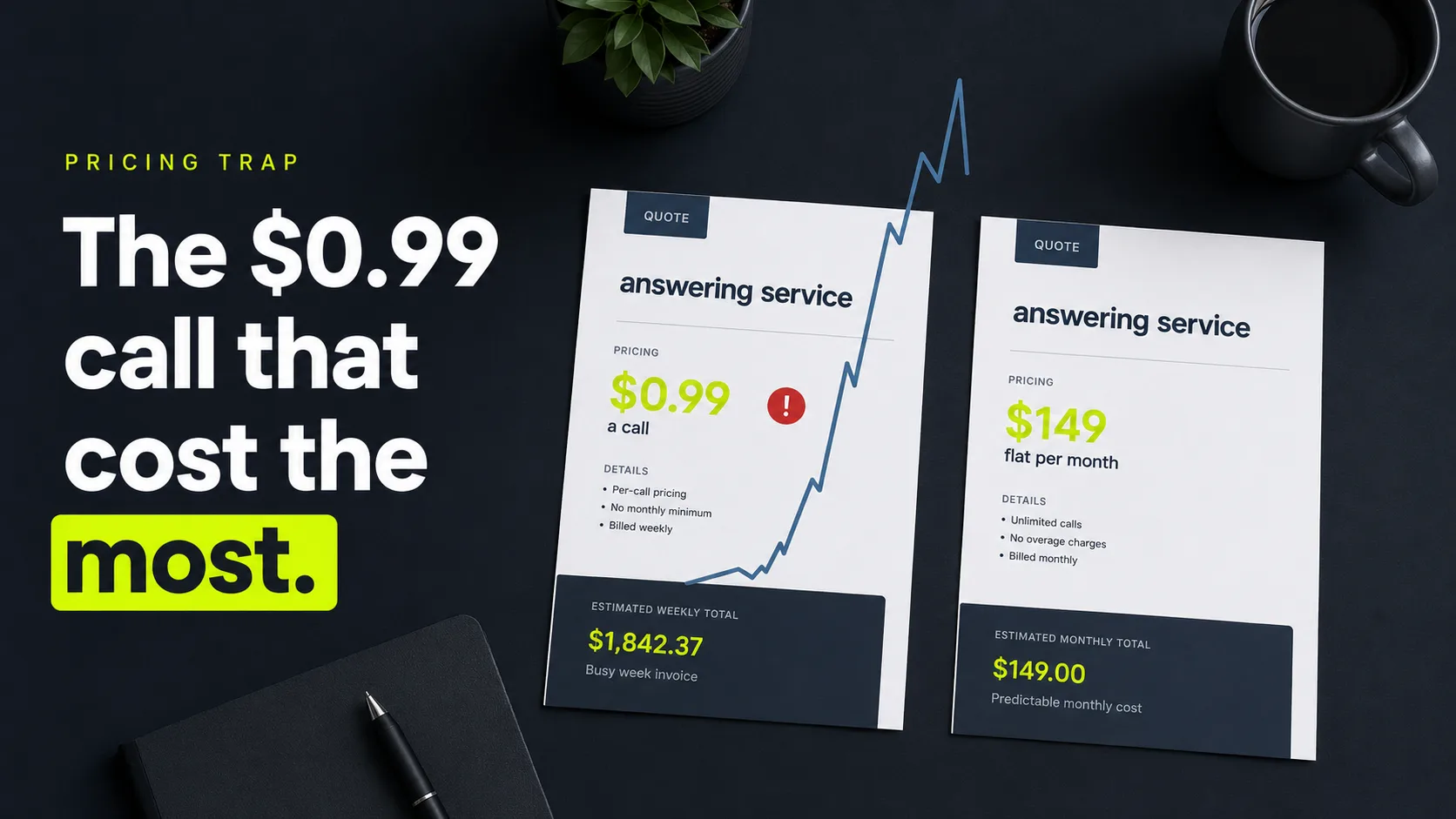
Now remember the trap from the top of this page, the cheap-per-call plan that posted the biggest invoice during a heat wave. Flat pricing closes that loop for good. The lower, calmer price is only half of it. The other half is what the plan does with each call. SkoreFlow answers in 0.4 seconds, filters spam, qualifies the caller, and books the estimate straight into your calendar. It books jobs, not messages. That's the line that separates it from answering services like Ruby, which take a message and leave you to call back. Why does that distinction decide real money? Because fewer than 3% of callers sent to voicemail leave a message, per Invoca (2024). A message you never get can't be returned, and inbound calls are your highest-intent leads of the day.
Built for home-service trades, SkoreFlow connects to ServiceTitan, Jobber, Housecall Pro, and Google Calendar, and the setup is TCPA-aware. Most accounts go live in 48 hours, and the plan is backed by a guarantee: 5 booked jobs in 30 days or your setup fee back. A flat plan also covers the calls a live desk drops cold. Invoca's call-tracking data shows 27% of calls to home-services businesses go unanswered, per Invoca (2024). A 24/7 AI agent on a flat plan answers the after-hours and overflow calls that would otherwise vanish, dispatch-ready, at the same price every month.
Representative scenario (illustrative model, not a real client): a 7-technician plumbing shop that answers around 94% of inbound calls (versus the roughly 38% an overloaded front desk manages) could return on the order of $14,200/month in otherwise-missed jobs, with the build paying for itself in about 11 days. These are benchmark figures, not a specific customer result. Use the calculator below to model your own numbers.
Citation capsule: SkoreFlow prices missed-call recovery on flat monthly plans ($197-$697/month plus setup) with no per-minute fees, sitting in the AI band of $50-$300/month versus $300-$2,000+/month for human service, per CloudTalk (2025). It books jobs rather than taking messages, which matters because fewer than 3% of voicemail callers leave a message, per Invoca (2024).
Want to see what those captured calls are worth to your shop? Use our missed-call revenue calculator to estimate your lost revenue and your breakeven point in minutes.
The bottom line: pick the model, not just the price
Answering service cost comes down to the billing model. AI runs about $50-$300/month and human service $300-$2,000+/month, per CloudTalk (2025), but the bigger decision is per-minute versus flat. Per-minute and per-call plans look cheap at low volume, then climb on your busiest weeks, the weeks worth the most revenue. Flat AI plans stay predictable and get cheaper per call as you scale.
So here's the honest read for 2026. For most small service businesses, a flat-priced AI agent that books jobs and escalates to a human when needed delivers the most coverage per dollar. A live service still makes sense for owners who want a person on every call and can absorb the per-minute rate. Want to see where your number lands before you commit a cent? Use the calculator to estimate your monthly cost and breakeven, or book a free, no-pressure call audit and we'll map what capturing those calls is worth in about 20 minutes.
Next steps: estimate your cost and breakeven with the calculator, or Book a Free Call Audit.
Written and reviewed by Maksim Skorokhod, Founder of SkoreFlow, who builds AI answering and voice automation for small service businesses. Last reviewed: 2026-06-07.