What do you actually pay for an AI receptionist?
You pay mostly one number: a flat monthly subscription. Published AI receptionist plans start at $95/month and scale to $800/month by call volume, per Smith.ai (2026), with most small businesses landing in the $50-$300/month band, per CloudTalk (2025). The headline line item is the monthly fee. Everything else is small or absent.
So what does the actual invoice look like? That's where most owners get a pleasant surprise, because the page is short. Here is what shows up on an AI receptionist invoice versus a traditional per-minute answering service, line by line.
| Cost line | AI receptionist | Per-minute answering service |
|---|---|---|
| Setup / onboarding | Often included or one-time; varies by provider | Often a one-time setup fee |
| Monthly base | Flat, ~$95-$300/mo, per Smith.ai (2026) / CloudTalk (2025) | Plan covers a minute bucket, ~$250-$1,725/mo, per Ruby (2026) |
| Per-minute charge | None on flat plans | $1.50-$5.00/min, per Ruby (2026) / AnswerConnect (2025) |
| Overage | Tier upgrade if you grow | $1.90-$2.30/min over your bucket, per Posh (2026) |
| Integrations / CRM write-back | Usually included | Often message-taking only; integration extra |
| After-hours / 24-7 | Same flat price, no premium | Sometimes a surcharge |
Read down that table and one contrast jumps out. An AI receptionist's price is mostly fixed. A live service's price is mostly variable. On a flat AI plan, a heavy call week costs the same as a quiet one. On a per-minute plan, a busy week is also an expensive week. That single difference decides who wins, and we'll prove it with numbers in the next section.
Citation capsule: AI receptionist pricing is overwhelmingly a flat monthly fee, with published plans from $95 to $800 per month and no per-minute meter, per Smith.ai (2026). Most small businesses pay $50 to $300 a month for AI answering versus $300 to $2,000+ a month for human services, per CloudTalk (2025).

For a deeper teardown by billing model, read our full answering-service cost breakdown.
AI receptionist cost vs answering service cost at different call volumes?
At low volume, the two cost about the same; as volume rises, the AI receptionist's flat price wins decisively. A per-minute answering service charges $1.50 to $5.00 per receptionist-minute, per Ruby (2026) and AnswerConnect (2025), so its bill grows with every call. A flat AI plan holds steady whether you take 50 calls or 500.
The crossover is driven by minutes, not calls. That distinction trips up a lot of owners, so here's the math. Ruby's published live plans run $250/mo for 50 minutes up to $1,725/mo for 500 minutes, which works out to roughly $3.45-$5.00 per receptionist-minute, per Ruby (2026). Posh charges $1.90-$2.30/min in overage, per Posh (2026). At a typical three-minute call, even a few hundred calls a month pushes a metered plan well past a flat AI subscription. Watch how fast the gap opens.
| Monthly call volume (~3 min each) | Live per-minute service (at ~$2.00/min, AnswerConnect (2025) low end + Posh (2026) overage range) | Flat AI receptionist (Smith.ai (2026) / CloudTalk (2025)) |
|---|---|---|
| ~50 calls (150 min) | ~$300/mo | ~$95-$270/mo |
| ~150 calls (450 min) | ~$900/mo | ~$270/mo |
| ~300 calls (900 min) | ~$1,800/mo | ~$270-$800/mo |
| ~500 calls (1,500 min) | ~$3,000/mo | ~$300/mo flat |
The per-minute model has a brutal sense of timing. Your busiest call week, a heat wave for an HVAC shop, a cold snap for a plumber, is also your most expensive week on a metered plan. The bill spikes at the exact moment you can least stomach a surprise. Flat AI pricing flips that script. The week you get the most value is the week the price stays flat. Cost and demand stop moving together, and your worst billing day quietly disappears.
Citation capsule: A live per-minute answering service costs $1.50 to $5.00 per receptionist-minute, per Ruby (2026) and AnswerConnect (2025), so at three-minute calls a few hundred calls a month can exceed $1,000. A flat AI receptionist holds at roughly $95 to $300 a month regardless of volume, per Smith.ai (2026) and CloudTalk (2025).
Estimate your own crossover and break-even with our Missed Call Revenue Calculator.
What drives an AI receptionist's price up or down?
Four factors move the number: call volume, transfer/escalation rules, language support, and how deeply it writes into your systems. Call volume is the biggest lever, since AI plans tier on it, with published bands from $95/mo (~2 calls/day) to $800/mo (~15 calls/day), per Smith.ai (2026). The rest add capability rather than per-minute risk.
So which levers actually matter for your shop? Here is what nudges your AI receptionist cost in each direction, and why each one is a step change, not a meter.
- Call volume. The main pricing axis. More calls means a higher tier, but tiers move in steps, not per-minute jumps, so the price stays predictable between thresholds.
- Live transfers and human escalation. Routing nuanced calls to a person is valuable, since 64% of customers would prefer companies didn't use AI in customer service, per Gartner (2024). Heavy transfer volume can affect plan choice.
- Languages. Bilingual or multilingual answering can sit on a higher tier or add-on, where live services often charge a bilingual premium.
- CRM / scheduler write-back. Booking straight into your calendar or field-service software is usually included with AI, while live services frequently treat integration as an extra.
- After-hours / 24-7 coverage. AI runs nights and weekends at the same flat rate, while live desks may surcharge off-hours.
The pattern is clean. AI pricing scales with capability and volume in steps, not with raw minutes. That keeps the bill legible. You can look at next month's expected call load and know your cost to the dollar, instead of waiting for a metered invoice to land and bracing for the total. Predictable beats cheap, because predictable lets you plan the season.
Citation capsule: An AI receptionist's price is driven mainly by call-volume tiers, plus optional language support, human-transfer rules, and CRM write-back, with published bands from $95/month for low volume to $800/month for higher volume, per Smith.ai (2026). Human escalation matters because 64% of customers prefer companies didn't use AI in service, per Gartner (2024).

See exactly how missed-call recovery handles transfers and booking when a caller needs a person.
Is an AI receptionist worth the cost vs booked-job recovery?
For most service businesses, yes, because the spend is small against the value of even a few recovered jobs. About 27% of calls to home-services businesses go unanswered, per Invoca (2024). In law, the gap is wider still: 48% of firms were effectively unreachable by phone in a 2024 secret-shopper audit, per Clio (2024). Every unanswered, high-intent call is recoverable revenue.
One hard fact sits behind those numbers: missed callers rarely call back. Fewer than 3% of callers pushed to voicemail leave a message, per Invoca (2024). So a missed call is usually a lost job, not a delayed one. Speed decides the rest. Firms that respond within five minutes are 21 times more likely to qualify a lead than those waiting 30 minutes, per Harvard Business Review (2011). That study is older now, but its speed-to-lead finding is still the most-cited benchmark in the field. The caller who reached your competitor first is not calling you back.
Now do the math on the upside. A recovered job only has to clear the flat fee. At roughly $270/month, an AI plan runs about $3,240 a year. So the break-even is whatever number of booked jobs equals that figure at your average ticket. The higher your ticket, the fewer recovered calls it takes. For most trades, that number is smaller than you'd guess.
Illustrative example 1 (HVAC, not a real client): Picture a 6-tech HVAC shop on a flat AI plan near $270/month. The average HVAC repair ticket reached about $1,205 in 2025, per Housecall Pro (2025). Recover just three previously missed repairs into booked jobs across the year and the plan more than pays for itself. Recover six and it returns many times its cost.
Illustrative example 2 (auto repair, not a real client): Now picture a general auto-repair shop. The most common average repair order sits in the $500-$749 band, reported by 36% of shops, per PartsTech (2024). At a roughly $625 ticket, recovering about five or six missed jobs a year clears the same plan. Lower ticket, slightly more recovered calls, same logic.
Compare either to hiring a body at the desk. A receptionist's median base wage alone is $37,230/year before benefits or payroll taxes, per the U.S. Bureau of Labor Statistics (2024). And one person still can't answer two calls at once, work the 7pm rush, or cover Saturday.
To stay honest: an AI receptionist is not free money. Some callers want a human, and a poorly configured agent that traps people costs goodwill. The worth depends on natural-sounding answering, a clean handoff to a person, and enough call volume that recovered jobs clear the subscription. For a low-call hobby business, the gap is thinner. For a busy trade, the gap is the whole point.
Citation capsule: An AI receptionist pays off when recovered booked jobs exceed its flat fee. With about 27% of home-services calls going unanswered, per Invoca (2024), and an average HVAC repair ticket near $1,205 in 2025, per Housecall Pro (2025), recovering roughly three to six missed jobs a year typically clears a $95-$300/month AI plan, per Smith.ai (2026).
For the broader cost-recovery picture across billing models, see our answering-service cost breakdown.
How does SkoreFlow price its missed-call recovery?
SkoreFlow prices its missed-call recovery as a flat monthly plan from $197 to $697 per month with no per-minute fees, so a busy week costs the same as a slow one. That model exists for one reason: per-minute billing punishes you on your highest-demand days. With live rates of $1.50 to $5.00 per minute, per Ruby (2026) and AnswerConnect (2025), a metered plan spikes exactly when call volume peaks. We refused to build it that way.
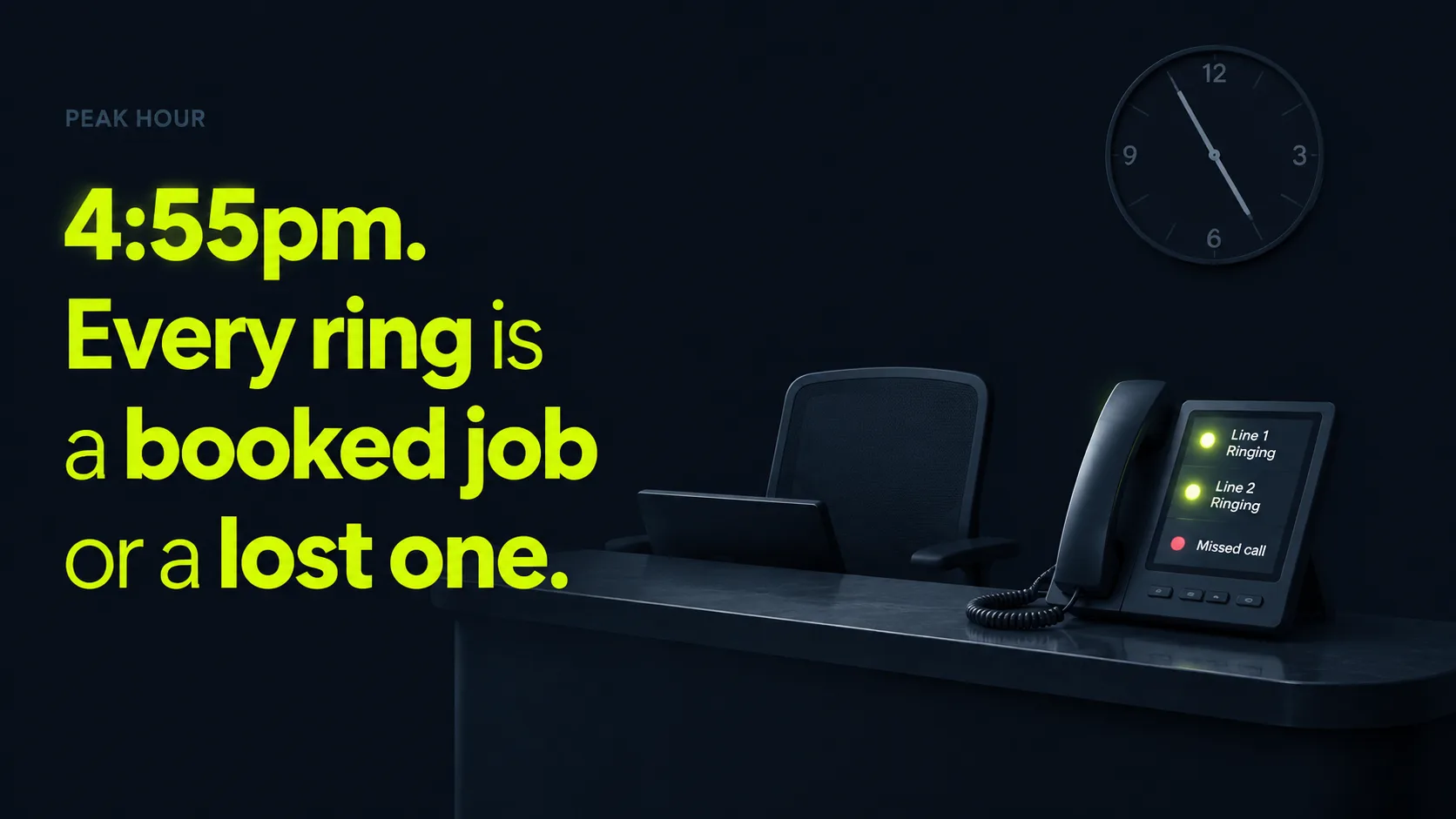
Remember the 4:55pm flood from the top of this article? Here's how it ends well. Plans tier on call volume, not minutes. Starter runs $197/month ($497 setup, up to 75 calls), Professional $397/month ($997 setup, up to 250 calls), and Enterprise $697/month ($1,497 setup, unlimited calls). You stay on one predictable figure whether you take 50 calls or 500, and most shops are live in 48 hours.
The flat price is built around booking, not just answering. SkoreFlow answers in 0.4 seconds, filters spam, runs a script for your trade, qualifies the caller, and books the estimate straight into ServiceTitan, Jobber, Housecall Pro, or Google Calendar. It does not take a message. That is the difference from an answering service like Ruby, which takes a message and leaves you to call back. SkoreFlow books jobs, not messages, and that matters because fewer than 3% of voicemail-bound callers leave a message, per Invoca (2024). A message you have to chase is a job you'll probably lose.
You keep your existing number, and the setup is TCPA-aware. We back it with a simple promise: 5 booked jobs in your first 30 days or we refund the setup. The risk sits on us, not you. Want to see where your break-even lands? Run your own numbers with our Missed Call Revenue Calculator, or Book a Free Call Audit and we'll map what capturing those calls would be worth. It's a 20-minute, no-pressure call.
Citation capsule: SkoreFlow prices its missed-call recovery as a flat monthly plan from $197 to $697 with no per-minute fees, designed to stay predictable on peak-demand weeks when live per-minute services charging $1.50 to $5.00 a minute, per Ruby (2026) and AnswerConnect (2025), cost the most. It books jobs into ServiceTitan, Jobber, Housecall Pro, or Google Calendar rather than just taking messages, since under 3% of voicemail callers leave one, per Invoca (2024).

Estimate your savings and break-even with our Missed Call Revenue Calculator before you decide.
The bottom line: flat AI cost vs a per-minute meter
The cost picture is straightforward. An AI receptionist charges a flat $95 to $300 a month with no per-minute fees, per Smith.ai (2026) and CloudTalk (2025), while a live answering service bills $1.50 to $5.00 a minute, per Ruby (2026). At low volume the two are close. As calls climb, the flat plan pulls ahead and stays ahead, because metered billing spikes on exactly your busiest weeks.
The real return, though, sits on the other side of the ledger: booked jobs. With about 27% of home-services calls going unanswered and fewer than 3% of voicemail callers leaving a message, both per Invoca (2024), a missed call is usually a lost job. Recover even a handful into appointments and the value typically dwarfs a flat AI subscription. So back to that 4:55pm flood we opened with: it's either your most expensive hour or your most profitable one, and the billing model you pick decides which. Want to know where your break-even lands? Run the numbers, or Book a Free Call Audit and we'll show you what your unanswered calls are worth in a 20-minute, no-pressure call.
Next step: estimate your cost and break-even with our Missed Call Revenue Calculator, then see how missed-call recovery answers and books every call.
Written and reviewed by Maksim Skorokhod, Founder of SkoreFlow, who builds AI answering and voice automation for small service businesses. Last reviewed: 2026-06-07. Learn more about SkoreFlow and our team, read our editorial and sourcing policy, or contact us with questions.