Why do after-hours calls put physicians at risk of missed urgent cases?
After-hours calls put doctors at risk because the urgent ones hide among the routine, and a tired physician self-screening at 2 a.m. can miss a real emergency. A peer-reviewed quality-improvement study at an urban academic medical center logged an average of 8.6 after-hours patient calls per shift, with 40.3% about pain and 4.1% leading to a subsequent emergency department visit (Annals of Medicine and Surgery, 2023).
That mix is the whole problem. Most calls are reassurance, a refill, a question that could have waited until Tuesday. A small share are not. And when you are the only filter, every call interrupts you, which means the one emergency of the night arrives wrapped in the exact same ringtone as the tenth routine question. Same buzz. Same dark room. Wildly different stakes.
Most solo doctors underestimate how heavy the off-hours actually are. Roughly 11% of patient calls land outside standard office hours or on weekends, with 10.0% during weekday off-hours and 1.3% on weekends (Hyro, 2023). One in nine calls hits when your front desk is dark and you are the switchboard.
| Time window | Share of patient calls |
|---|---|
| Office hours | 88.7% |
| Weekday off-hours | 10.0% |
| Weekends | 1.3% |
Source: Hyro, The State of Healthcare Call Centers 2023 (analysis of ~300,000 patient calls), 2023.
The timing makes it worse. In that same after-hours study, 32% of calls arrived on Saturdays and 14.9% on Sundays (Annals of Medicine and Surgery, 2023). So much for the quiet weekend. Saturdays are when the patients who white-knuckled it all week finally call, and they call straight into your living room.
Now do the math on what that costs you. In a Forrester Consulting survey commissioned by Cedar, 28% of US healthcare consumers switched or stopped seeing a provider over a poor digital or administrative experience, a 40% jump from the prior year (Forrester Consulting / Cedar, 2020). A more recent survey is even blunter: 35% of patients would switch doctors over poor digital experiences (Software Finder, via eMarketer, 2026). The patient who hit your cold voicemail is one tap away from a competitor's online booking page.
But the real hidden cost is not the calls you take. It is the alertness those calls drain. With 8.6 after-hours calls per shift and only 4.1% leading to an ED visit (Annals of Medicine and Surgery, 2023), a physician who has already fielded six routine calls has less judgment in reserve for the seventh. Which might be the real one. A consistent first-line screen protects your attention for the cases that actually need it, and that is the loop we close at the end of this guide.
Citation capsule: Doctors field an average of 8.6 after-hours patient calls per shift, 40.3% about pain and 4.1% ending in an ED visit (Annals of Medicine and Surgery, 2023), with 32% of those calls arriving on Saturdays. Urgent cases hide among routine ones, which is why unscreened self-answering risks missing the call that matters.
For the full picture of how unanswered calls drain patient bookings and trust, see our Consultation Booking Voice Agent.
How SkoreFlow screens calls and pages the on-call physician
SkoreFlow's Consultation Booking Voice Agent answers every call instantly, runs your approved triage script, and pages you only when a call meets your definition of urgent. Speed is the whole point: firms that respond to an inbound contact within five minutes are 21 times more likely to qualify it than those waiting 30 minutes (Harvard Business Review, 2011). In representative clinic deployments the agent responds in under 30 seconds. For an on-call doctor, that same instant response protects both the patient and your sleep.
So how does a machine know what counts as an emergency? It does not decide. You do.
Triage, in this context, means sorting incoming calls by clinical urgency so genuine emergencies reach you immediately while routine requests are captured and held. The AI never diagnoses. It classifies the call against your rules, then escalates or holds accordingly.
Here is how a typical after-hours call flows, step by step:
- Answer on the first ring. The voice agent picks up live, names your practice, and starts a natural conversation. No phone tree, no hold music, no voicemail beep.
- Confirm the caller. It collects the minimum identifying information your protocol requires before discussing any patient details.
- Run your triage script. The agent asks your pre-set questions and listens for the urgency cues you defined, such as chest pain, difficulty breathing, or severe bleeding.
- Page you for true urgencies. If the call meets your urgent criteria, the agent delivers your approved guidance, then pages you directly per your escalation tree, with a structured summary so you walk in informed.
- Book the routine ones. For non-urgent calls, it can book the follow-up or consult directly into your calendar or PMS, captures the question, logs a clean summary, and queues it for morning delivery rather than waking you. It books appointments, not just messages.
- Log every call. Each interaction is recorded and timestamped, so nothing is lost between the call and your next clinic morning.
Caller patience shapes the design, and patience is thin. Over half of callers, 54%, hang up after being on hold for up to eight minutes, and 75% would rather get a scheduled callback than wait on hold (Nextiva, 2024). A worried patient on hold is a patient halfway to a competitor's number, or to the ER waiting room for something that did not need it. An always-on agent removes the hold queue entirely, so they hear a calm voice instead of a busy signal.
[PERSONAL EXPERIENCE] When we build these for solo physicians, the triage script is where the doctor spends the most time, and that is exactly right. The value is not cleverness. It is the agent asking the same safety questions on call number three and call number three hundred, with no fatigue, no shortcuts, no "I'll just ring them back in the morning." Consistency, not intelligence, is what protects a frightened caller at 2 a.m. The whole setup goes live in about five days. And unlike a message-taking service such as Ruby, it books the consult on the call instead of handing you a callback list to work through.
Citation capsule: Responding within five minutes makes a provider 21 times more likely to qualify an inbound contact than waiting 30 minutes (Harvard Business Review, 2011), while 54% of callers abandon a hold queue within eight minutes (Nextiva, 2024). Instant, rule-based screening reaches urgent callers fast and holds routine ones for morning.
How do symptom triage scripting and escalation rules work, and who controls them?
You control them. The triage script and escalation rules are built around your clinical judgment, not a generic template, so the agent pages you for exactly what you consider urgent and nothing else. This control matters because consumer trust in automated systems is fragile: 64% of customers would prefer companies did not use AI in customer service at all (Gartner, 2024). Earned trust comes from disciplined, doctor-defined handling, not from a clever bot.
A triage script is the ordered set of questions and decision rules the agent follows on every call. It defines what counts as urgent, what gets held, and what guidance the caller hears, all approved by you before a single call routes through.
What you decide
You set the rules that govern the after-hours line. The agent executes them, every single time, without drift.
- Urgency thresholds: Which symptoms or phrases trigger an immediate page versus a held message.
- Escalation path: Who gets paged first, how, and after how long without acknowledgment.
- Caller guidance: The exact approved language a caller hears, for example "call 911" for a possible emergency.
- Quiet rules: What is important enough to wake you for, and what waits until 7 a.m.
Why a written script beats self-screening
A consistent script removes the variability of a human answering half-asleep. The agent does not get impatient on the fifth call. It does not skip a question to get back to bed. It does not misjudge urgency because it is exhausted. That reliability is the safety feature, not a side effect.
[UNIQUE INSIGHT] Here is the counterintuitive part. The single biggest consumer worry about AI on the phone is that it becomes harder to reach a person (Gartner, 2024). A well-built triage line does the opposite. It reaches you faster when it counts, and shields you when it does not. The AI is not a wall between patient and doctor. It is the fastest path to the right human at the right moment.
| Caller signal detected | Agent action | Outcome |
|---|---|---|
| Urgent cue (e.g. chest pain, trouble breathing, severe bleeding) | Deliver approved guidance, then page the on-call physician | Physician reached immediately with a structured summary |
| No urgent cue, time-sensitive question | Capture details, flag for early review | Queued at top of the morning list |
| Routine request (refill, scheduling, reassurance) | Log a clean summary, hold | Delivered next morning; no page |
Source: SkoreFlow illustrative triage model. Thresholds are set by the physician.
Citation capsule: With 64% of customers preferring companies avoid AI in service (Gartner, 2024), a physician answering service must run a doctor-controlled triage script, escalate true urgencies to the on-call physician, and never block a caller from reaching a human when it matters.
How does HIPAA-aware message capture and secure delivery work for an individual physician?
SkoreFlow's Consultation Booking Voice Agent is built to be HIPAA-aware and handles protected health information under safeguards modeled on the HIPAA Security Rule, with a BAA available [CONFIRM BAA]. For a solo doctor, this is not bureaucracy. It is the difference between a patient's symptom sitting encrypted in a secure channel and the same symptom sitting exposed in an open text thread or a generic voicemail box anyone could thumb through.
Protected Health Information (PHI) is any individually identifiable health information you create or handle, including a caller's name tied to a symptom, a callback number, or a refill request. Under HIPAA, a vendor that touches PHI on your behalf is a business associate and must sign a BAA before handling a single call.
What a BAA covers and why you cannot skip it
A Business Associate Agreement (BAA) is a written contract binding a vendor to safeguard PHI, limit how it is used, report breaches, and follow HIPAA rules. If a vendor will not sign one, it cannot lawfully handle your patient calls. Full stop. Ask SkoreFlow about a BAA before any call routes through the system [CONFIRM BAA]. To see how this fits the full clinic workflow, see the Consultation Booking Voice Agent.
How a message moves from caller to you
PHI is encrypted in transit and at rest, access is limited to the minimum necessary, and every call is logged for auditability. The agent captures only what your protocol requires, then delivers it to you through a secure channel, not plain SMS and not an unsecured voicemail box. The structured summary means you read a clean, organized note in the morning rather than squinting at a garbled recording while your coffee goes cold.
[ILLUSTRATIVE MODEL] A simple time model shows the stakes. Picture a solo physician fielding about 30 after-hours calls a week. If each self-handled call plus the mental reset costs roughly 10 minutes, that is about 5 hours a week tied to the after-hours line. Five hours. Every week. Most of it spent answering questions that could have waited until 9 a.m. A screening layer that pages only for true urgencies, in representative clinic scenarios, can cut missed calls to roughly three a week and trim no-shows by about 68%, while handing most of those hours back to you. These are illustrative model inputs and benchmarks, not measured results; swap in your own call count and minutes with the SkoreFlow tools.
Citation capsule: A HIPAA-aware answering service for doctors encrypts PHI in transit and at rest, works with your practice management system, and delivers messages through secure channels rather than plain text or open voicemail, so an individual physician's after-hours patient data stays protected from caller to callback. A BAA is available on request.
How does an AI on-call answering service compare to a traditional one for doctors?
An AI on-call answering service answers instantly, runs your exact triage script every time, and pages you at a lower per-call cost, while a traditional service relies on human operators with hold times, per-minute billing, and operator-to-operator variability. The cost gap is wide: live virtual receptionist plans run roughly $3.45 to $5.00 per receptionist-minute (Ruby pricing, 2026), versus AI receptionist plans starting around $95/month (Smith.ai pricing, 2026).
The table below compares the two on the factors on-call doctors ask about most.
| Factor | AI on-call answering service | Traditional (human) answering service |
|---|---|---|
| Availability | 24/7/365, no hold queue | After-hours shifts, often shared operators |
| Speed to answer | Instant, every call answered live | Variable; callers may hold or hit voicemail |
| Triage consistency | Same doctor-approved script every call | Depends on the operator on shift |
| Concurrent calls | Many at once, in parallel | Limited by staff on shift |
| Escalation to you | Pages per your rules with a structured summary | Pages, but summary quality varies |
| HIPAA / BAA | HIPAA-aware, encrypted PHI, BAA available on request | Varies by provider; confirm before signing |
| Typical cost | From ~$95/mo (Smith.ai, 2026) | ~$3.45-$5.00/receptionist-min (Ruby, 2026) |
| Best for | Consistent triage, after-hours coverage, lower cost | Callers who want a live human for every call |
Now the honest tradeoff, because there is one. Human warmth. Some patients want a person, every time, and 64% of customers say they would prefer companies did not use AI in service at all (Gartner, 2024). So the real question was never "AI or human." It is AI that answers and screens instantly, then pages a human, you, the very moment a caller needs one. You stay the warmth. The agent handles the wait.
Citation capsule: Live answering services cost about $3.45 to $5.00 per minute (Ruby, 2026), while AI plans start near $95/month (Smith.ai, 2026). AI screens instantly and consistently but should always page a live physician for urgencies, since 64% of customers prefer companies avoid AI in service (Gartner, 2024).
What an answering service for doctors costs, and how the ROI works
An answering service for doctors costs far less than the time and risk it removes, which is the core of the ROI for an individual physician. SkoreFlow's Consultation Booking Voice Agent runs $497 to $1,497/mo (the wider AI receptionist market starts around $95/month, per Smith.ai, 2026), against an in-house receptionist's $37,230 median base wage (U.S. Bureau of Labor Statistics, 2024). For a solo doctor, though, the bigger return is reclaimed hours and reduced missed-urgent-call risk.
The ROI logic is not complicated. Count your after-hours calls. Estimate how many actually needed you. Put a dollar value on the hours you burn screening the rest. Then set that against a flat monthly cost that pages you only for the calls that matter. SkoreFlow backs it with a guarantee: recover $3,000 in 30 days or your setup fee is refunded. Even before you count a single recovered booking, the reclaimed time alone usually justifies the spend.
There is a revenue side too, and it compounds quietly. When a missed or fumbled after-hours call becomes a lost patient, the bleeding does not stop at one appointment. A peer-reviewed multi-hospital VA study put the average cost of a single patient no-show at $196 per appointment (BMC Health Services Research, 2016). A patient who could not reach you, or who reached a cold voicemail, is one easy tap from booking elsewhere, and once gone, they take every future visit with them.
Plug your real numbers into the SkoreFlow tools to see your breakeven. Most solo physicians find the question is not whether the service pays off. It is how fast.
| Coverage option | Typical cost | Source |
|---|---|---|
| SkoreFlow Consultation Booking Voice Agent | $497 to $1,497/month | SkoreFlow pricing, 2026 |
| AI receptionist market (entry tier reference) | From ~$95/month | Smith.ai pricing, 2026 |
| Live virtual receptionist | ~$3.45-$5.00 per receptionist-minute | Ruby pricing, 2026 |
| In-house receptionist (base wage only) | $37,230/year median | U.S. Bureau of Labor Statistics, 2024 |
Sources: SkoreFlow (2026), Smith.ai (2026), Ruby (2026), U.S. Bureau of Labor Statistics (2024). Reclaimed after-hours hours are modeled, not measured.
Citation capsule: AI answering plans start near $95/month (Smith.ai, 2026) against a $37,230 median receptionist wage (U.S. Bureau of Labor Statistics, 2024). For a solo doctor, reclaimed after-hours hours plus avoiding a lost patient, where a single no-show averages $196 (BMC Health Services Research, 2016), covers the cost quickly.
Why physicians choose SkoreFlow
Physicians choose SkoreFlow because it answers every patient call instantly, screens by their own triage rules, pages them only for true urgencies, books the routine consults, and runs in a HIPAA-aware way with a BAA available, all for a fraction of front-desk cost. AI adoption among the smallest US firms is climbing fast, roughly doubling to 5.8% in six months (U.S. SBA Office of Advocacy / Census BTOS, 2025), and the early-adopting doctors are the ones quietly reclaiming their off-hours.
We are honest about what SkoreFlow is and is not. It is not a clinician and it does not diagnose. It is a disciplined first-line screen: it answers, runs your script, pages you for emergencies, and holds the rest for morning. The goal is plain. A quieter pager. A clearer head on the calls that count. Patients who always reach a calm answer.
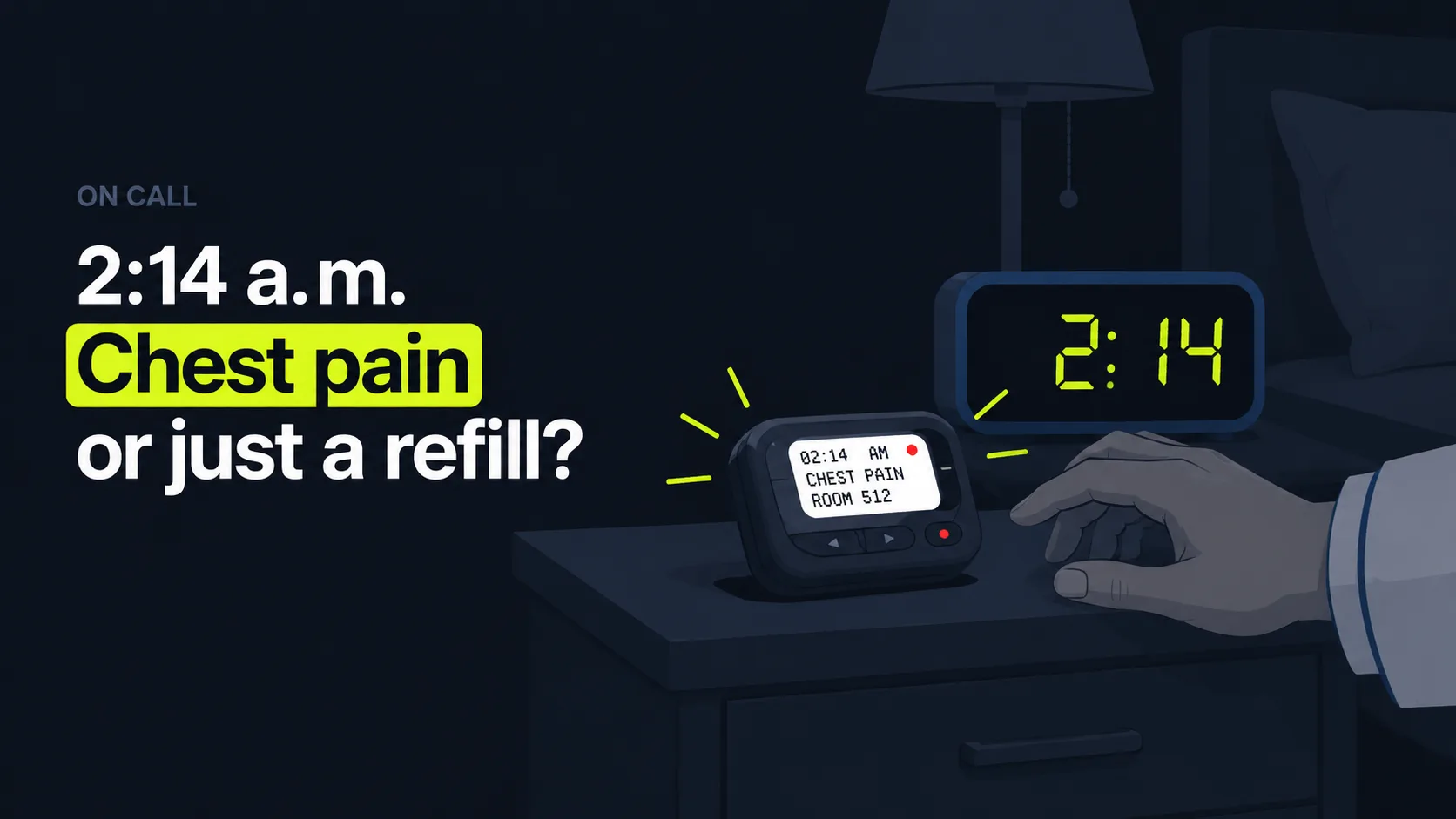
Remember that 2:14 a.m. pager from the top of this page? The moment that lands for an on-call doctor is rarely the feature list. It is the first full night of uninterrupted sleep after the routine calls stop reaching the bedside, with a clean morning summary waiting instead of a backlog of voicemails. You cannot fix what you have not measured, which is exactly where a free audit starts.
Key Takeaways
- Doctors field about 8.6 after-hours calls per shift, 40.3% about pain and 4.1% ending in an ED visit (Annals of Medicine and Surgery, 2023), with urgent cases hidden among routine ones.
- An answering service for doctors answers instantly, runs your triage script, books routine consults, and pages you only for true urgencies, in a HIPAA-aware way with a BAA available.
- You control the urgency thresholds, escalation path, and approved caller guidance; the agent executes them the same way every call.
- SkoreFlow's Consultation Booking Voice Agent runs $497 to $1,497/mo, far below a $37,230 receptionist wage (U.S. Bureau of Labor Statistics, 2024), and goes live in about 5 days.
Book a free consult audit
If your pager owns your evenings, you are not failing. You are simply doing the work of a switchboard on top of being a doctor. The fix is not a louder ringtone or a colder voicemail. It is a HIPAA-aware screening layer that answers instantly, books the routine consults, pages you for the genuine emergencies, and holds the rest for morning. Start by seeing your own numbers: book a free consult audit, a 20-minute, no-pressure call, and we will map how many after-hours calls you take, how few actually needed you, and what disciplined triage would reclaim. There is no cost and no obligation, and if you go live, you are backed by the recover-$3,000-in-30-days-or-refund guarantee. Then run the math yourself with the SkoreFlow tools, or explore the Consultation Booking Voice Agent for clinics.
Written by Maksim Skorokhod, SkoreFlow. This guide is educational and is not medical or legal advice; confirm HIPAA and on-call protocols with your own counsel and clinical judgment.