Quick verdict: which should you choose?
Choose by what you actually need on a call, not by the label on the sales page. The decision comes down to three things: your budget, how many hours you need covered, and whether you need a real booking or just a message. With phone calls rated the top SMB lead source by 66% of small businesses, ahead of online forms and email, per BIA/Kelsey (2014), getting this one right guards your most valuable channel.
Here's the fast read in three columns. We do the math on each row in the sections below, and one of these numbers tends to surprise owners once they run it.
| Live virtual receptionist | Answering service | AI virtual receptionist | |
|---|---|---|---|
| Who answers | A remote human | A remote human team | Natural-voice software |
| Best at | Warm, nuanced conversations | Simple message-taking, overflow | Instant answer, 24/7 booking |
| Books appointments? | Sometimes, if set up | Rarely, mostly messages | Yes, into your calendar |
| Hours | Limited to staffed shifts | Often extended or after-hours | Always on, 24/7 |
| Relative cost | Highest per minute | Low to moderate | Lowest per minute |
| Pick it when | You want a human on every call | You only need basic coverage | You want every call booked for less |

Citation capsule: Choosing between a live virtual receptionist, an answering service, and an AI virtual receptionist comes down to cost, hours, and whether you need booking or just messages. Getting it right protects your top lead channel, since 66% of small businesses rate phone calls a "good" or "excellent" source of leads, ahead of online forms and email, per BIA/Kelsey (2014).
What each one actually is
All three pick up your phone. What separates them is who answers and what they can finish once the call connects, and that single difference drives both your cost and your booked-job count. It matters because callers don't wait around. Over half of callers hang up within eight minutes on hold, per Nextiva (2025). The option that answers fastest and actually closes the loop is the one that keeps the job.
Live virtual receptionist
A live virtual receptionist is a real person, working remotely, who answers in your business name. They greet the caller warmly, take messages, transfer the urgent ones, and, in some setups, book appointments. The strength is human nuance on a tricky or emotional call. The catch is cost and coverage: you're renting someone's time, and that time stops the moment their shift ends.
Answering service
An answering service is a remote team built for the basics. Pick up the call, capture the caller's name and reason, pass the message along. Many run extended or after-hours coverage and catch overflow when your own line is busy. But most lean toward message-taking and routing, not full booking, so your team still has to circle back to actually close the loop. That callback is where deals quietly leak.
AI virtual receptionist
An AI virtual receptionist is software that answers in a natural voice, follows your script, qualifies the caller, and books the appointment straight into your calendar. It answers instantly. It handles many calls at once. It never sleeps. To judge one properly, including how it handles handoffs and the weird edge cases, see our checklist below.
How to evaluate the AI option, feature by feature
Citation capsule: A live virtual receptionist is a remote human, an answering service is a lighter message-taking team, and an AI virtual receptionist is natural-voice software that books appointments. The fastest, most complete answer tends to win, since over half of callers hang up within eight minutes on hold, per Nextiva (2025).
How does the cost compare?
AI is the cheapest per minute, a live virtual receptionist is the most expensive, and a basic answering service sits in the middle. The spread is wide once you look past the headline price. Live human receptionist time runs roughly $3.45 to $5.00 per minute when you divide published plans by their included minutes, per Ruby (2026). AI plans start far lower, with self-serve AI receptionist tiers around $95 a month, per Smith.ai (2026).
The reason is simple, and it isn't magic. A human handles one call at a time, so you're buying scarce labor by the minute. The benchmark for that labor is real: a U.S. receptionist's median wage is $17.90 an hour, about $37,230 a year before benefits, per the U.S. Bureau of Labor Statistics (2024). AI software spreads its cost across unlimited simultaneous calls. That's why the per-minute number collapses.
Effective cost per minute, at a glance:
| Option | Effective cost per minute | Source |
|---|---|---|
| Live virtual receptionist | $3.45 to $5.00 per minute | Ruby (2026) |
| AI virtual receptionist | Well below $1 per minute (from ~$95/mo plans) | Smith.ai (2026) |
Here's how published pricing stacks up:
| Option | Typical monthly range | Effective per-minute cost | Source |
|---|---|---|---|
| Live virtual receptionist | $250/mo (50 min) to $1,725/mo (500 min) | ~$3.45-$5.00/min | Ruby (2026) |
| Live answering (live operators) | ~$300-$500/mo at ~200-300 min | ~$1.50-$1.75/min | AnswerConnect (2025) |
| AI virtual receptionist | ~$95/mo (Starter) to $800/mo (Pro) | Well below human rates | Smith.ai (2026) |
The per-minute rate is where the real decision hides, not the monthly headline. Two providers can both advertise "from a few hundred a month," but a live plan meters you in expensive human minutes while an AI plan does not. In our experience, owners who only compare monthly tiers get caught out when a busy month on a per-minute live plan runs past plan, while the AI line stays flat no matter how loud the phone gets.
Illustrative example (industry-based scenario, not a real client): Picture a service business taking about 300 receptionist-minutes a month. On live virtual receptionist pricing near the low end of the Ruby range above, that's roughly $1,000-plus in human minutes. A flat-rate AI plan in the mid-tier covers the same volume for a fraction of that, and the gap only widens the busier you get. These are published industry list prices, not a client's bill.
Citation capsule: AI is the cheapest per minute, a live virtual receptionist the most expensive. Live human receptionist time runs roughly $3.45 to $5.00 per minute, per Ruby (2026), against a $17.90 hourly median receptionist wage, per the U.S. Bureau of Labor Statistics (2024). AI receptionist plans start around $95 a month, per Smith.ai (2026).
Estimate what your missed calls are worth with the revenue calculator
Takes messages vs books appointments: what's the real difference?
This is the line that separates the three options, and for most shops it matters more than price. A message is a delayed lead. A booked appointment is a captured one. And the gap between them is brutal, because voicemail almost never bounces back: among home-services callers, fewer than 3% of those pushed to voicemail actually leave a message, per Invoca (2024). A message you never receive can't become a job.
Speed is the other half of it. Booking on the call closes the loop before the lead cools. A message reopens it, and now you're racing a clock you can't see. Contacting a web lead within five minutes makes a firm 21 times more likely to qualify it than waiting 30 minutes, per Harvard Business Review (2011). When the appointment is booked the moment the phone rings, you never enter that race at all.
Here's how each option handles it:
- Answering service. Usually takes a message and relays it. Your team still has to call back to actually book, which only works if someone circles back fast.
- Live virtual receptionist. Can book if you've set up calendar access and training, but it's still gated by staffed hours and one-call-at-a-time capacity.
- AI virtual receptionist. Books directly into your calendar on the call, 24/7, across many simultaneous calls, with no callback required.
Building AI answering for service shops, we've found booking is the part owners feel first, almost physically. A message sitting in an inbox still depends on someone calling back before the caller dials a competitor. When the agent books the slot during the call, the job is locked the second the phone rings, not the next morning when half the callers have already booked someone else.

Citation capsule: The real divide is messages versus booking. Answering services mostly take messages, a live virtual receptionist can book if configured, and an AI virtual receptionist books on the call. This matters because fewer than 3% of callers sent to voicemail leave a message, per Invoca (2024), and five-minute response makes a firm 21x more likely to qualify a lead, per Harvard Business Review (2011).
After-hours and speed-to-answer: which covers you?
AI covers after-hours best because it's always on, a good answering service can cover extended or overnight hours with humans, and a live virtual receptionist is boxed into staffed shifts. This matters because a real chunk of demand shows up outside 9-to-5. In some verticals it's the majority: restaurants receive 51% of their calls after 5pm, per BrightLocal (2019). A phone that clocks out at five misses all of it.
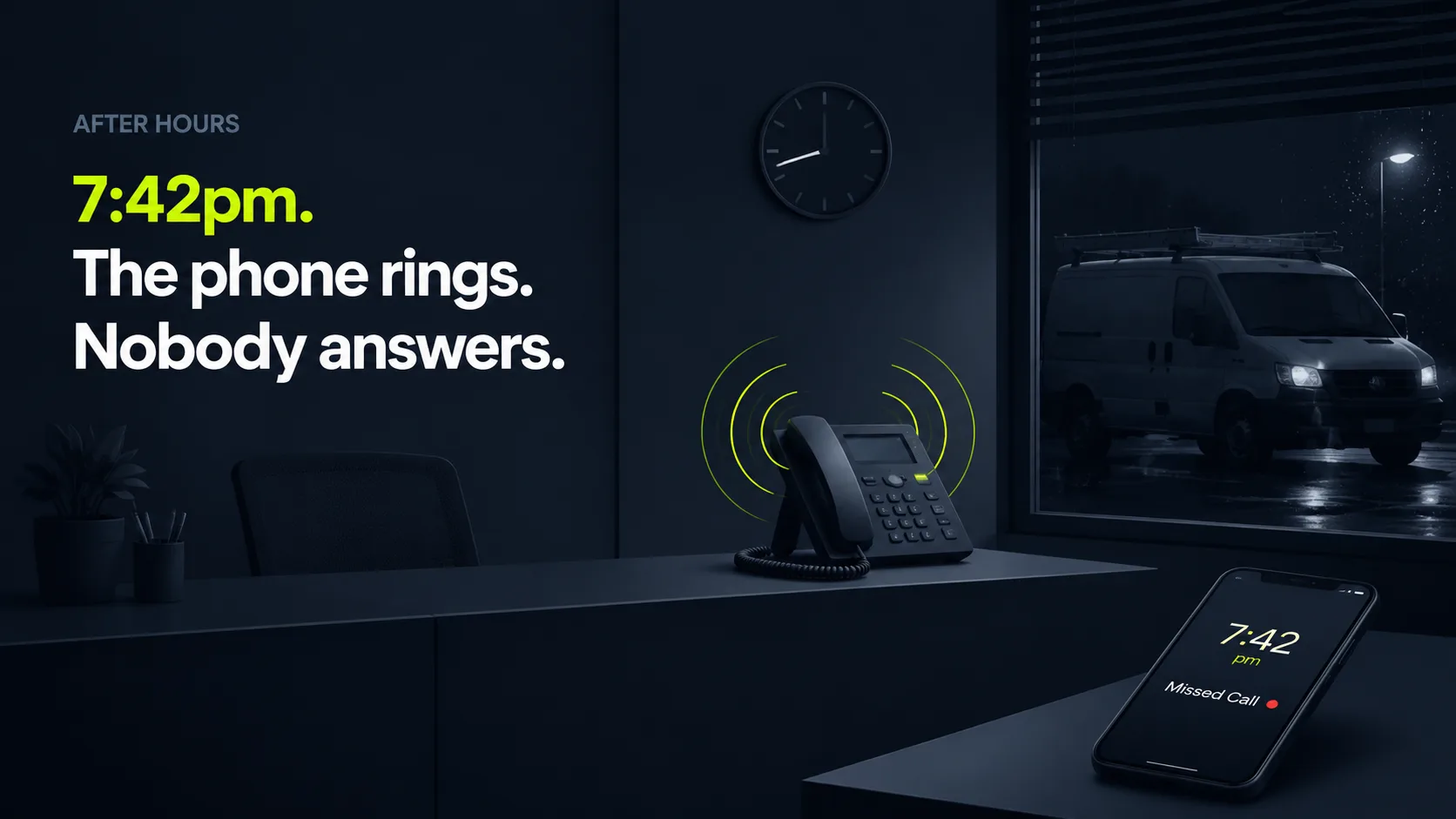
Speed-to-answer is the same coin, flipped. Callers are impatient, and they leave fast. After a missed response window, 56% of customers immediately try another channel and 28% abandon entirely, per Nextiva (2025). Remember that homeowner from the opening, the one with water on the floor at 7:42pm? An AI agent answers her on the first ring, every ring, with no hold queue and no closed sign. That's the call a 9-to-5 line never even knew it lost.
Here's how the three compare on coverage:
| Option | After-hours coverage | Simultaneous calls | Speed to answer |
|---|---|---|---|
| Live virtual receptionist | Only during staffed shifts | One at a time | Fast, until they're busy |
| Answering service | Often extended or 24/7 (human) | Limited by team size | Good, can queue at peaks |
| AI virtual receptionist | Always on, 24/7 | Many at once | Instant, no hold |
Overflow is the part most owners forget to plan for. A single human, live receptionist or answering-service agent, answers one call while the second caller hits hold or voicemail. So for many small shops, the value of AI isn't replacing a human at all. It's catching the second and third caller ringing at the same moment, the ones a single-human setup structurally cannot reach.
Citation capsule: AI covers after-hours best because it's always on; a live virtual receptionist is limited to staffed shifts. Coverage matters because restaurants receive 51% of calls after 5pm, per BrightLocal (2019), and after a missed response window 56% of customers immediately try another channel, per Nextiva (2025).
When to choose each option
Choose based on your call mix, your budget, and whether you need warmth, basic coverage, or 24/7 booking. There's no single winner for everyone, but the data tilts most small businesses toward AI for value. The market is already moving: 85% of customer service leaders will explore or pilot customer-facing conversational GenAI in 2025, per Gartner (2024). Match the option to your reality below.
When a live virtual receptionist is better
- Your calls are often complex, emotional, or high-touch, and a human voice is what closes them.
- Brand perception on the phone matters to you more than per-minute cost.
- Your call volume is moderate and predictable, so human-minute pricing stays in check.
- You want nuanced judgment on unusual requests, not script-following.
When an answering service fits
- You mainly need someone to catch overflow and after-hours calls and take a message.
- Full appointment booking isn't critical, and your team is fine calling back to close.
- You want human coverage on a modest budget without building a front desk.
- Your call types are simple, so routing or a message is usually enough.
When AI wins
- You want every call answered instantly, 24/7, with appointments booked on the call.
- Per-minute cost matters, and you'd rather pay a flat rate than expensive human minutes.
- You regularly get two or more calls at once and can't let the extras drop.
- You're comfortable with a natural-voice agent that hands off to a human when needed.
In our experience, the clearest signal isn't call volume at all. It's regret. When an owner can rattle off the jobs they lost to a missed or after-hours call last month, off the top of their head, the decision is usually already made. AI's always-on coverage is simply the cheapest way to close that exact gap.
Citation capsule: Choose a live virtual receptionist for warmth, an answering service for basic human coverage, and AI for instant 24/7 booking at the lowest per-minute cost. The market is tilting toward AI, with 85% of customer service leaders set to explore or pilot customer-facing conversational GenAI in 2025, per Gartner (2024).
How does SkoreFlow approach the virtual receptionist?
SkoreFlow builds the AI virtual receptionist as a booking engine, not a message desk. An AI voice agent answers your calls in 0.4 seconds, filters spam, qualifies the caller, books the estimate, and hands off to a human cleanly when a call needs one. It books jobs, not messages. That's the line that separates it from answering services like Ruby, which take a message and leave you to call back. The design follows the data on caller trust. Because 64% of customers would prefer companies didn't use AI in customer service, and the top concern is that it gets harder to reach a person, per Gartner (2024), the agent is built to sound natural and pass calls to a human without friction.
The aim is to answer more callers, not wall them off behind a robot. An AI agent that answers instantly removes the hold entirely, which is exactly what callers want, since 75% of customers prefer or want a scheduled callback over waiting on hold, per Nextiva (2024). Used well, AI is the value pick that captures every call, with a live receptionist as the high-touch alternative when warmth on every single call is the priority.
For home-service trades, SkoreFlow's missed-call recovery goes live in 48 hours and plugs into the tools you already run, including ServiceTitan, Jobber, Housecall Pro, and Google Calendar. Plans run $197 to $697 a month depending on call volume, and the setup is TCPA-aware and GDPR-aware. The guarantee is concrete, not a vibe: 5 booked jobs in 30 days, or your setup fee back. The method is open. Your numbers, clients, and data stay private.
Illustrative example (representative scenario, not a real client): Picture a 6-technician HVAC shop whose crews are out on calls most of the day. Using the home-services unanswered rate, a meaningful slice of its calls drop to voicemail and vanish. Modeled on SkoreFlow's home-service benchmarks, a shop recovering missed calls might lift its answer rate toward 94% and return roughly $14,200 a month, at the $1,205 average repair ticket reported by Housecall Pro (2025). These are representative benchmark figures, not a measured client result.
Citation capsule: SkoreFlow treats the virtual receptionist as a booking engine that books jobs, not messages: a 24/7 AI voice agent answers in 0.4 seconds, qualifies callers, and books estimates, with a clean human handoff. The approach follows caller trust data, since 64% of customers would prefer companies didn't use AI in customer service, per Gartner (2024), so a natural voice and easy human handoff are built in.
The bottom line
Here's the short version. All three options answer your phone, but they solve different problems. A live virtual receptionist gives you human warmth at the highest per-minute cost. An answering service gives you basic human coverage and message-taking. An AI virtual receptionist gives you instant, 24/7 answering and booking at the lowest per-minute cost, with a human handoff when a call calls for one.
For most small businesses, the math points to AI as the value pick, especially once you add up after-hours demand, overflow, and the brutal reality that almost nobody leaves a voicemail. The right choice still hinges on your call mix and how much warmth matters on every single call. And that 7:42pm caller with water on the floor? With an always-on agent, she books an estimate instead of dialing the next name on the list. Want to know what recovering your missed calls is actually worth? Book a Free Call Audit, a 20-minute, no-pressure call, and we'll map where your phone is leaking jobs and what fixing it could return, all backed by our guarantee of 5 booked jobs in 30 days or your setup fee back.
Book a Free Call Audit with SkoreFlow How to evaluate an AI virtual receptionist, step by step See the full missed-call recovery service
Written and reviewed by Maksim Skorokhod, Founder of SkoreFlow, who builds AI answering and voice automation for small service businesses. Last reviewed: 2026-06-07.