Why does good call handling win more jobs?
Good call handling wins jobs because inbound phone calls are the highest-intent lead a home-service business gets, and most of that intent evaporates within minutes. According to BIA/Kelsey (2014), 66% of SMBs rate inbound phone calls as a good or excellent lead source, ahead of online forms at 58.2%.
Think about who actually picks up the phone. Nobody calls a plumber to browse. They call because water is on the floor, the furnace died, or a tenant is yelling. That caller already decided to buy. Your only job is to not lose them.
Call handling is the full process of receiving, qualifying, booking, and following up on an inbound phone call so the caller becomes a scheduled, confirmed job. It is not just "picking up." It is everything between the first ring and the appointment reminder.
The cost of doing it poorly is brutal. Invoca (2024) found that 27% of calls to home-services businesses go unanswered, and fewer than 3% of callers pushed to voicemail actually leave a message. So a missed call almost never becomes a callback. The caller dials the next listing, and you never even knew they existed.
This is not a single-vendor fluke. An independent 30-day audit of 85 small businesses across 58 industries found only 37.8% of calls were answered by a live person, with the rest going to voicemail or no response at all (411 Locals, 2016). The study is older and directional, but it confirms the pattern from a different dataset: most small-business calls never reach a person. Hold that number in your head, because later we will do the math on what it costs a single crew.
Citation capsule: Inbound phone calls are the top-rated lead source for small businesses, with 66% of SMBs calling them good or excellent, ahead of online forms (58.2%) and email (43.7%), per BIA/Kelsey's 2014 "Phone Calls Are the New Click" report.
When you cannot pick up live, the next best move is an instant auto-text back to the caller. Our missed-call text-back guide walks through setting that up.

What you'll need before you answer the phone
Before you answer a single call well, you need three things ready: a short greeting-and-qualifying script, a live calendar you can book into during the call, and a follow-up step that sends a confirmation. According to Nextiva (2025), 75% of callers hang up after eight or more minutes on hold, so fumbling for tools mid-call costs you the job.
Picture the alternative. You pick up, the caller starts talking, and you are hunting for a pen while a compressor runs in the background. They can hear the scramble. So set up the kit first, and keep it within arm's reach of whoever answers.
- A call script. Five lines: greeting, who you are, what they need, when you can come, and the text confirmation close.
- A live booking calendar. Shared, real-time, and visible to everyone who answers. No double-booking, no "let me check and call you back."
- A qualifying checklist. Service type, address or service area, urgency, and the customer's name and number.
- A follow-up trigger. A way to fire off a confirmation text the moment you hang up.
- A coverage plan for after hours. Many service calls land outside 9 to 5, so decide who or what answers then.
That last item is not optional. Restaurants get 51% of their calls after 5 p.m., and locksmiths take a large share before 9 a.m. or after 5 p.m. (per BrightLocal, 2019). Home-service demand spikes when something breaks, and pipes do not check your hours before they burst.
Citation capsule: Customer patience for hold time is thin. Nextiva's 2025 Customer Patience study found 75% of callers hang up after being on hold for eight or more minutes, with 54% abandoning inside eight minutes, a strong case for tools that let you book on the first call.

What are the step-by-step call answering best practices?
The step-by-step best practices are a six-step sequence: answer in under three rings, greet by business name, qualify the job, confirm the details, book on the call, and send a text confirmation. Each step exists to move the caller toward a scheduled appointment. According to Invoca (2024), 27% of home-services calls go unanswered, so step one alone recovers a quarter of lost demand.
Run the steps in order. Skip one, and you usually skip the booking step, which is exactly where most jobs leak out the bottom.
- Answer in under three rings.
- Greet by business name.
- Qualify the job.
- Confirm the details back.
- Book on the call.
- Send a text confirmation.
Step 1: Answer in under three rings
Answer fast, because speed is the single biggest lever on whether a caller becomes a job. Harvard Business Review (2011) found that contacting a lead within five minutes makes you roughly 100 times more likely to connect than waiting 30 minutes. On a live call, "under three rings" is your version of that five-minute window.
A ringing phone is a customer with a problem right now. Every extra ring is a chance for them to hang up and dial the next number. If your team is elbow-deep in a job, route the call to a teammate, a service, or an automated answer. Never to voicemail.
Step 2: Greet by your business name
Open with your business name, your own name, and an offer to help, in that order. A clear greeting signals the caller reached a real, organized business and not a wrong number. "Greenline Landscaping, this is Sam, how can I help?" beats a flat "Hello" every time.
This is the heart of phone etiquette for small business: warm, fast, and identifiable. The caller should know within two seconds that they reached the right place. Smile when you say it. They can hear it through the line.
Step 3: Qualify the job
Ask three or four quick questions to understand the job before you talk price or timing. Qualifying means capturing the service type, the address or service area, the urgency, and the caller's name and callback number. According to BIA/Kelsey (2014), inbound callers are high-intent, buying-stage customers, so a few smart questions rarely scare them off.
Keep it conversational, not an interrogation. "What's going on with the unit?" tells you more than a checklist read aloud. Grab the callback number early, in case the call drops mid-sentence.
Step 4: Confirm the details back
Repeat the key details back to the caller before you book. Confirming the address, the service needed, and the timing prevents wrong-site visits and no-shows. It takes ten seconds and saves a wasted truck roll. "So that's a no-heat call at 14 Oak Street, you'll be home after 3, correct?"
This step also builds trust. The caller hears that you actually listened, which makes them far more likely to keep the appointment they just made.
Step 5: Book on the call
Schedule the appointment while the caller is still on the line. Booking on the first call is the difference between a job and a maybe. Once you hang up without a time on the calendar, the lead cools fast, and most callers will not pick up your callback. Invoca (2024) reports fewer than 3% of voicemail-bound callers leave a message, so "we'll call you back" is where deals quietly die.
In our experience, the phrase that works is direct: "I can have a tech out Thursday morning or Friday afternoon, which works better?" Offer two choices, not an open question. Two options make saying yes feel easy.
Step 6: Send a text confirmation
Send a confirmation text the second you hang up. A text locks in the appointment, reduces no-shows, and gives the customer your number to reach you. According to a Nuance Communications / Research Now survey (2014), 95% of people find texting more convenient than voicemail, so your confirmation lands where they actually look.
Include the date, time, your business name, and a one-tap way to reschedule. A simple text turns a verbal "yes" into a committed slot. Want this to fire automatically? See our missed-call text-back guide.
Citation capsule: Texting beats voicemail decisively for service confirmations: 95% of people surveyed by Nuance Communications and Research Now said text messaging is more convenient than voicemail, which helps explain why a confirmation text reduces no-shows better than a voicemail callback.
What are the most common call-answering mistakes?
The most common mistakes are sending after-hours calls to voicemail, never following up, and failing to book on the first call. Each one quietly drains revenue. According to BrightLocal (2019), local businesses get 94% of their calls Monday to Friday, but the 6% on weekends, plus heavy after-hours demand in trades, is exactly where unstaffed phones lose jobs.
Each mistake feels small in the moment. Add them up over a month, and they total real money walking out the door. Here are the three that cost the most.
Mistake one: dumping after-hours calls to voicemail. Voicemail recovers almost nothing. Fewer than 3% of callers leave a message, and about 80% of callers sent to voicemail never leave one at all (destinationCRM citing Forbes, 2014). That emergency water-heater call at 8 p.m. goes straight to your competitor.
Mistake two: no follow-up. When you do take a message or miss a call, nobody calls back fast, or at all. Nextiva (2025) found 56% of customers immediately try another channel after a missed response window, and 28% abandon entirely. Silence is a decision, and it usually goes against you.
Mistake three: not booking on the first call. "We'll get back to you with a time" feels polite but kills momentum. The caller's intent is highest during the call. Take a message instead of a booking, and you trade a near-certain job for a long-shot callback. Book it live, every time.
Citation capsule: Voicemail is a dead end for home-service leads. Per destinationCRM citing Forbes (2014), roughly 80% of callers sent to voicemail never leave a message, meaning after-hours calls dumped to voicemail rarely convert and typically route the customer straight to a competitor.
Curious what those three mistakes add up to in dollars? Our missed-call revenue calculator estimates the monthly revenue your unanswered calls cost.
Illustrative example (industry-based scenario): Picture a small landscaping crew that takes roughly 40 inbound calls a month. The owner usually catches calls on a job site, so about a quarter go unanswered, matching the 27% home-services miss rate from Invoca (2024). That is about 11 missed calls. Because fewer than 3% of voicemail-bound callers leave a message, almost none call back. Now do the math the other way. If the crew answered and booked even half of those 11 calls, that is roughly 5 to 6 extra booked jobs a month, from the same call volume, with no new advertising. This is a modeled scenario for illustration, not a specific client result.
How does SkoreFlow automate call answering?
SkoreFlow's Missed Calls Recovery agent automates all six best-practice steps so no call goes unanswered, day or night. It answers in 0.4 seconds, filters spam, greets callers by your business name, qualifies the job, and books the estimate into your live calendar. The key difference: it books jobs, not messages. According to BrightLocal (2019), trades take a large share of calls outside business hours, which is exactly when an automated answer earns its keep.
That last point separates SkoreFlow from a traditional answering service. A service like Ruby takes a message and leaves you to call the lead back later, after the intent has already cooled. SkoreFlow qualifies and books the estimate on the call itself. It plugs into ServiceTitan, Jobber, Housecall Pro, and Google Calendar, is TCPA-aware, and is typically live in 48 hours. The Starter plan runs $197/mo, scaling to $697/mo for unlimited call volume, and it ships with a guarantee: 5 booked jobs in 30 days or your setup fee back. So the downside risk is small, and the slot stays on your calendar either way.
Now, the fair objection. Does AI on the phone annoy callers? Gartner (2024) found 64% of customers would prefer companies not use AI in customer service, and the top concern is that it becomes harder to reach a person. The fix is design: answer naturally, keep it short, and offer a fast human handoff. A booked appointment beats a missed call every time.
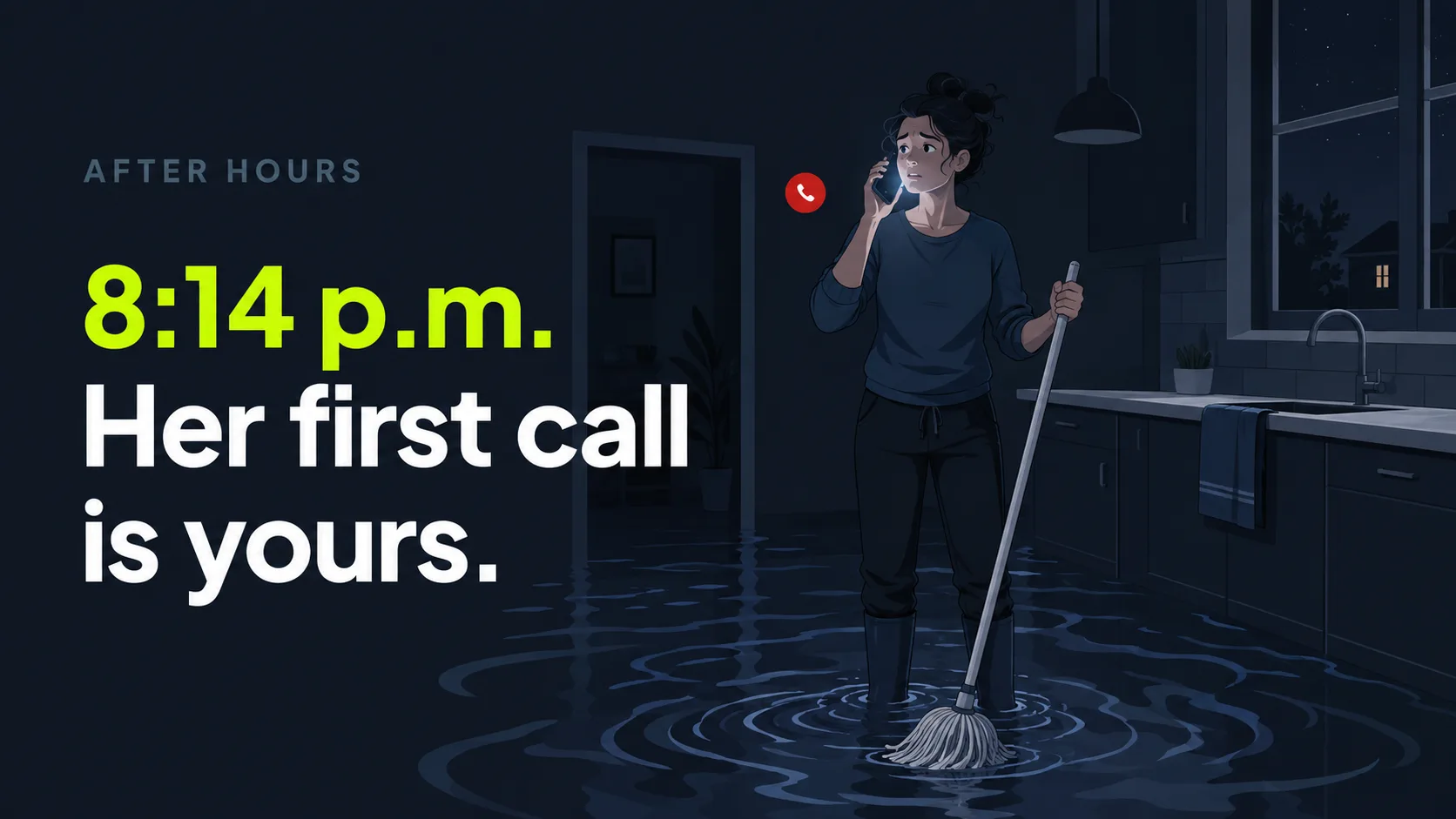
This is where the loop we opened earlier finally closes. The data cuts against the usual "AI versus human" debate. The real comparison for most home-service shops is not AI versus a friendly receptionist. It is AI versus voicemail at 8 p.m. Against voicemail, where roughly 80% of callers leave nothing, even a plain automated answer that books the job wins decisively. We have watched owners agonize over the AI question while their phone quietly dumped after-hours emergencies into a mailbox nobody checked until morning. The woman with the flooded kitchen never gets a callback. She gets a different plumber.
Representative scenario (illustrative, not a specific client): a seven-technician plumbing shop fielding heavy after-hours demand might lift its answer rate from the industry's typical low-to-mid range toward roughly 94% once every call is picked up live, recovering on the order of $14,200 a month in jobs that previously went to voicemail. These are offer benchmarks modeled on industry figures, not a guaranteed or specific customer result.
| Approach | What the caller gets at 8 p.m. | Outcome on the calendar |
|---|---|---|
| Voicemail | A beep and a mailbox | ~80% leave no message (Forbes via destinationCRM, 2014); call lost |
| Traditional answering service | A live message-taker | A message, then a callback after intent cools |
| SkoreFlow Missed Calls agent | A 0.4-second live answer that qualifies and books | A booked estimate on your live calendar |
Citation capsule: Against an unstaffed phone, automated answering wins on the numbers. Per destinationCRM citing Forbes (2014), roughly 80% of callers sent to voicemail leave no message, so a SkoreFlow Missed Calls agent that answers in 0.4 seconds and books the estimate, rather than taking a message, captures after-hours demand that voicemail loses outright.
Want to see how many jobs your unanswered calls are costing? Book a Free Call Audit, a 20-minute, no-pressure walkthrough of where your phone leaks revenue.
The bottom line
Answering calls well is not about a perfect phone voice. It is about a repeatable sequence: pick up fast, greet clearly, qualify, confirm, book on the call, and text to lock it in. Get those six steps right and you convert more of the high-intent callers who already chose to dial you. Skip the booking step or lean on voicemail, and you hand jobs to whoever answers next.
The numbers make the case plainly. Phone leads are the top-rated source for small businesses, yet 27% of home-services calls go unanswered and fewer than 3% of voicemail callers leave a message (Invoca, 2024). The gap between those two facts is booked revenue waiting to be captured. Start with the checklist above, then decide how you will cover the calls that arrive after the trucks are back in the yard.
Want to see what those missed calls are costing you? Run the numbers with our missed-call revenue calculator.
Ready to go deeper? Our missed-call recovery hub covers the full playbook for capturing every inbound opportunity, on the call and after hours. When you want a second set of eyes on your own phone, Book a Free Call Audit: a 20-minute, no-pressure look at where your calls leak, with no obligation.
Written and reviewed by Maksim Skorokhod, SkoreFlow.