How does the auto-reply work?
The auto-reply works in four fast steps: it detects the missed call, sends an instant SMS, opens a two-way text conversation, then routes the lead toward booking. The whole sequence runs in seconds, with no one on your team touching a thing. That speed matters because voicemail rarely recovers the lead. For home-services businesses, fewer than 3% of callers pushed to voicemail actually leave a message, per Invoca (2024).
So while you're still up that ladder, the system has already gone to work. It runs one exact sequence every time a call goes unanswered:
- Missed call detected. The moment a call rings out, hits voicemail, or goes unanswered after hours, the system flags it as missed and grabs the caller's number.
- Instant SMS fires. Within seconds, the caller gets a friendly text: "Sorry we missed you, this is the team at your shop. How can we help?" The caller now has a thread open instead of a dead end.
- Two-way conversation opens. The caller replies in their own time. They describe the job, ask about pricing, or share an address, all by text. No hold music, no second call attempt.
- Booking or handoff. The thread captures the lead's details and either books the job, offers time slots, or routes a hot lead to a human to close.

Most owners miss the quiet part of this. The text doesn't just apologize. It hands the next move to the caller on a channel they actually like. A returned voicemail puts the work back on you, another callback to squeeze between jobs. A text-back thread keeps the lead warm while letting them reply from a job site, between meetings, or at 9pm on the couch, right when most callers want to deal with it. You stayed busy. The lead stayed yours.
Citation capsule: Missed call text back works in four steps: it detects the unanswered call, fires an instant SMS, opens a two-way text thread, and routes the lead to booking. It beats voicemail because, for home-services businesses, fewer than 3% of callers pushed to voicemail leave a message, per Invoca (2024). The auto-reply runs in seconds with no staff effort.
Related reading: how after-hours calls get answered automatically.
Why does speed matter so much?
Speed matters because lead value collapses fast: contacting a web lead within 5 minutes makes a firm 21 times more likely to qualify it, and 100 times more likely to connect, than waiting just 30 minutes, per Harvard Business Review (2011). A missed call already burned your first window. An instant text reopens it before the caller dials someone else.
That five-minute window is brutal, and almost nobody hits it. A later large-scale analysis found lead-to-conversion rates are about 8 times higher when a lead is engaged within the first five minutes versus the five-minutes-to-24-hours window, yet only 0.1% of inbound leads actually get engaged that fast, per InsideSales.com / XANT (2021). Read that again. One in a thousand. The shop that texts back in seconds is competing in a window 999 of its rivals never reach.
Why does the decay run so steep? Think about who's calling. A service caller with a dead furnace or a leak under the sink is in buying mode right now, today, this minute. They aren't calling one shop. They're working down a list. The first business to respond usually wins, not because it's the best one, but because it's the available one. The moment a caller connects with your competitor, your missed call is dead. There's no winning a job that's already booked.
| Response window | Likelihood to qualify the lead | Likelihood to connect |
|---|---|---|
| Within 5 minutes | 21x higher | ~100x higher |
| After 30 minutes | Baseline | Baseline |
In our experience working with service shops, owners badly underestimate how fast callers move on. [PERSONAL EXPERIENCE] They picture the caller patiently waiting for a callback "later today." What actually happens is this: by the time someone climbs down, washes up, and returns the call two hours later, the caller has already booked the next contractor who picked up. The estimate is scheduled. The job is gone. An instant text keeps you in the conversation while your hands are still full.
Citation capsule: Speed-to-lead determines whether a missed call converts. Contacting a lead within 5 minutes makes a business 21 times more likely to qualify it than waiting 30 minutes, per Harvard Business Review (2011). Yet only 0.1% of inbound leads are engaged within 5 minutes, per InsideSales.com (2021), so an instant text-back is a rare competitive edge.
Try this next: estimate what missed calls cost you each month.
Who needs missed call text back?
Any business that earns leads by phone needs it, but it pays off most for high-call-volume trades and solo operators who physically can't pick up. Phone calls remain the top-rated lead channel: 66% of small businesses rate inbound calls a "good" or "excellent" source of leads, ahead of every other channel, per BIA/Kelsey (2014). If your best leads call, every missed call is lost revenue.
Some shops feel this pain harder than others. Here's who benefits most, and why:
- High-call-volume trades. Plumbers, HVAC, electricians, roofers, and pest control field steady inbound calls, often while crews are mid-job and can't answer. With around 27% of calls to home-services businesses going unanswered, per Invoca (2024), a text-back recovers leads that would otherwise vanish.
- Solo operators and small crews. A one-person shop can't run a saw and answer the phone at the same time. Missed call text back acts as a tireless backup, so being hands-on doesn't mean losing the lead.
- After-hours and weekend callers. Emergencies and shopping happen at night and on weekends. An instant text confirms you exist and captures the request even when no one is on the clock.
- Anyone competing on availability. In trades, the caller often hires whoever responds first. A text-back keeps you in that race when a live answer isn't possible.

Most owners assume missed call text back is for big call centers with banks of phones. [UNIQUE INSIGHT] The opposite is true. The smaller the team, the more it matters, because a solo operator has zero overflow. No front desk. No second line. No one to catch the call you physically cannot take. For a one-person business, the auto-reply isn't a nice-to-have. It's the only thing standing between a missed call and a customer you never knew you almost had.
Citation capsule: Missed call text back pays off most for high-call-volume trades and solo operators who can't always pick up. Phone calls are the top-rated SMB lead channel, with 66% rating them good or excellent, per BIA/Kelsey (2014), and around 27% of home-services calls go unanswered, per Invoca (2024).
See also: coverage for the calls that come in after you close.
What does missed call text back cost, and what are its limits?
Missed call text back is inexpensive to run, but it isn't a magic fix, and the real costs are compliance and deliverability, not software fees. The economics favor it heavily because the leads it saves are high-value. Phone calls convert to revenue at roughly 10 to 15 times the rate of web form leads, per BIA/Kelsey (2014). Recovering even a few calls a month usually dwarfs the monthly cost.
Let's be straight about the trade-offs, and what each one means for you:
| Factor | What to expect | What to watch |
|---|---|---|
| Software cost | Usually a low monthly fee plus per-text charges | Cheap relative to one recovered job |
| SMS deliverability | Carriers may filter or delay messages | Register your number (A2P 10DLC) to land reliably |
| TCPA / opt-in | Promotional texts need prior consent | A transactional reply to the caller's own call is lower risk; marketing follow-ups need opt-in |
| Wrong numbers | Some callers are spam or misdials | Filter and don't auto-text obvious robocalls |
| Not a full receptionist | It captures and routes, doesn't fully sell | Pair with a human or AI for complex closes |
Two limits deserve your real attention: deliverability and consent. On deliverability, US carriers now require business texting numbers to be registered under A2P 10DLC rules, or your messages get filtered into the void. On consent, the TCPA governs automated texting, and the safe path is to treat the auto-reply as a transactional response to the caller's own inbound call, then collect explicit opt-in before any marketing follow-ups. We're not lawyers, and the rules change, so confirm your setup with qualified counsel.

So what does the math actually look like? Illustrative example (industry-based scenario, not a real client): Picture a 6-tech HVAC shop missing about 12 calls a week. Today, voicemail captures almost none of them, since fewer than 3% of callers pushed to voicemail leave a message, per Invoca (2024). Recover just one or two of those calls a month, and with average HVAC repair tickets near $1,205 in 2025, per Housecall Pro via ACHR News (2025), the saved work quickly outweighs the monthly cost. These are illustrative industry-style figures, not measured client results.
Citation capsule: Missed call text back is cheap to run; its real limits are SMS deliverability (register under A2P 10DLC) and TCPA consent (collect opt-in for marketing texts). The economics still favor it, because phone calls convert to revenue at roughly 10 to 15 times the rate of web form leads, per BIA/Kelsey (2014).
Run the numbers: put a dollar figure on your missed calls.
How SkoreFlow runs missed call text back as a full system
SkoreFlow sets up missed call text back as part of a complete missed-call recovery system that books jobs, not messages: it detects the missed call, fires a TCPA-aware instant text, holds the two-way conversation, and books the estimate or routes the lead, all without your team stopping work. This works because callers genuinely prefer texting, with 95% saying it's more convenient than voicemail, per Nuance / Research Now via destinationCRM (2014). Meet callers where they already are, and a missed call turns into a reply.
Here's what separates this from an old-school answering service. A service like Ruby takes a message and leaves you to call back, which just hands the lead right back to you, another callback on the pile. SkoreFlow qualifies and books on the spot, so the missed call becomes a scheduled estimate instead of one more chore. And it plugs straight into the tools trades already run, with native integrations for ServiceTitan, Jobber, Housecall Pro, and Google Calendar, so a booked job lands on the right calendar automatically. No double entry. No dropped detail.
We treat it as a system, not a single text, for one blunt reason. A bare auto-reply that nobody watches just creates a thread that dies. The value lives in what happens after the first message: capturing the job details, answering common questions, offering booking slots, and escalating hot leads fast. That's where a missed call actually becomes revenue instead of a polite apology nobody reads.
The setup is fast and the math is committed up front. SkoreFlow gets a trades shop live in 48 hours, and plans run from $197/mo (Starter, up to 75 calls) to $697/mo (Enterprise, unlimited), each with a one-time setup fee. The guarantee is concrete, not vague: 5 booked jobs in 30 days or your setup is refunded. You're not betting on fuzzy "engagement" lift. You're betting on jobs on the calendar, and we put our own setup fee on the line to prove it.
Here's the part that actually decides whether this works. [PERSONAL EXPERIENCE] In our experience, the highest-return piece isn't clever copy in the first text. It's reliability. The auto-reply has to fire on every missed call, every time, including the 11pm burst-pipe emergency and the Saturday-morning shopper comparing three quotes. Humans forget. Crews get slammed. Phones get left in the truck. An automation that never misses is what quietly recovers the calls that used to slip through, and consistency beats cleverness here every single time.
That consistency adds up fast. Illustrative example (industry-based scenario, not a real client): Consider a solo electrician who currently sends every missed call to voicemail and rarely gets a callback. After turning on an instant text-back, callers who once hung up now reply with job details by text, and the system books them between appointments. In a representative trades scenario, a shop that recovers its missed calls lifts its answer rate toward 94% (versus roughly 38% before) and can return on the order of $14,200/month in otherwise-lost work. These are illustrative industry-style figures, not measured client results.

Citation capsule: SkoreFlow runs missed call text back as a full missed-call recovery system that books jobs rather than taking messages: detect, instant TCPA-aware text, two-way conversation, then book the estimate or route the lead. It works because 95% of people find texting more convenient than voicemail, per Nuance / Research Now via destinationCRM (2014). Reliability, firing on every missed call, is what recovers leads that voicemail loses.
Go deeper: see the full missed-call recovery approach.
Stop losing calls you already earned
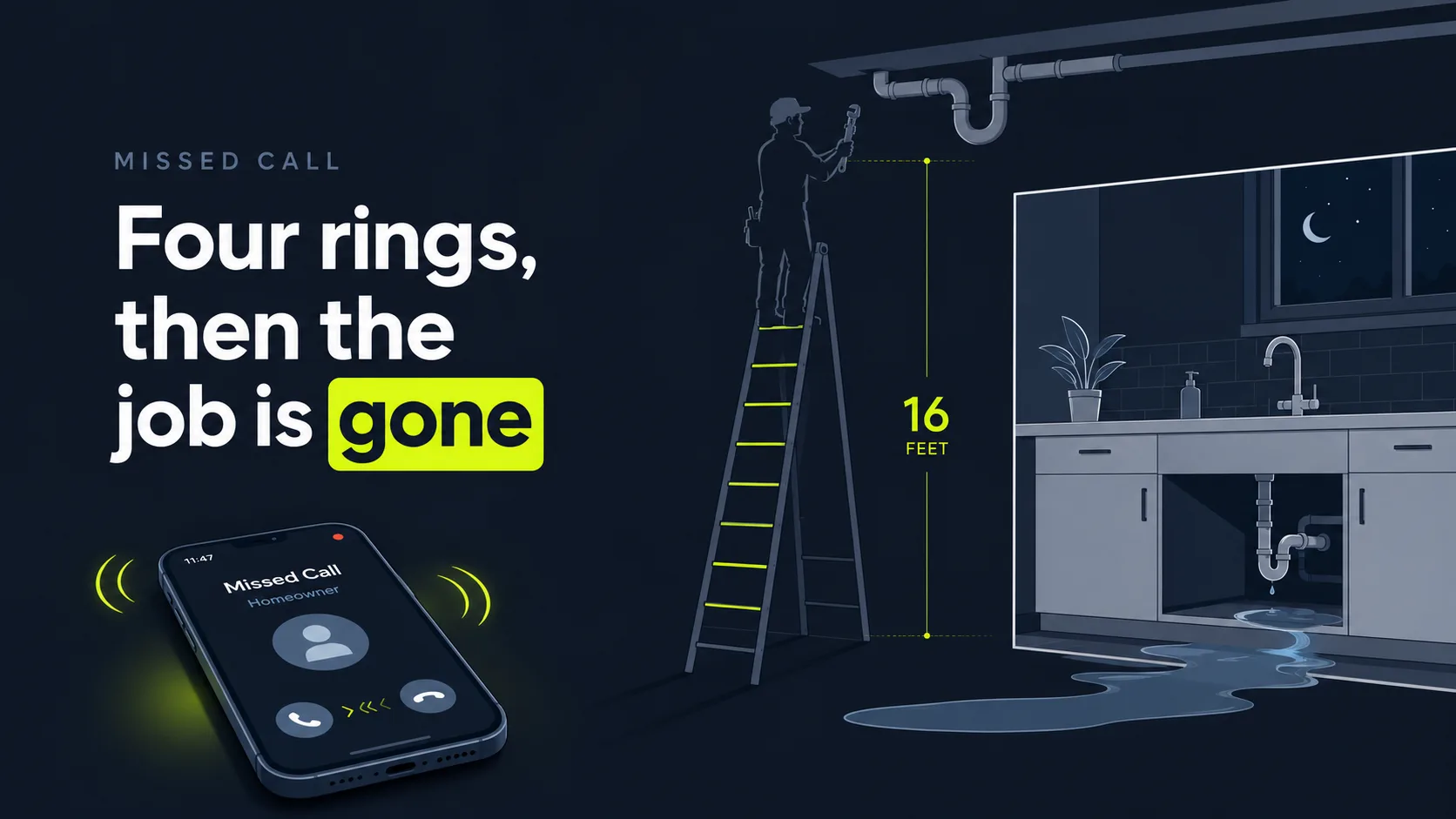
Go back to that kitchen floor and the homeowner standing in the spreading water. The only thing that decided who won that job was who replied first. A missed call is a lead you already paid to generate, and an instant text-back is the cheapest way to save it. The auto-reply detects the missed call, fires an SMS in seconds, opens a two-way conversation, and routes the lead toward a booking, all while your hands stay full on the job in front of you.
Speed is what makes it work. Lead value drops off a cliff once a caller moves on, and almost no one reaches the five-minute window where conversion peaks. An instant text keeps you in the race when a live answer isn't possible, on a channel callers actually prefer. Set it up TCPA-aware with deliverability handled, pair it with a system that books on the call instead of taking a message, and you stop bleeding revenue through your voicemail. Want to see what your missed calls are costing right now? Book a Free Call Audit, a 20-minute, no-pressure walkthrough where we map exactly where your phone is leaking jobs. No prep, no commitment, just the number.
Next steps: see the full missed-call recovery approach or calculate your missed-call revenue.
Written and reviewed by Maksim Skorokhod, Founder of SkoreFlow, who builds AI answering and voice automation for small service businesses. Last reviewed: 2026-06-07.