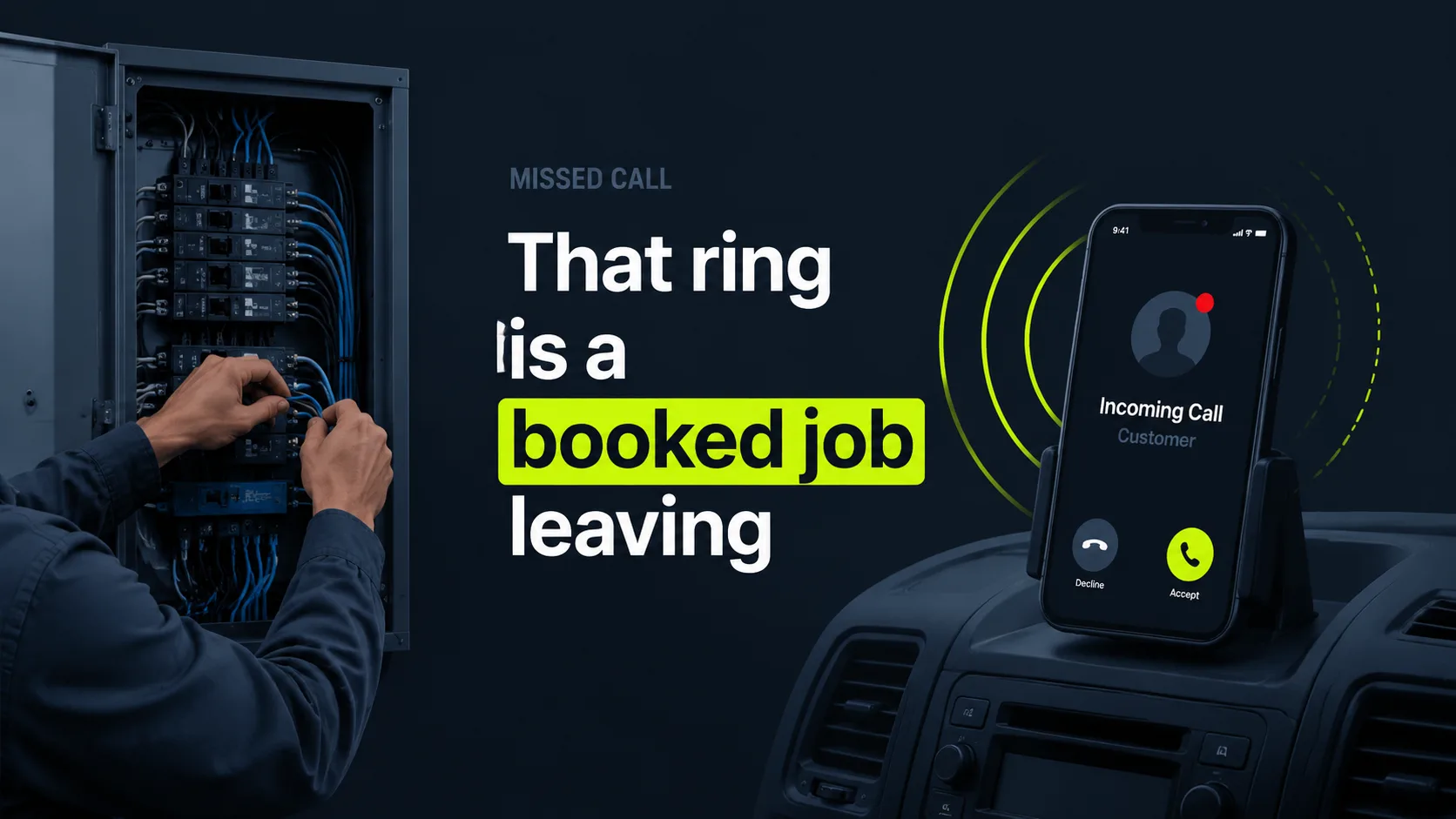
Why do contractors lose jobs to missed calls while on a job site?
Contractors lose jobs because they physically can't answer while working, and most callers won't try twice. For service businesses, 27% of inbound calls go unanswered, and fewer than 3% of callers sent to voicemail leave a message, according to Invoca (2024). A missed call isn't a delayed lead. It's usually a lost one.
Think about who that caller actually is. The phone is your best lead source, not a nuisance you tolerate between jobs. In a frequently cited 2014 study, 66% of small businesses rated inbound phone calls a good or excellent source of leads, the top-rated channel ahead of online forms, in-person, and email, per BIA/Kelsey (2014). The figure is older, but high-intent callers ready to book are still exactly who you're dropping while wiring a panel.
Now factor in the clock. Speed decides who wins the job. Firms that contact a lead within five minutes are 21 times more likely to qualify it, and roughly 100 times more likely to connect, than firms that wait 30 minutes, according to Harvard Business Review (2011). A homeowner standing in a flooding kitchen won't wait for tomorrow's callback. They'll have someone on the way before you've packed up your tools.
Citation capsule: 27% of calls to home-services businesses go unanswered, and fewer than 3% of callers pushed to voicemail leave a message, according to Invoca (2024). Because 66% of SMBs rate inbound phone calls their best lead source (BIA/Kelsey, 2014), every unanswered ring is high-intent, booked work handed to a competitor.
One detail most owners miss. [PERSONAL EXPERIENCE] Working with trades, one pattern stands out: the worst call drop happens at peak demand. A burst pipe at 9pm. A dead AC unit in July. A wasp nest by the front door. Those calls come when you're already slammed on another job, hands full, phone two rooms away. The crew that answers at that exact moment books the work the busy 9-to-5 shop never even sees. So the busier you are, the more you bleed. That's the trap. The rest of this guide is how you close it.

To see what each ring is worth, read our breakdown of how missed calls cost service businesses revenue.
How does SkoreFlow book estimates and service calls while you're on the tools?
SkoreFlow's AI voice agent answers in about 0.4 seconds, filters spam, and runs a structured booking script built for contracting work, so it captures the same details your office manager would, on every call, without fatigue. Because firms that respond within five minutes are 21 times more likely to qualify a lead (per Harvard Business Review, 2011), answering instantly is what wins the job.
Here's the difference that matters. An answering service like Ruby takes a message and leaves you to call back, usually after the homeowner has already booked someone else. The agent books and qualifies the job on the call itself. It books jobs, not messages. The build is fast too: most trades shops go live in 48 hours, and the agent is TCPA-aware, so it follows call-consent rules from day one.
The booking flow follows a consistent order:
- Greet and identify the job type. The agent confirms your business name and asks what the caller needs (estimate, repair, install, inspection, recurring service).
- Capture contact details. Full name, phone, email, and the service address, recorded verbatim.
- Qualify the job. Service area fit, property type, and the scope or problem in the caller's words.
- Flag urgency. The agent distinguishes a routine estimate from an emergency that needs same-day attention.
- Book the visit. It offers open slots and confirms the estimate or service call directly on your calendar.
- Route and notify. A clean job summary lands on your phone or in your field-service app within seconds.
- Escalate emergencies. True emergencies get connected or pushed to the on-call tech immediately, per your rules.
[UNIQUE INSIGHT] In our experience setting up booking scripts for trades, the biggest win isn't the booking itself. It's the qualification that happens before the truck ever rolls. When the agent confirms the address is in your service area and the job is your kind of work, you stop driving 40 minutes to quote a job you'd never take. That's an hour of windshield time you get back per dead lead. Confirmed visits drop straight into ServiceTitan, Jobber, Housecall Pro, or Google Calendar, so a captured call becomes a scheduled job without anyone re-keying details.
Citation capsule: Firms that contact a lead within five minutes are 21 times more likely to qualify it and 100 times more likely to connect than those waiting 30 minutes, per Harvard Business Review (2011). An AI agent answering on the first ring books the estimate while the homeowner is still motivated.
| Response time | Relative odds of qualifying the lead |
|---|---|
| Within 5 minutes | 21x |
| After 30 minutes | 1x (baseline) |
Comparing setups for your trade? See our answering service options by industry guide for plumbers, electricians, and roofers.
How do you capture the lead while you're up a ladder or under a house?
You capture it with overflow and after-hours coverage, because the calls you miss cluster outside the moments you can answer. After a missed response window, 56% of customers immediately try another channel and 28% abandon the purchase entirely, according to Nextiva (2025). When your hands are full, the agent picks up so the lead never has a reason to leave.
Start with overflow. It handles the calls your office can't. When you're mid-job, on another line, or short-staffed, the AI catches the call instead of letting it ring out. That matters because callers won't hold: 75% hang up after eight or more minutes on hold, and 75% would rather have a scheduled callback than wait in a queue, per Nextiva (2025). A homeowner stuck in your queue isn't loyal. They're hanging up and dialing the next listing.
Then there's after-hours, where a closed office hands work straight to the competition. Industry call patterns vary, but after-hours volume is real and concentrated. In older but still-cited 2019 data, restaurants received 51% of calls after 5pm and locksmiths 42% before 9am or after 5pm, per BrightLocal (2019). Treat the exact splits as directional. For contractors, evening and weekend emergency calls are exactly the high-value work you don't want sliding to voicemail.
What overflow coverage looks like for a small crew
For a small crew, overflow means you stop choosing between finishing the job and answering the phone. The agent answers simultaneous calls without a busy signal, qualifies each one, and books what it can. You climb down to a clean list of scheduled visits instead of a stack of missed-call notifications you'll never chase down.
What after-hours coverage looks like
After-hours coverage means a real answer at 9pm, not a voicemail box. The agent books routine work for the next business day and escalates genuine emergencies to your on-call line right away. A homeowner with no heat in January gets a confirmed appointment, not a callback promise from the shop across town.
[UNIQUE INSIGHT] Most contractors think after-hours coverage is only about emergencies. We've found the bigger payoff is routine bookings: the homeowner who finally has a free minute to call about a kitchen remodel at 8:30pm, kids in bed, laptop open, ready to commit. That's high-value, non-urgent work that the next-morning callback usually loses, because by morning they've cooled off or called three other shops. Remember that 40-minute drive we talked about saving? This is the flip side: the big jobs that only surface after dark.

Citation capsule: After a missed response window, 56% of customers immediately try another channel and 28% abandon the purchase, per Nextiva (2025). With 75% hanging up after eight minutes on hold, overflow and after-hours answering keep contractor leads from leaking to a faster competitor.
For more on why round-the-clock coverage pays off, see how 24/7 answering protects after-hours revenue.
How does pest control coverage handle recurring plans and emergency treatment calls?
Pest control coverage handles both the steady recurring book and the urgent one-off, because the business runs on both. US structural pest control service revenue reached $12.654 billion in 2024, up 7.9% year over year, with residential recurring revenue making up 85.2% of residential service revenue across 13.25 million-plus residential customers, according to the NPMA (2024). Recurring accounts are the asset; the answering service protects it.
For recurring service plans, the agent manages the routine flow. It schedules quarterly or monthly treatments, answers plan questions, books renewals, and adds new recurring customers, so the line that signs up subscribers is never busy. With recurring revenue making up the bulk of residential pest control income (per NPMA, 2024), each captured signup is years of value, not a one-time job. Miss that call and you don't just lose a treatment. You lose the whole contract.
For emergency treatment calls, the agent moves fast. A wasp nest above the back door at dinnertime. A roach that just crossed the counter in front of the kids. A rodent in the kitchen. These callers want help now, and they won't wait. The agent qualifies the pest type and address, books the soonest available slot, and escalates true emergencies to the on-call technician under the rules you set.
Recurring-service scheduling and renewals
Recurring scheduling is where pest control answering pays back quietly. The agent books the next treatment, confirms the address and plan tier, and notes access details the tech needs. New subscribers get added without an office staffer manually re-keying anything, so the recurring book grows even while crews are out treating properties.
Emergency and one-off treatment requests
Emergency requests get triaged on the call. The agent captures the pest, the severity, and the location, then either books the next open same-day slot or escalates to the on-call tech. A panicked caller watching a hornet's nest grow reaches a calm, structured booking, not a ringing phone that sends them straight to the next listing.
Citation capsule: US structural pest control revenue hit $12.654 billion in 2024 (up 7.9%), with recurring revenue making up 85.2% of residential service income across 13.25M-plus customers, per the NPMA (2024). An answering service that captures every recurring signup and emergency call protects the industry's core subscription asset.
| Revenue type | Share of residential service revenue |
|---|---|
| Recurring plans | 85.2% |
| One-time / other | 14.8% |
Want to compare coverage across home-service verticals? Browse our answering service options by industry overview.
AI vs. traditional contractor answering service: which fits your business?
The core trade-off is coverage versus headcount: AI answers every call instantly at a lower cost, while a traditional live service offers human voices at a premium with limited capacity. Live virtual receptionist plans at one national provider run from $250/month for 50 minutes to $1,725/month for 500 minutes, per Ruby's pricing page (2026), which works out to roughly $3.45 to $5.00 per receptionist-minute.
Both models beat voicemail. The question is which mix of cost, capacity, and escalation fits your call volume and your seasonality.
| Factor | AI contractor answering service | Traditional live answering service |
|---|---|---|
| Availability | 24/7, no hold time, answers on first ring | Business hours or after-hours desk; possible hold queue |
| Call capacity | Handles simultaneous calls during a rush | Limited by staffed agents on duty |
| Cost signal | Typically below live plans; AI receptionist tiers from ~$95/mo, per Smith.ai | $250-$1,725+/mo; ~$3.45-$5.00/min derived from published Ruby pricing |
| Consistency | Same qualifying script every call | Varies by agent and shift |
| Job intake | Structured job-type, address, and scope capture | Depends on agent training and script adherence |
| Human escalation | Routes true emergencies to your on-call line | Live agent judgment for nuance |
| Best for | Seasonal spikes, after-hours coverage, tight budgets | Owners wanting a human voice on every call |
Most owners frame this as AI or human, one or the other. We've found the better frame is AI plus human escalation. The AI catches the 11pm no-heat call a live desk would have missed entirely, then hands the genuine emergency straight to your on-call tech. You stop trading coverage for judgment, and you keep both.
The bigger difference shows up after the phone stops ringing. A live answering service like Ruby takes a message and leaves you to call the homeowner back, by which point the job may already be booked elsewhere. SkoreFlow books and qualifies on the call. It books jobs, not messages, so you come back to confirmed estimates instead of a callback list you'll work through after dinner.
| Option | Monthly plan range |
|---|---|
| AI receptionist (Smith.ai) | from ~$95/mo |
| Live virtual receptionist (Ruby) | $250 to $1,725/mo |
Citation capsule: Live virtual receptionist plans cost roughly $3.45 to $5.00 per receptionist-minute, derived from Ruby's published 2026 pricing ($250/mo for 50 minutes to $1,725/mo for 500 minutes). AI answering tiers, starting near $95/month per Smith.ai (2026), let contractors cover every call for far less.
What does a contractor answering service cost, and what is the ROI?
Pricing spans a wide band, but the ROI math is simple: one booked job usually pays for months of coverage. Industry pricing for virtual receptionist services runs about $50-$300/month for AI and $300-$2,000+/month for human services, per CloudTalk (2025). Against the value of a single won estimate, that cost is small.
The return comes from calls you currently lose. Remember the data: 27% of home-services calls go unanswered and fewer than 3% of voicemail callers leave a message, per Invoca (2024). Hiring a receptionist instead means a median wage of $37,230 a year before benefits, per the U.S. Bureau of Labor Statistics (2024). And one person still can't cover nights, weekends, or two ringing lines at once. The AI covers the same calls around the clock for a fraction of that.
SkoreFlow's missed-call recovery sits inside that range. Plans run from $197/month for a starter setup (up to 75 calls) to $397/month for a professional setup (up to 250 calls) and $697/month for unlimited calls, with a one-time setup fee per tier. There's a guarantee behind it too: 5 booked jobs in 30 days, or your setup fee is refunded. Most shops are live in 48 hours. So the downside is capped, and the upside isn't.
Illustrative example (industry-based scenario, not a real client): Picture a 3-crew contractor missing 14 calls a week. Over a year that's roughly 728 missed calls, and almost no one leaves a voicemail (per Invoca, 2024). Say the agent captures just 5% as booked jobs: about 36 jobs a year. At an average HVAC repair ticket near $1,205 (per Housecall Pro, 2025), that's roughly $43,000 in recovered work. A SkoreFlow plan at $197 to $397/month runs about $2,364 to $4,764 a year. The recovered revenue dwarfs the subscription, by close to ten to one. Run your own numbers with the calculator below.
Estimate the figure for your own shop with our Missed Call Revenue Calculator.
Citation capsule: Virtual receptionist pricing runs about $50-$300/month for AI versus $300-$2,000+/month for human services, per CloudTalk (2025). Against a median in-house receptionist wage of $37,230/year (BLS, 2024), AI answering covers every call around the clock at a fraction of the cost.
| Item | Estimated annual amount |
|---|---|
| SkoreFlow plan | ~$2,364 to $4,764 |
| Recovered booked jobs (5% of 728 missed calls at ~$1,205 ticket) | ~$43,000 |
Why do contractors choose SkoreFlow?
Contractors choose SkoreFlow because it closes the exact gap the data exposes: a live answer on every call, structured job intake, and instant escalation to your phone when the job is urgent. With 27% of home-services calls going unanswered, per Invoca (2024), simply answering well is a competitive edge most shops haven't claimed yet.
The approach is built for how homeowners search now. Across consumers, 45% now use AI tools to find local services, up from 6% a year earlier, per BrightLocal (2026). It also respects how people feel about AI: 64% of customers would prefer companies didn't use AI in customer service, per Gartner (2024). So the agent sounds natural and hands off to a human the moment a caller needs one. No robotic loop, no dead end.
The mechanics are simple, built for small teams, not enterprise theater. The agent answers in about 0.4 seconds, filters spam, qualifies the job, and books it into ServiceTitan, Jobber, Housecall Pro, or Google Calendar. It's TCPA-aware, most shops are live in 48 hours, and the work is backed by a guarantee: 5 booked jobs in 30 days, or your setup fee is refunded. Unlike Ruby and other message-taking services, it books jobs, not messages.
In a representative scenario (not a real client), a busy trades shop that captures its missed calls instead of losing them to voicemail can move from roughly a 38% answer rate to about 94%, recovering on the order of $14,200 a month in booked work. Treat those figures as an illustrative model of what closing the gap looks like, not a guaranteed or specific customer result.
Now the honest version. We don't publish invented testimonials or named job results, and you should be wary of anyone who does. What we will say plainly: the contractors who benefit most are the ones currently sending after-hours and overflow calls to voicemail. Plug the leak first, then optimize. That order tends to produce the fastest, most honest wins. And it answers the question we opened with: the busier you are, the more the leak costs, which is exactly why the fix pays back fastest for the shops that need it most.
Citation capsule: Consumer use of AI tools to find local services jumped to 45% in 2026, up from 6% a year earlier (BrightLocal), yet 64% still prefer companies didn't use AI in service (Gartner, 2024). A contractor agent that answers naturally and escalates to a human wins both phone and AI-driven discovery.

Stop sending jobs to voicemail
Come back to that panel box from the start. The phone buzzed, you couldn't answer, and the caller dialed the next shop on the list. The data says that scene plays out constantly: 27% of home-services calls go unanswered, almost no one leaves a voicemail, and the contractor who responds first usually wins the job. An AI contractor answering service rewrites that scene. It answers every call, qualifies job type and location, books the estimate or service visit, and escalates true emergencies to your phone.
You don't have to choose between finishing the job and answering the phone, ever again. Let the agent catch the overflow and after-hours calls, then hand you the work that needs you on site. Want to see what unanswered calls are costing you? Book a Free Call Audit: a 20-minute, no-pressure call where we map where jobs are slipping and what capturing them would be worth. No commitment, and your setup fee is refundable if the agent doesn't book 5 jobs in the first 30 days.
Start here: Book a Free Call Audit, or estimate your lost revenue with the calculator to see what unanswered calls are worth.
Written and reviewed by Maksim Skorokhod, Founder of SkoreFlow, who builds AI answering and voice automation for small service businesses. Last reviewed: 2026-06-07.
Questions or corrections? Contact our team or read about SkoreFlow and our editorial standards.