Why do dental practices lose new patients to missed and after-hours calls?
Dental practices lose new patients because the phone is the practice's front door, and most front doors are unattended part of the time. The average practice misses about 20% of new-patient calls, and of those answered, fewer than half convert, per Dentistry IQ (2023). A new patient who reaches voicemail simply dials the next office.
The money at stake is concrete. Top-performing practices answer 95% of new-patient calls and convert at 75%, and moving from average to top performer is worth roughly $150,000 per 100 new-patient calls, with an average long-term patient lifetime value near $4,500, according to Dentistry IQ (2023). That is the spread between a busy schedule and a leaky one.
Sit with that number for a second. A hundred new-patient calls is not a lot of phone traffic. Yet the difference between answering them like an average office and answering them like a top one is six figures. Same patients. Same town. Different pickup rate.
Voicemail almost never saves the call. For service businesses, 27% of inbound calls go unanswered, and fewer than 3% of callers pushed to voicemail leave a message, per Invoca (2024). So picture 100 missed calls. Voicemail hands you back fewer than three of them. The other 97 are gone, and they didn't go home. They went to a competitor.
After-hours demand is real, too. Roughly 11% of patient calls land during off-hours or weekends, per Hyro's analysis of about 300,000 patient calls (2023). A practice with no after-hours answer hands those callers, and their toothaches, to whoever picks up.
Citation capsule: The average North American dental practice misses about 20% of new-patient inbound calls, and fewer than half of answered calls convert, according to Dentistry IQ (2023). Moving from average to top performer is worth roughly $150,000 per 100 new-patient calls, given an average patient lifetime value near $4,500.
Here's the part most owners overlook, and it stings a little. The front desk misses calls precisely when it's doing its job well. A receptionist seating a patient, processing a copay, or calming a nervous caller cannot also answer the three lines ringing during the lunch rush. The busiest hours are the leakiest. That's exactly when new-patient calls spike. You're not losing calls because your team is slow. You're losing them because one person can't be in four places at once.

Want the numbers behind this leak? Our consultation booking voice agent breakdown walks through the math line by line for clinics and practices.
How does SkoreFlow book new patients and fill last-minute cancellations?
SkoreFlow's AI voice agent answers on the first ring and runs a structured booking flow built for dental scheduling, so it captures the new patient and protects the open chair every time, without fatigue. Unlike an answering service, it books the appointment on the call rather than taking a message for your team to chase later. Speed decides the outcome: after a missed response window, 56% of customers immediately try another channel and 28% abandon entirely, per Nextiva (2025). Capturing the call cleanly is the step that pays for everything downstream.
Read that number again. More than half of the people you couldn't reach in time don't wait. They go looking elsewhere within minutes, while the pain or the impulse is still fresh. A message sitting in a voicemail box is not a booking. It's a head start you've handed your competitor.
The booking flow follows a consistent order:
- Greet and identify the reason for the call. The agent confirms the practice name and asks what the caller needs (new-patient exam, cleaning, emergency, recall, or rescheduling).
- Collect patient details. Full name, phone, email, date of birth, and whether they are a new or existing patient, captured verbatim.
- Capture insurance basics. Carrier, plan, and member ID where applicable, so the front desk can verify benefits ahead of the visit.
- Offer real open slots. The agent reads availability from the connected schedule and books the appointment directly, including new-patient exam blocks.
- Fill cancellations from a waitlist. When a slot opens, the agent can call or text waitlisted patients and book the first to confirm, so same-day gaps don't sit empty.
- Confirm and remind. The agent confirms the appointment, sends details, and can trigger reminders to cut no-shows.
- Route and notify. A clean appointment summary lands in the practice's inbox or practice-management system within seconds, with emergencies escalated immediately.
In our experience setting up booking scripts, the cancellation waitlist is the most underused lever in a dental schedule, and it's nearly free money. A 9 a.m. cancellation that goes unfilled is pure lost production for that chair, gone the moment the clock ticks past. An agent that works a confirmed waitlist the instant a slot opens turns a dead hour into a booked one, with no staff scramble and no awkward callback marathon.
The voice agent is grounded in your site, services, and brand, answers common pre-consult questions, and is live in 5 days. So what does that buy you? A front desk that stops triaging the phone and starts treating patients in the room, and a schedule that fills itself while your team works. SkoreFlow backs it with a guarantee: recover $3,000 in 30 days or your setup fee is refunded.
Citation capsule: After a missed response window, 56% of customers immediately try another channel and 28% abandon the product or service entirely, per Nextiva's Customer Patience Benchmark survey (2025). For a dental practice, that means an unanswered new-patient call is rarely a delayed booking. It is a patient who has already moved on to the next office.

Sizing up your options? See how the consultation booking voice agent is set up for clinics, or estimate your own leak with our tools.
After-hours emergency triage and HIPAA-aware call transfer
After-hours dental emergencies are handled by triage and routing: the agent gathers the symptoms, applies the practice's rules, and connects or notifies the on-call dentist for genuine emergencies while booking routine calls for the next open slot. With roughly 11% of patient calls landing off-hours or on weekends, per Hyro (2023), a practice without after-hours coverage is dark when patients hurt most.
It's 9 p.m. A patient stands at the bathroom sink with a knocked-out tooth wrapped in a paper towel, jaw throbbing, scrolling for any office that picks up. The first practice that answers like a human, not a recording, gets that patient for life. The rest get nothing.
Pain drives the late call, and the data backs the scene. In a peer-reviewed study of after-hours patient phone calls, 40.3% concerned pain or pain management, with practices averaging 8.6 after-hours calls per shift and 32% of those calls arriving on Saturdays, according to Annals of Medicine and Surgery (2023). A swollen jaw or a knocked-out tooth at 9 p.m. needs a real answer, not a beep.
How the emergency triage and transfer works
The agent never diagnoses. It collects, screens against the practice's criteria, and routes:
- Captures the symptom and history. Pain level, swelling, bleeding, trauma, and timing, in the caller's words.
- Applies the practice's triage rules. True emergencies (uncontrolled bleeding, facial swelling, trauma, severe pain) trigger escalation; routine issues are booked for the next open visit.
- Connects or notifies the on-call dentist. For a genuine emergency, the agent follows escalation rules and reaches the dentist immediately, or warm-transfers the live call.
- Documents everything. A clean call summary reaches the practice so the morning team has full context.
What "HIPAA-aware" means here
HIPAA-aware means the service is designed to handle protected health information responsibly: limiting what's collected to what scheduling and triage require, transmitting details through secure channels, and working within your existing practice-management system. This is operational care, not a blanket "compliant" claim and not a substitute for your own compliance review with counsel. [CONFIRM BAA] Whether SkoreFlow signs a Business Associate Agreement for your engagement is confirmed during onboarding.
Privacy is also part of why some patients prefer to handle scheduling away from a live front-desk conversation. In a peer-reviewed analysis of English primary-care patients, working-age patients valued online booking specifically for convenience and privacy, including not wanting to call during work hours, per the Journal of Medical Internet Research (2024). A discreet, consistent intake channel meets that expectation.
Now, the honest counterpoint, because ignoring it would be a mistake. Trust in AI on the phone is fragile. A Gartner survey (2024) of 5,728 customers found 64% would prefer companies did not use AI in customer service, and the top concern is that it becomes harder to reach a person. So the agent's whole design points the other way. Its job is to connect callers to a human the moment a real emergency calls for one, never to wall them off. That's the difference between a phone tree people resent and a system that quietly earns trust.
Citation capsule: Roughly 11% of patient calls occur off-hours or on weekends, per Hyro (2023), and 40.3% of after-hours calls concern pain, with 32% arriving on Saturdays, per Annals of Medicine and Surgery (2023). A dental answering service triages these calls and routes genuine emergencies to the on-call dentist, day or night.
SkoreFlow and Dentrix: how the booking layer works alongside your PMS
A dental answering service works alongside your practice-management software (PMS) as a booking and routing layer, not a replacement: the agent reads availability, books appointments, and writes a clean summary into the system you already use, including Dentrix, Eaglesoft, Open Dental, and others. Dentrix itself does not ship a built-in AI phone receptionist, so the answering layer fills that gap and connects to the schedule.
You don't rip anything out. That's the point. Your charts, your block templates, and your provider rules all stay exactly where they are. The agent slots in front of them like a tireless receptionist who happens to type perfectly and never takes a lunch break.
Integration depth varies by system, so the practical model is the same regardless of PMS. The agent captures the appointment and patient details during the call, then delivers them to the practice through a supported integration or a structured summary the front desk drops into the chart. Either way, the booked call becomes a scheduled visit without a staff member retyping anything.
What integration looks like in practice
- Reads real availability. The agent offers genuine open slots, including new-patient exam blocks, from the connected schedule or a synced calendar.
- Writes back the appointment. Confirmed bookings flow into the PMS or land as a clean, ready-to-enter summary.
- Hands off insurance and patient data. Carrier, member ID, and contact details arrive structured, so verification is faster.
- Respects your workflow. The practice keeps its own scheduling rules, block templates, and provider preferences; the agent works within them.
Most practices ask "does it integrate with Dentrix" when the better question is "does it reliably get the right appointment into my schedule without double-booking." From the setups we've run, the integration label matters less than the booking logic behind it. A clean structured handoff the front desk trusts beats a flashy sync that creates ghost appointments your team has to hunt down and delete. Pretty syncs that breed double-bookings cost more time than they ever save.
Citation capsule: Dentrix does not include a built-in AI phone receptionist, so an AI dental answering service operates as a booking and routing layer alongside it. The agent reads availability, books the appointment, and writes a clean summary back to the PMS, including Dentrix, Eaglesoft, and Open Dental, without staff re-keying.
Run a med spa or aesthetic clinic too? The same consultation booking voice agent handles intake and booking across health and aesthetic verticals.
AI vs. traditional dental answering service: matching the model to your practice
The core trade-off is coverage versus nuance: AI answers every call instantly at a lower cost, while a traditional live service offers human judgment at a premium and limited capacity. Live virtual receptionist plans at one national provider run from $250/month for 50 minutes to $1,725/month for 500 minutes, per Ruby's pricing page (2026), which works out to roughly $3.45 to $5.00 per receptionist-minute.
Both models beat voicemail. What you have to decide is which mix of cost, capacity, and escalation fits your call volume and your schedule.
| Factor | AI dental answering service | Traditional live answering service |
|---|---|---|
| Availability | 24/7, no hold time, answers on first ring | Business hours or after-hours desk; possible hold queue |
| Call capacity | Handles simultaneous calls without overflow | Limited by staffed agents on duty |
| Cost signal | Typically below live plans; AI receptionist tiers from ~$95/mo, per Smith.ai | $250-$1,725+/mo at ~$3.45-$5.00/min, per Ruby |
| Consistency | Same booking and triage script every call | Varies by agent and shift |
| New-patient booking | Structured, repeatable capture and scheduling | Depends on agent training and script adherence |
| Cancellation backfill | Works a waitlist automatically when slots open | Manual, if offered at all |
| Human escalation | Routes true emergencies to the on-call dentist | Live agent judgment for nuance |
| Best for | High call volume, after-hours coverage, tight budgets | Practices wanting a human voice on every call |
Most practices frame this as AI or human. The sharper frame is AI plus human escalation. The AI catches the 9 p.m. broken-crown call a closed front desk would have missed entirely, then hands the genuine emergency straight to the dentist. You stop choosing between coverage and clinical judgment. You get both.
There's one more distinction worth drawing, and it's the one that decides bookings. A live answering service like Ruby takes a message and leaves your team to call back, often after the patient has already booked elsewhere. SkoreFlow's voice agent books the consult on the call. The patient hangs up with an appointment, not a promise of a callback.
Citation capsule: Live virtual receptionist plans cost roughly $3.45 to $5.00 per receptionist-minute, derived from Ruby's published 2026 pricing ($250/mo for 50 minutes to $1,725/mo for 500 minutes). AI answering tiers, starting near $95/month per Smith.ai (2026), let practices cover every call for far less.
What does a dental answering service cost, and what is the ROI?
Pricing spans a wide band, but the ROI math is simple: a handful of captured new patients usually pays for a year of coverage. Industry pricing for virtual receptionist services runs about $50-$300/month for AI and $300-$2,000+/month for human services, per CloudTalk (2025). Against an average patient lifetime value near $4,500, per Dentistry IQ (2023), that cost is small.
Walk the math out loud, because that's where the decision gets easy. The return comes from calls you currently lose. Remember the data: the average practice misses about 20% of new-patient calls, per Dentistry IQ (2023), and fewer than 3% of callers sent to voicemail leave a message, per Invoca (2024). Every captured new-patient call is revenue the practice was otherwise leaving on the table.
Illustrative example (industry-based scenario, not a real client): Picture a 2-chair practice that misses 10 new-patient calls a week. Over a year that is roughly 520 missed calls. Even if a modest share would have become patients, the math gets large fast: at an average lifetime value near $4,500 per patient (Dentistry IQ, 2023), capturing even a few extra new patients per month dwarfs a $497 to $1,497/month voice-agent subscription. In representative clinic scenarios, the agent cuts no-shows by around 68% and answers in under 30 seconds, so the schedule fills and stays full. One recovered patient roughly covers the whole year. Everything after that is profit. Run your own numbers with our tools to see your practice's figure.
Citation capsule: Virtual receptionist pricing runs about $50-$300/month for AI versus $300-$2,000+/month for human services, per CloudTalk (2025). With an average patient lifetime value near $4,500 (Dentistry IQ, 2023), a single recovered new-patient call can return the annual cost many times over.
Why do dental practices choose SkoreFlow?
Practices choose SkoreFlow because it closes the exact gap the data exposes: a live answer on every call, structured new-patient booking, automatic cancellation backfill, and instant escalation to a human for true emergencies. With the average practice missing about 20% of new-patient calls, per Dentistry IQ (2023), simply answering well is a competitive edge most offices have not claimed.
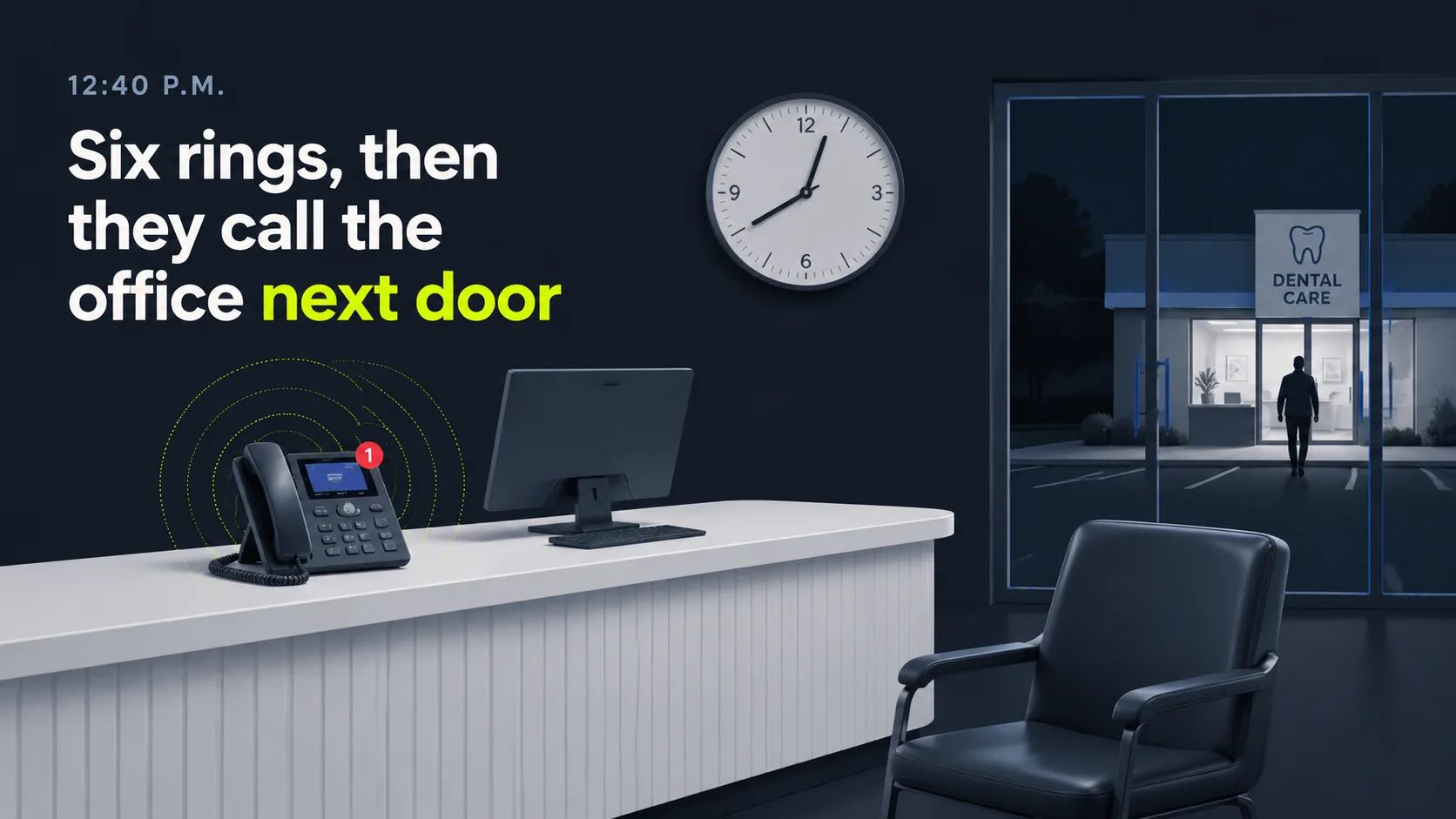
Remember that lunchtime call from the top of this article, the new patient with the cracked molar who gave up after six rings? With an agent on the line, that call never reaches the sixth ring. It's answered, booked, and summarized before your front desk even hears the phone. The leak closes itself.
The approach also fits how patients act now. Access matters: 35% of patients say they would switch doctors over poor digital experiences, per a Software Finder survey reported by eMarketer (2026), echoing a 2020 Forrester finding that 28% had already switched or stopped seeing a provider over a poor digital experience. A practice that answers, books, and follows up cleanly keeps patients others lose.
Discovery is shifting, too. Across consumers, 45% now use AI tools to find local services, up from 6% a year earlier, per BrightLocal (2026). A practice that captures and documents every call is better positioned for both the phone and AI-driven search.
A candid note from our own work: we don't publish invented testimonials or named patient results. What we can say plainly is that the practices that benefit most are the ones currently sending lunchtime and after-hours callers to voicemail. Plug the leak first, then optimize the schedule. That order tends to produce the fastest, most honest wins. SkoreFlow stands behind the build with a simple guarantee: recover $3,000 in 30 days or your setup fee is refunded.
Citation capsule: 35% of patients would switch doctors over poor digital experiences, per a Software Finder survey reported by eMarketer (2026), and 45% of consumers now use AI tools to find local services, up from 6% a year earlier, per BrightLocal (2026). A practice that answers and books every call wins on both access and discovery.
Stop sending new patients to voicemail
The pattern in the data is hard to ignore: the average practice misses about 20% of new-patient calls, fewer than 3% of voicemail-bound callers leave a message, and moving from average to top performer is worth roughly $150,000 per 100 new-patient calls. An AI dental answering service closes that gap by answering every call, booking new patients, filling cancellations, and escalating real emergencies to you.
You don't have to choose between coverage and clinical judgment. Let the agent catch the lunchtime and after-hours calls, then hand you the emergencies that need a dentist. Want to see what unanswered calls are costing your practice? Book a Free Consult Audit, a no-pressure 20-minute call where we map where new patients are slipping and what capturing them would be worth. You see the number in 20 minutes, you go live in 5 days, and the build is backed by recover $3,000 in 30 days or your setup fee back. Prefer to run the numbers yourself first? Start with our tools.
Written and reviewed by Maksim Skorokhod, Founder of SkoreFlow, who builds AI answering and voice automation for small service businesses. Last reviewed: 2026-06-07.