What should you have ready before you follow up?
Before you send a single follow-up, line up three things: the quote details, a concrete reason to reach out, and the right channel for that customer. This prep is what separates a helpful nudge from a pestering one. It also respects the value of the lead, because inbound buyers are high-intent: phone calls convert to revenue at roughly 10 to 15 times the rate of web form leads, per BIA/Kelsey (2014).
Think of it like this. A vague "just checking in" tells the buyer you forgot the details and you're fishing for a yes. A specific, prepared message tells them you remember exactly who they are and what they asked for. Same intent, opposite signal. Get these four things in order before the first touch goes out.
- The quote details at your fingertips. Know the price, scope, date sent, and any line items the customer asked about. Referencing specifics ("the $4,200 panel upgrade we quoted Tuesday") shows you remember them, not a copy-paste list.
- A real reason to reach out. Each touch needs its own purpose: confirming receipt, sharing a relevant tip, answering a likely objection, or flagging a deadline. No reason means no message.
- The right channel. Match how the customer first contacted you. Most people now skip voicemail entirely: roughly 80% of callers sent to voicemail never leave a message, per destinationCRM citing Forbes (2014), so a text or email often lands better than a missed call.
- A clear next step. End every message with one easy action: reply yes, pick a date, or ask a question. The simpler the ask, the faster the reply.

Citation capsule: Inbound buyers are high-intent: phone calls convert to revenue at roughly 10 to 15 times the rate of web form leads, per BIA/Kelsey (2014). Before following up on a quote, have the quote details, a concrete reason to reach out, and the right channel ready, so every touch feels specific and useful rather than like a generic nag.
Want the wording done for you? Grab copy-paste quote follow-up templates for each step in the cadence.
What is the step-by-step quote follow-up timeline?
The proven timeline is four touches over fourteen days: confirm on day 1, add value on day 3, check in on day 7, and send a last call on day 14. This rhythm keeps you present without crowding the buyer. Speed front-loads the whole thing, because contacting a web lead within 5 minutes makes a firm 21x more likely to qualify it and 100x more likely to connect than waiting 30 minutes, per Harvard Business Review, citing the Oldroyd/InsideSales Lead Response study (2011).
The faster your first touch, the warmer the rest of the cadence stays. So treat day one as the move that earns you the next three. Here's the cadence, step by step. Stop the sequence the second the customer replies or books.
Day 1: Confirm they got the quote
The first touch confirms receipt within a few hours of sending the quote, while the conversation is still warm. Keep it light: "Just making sure the quote landed, happy to walk through anything." This does two jobs at once. It catches quotes lost to spam folders, and it opens a low-pressure door for questions. Nobody reads a long pitch on day one, so don't send one.
Day 3: Add value, don't just chase
The day-3 touch gives the buyer a reason beyond "are you ready yet?" Share something useful: a relevant tip, a quick note on what's included, or an answer to the objection you know is coming. This is the most-skipped step and the most important one. A value nudge keeps you helpful instead of pushy, and it hands the customer a soft excuse to re-engage without feeling cornered.
Day 7: Check in directly
By day 7, a direct, friendly check-in is fair game: "Wanted to see where you've landed on the kitchen remodel, any questions I can clear up?" A week is enough time for a buyer to compare options or sort out budget. Offer to hop on a quick call or hold a slot. Channel choice matters here: 95% of people find texting more convenient than voicemail, per Nuance / Research Now via destinationCRM (2014), so a short text often beats another unreturned call.
Day 14: Send a polite last call
The final touch is an honest close-out, not a guilt trip: "I'll close out your file for now, but if the timing changes, just reply and I'll pick it right back up." This respects the customer's silence while leaving the door open. Owners are usually surprised by what comes next: the last-call message often pulls the most replies, because it signals you're done chasing and the pressure lifts. After day 14 with no answer, let it rest.
| Touch | Day | Purpose | Channel |
|---|---|---|---|
| 1. Confirm receipt | Day 1 | Make sure the quote landed and open a low-pressure door for questions | Text or email (match how they reached you) |
| 2. Value nudge | Day 3 | Add a useful tip or answer a likely objection, not just "are you ready?" | Email or text |
| 3. Direct check-in | Day 7 | Ask where they've landed and offer to hold a slot or hop on a call | Text or short call |
| 4. Polite last call | Day 14 | Close the file gracefully and leave the door open if timing changes | Text or email |
Most advice tells you to "be persistent." That advice is wrong, or at least half-right. The real lever isn't volume, it's the reason behind each touch. Four well-reasoned messages beat ten "just following up" pings, because each one earns its place in the inbox instead of training the buyer to ignore you. That's why the last-call message pulls so many replies. By touch four, the buyer trusts that you respect their time.
Citation capsule: The quote follow-up timeline runs four touches over fourteen days: confirm receipt on day 1, add value on day 3, check in on day 7, and send a polite last call on day 14. Speed front-loads it, since contacting a web lead within 5 minutes makes a firm 21x more likely to qualify it, per Harvard Business Review, citing the Oldroyd/InsideSales Lead Response study (2011). Stop the sequence the moment the customer replies.
Rather not run this by hand? See how to automate the quote follow-up cadence so it runs on its own.
How should a contractor follow up on a job estimate?
A contractor should run the same four-touch timeline but adapt it to job-site reality: lead with text, keep messages short, and reference the actual job, not a generic "estimate." Field customers screen calls and rarely sit at a desk, so the channel matters. Texting wins here, since 95% of people find it more convenient than voicemail, per Nuance / Research Now via destinationCRM (2014).
Picture the homeowner you're chasing. She's halfway up a ladder cleaning gutters, the dog is barking, and her phone buzzes with a voicemail from a number she doesn't recognize. That voicemail dies unheard. A short text that reads "Hey, it's the team from your roofing company, the roof estimate is ready" gets read at the next red light instead. The cadence is identical, but the tone and timing shift for trades. A homeowner weighing a $9,000 roof decides differently than someone booking a $200 service call. Here's how contractors adapt each touch.
- Lead with text or a quick call, not email. Job-site customers often gave you a cell, not an inbox they check. A short text on day 1 confirming the estimate landed gets read fast. Save the detailed PDF for whoever asks.
- Reference the real job. "Your gutter replacement quote" beats "your estimate." Naming the specific work reminds a busy homeowner exactly which of three contractors you are.
- Respect bigger decisions on bigger jobs. A large quote may need a spouse, a budget, or a season to align. Stretch the day-7 and day-14 touches a little, and never pressure. Offer to hold pricing or a start date instead.
- Make scheduling the easy yes. Trades close on availability. "I've got an opening next Thursday if you want to lock it in" converts better than "let me know your thoughts."
Illustrative example (representative scenario, not a real client): Consider a remodeler who sends 30 quotes a month and currently chases each one once, then forgets it. Adding a structured day-3 and day-7 nudge to the cadence can recover a handful of jobs that would otherwise go cold, though the exact lift depends on the shop's volume and close rate. Average HVAC repair tickets ran about $1,205 in 2025, per Housecall Pro via ACHR News (2025), and remodeling jobs typically run far higher, so even a few recovered jobs can be meaningful. These are representative figures used to illustrate the model, not measured client results.

Citation capsule: Contractors should run the same four-touch follow-up timeline but lead with text, since 95% of people find texting more convenient than voicemail, per Nuance / Research Now via destinationCRM (2014). Reference the specific job by name, stretch the cadence for bigger decisions, and make scheduling the easy yes, because trades close on availability, not on pressure.
Curious what this is worth for your shop? Estimate what recovering cold quotes could earn with the Quote Follow-Up Leak Calculator.
What mistakes make quote follow-up feel annoying?
Follow-up feels annoying for three reasons: too much frequency, the wrong tone, and generic copy. Each one trains the buyer to tune you out. The biggest cost is the silence after a missed window. After a missed response, 56% of customers immediately try another channel and 28% abandon entirely, per a Nextiva customer-patience survey (vendor-sourced, 2025).
Read that again. Annoying follow-up doesn't just fail to close. It pushes the buyer toward whoever answers next, which is usually your competitor. So the cost of getting this wrong isn't a neutral "no." It's a job you already half-won, handed to someone else. Avoid these patterns, because they're what actually make people stop replying.
- Chasing too often. A daily "any update?" reads as desperate. Stick to the four-touch, two-week spacing so each message has room to breathe.
- Generic "just checking in" copy. With no fresh reason, the buyer learns your messages carry no new information and stops opening them. Every touch needs a purpose.
- The wrong channel and dead-end voicemails. Leaving repeated voicemails rarely works, since roughly 80% of callers won't even leave one themselves, per destinationCRM citing Forbes (2014). Meet buyers where they actually respond.
- Pushy, pressure-heavy tone. "This deal expires today" tactics erode trust on a considered purchase. Stay helpful and let the value carry the decision.
- Never knowing when to stop. Following up forever annoys people and burns goodwill. After the day-14 last call, close it out gracefully.
Working with service shops on follow-up, we've found the line between helpful and annoying is almost always the reason for the message, not the count. Owners assume four touches will bug people. The opposite is true. Four specific, useful touches feel like good service, while even two lazy "you there?" pings feel like spam. The buyer isn't counting your messages. They're judging whether each one was worth opening.
Citation capsule: Quote follow-up feels annoying because of too much frequency, the wrong tone, and generic copy. The stakes are real: after a missed response, 56% of customers immediately try another channel and 28% abandon entirely, per a Nextiva customer-patience survey (vendor-sourced, 2025). The fix is spacing touches across two weeks and giving each one a specific, useful reason to exist.
Need wording that stays polite? Swipe non-pushy follow-up templates for every step.
How does SkoreFlow run this follow-up cadence for you?
SkoreFlow's Quote Follow-Up Automation runs the entire cadence for you: it tracks every silent proposal, sends a contextual sequence on the customer's preferred channel, and pauses the moment they reply, so no stalled deal slips while your team is heads-down. The need keeps rising, because buyers increasingly research and decide outside business hours, and 75% of customers prefer a scheduled callback over waiting on hold, per a Nextiva customer-patience survey (vendor-sourced, 2024).
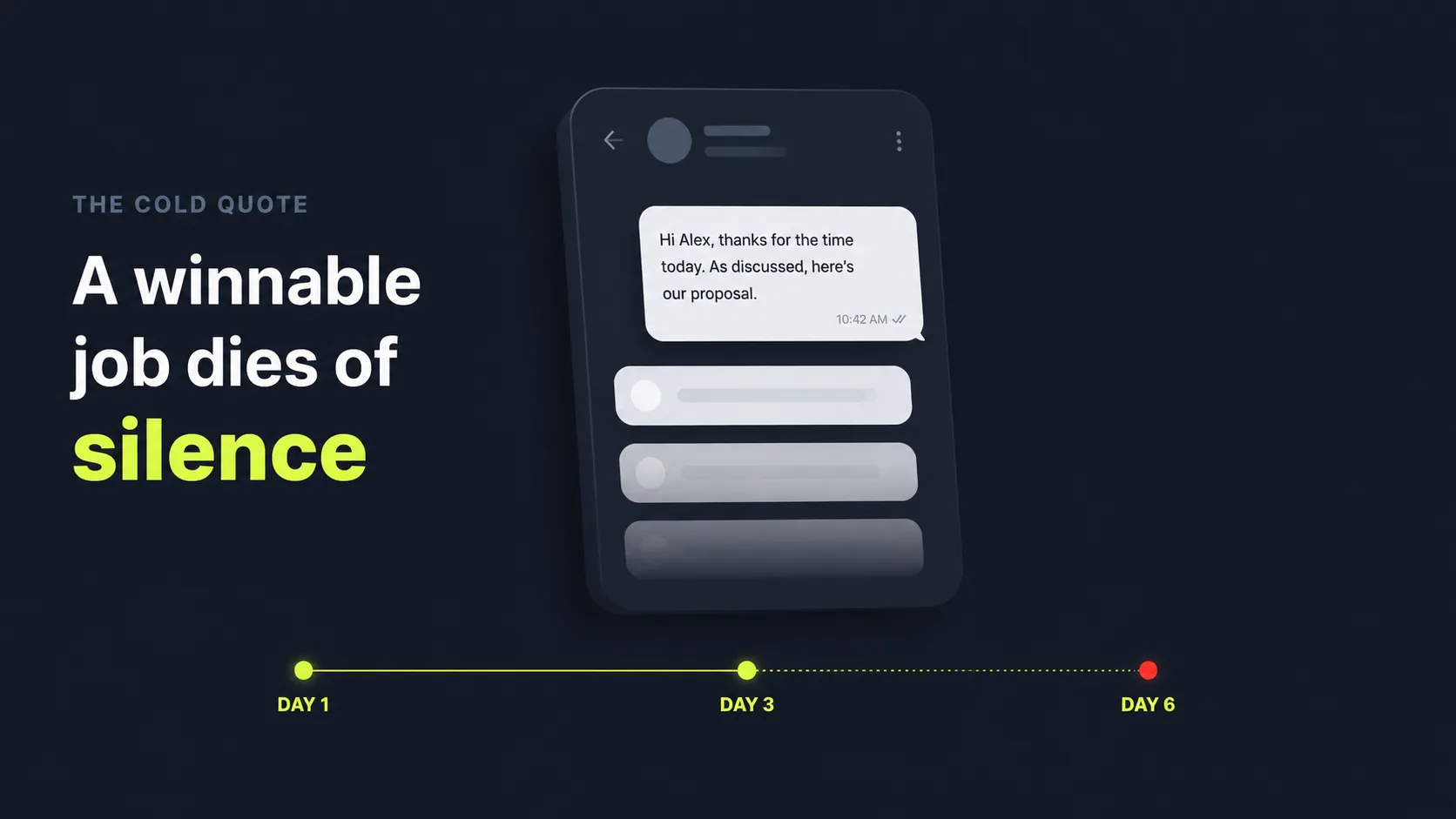
Think back to the quote that died of silence at the top of this guide. It didn't die because the work wasn't wanted. It died because someone got busy and the day-3 nudge never went out. That's the whole problem in one sentence. A manual cadence depends on a human remembering, on the right day, for every open proposal, and that's the very first thing to slip when you're delivering the work you already won.
An automated cadence removes the memory problem entirely. It uses a progressive value reveal, so each touch adds something instead of just nagging, and it runs whether you're slammed or on vacation. The service is built for agencies, consultancies, freelancers, and contractors who send proposals and then watch them go quiet. It connects to the tools you already use, HubSpot, Pipedrive, PandaDoc, Gmail, and Outlook, with a data-safe setup that keeps your numbers and client list private. Most accounts go live in 5 to 10 days. And the work is backed by one simple promise: 3 recovered deals in 30 days or your money back.
Here's what we've found working on stalled proposals. The highest-ROI automation isn't a clever sales sequence. It's plain consistency. The day-3 value nudge isn't hard to write. It's hard to remember to send 30 times a month, every month, while three jobs are on fire. Automating the boring, reliable part is what quietly recovers deals that used to vanish.
Illustrative example (representative scenario, not a real client): Take a consultancy sending 40 proposals a month, where many currently get one chase and then nothing. With an automated cadence handling every quote on the channel each customer prefers, a shop in this position could lift its close rate toward roughly 41% and re-engage around 87% of silent quotes, while cutting hands-on follow-up to about 1.5 hours a week. These are representative offer benchmarks used to illustrate the model, not measured results from a specific customer.

Citation capsule: SkoreFlow's Quote Follow-Up Automation runs the cadence for you, tracking silent proposals, scheduling each touch on the customer's preferred channel, and pausing on reply. The need is rising: 75% of customers prefer a scheduled callback over waiting on hold, per a Nextiva customer-patience survey (vendor-sourced, 2024). It connects to HubSpot, Pipedrive, and PandaDoc, goes live in 5 to 10 days, and backs the work with a 3-recovered-deals-in-30-days-or-refund guarantee.
See how SkoreFlow's Quote Follow-Up Automation recovers stalled deals end to end, or read how to automate the cadence step by step.
Chase smarter, not harder
It comes down to this: a quote follow-up that lands well is four respectful touches over two weeks, each with a real reason behind it. Confirm on day 1, add value on day 3, check in on day 7, and send a polite last call on day 14. Match the channel to the customer, keep every message short and specific, and stop when they reply or when the timeline ends.
What makes follow-up annoying isn't persistence. It's lazy, frequent, generic copy with no reason to exist. Fix that, and follow-up reads as good service instead of a nag. The real catch, though, is consistency. Remembering the day-3 and day-7 nudge for every open quote, every month, is exactly what slips when the work piles up, and that's where the deals quietly leak out. Want to see what recovering cold quotes is worth for your shop? Book a Free Quote Audit, a 20-minute, no-pressure call, and we'll map where your follow-up is leaking deals. No retainer, no hard sell, just the leak and the math.
Next steps: see the Quote Follow-Up Automation service for how the whole cadence runs, or grab copy-paste follow-up templates to send each touch.
Written and reviewed by Maksim Skorokhod, Founder of SkoreFlow, who builds AI quote follow-up and answering automation for small service businesses, agencies, and consultancies. See the author and editorial page for credentials and review process. Last reviewed: 2026-06-07.