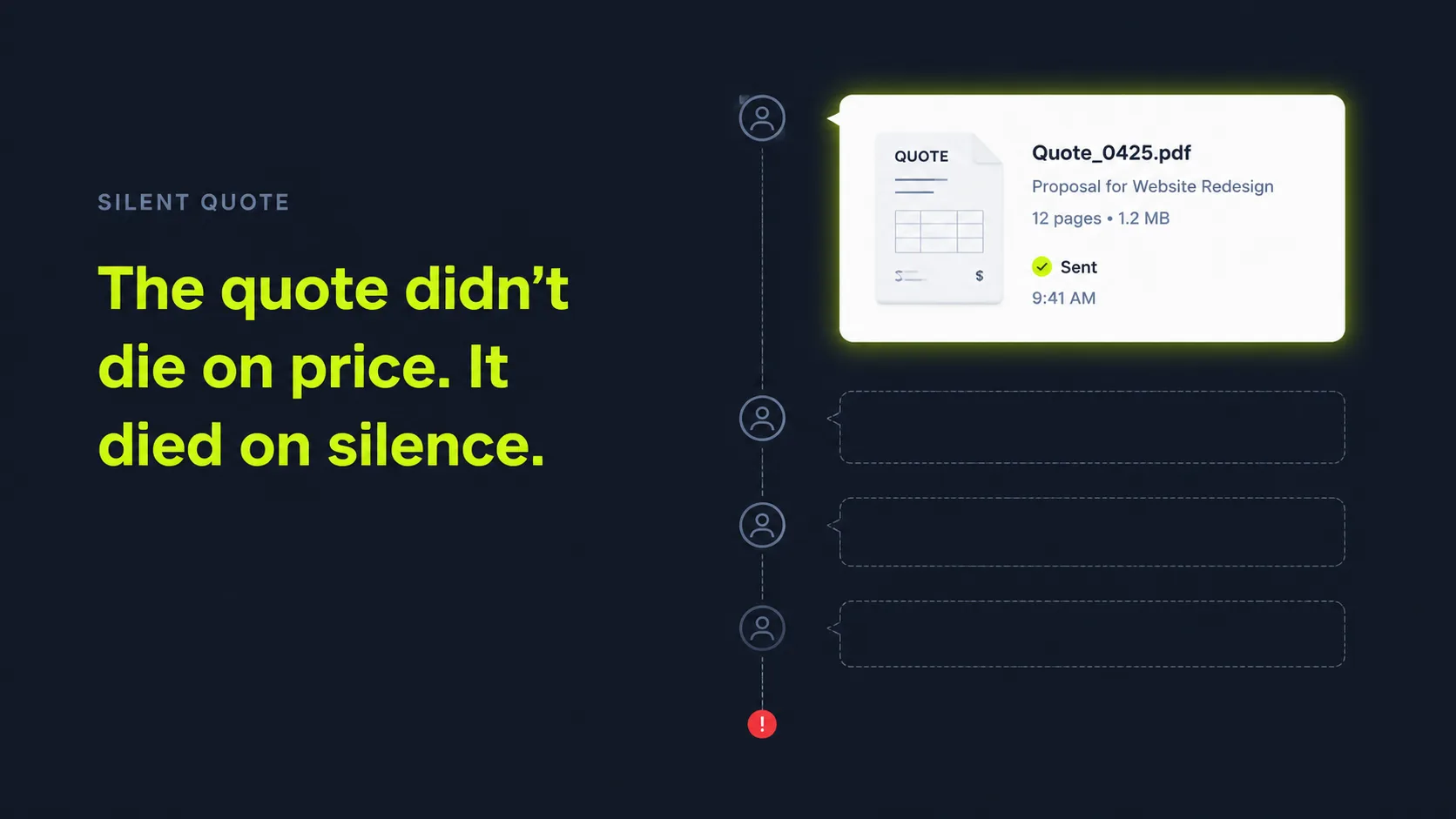
How does automated quote follow-up work?
Automated quote follow-up works by triggering a timed sequence the instant a quote goes out, then texting and calling the customer on a fixed cadence until they reply or a human takes over. The reason it works is speed and persistence: contacting a lead within 5 minutes makes a firm 21 times more likely to qualify it and roughly 100 times more likely to connect than waiting 30 minutes, per Harvard Business Review (2011).
So why do good shops keep dropping the ball? It is not laziness. It is math. A two-person office cannot reliably track 40 open quotes by memory while still running the actual business. Software can. That single shift, from human memory to a system that never forgets, is the whole trick. A typical setup runs this sequence, in order.
- Trigger on send. The moment a quote, proposal, or estimate is marked sent, the automation starts. No one has to remember to add the customer to a list.
- First touch fast. A short confirmation text goes out quickly, while the quote is still top of mind. Early contact is where the conversion edge lives.
- Multi-touch cadence. Over the next one to two weeks, the system sends spaced reminders, usually a mix of texts and at least one call attempt, each one short and specific to that quote.
- Stop on reply. The second the customer texts, calls, or clicks back, the sequence halts so they never get a "did you get my quote?" message after they've already answered.
- Hand off to a human. Any real reply, question, or objection routes to a person to finish the job. Automation opens the door; a human closes it.
Here is the mistake almost nobody catches in themselves. The problem isn't sending too few quotes. It's stopping the follow-up after one polite try. The inbound numbers are brutal: only 0.1% of leads are engaged within the first five minutes, even though doing so lifts conversion roughly 8x, per InsideSales (2021). Read that again. A near-total miss on the one window that converts best. That gap exists for a single reason, the human bottleneck, and automation is the only thing that removes it.
Citation capsule: Automated quote follow-up triggers a timed text-and-call cadence the moment a quote is sent and stops the instant the customer replies. Its edge is speed and persistence: contacting a lead within 5 minutes makes a firm 21x more likely to qualify it than waiting 30 minutes, per Harvard Business Review (2011), and conversion is roughly 8x higher inside that first five-minute window, per InsideSales (2021).

Are proposals and estimates the same problem as quotes?
Yes. Proposals and estimates are the exact same problem as quotes, and one cadence handles all three. Whatever you call the number you sent, a customer received a price and went quiet, and the revenue leak is identical. The behavior driving it is consistent too: after a missed response window, 56% of customers immediately try another channel and 28% abandon the purchase entirely, per Nextiva (2025).
Sit with what those two numbers mean for your pipeline. More than half of your silent prospects are not gone, they have just wandered to whoever answers next. Roughly a quarter walk away from the purchase altogether. The naming differs by trade, not by mechanics. A plumber sends a quote. A remodeler sends a proposal. An HVAC tech sends an estimate. In all three, a document with a price went out, and the next move belongs to the customer, who is busy, comparing options, and easily distracted. Without a nudge, the quiet ones stay quiet.
Proposal follow-up automation
Proposal follow-up automation works the same as quote follow-up: it triggers on send and runs a cadence until the prospect engages. Proposals tend to carry higher values and longer decision windows, so the cadence can stretch a little, with a touch or two further out. The goal stays the same, keep your bid alive while the customer decides, without making your office chase it by memory.
Estimate follow-up software
Estimate follow-up software is just quote follow-up automation pointed at estimates, and it matters most in trades where customers gather two or three estimates before choosing. Being the bid that follows up, politely and on time, is often what tips a tie. The first contractor to re-engage frequently wins, simply because the others never circled back. That is an advantage your competitors hand you for free.
Citation capsule: Proposals, estimates, and quotes are one workflow, because the leak is identical: a customer received a price and went silent. After a missed response window, 56% of customers immediately try another channel and 28% abandon the purchase, per Nextiva (2025). A single follow-up cadence keeps the bid alive across all three document types.

Who needs quote follow-up automation and what does it recover?
Any shop that sends more quotes than it can manually chase needs follow-up automation, and what it recovers is close-rate points on work you already bid. The economics favor it because phone-based, high-intent leads are the ones worth chasing: 66% of SMBs rate inbound phone calls a good or excellent lead source, the top channel, per BIA/Kelsey (2014).
So ask yourself one question. Do your quotes pile up faster than anyone can chase them? If the answer is yes, you are the target customer. These scenarios are where the silent-quote leak runs widest.
- Marketing and creative agencies sending project proposals on long decision cycles, where one timely nudge keeps the bid in the running for weeks.
- Consultancies and advisory firms quoting scoped engagements that compete directly against two or three other proposals.
- Freelancers and solo contractors sending estimates with no admin to chase them, where a single follow-up often wins a tie.
- B2B service shops sending recurring-retainer or renewal quotes, where momentum fades fast once the prospect goes quiet.
- Trades contractors sending same-day repair and replacement estimates, where a customer often "thinks about it" and never circles back.
In our experience working with small service businesses, the silent quotes aren't lost on price nearly as often as owners assume. They're lost because the team got busy, the quote scrolled off the screen, and nobody followed up. The prospect wasn't a no. They were a maybe who never got asked twice. Sit with that distinction, because it quietly changes what you do next.
What it recovers is straightforward: a few points of close rate on quotes you'd otherwise write off. That sounds modest. It isn't. On a steady flow of bids, a handful of recovered deals a month compounds into serious money over a year, and the cost section below makes the figure concrete.
Citation capsule: Any agency, consultancy, freelancer, or contractor sending more quotes than it can manually chase benefits from follow-up automation. Inbound phone leads justify the effort: 66% of SMBs rate phone calls a good or excellent lead source, the top-rated channel ahead of forms and email, per BIA/Kelsey (2014). Recovered close-rate points compound across every bid.

What does it cost, and where should automation stop?
Quote follow-up automation costs far less than the labor it replaces, but it should never replace the human at the moment of a real reply. For context, a US receptionist's median wage is $17.90 an hour, or about $37,230 a year before benefits and overhead, per the U.S. Bureau of Labor Statistics (2024). Software that chases every quote for a fraction of that pays for itself on a handful of recovered jobs.
Here is what silence actually costs. Say you send 40 quotes a week and close 25% of them. Lift that close rate just 5 points with consistent follow-up, and you recover roughly two extra jobs a week. At a $1,500 average ticket, that is around $12,000 a month in work you were already leaving on the table. Now weigh that against the price of the tools that recover it.
Pricing varies by provider and call volume, so confirm current rates on any vendor's pricing page before you buy. As a benchmark, AI receptionist and follow-up plans run well below live-human answering: Smith.ai lists AI tiers from $95 a month, per its official pricing page (Smith.ai, 2026), while comparable live virtual-receptionist plans start near $250 a month, per Ruby (2026). So the cost question almost answers itself. The harder, more important decision is knowing where the automation should stop.
Where automation should stop
Automation should stop the instant the conversation gets human. It's excellent at the repetitive part, the reminders nobody has time to send, and poor at the judgment part, negotiating, handling objections, or answering "can you do it cheaper?" Hand those off immediately. The risk of over-automating is real and measurable: 64% of customers would prefer companies didn't use AI in customer service, and their top concern is that it gets harder to reach a person, per Gartner (2024). Push a bot into a live negotiation and you do not just lose the deal. You annoy the buyer on the way out.
Where automation pays off
Automation pulls its weight in the gap between "quote sent" and "customer replied," exactly where busy shops drop the ball. It never forgets, never gets too busy, and works the cadence the same way on a chaotic Friday as a slow Tuesday. Keep the touches short, helpful, and easy to opt out of, and the tool stays an asset rather than an annoyance.
The balanced read is that follow-up automation is a chaser, not a closer. Shops that try to make it close, by automating price negotiation or pushing past a customer's first "not yet," usually erode trust. The ones that win let it do one job well: keep the bid alive and politely ask again until a human can take over.
Citation capsule: Quote follow-up automation costs a fraction of staff labor, far below a receptionist's ~$37,230 median annual wage, per the U.S. Bureau of Labor Statistics (2024), but it should stop at the human moment. With 64% of customers preferring companies not use AI in service and fearing they can't reach a person, per Gartner (2024), automation must hand off cleanly on any real reply or objection.
| Approach | Typical monthly cost | Source | What it covers |
|---|---|---|---|
| In-house receptionist (manual chasing) | ~$3,100/mo (~$37,230/yr base wage, before benefits) | U.S. Bureau of Labor Statistics (2024) | Live answering plus other front-desk duties; follow-up competes with everything else and gets dropped on busy days |
| Live [virtual receptionist](/blog/virtual-receptionist/) | From ~$250/mo (entry plan) | Ruby (2026) | Humans answer and chase, but per-minute pricing climbs fast with quote volume |
| AI follow-up / receptionist software | From ~$95/mo (entry plan) | Smith.ai (2026) | Automated text-and-call cadence on every quote, never forgets, hands real replies to a human |
How does SkoreFlow run quote, proposal, and estimate follow-up?
SkoreFlow runs quote, proposal, and estimate follow-up as one automated cadence: it triggers when you send the bid, works the prospect on a schedule you set, stops the moment they reply, and routes the live conversation to your team. The aim is to recover deals, not just send messages, and the upside is well documented, 91% of SMBs using AI say it boosts revenue, with 75% already experimenting with or using it, per Salesforce (2025).
Remember the quote that went cold at the top of this article? Here is where it comes back to life. The setup is hands-off by design and fits the tools you already use. SkoreFlow's quote follow-up automation connects to HubSpot, Pipedrive, PandaDoc, Gmail, and Outlook, so the cadence triggers straight off your proposal tool, no new system to learn. Most teams are live in 5 to 10 days [CONFIRM], and your numbers, clients, and pipeline data stay private.
Now here's the differentiator that matters most. SkoreFlow is built to recover deals, not take messages. A live answering service like Ruby writes down that a prospect called and leaves you to chase the callback; SkoreFlow works the silent quote itself, with a contextual cadence and a progressive value reveal, then hands you a warm, re-engaged lead. Mark a quote sent, and it takes the thread from there: a fast first touch, spaced reminders, a call attempt, and an automatic stop on any reply. When the prospect engages, your team picks up with full context, no awkward "did we already follow up?" guesswork.
We built this after watching agencies and contractors pour effort into producing quotes, then let the silent ones die because chasing them felt like nagging. The fix wasn't more bids. It was working the bids already out the door, consistently, so a "maybe" got a second polite ask instead of being forgotten.
That's the whole philosophy: automate the persistence, keep the humans for the conversation. The plan reflects it too, with a 3 recovered deals in 30 days or your setup refunded guarantee [CONFIRM], so the downside risk sits with us, not you. Representative benchmark scenarios for this service: silent-quote re-engagement near 87%, close rate climbing toward 41%, and weekly follow-up effort cut to roughly 1.5 hours [CONFIRM]. These are illustrative service benchmarks, not a specific customer's result. Plans run from $149/mo (Starter, up to 30 active quotes) to $649/mo (Scale, unlimited) [CONFIRM]; confirm current rates on the service page.
Citation capsule: SkoreFlow's quote follow-up automation runs a single contextual cadence that triggers on send, works the silent quote with a progressive value reveal, stops on reply, and hands a warm lead to a human, recovering deals rather than taking messages like a Ruby-style answering service. SMBs see the payoff: 91% using AI say it boosts revenue and 75% are experimenting with or using it, per Salesforce (2025).
Prefer to do it by hand first? Read the step-by-step guide on how to follow up on a quote, or grab the quote follow-up message templates the automation can send.
The bottom line on chasing silent quotes
Silent quotes aren't lost on price as often as owners think. They're lost on silence, because the shop got busy and nobody followed up. That is the loop this guide opened with, and here is how you close it: quote follow-up automation works every unanswered quote, proposal, and estimate on a timed text-and-call cadence, then steps aside the moment a human is needed. Speed and persistence are what convert, contacting a lead within 5 minutes makes you 21x more likely to qualify it, per Harvard Business Review (2011).
Keep the automation in its lane: it's a chaser, not a closer. Let it handle the reminders no one has time to send, and keep your team for the conversation that wins the deal. So before another bid scrolls off your screen, find out what your quiet quotes are actually worth. Estimate it, then book a free Quote Audit, a no-pressure 20-minute call where we map where your bids are leaking, backed by a 3 recovered deals or refund guarantee waiting on the other side.
Next steps: estimate what your silent quotes are worth with the Quote Follow-Up Leak Calculator, then see the full quote follow-up automation service for how the whole cadence runs and book your free audit.
Written by Maksim Skorokhod, Founder of SkoreFlow, who builds AI answering and follow-up automation for small service businesses. See the author and editorial page for credentials and review process. Last reviewed: 2026-06-07.