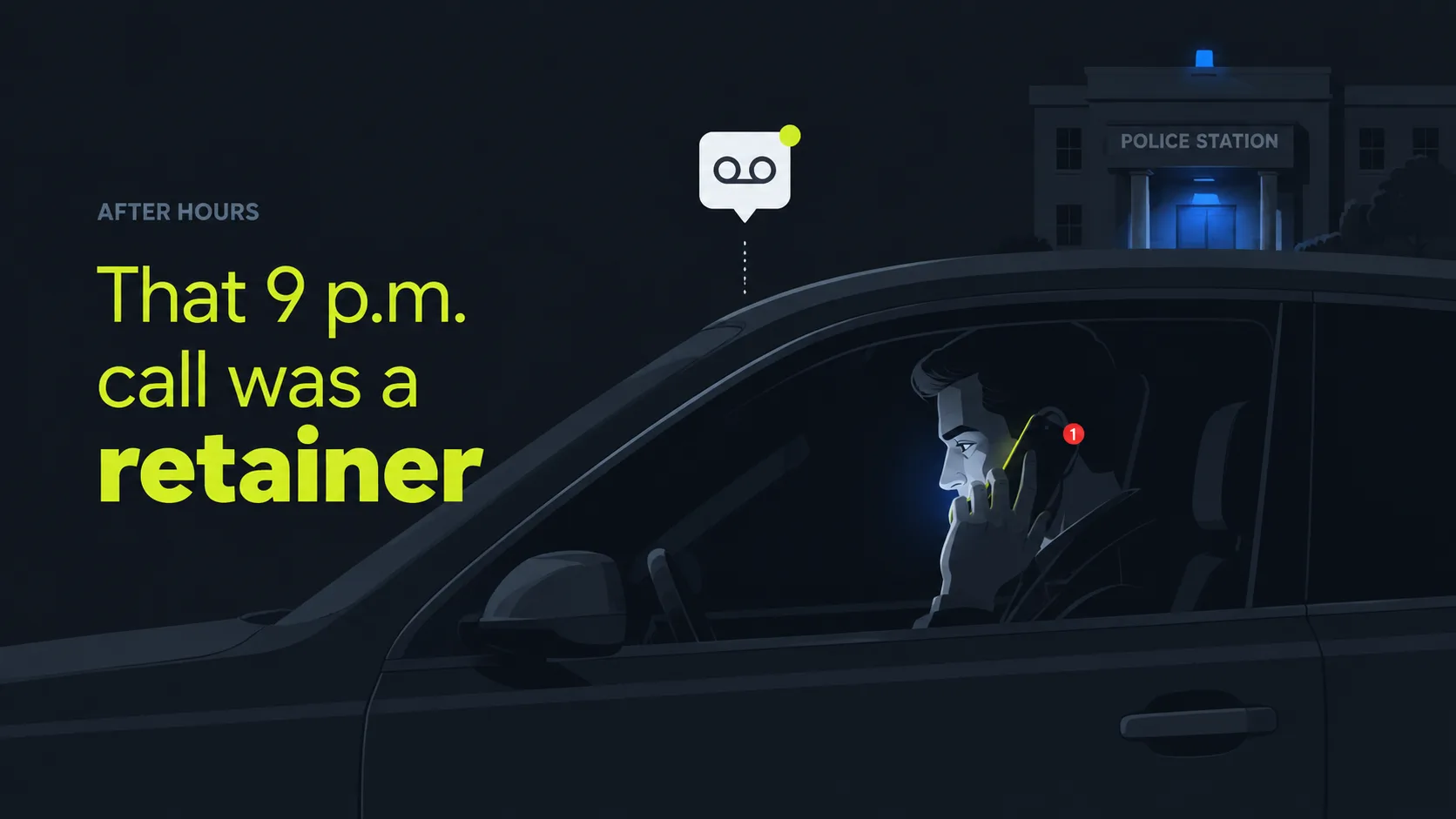
Why do law firms lose retainers to unanswered intake calls?
Law firms lose retainers because the first firm to respond usually wins the matter, and most firms respond too slowly or not at all. The Clio 2024 Legal Trends Report (2024) found that over 50% of law firms ignore client inquiries outright. When the phone goes unanswered, a high-intent prospect simply calls the next name on the list. No second chance. No callback window.
Speed decides it. Firms that contact a web lead within five minutes are 21 times more likely to qualify it, and roughly 100 times more likely to connect, than firms that wait 30 minutes, per the Lead Response Management study (Oldroyd/MIT and InsideSales, cited by Harvard Business Review, 2011). Think about the person on the other end. They just got arrested, served, or rear-ended. A potential client with a fresh legal problem will not wait for a callback tomorrow. They want an answer now, and their wallet is open.
Voicemail won't save the call either. For service businesses, 27% of inbound calls go unanswered, and fewer than 3% of callers pushed to voicemail leave a message, per Invoca (2024). Read that again. Fewer than 3 in 100. A missed call is not a delayed lead. It is a lost one, and your name was on it.
Citation capsule: A secret-shopper study of 500 U.S. firms found only 40% answered the phone and 48% were unreachable, down from 56% answering in 2019, according to the Clio 2024 Legal Trends Report. Over half of firms ignore inbound client inquiries entirely, handing those retainers to faster competitors.
One pattern should worry you more than the rest. In our experience working with service firms, the intake gap is worst at the exact moments demand spikes. The prospect who just got arrested, was served papers, or had an accident calls immediately, often nights and weekends, often in a panic. Your front desk went home at five. So the firm with a real answer at 9 p.m. signs the matter the 9-to-5 firm never knew existed. The competition is not winning on talent. It is winning on availability. We'll do the dollar math on that gap in a moment.

To see how the same gap plays out in plumbing, HVAC, and other trades, read our breakdown of how missed calls cost service businesses revenue. The trades hub covers the home-service angle; the voice-agent call-recovery service covers the booking-on-the-call approach a law firm needs.
How does SkoreFlow capture and qualify new-client intake?
SkoreFlow's AI voice agent answers on the first ring and runs a structured intake script built for legal matters, so it captures the details a paralegal would gather, every time, without fatigue. That matters because phone calls convert at roughly 10 to 15 times the rate of web-form leads, per BIA/Kelsey (2014). The call is the most valuable thing your marketing budget produces. Capturing it cleanly is the highest-impact move in the entire funnel.
So what actually happens on the line? The intake flow follows a consistent order:
- Greet and identify the matter type. The agent confirms the firm name and asks what the caller needs help with (family, criminal, personal injury, estate, and so on).
- Collect contact details. Full name, phone, email, and best callback time, captured verbatim.
- Capture the matter summary. Key facts, dates, parties, and any deadlines the caller mentions.
- Run preliminary conflict questions. Opposing-party and related-party names, flagged for the firm to clear (see the next section).
- Qualify the matter. Practice-area fit, jurisdiction, and basic urgency, so non-fit matters are politely declined or referred.
- Book the consultation. The agent offers open slots and confirms the appointment directly on the calendar.
- Route and notify. A clean intake summary lands in the firm's inbox or case-management tool within seconds, with urgent matters escalated immediately.
Most firms underestimate this next part. In our experience setting up intake scripts, the single biggest win is consistency. Human front desks have great days and rough days. The flu hits. A baby gets sick. Someone quits without notice. An AI agent asks the same qualifying questions on call number 2 and call number 52, at 2 p.m. or 2 a.m., so partners stop reviewing half-finished intake notes and start reviewing matters that are ready to sign.
Setup is fast. SkoreFlow gets the voice agent live in about 48 hours, then it answers, qualifies, and books the consult on the call rather than leaving a message for someone to chase later. That booking-on-the-call approach is the whole difference from a message-taking service like Ruby, where the call still lands back on your desk and you still have to make it. The agent closes the loop. You wake up to a booked consult, not a stack of pink slips.
Citation capsule: Inbound phone calls convert to revenue at roughly 10 to 15 times the rate of web-form leads, per BIA/Kelsey's "Phone Calls Are the New Click" report (2014). For a law firm, that means a cleanly captured intake call is the most valuable lead the marketing budget produces.
| Lead source | Relative conversion rate |
|---|---|
| Web-form lead | 1x (baseline) |
| Inbound phone call | 10x to 15x |
See how coverage compares across trades and professions in our answering service options by industry guide.
How does the AI handle conflict checks, confidentiality, and secure routing?
The AI handles conflict questions by gathering, not deciding. It asks structured questions to surface opposing-party and related-party names during intake, then passes those names to the firm so a lawyer can run the actual conflict check before any consultation is confirmed. The agent never gives legal advice and never clears a conflict on its own. That line stays bright, and that line is non-negotiable.
This distinction matters because consumer trust in AI on the phone is fragile, and you cannot afford to spend it carelessly. A Gartner survey (2024) of 5,728 customers found 64% would prefer companies did not use AI in customer service, and 53% would consider switching to a competitor if they learned a company used AI. So the agent stays firmly in its lane: gather facts, schedule the consult, escalate to a human. It earns trust by being useful, then getting out of the way.
What gets asked during the preliminary conflict screen
The agent captures the names a firm needs to clear a matter without rendering any judgment:
- The caller's full legal name and any aliases.
- The opposing party or parties.
- Related individuals or entities the caller names (spouse, business partners, co-defendants).
- The general nature of the dispute, in the caller's words.
The firm clears the conflict; the agent only collects. That keeps the unauthorized-practice line bright and clean, and it keeps you out of trouble you never want to explain to the bar.
How confidentiality and routing work
Confidentiality is enforced at the process level, not promised in a tagline. Intake details are transmitted to the firm through the firm's chosen secure channel, escalation rules decide who sees what, and the agent is scripted to avoid soliciting privileged detail beyond what intake requires. The SkoreFlow voice agent is built TCPA-aware for inbound call handling. The top consumer worry about AI, per the same Gartner survey (2024), is that it gets harder to reach a person, so SkoreFlow routes any caller to a human the moment the situation calls for it.
Easy human access is part of confidentiality, not separate from it. In a Nextiva customer-patience survey, 75% of customers said they prefer a scheduled callback over waiting on hold, per Nextiva (2024). For a firm handling privileged matters, that means the agent gathers only what intake requires, then hands a callback or a live transfer to an attorney when the situation is sensitive. The frightened caller still gets a person. The privilege still holds. Nothing leaks.
Citation capsule: Gartner's 2024 survey of 5,728 customers found 64% would prefer companies did not use AI in customer service, and their top concern is that it becomes harder to reach a person. A legal answering agent must therefore gather facts and escalate to a human, never replace the attorney relationship.

Coverage by firm type: solo lawyers vs. multi-attorney firms
Coverage scales to the firm because the intake problem looks different at each size, but the lost-retainer math is the same. With only 40% of firms answering the phone, per the Clio 2024 Legal Trends Report (2024), every firm size has room to capture matters competitors are dropping. The answering service simply changes who it hands the matter to.
Answering service for solo lawyers
For a solo lawyer, the answering service is the front desk you can't afford to staff. You cannot take a deposition and answer intake at the same time. You're one person. Hiring a receptionist means a median wage of $37,230 per year before benefits, per the U.S. Bureau of Labor Statistics (2024), and that person still goes home at five and still gets sick. An AI agent covers the line during court, after hours, and on weekends, then drops a clean intake summary to your phone. You walk out of the courtroom to a booked consult, not a missed call.
Answering service for multi-attorney firms
For a multi-attorney firm, the answering service is a routing layer. The agent runs consistent intake across every practice area, then directs each matter to the right attorney or paralegal based on rules the firm sets. New criminal matters at midnight reach the on-call attorney. Routine estate intake waits for business hours. The result is one professional front door, the same calm, competent greeting, no matter who is in court and who is on vacation. Your firm sounds like itself at every hour.
Citation capsule: Firms using client-intake technology saw measurably more leads and higher revenue than those without, according to the Clio 2024 Legal Trends Report (2024). Whether solo or multi-attorney, structured intake on every call closes the gap that leaves over half of firms ignoring inquiries.
Want to see how this maps to accounting, real estate, or the trades? Compare setups in our answering service by industry overview.
AI vs. traditional legal answering service: which fits your firm?
The core trade-off is coverage versus nuance: AI answers every call instantly at a lower cost, while a traditional live service offers human judgment at a premium and limited capacity. Live virtual receptionist plans at one national provider run from $250/month for 50 minutes to $1,725/month for 500 minutes, per Ruby's pricing page (2026), which works out to roughly $3.45 to $5.00 per receptionist-minute.
Both models beat voicemail. That part is not in dispute. What you actually have to decide is which mix of cost, capacity, and escalation fits your caseload.
| Factor | AI legal answering service | Traditional live answering service |
|---|---|---|
| Availability | 24/7, no hold time, answers on first ring | Business hours or after-hours desk; possible hold queue |
| Call capacity | Handles simultaneous calls without overflow | Limited by staffed agents on duty |
| Cost signal | Typically below live plans; AI receptionist tiers from ~$95/mo, per Smith.ai | $250-$1,725+/mo at ~$3.45-$5.00/min, per Ruby |
| Consistency | Same intake script every call | Varies by agent and shift |
| Legal-matter intake | Structured, repeatable conflict and matter capture | Depends on agent training and script adherence |
| Human escalation | Routes urgent matters to the on-call attorney | Live agent judgment for nuance |
| Best for | High call volume, after-hours coverage, tight budgets | Firms wanting a human voice on every call |
Most firms frame this as AI or human. We've found the better frame is AI plus human escalation. Picture the 2 a.m. arrest call again, the one from the opening. A live desk that closed at six never hears it. The AI catches it, runs intake, then hands the genuine emergency straight to the attorney's cell. You stop choosing between coverage and judgment. You get both, on the same call.
| Option | Published monthly range | Effective per-minute |
|---|---|---|
| AI receptionist (Smith.ai) | From ~$95/mo (Starter) | Flat-tier pricing |
| Live virtual receptionist (Ruby) | $250 to $1,725+/mo | ~$3.45 to $5.00/min |
Citation capsule: Live virtual receptionist plans cost roughly $3.45 to $5.00 per receptionist-minute, derived from Ruby's published 2026 pricing ($250/mo for 50 minutes to $1,725/mo for 500 minutes). AI answering tiers, starting near $95/month per Smith.ai (2026), let firms cover every call for far less.
What does a legal answering service cost, and what is the ROI?
Pricing spans a wide band, but the ROI math is simple. One signed matter usually pays for a year of coverage. Industry pricing for virtual receptionist services runs about $50-$300/month for AI and $300-$2,000+/month for human services, per CloudTalk (2025). SkoreFlow's voice-agent plans sit inside that range at roughly $297 to $897/month, with setup from $1,500 to $4,000, and they go live in about 48 hours. Set that against the lifetime value of a single retained client. The cost stops looking like a cost.
Now do the math on what you're losing. Remember the data: only 40% of firms answer the phone, per the Clio 2024 Legal Trends Report (2024), and fewer than 3% of callers sent to voicemail leave a message, per Invoca (2024). So of every 100 missed calls, more than 97 vanish without a trace. Every one of those was a person with a legal problem and money to solve it. That is not a marketing leak. That is revenue walking out the door, unbilled.
Illustrative example (industry-based scenario, not a real client): Picture a 3-attorney firm that misses 10 intake calls a week. Over a year that is roughly 520 missed calls, and fewer than 3% of those callers will leave a voicemail, per Invoca (2024). As a representative benchmark, a well-tuned voice agent answers around 94% of inbound calls, versus the rough 38% live-answer rate many small offices see. The exact dollar value depends on your practice area and average matter, so we won't put a fabricated number on it. Instead, plug your own caseload, conversion rate, and matter value into the calculator below. In most firms, recovering even one or two of those 520 calls covers a full year of coverage. The rest is upside.
There's a risk-reversal that should settle it. SkoreFlow backs the setup with a guarantee: book a set number of new consults in the first 30 days or the setup fee is refunded. You're not betting on a promise. You're testing it on your own caseload, with your money protected. Estimate the number for your own firm with the Missed Call Revenue Calculator in our tools hub. [CONFIRM exact calculator slug, e.g. /tools/missed-call-revenue-calculator/]
Citation capsule: Virtual receptionist pricing runs about $50-$300/month for AI versus $300-$2,000+/month for human services, per CloudTalk (2025). With only 40% of law firms answering the phone (Clio, 2024), a single recovered intake call can return the annual cost many times over.
| Item | Figure |
|---|---|
| Missed intake calls per year | ~520 (10 per week) |
| Callers who leave a voicemail | Fewer than 3% (Invoca, 2024) |
| Annual AI answering cost | ~$600 to $3,600 ($50 to $300/mo, CloudTalk 2025) |
| Calls needed to break even | Often just 1 to 2 signed matters |
Why do firms choose SkoreFlow for legal intake?
Firms choose SkoreFlow because it closes the exact gap the data exposes: a live answer on every call, structured legal intake, and instant escalation to a human when the matter is urgent. With over 50% of firms ignoring client inquiries, per the Clio 2024 Legal Trends Report (2024), simply answering well is a competitive edge most firms have not bothered to claim. The bar is low. Almost nobody is clearing it.
The approach is built for how clients actually search now, not how they searched five years ago. Across consumers, 45% now use AI tools to find local services, up from 6% a year earlier, per BrightLocal (2026). That is a sevenfold jump in twelve months. A firm that captures, qualifies, and books every caller, then keeps clean records of each intake, is positioned to win in both phone and AI-driven discovery, while the firm down the street is still waiting for someone to leave a voicemail.
Back to that 9 p.m. call from the opening. A message-taking service like Ruby would hand you a slip to call back tomorrow, by which point the prospect has already retained someone else. The SkoreFlow voice agent does the opposite. It qualifies the matter and books the consult on the call itself, while the prospect is still motivated and still on the line. It books consults, not messages. That single difference is why the after-hours call becomes a signed client instead of a regret.
One thing we will not do is dress this up with invented testimonials or named case results. We don't publish them, because they wouldn't be real. What we can say plainly: the firms that benefit most are the ones currently sending after-hours callers to voicemail. Plug the leak first, then optimize. That order tends to produce the fastest, most honest wins.
Citation capsule: Consumer use of AI tools to find local services jumped to 45% in 2026, up from 6% a year earlier, per BrightLocal's Local Consumer Review Survey. Law firms that capture and document every intake call are better positioned for both traditional and AI-driven client discovery.

Stop sending new clients to voicemail
The pattern in the data is hard to ignore: only 40% of law firms answer the phone, over half ignore inquiries, and the first firm to respond usually signs the matter. Somewhere tonight, a prospect is sitting in a parking lot, dialing. The only question is whose phone gets answered. An AI legal answering service makes sure it's yours by answering every call, qualifying the matter, screening for conflicts, and escalating real emergencies to you.
You don't have to choose between coverage and judgment, and you don't have to take the claim on faith. Let the agent catch the after-hours intake call, then hand you the matters that need an attorney. Book a set number of new consults in the first 30 days or the setup fee is refunded, and you can be live in about 48 hours. Want to see what unanswered calls are costing you right now? Book a Free Call Audit, a 20-minute, no-pressure call where we map where retainers are slipping and what capturing them would be worth.
Start here: Book a Free Call Audit, or estimate your lost revenue with the Missed Call Revenue Calculator to see what unanswered calls are worth.
Written and reviewed by Maksim Skorokhod, Founder of SkoreFlow, who builds AI answering and voice automation for small service businesses. Last reviewed: 2026-06-07.