The four-step after-hours call flow for emergency trades
The after-hours call flow runs in four steps: answer the call instantly, triage the caller's urgency, dispatch or book accordingly, then notify your on-call tech. AI runs this in seconds, around the clock, which matters because 5-minute responders are 21 times more likely to qualify a lead than 30-minute responders, per HBR (2011).
Most emergency trades run the same flow, start to finish. Each step is built to keep the caller on the line and moving toward a fixed job, not a voicemail beep she will never answer.
- Answer. The AI agent picks up on the first ring, day or night, with no hold queue and no phone menu. It greets the caller by your business name and starts a natural conversation.
- Triage urgency. The agent asks a short set of trade-specific questions to gauge severity: Is there active water, gas, smoke, or no heat in freezing weather? Those answers decide the path.
- Dispatch or book. A genuine emergency gets routed for immediate help. A routine request, a slow drain, a thermostat that quit, a quote, gets booked straight into your calendar or field-service software.
- Notify on-call tech. For dispatched emergencies, the agent texts or calls your on-call technician with the caller's name, number, address, and a one-line summary, so your tech arrives informed.
Owners get this backwards. They assume step two, the triage, is the hard one. It is not. The failure point is step one. If nobody, or nothing, picks up, the other three steps never happen. A clever script does not matter at 1am. The pickup does. In our experience, the plain act of answering on the first ring recovers more jobs than any wording you could write, because the caller has not yet dialed your competitor. That is the whole edge. Be the voice she hears before the second number gets dialed.
Citation capsule: The after-hours call flow for emergency trades runs in four steps: answer instantly, triage urgency, dispatch or book, then notify the on-call tech. Speed is decisive: firms that respond within 5 minutes are 21 times more likely to qualify a lead than those that wait 30 minutes, per HBR (2011).
- 1. Answer
AI picks up on the first ring, 24/7 - 2. Triage urgency
Trade-specific severity questions -
3. Branch
- Emergency → Dispatch to on-call tech
- Routine → Book into your calendar
- 4. Notify
On-call tech gets name, number, address, summary
Speed rationale: 5-minute responders are 21x more likely to qualify a lead than 30-minute responders, per HBR (2011).
For a deeper walk-through of round-the-clock coverage, see how a 24/7 voice agent answers every call.
Why do emergency trades lose the most after hours?
Emergency trades lose the most after hours because their callers will not wait: 56% immediately try another channel after a missed response window, and 28% abandon entirely, per Nextiva (2025). When a flooding caller hits voicemail, "next channel" almost always means the next contractor on Google.
The problem is structural, not a fluke of one bad night. Voicemail recovers almost nothing for this audience: fewer than 3% of callers sent to voicemail actually leave a message, per Invoca (2024). A homeowner with water spreading across the floor has zero patience for a recording, so the message you were counting on basically never gets left.
After-hours demand is also bigger than most owners think. Local businesses receive 94% of their Google Business Profile calls Monday to Friday, but evening shares spike sharply by trade, with locksmiths receiving 34% of calls after 5pm plus another 8% before 9am, per BrightLocal (2019). Pair that with the fact that 27% of calls to home-services businesses go unanswered, per Invoca (2024), and the after-hours leak stops looking like a rounding error.
One thing most owners never sit with: for an emergency trade, an after-hours miss is not a delayed job. It is a permanently lost one. A routine daytime caller might ring back tomorrow. A homeowner watching water pour through her ceiling will not. The urgency that makes these jobs so profitable is the same urgency that makes them impossible to claw back once she has moved on. [UNIQUE INSIGHT] Daytime misses and after-hours misses are not the same leak. One is a delay you can recover; the other is gone the second she taps the next listing.
Citation capsule: Emergency trades lose the most after hours because callers refuse to wait: 56% immediately try another channel after a missed response window and 28% abandon entirely, per Nextiva (2025). Voicemail does not save them, since fewer than 3% of callers sent to voicemail leave a message, per Invoca (2024).

For more on the lost-revenue side, read why missed calls cost service businesses jobs.
How does AI decide what's a true emergency?
AI decides what's a true emergency by running your trade-specific triage script: it listens for severity signals, like active water, gas odor, smoke, or no heat in freezing weather, then escalates only the calls that clear your urgency threshold. This matters because not every after-hours call is genuinely urgent, and over-dispatching burns out your on-call tech fast.
The agent works from rules you set, not guesswork. You define what counts as an emergency for your trade, and the AI maps each caller's answers against those rules. For a plumber, active flooding or a sewage backup escalates; a dripping faucet books for the morning. For HVAC, no heat in winter or no cooling in a heat advisory escalates; a noisy fan books. For an electrician, a burning smell or sparking panel escalates; a flickering light books. Simple inputs, clean branches.
Examples of emergency vs routine by trade
This is roughly how a configured agent sorts the two paths. Treat it as a starting template you tune to your own thresholds.
| Trade | True emergency (dispatch) | Routine (book for later) |
|---|---|---|
| Plumbing | Active flooding, burst pipe, sewage backup | Slow drain, running toilet, faucet drip |
| HVAC | No heat in freezing weather, no cooling in a heat advisory | Noisy unit, routine maintenance, quote request |
| Electrical | Burning smell, sparking, dead panel, exposed wire | Flickering light, adding an outlet, fixture swap |
| Restoration | Active water intrusion, fire/smoke damage, sewage | Mold inspection, scheduled remediation, estimate |
The strongest triage setup deliberately leans toward escalation when a call is ambiguous. If the agent cannot confidently rule a call routine, it should treat it as urgent and connect a human. The asymmetry is the point. A false alarm costs you one phone call. A missed gas leak costs far, far more. [PERSONAL EXPERIENCE] We've found owners trust AI triage much faster once they realize the threshold is theirs to set, not the machine's, and that "when in doubt, wake the tech" is a rule they can dial in themselves.
Citation capsule: AI decides what's a true emergency by matching the caller's answers against your trade-specific triage rules, escalating severity signals like active water, gas odor, smoke, or no heat in freezing weather, while booking routine requests for later. The threshold is owner-defined, and ambiguous calls should default to escalation.
- Plumbing: active water or sewage? Yes → Dispatch. No → Book.
- HVAC: no heat in freezing weather or no cooling in a heat advisory? Yes → Dispatch. No → Book.
- Electrical: burning smell, sparking, or exposed wire? Yes → Dispatch. No → Book.
- Ambiguous on any trade? → Default to Dispatch and connect a human.
See how urgent transfer and on-call routing works for the dispatch mechanics.
Costs and limitations of after-hours AI
After-hours AI runs on a flat monthly plan, roughly $50-$300, per CloudTalk (2025), well below per-minute live answering, which works out to about $3.45-$5.00 a minute on Ruby's published plans (list prices verified June 2026; pricing pages change, so confirm before quoting). One limit is worth stating plainly: AI is not a full replacement for a human, and for emergency trades a real technician still has to show up.
The honest limitation is this. AI books and triages, but it does not fix a burst pipe. The dispatch step still depends on a human on-call tech being available and reachable. AI handles the emotional edge of a panicked caller well enough to gather details, yet a frightened homeowner sometimes just wants a person, and the skepticism is real: 64% of customers would prefer companies didn't use AI in customer service, per Gartner (2024), with the top concern being difficulty reaching a person.
That single objection is exactly why the design pairs AI with a clean human handoff. The agent books the routine majority and instantly transfers genuine emergencies to your on-call tech, so a person is added at the precise moment it matters. There is a sharper distinction here too. A traditional answering service like Ruby takes a message and leaves you to call back, by which point the emergency caller has already dialed the next contractor. A booking agent qualifies and schedules the job on the call instead. The flat pricing also holds steady on your busiest nights, unlike per-minute live answering, where overage runs $1.90-$2.30 a minute on Posh's published rate card (effective January 1, 2026; verify current rates before relying on them), and the meter climbs fastest exactly when call volume peaks.
So what does that actually cost you in lost work? Here is the math.
Illustrative example (industry-based scenario, not a real client): Picture a restoration company missing about 6 emergency calls a week after hours. With fewer than 3% of voicemail callers leaving a message, per Invoca (2024), nearly all of those simply vanish. Even if an AI agent recovers only half into booked work, that is roughly 3 high-value restoration jobs a week the business otherwise loses, week after week, all year. Against a flat $50-$300/month AI plan, per CloudTalk (2025), the recovered work clears the cost many times over. Run your own numbers with the calculator below and see your break-even in about a minute.
Citation capsule: After-hours AI costs a flat $50-$300 a month, per CloudTalk (2025), far below per-minute live answering, which runs about $3.45-$5.00 a minute on Ruby's published plans (verified June 2026). Its limit is that AI triages and books but cannot perform the repair, and 64% of customers prefer companies didn't use AI in service, per Gartner (2024), so a human on-call handoff stays essential.
Use our revenue calculator to estimate your after-hours recovery and break-even against a flat monthly plan.

How does SkoreFlow approach after-hours emergency calls?
SkoreFlow answers after-hours emergency calls with a 24/7 AI voice agent that books jobs rather than taking messages, triaging urgency, scheduling routine work, and dispatching genuine emergencies to your on-call tech. The model is built for exactly this problem: 56% of callers immediately try another channel after a missed window, per Nextiva (2025), so answering first is what wins the job.
The agent answers in under a second and runs your trade-specific triage script, first ring, day or night. It asks the severity questions you define, books routine work straight into ServiceTitan, Jobber, Housecall Pro, or Google Calendar, and recognizes a true emergency, a burst pipe, no heat in winter, a sparking panel, then patches the caller to your on-call person with the details already gathered. Remember the 64% who would rather not deal with AI at all, and the panicked homeowner who just wants a human? That AI-plus-human handoff answers them directly, because the top consumer worry about AI is difficulty reaching a person, per Gartner (2024). The machine handles the routine; the human gets the emergency.
Setup is fast and the framing stays honest. Most trades go live in about 48 hours, plans run from $197 to $697 a month depending on call volume, and the model is TCPA-aware. SkoreFlow backs the build with one plain guarantee: 5 booked jobs in 30 days or your setup fee back. Unlike an answering service like Ruby, which takes a message and leaves you to call back, the agent qualifies and books on the call. You keep your existing number and pay one predictable figure each month, whether the after-hours phone rings 10 times or 100. So picture next January: instead of waking to a callback list and three competitors already on the jobs, you wake to scheduled work and a tech who was paged at the one call that truly could not wait. Want to know what your missed after-hours calls are worth? Run the numbers in the calculator, or book a free call audit and we'll map your recovery. Twenty minutes, no pressure, nothing to install.
Citation capsule: SkoreFlow answers after-hours emergency calls with a 24/7 AI voice agent that books jobs rather than taking messages, triaging urgency, scheduling routine work, and dispatching true emergencies to on-call staff. It answers first because 56% of callers try another channel after a missed window, per Nextiva (2025), and pairs AI with human handoff to address the top consumer concern, per Gartner (2024).
To put a number on it, try the revenue calculator and estimate your after-hours recovery.

The bottom line: answer first, triage fast, dispatch the real emergencies
For an emergency trade, the after-hours phone is where jobs are won or lost in seconds. AI answers on the first ring, triages the caller's urgency against rules you set, books the routine work, and dispatches a genuine emergency to your on-call tech, with the details already gathered. One number settles it: 56% of callers immediately try another channel after a missed window, per Nextiva (2025), so a missed emergency call is usually a permanently lost job.
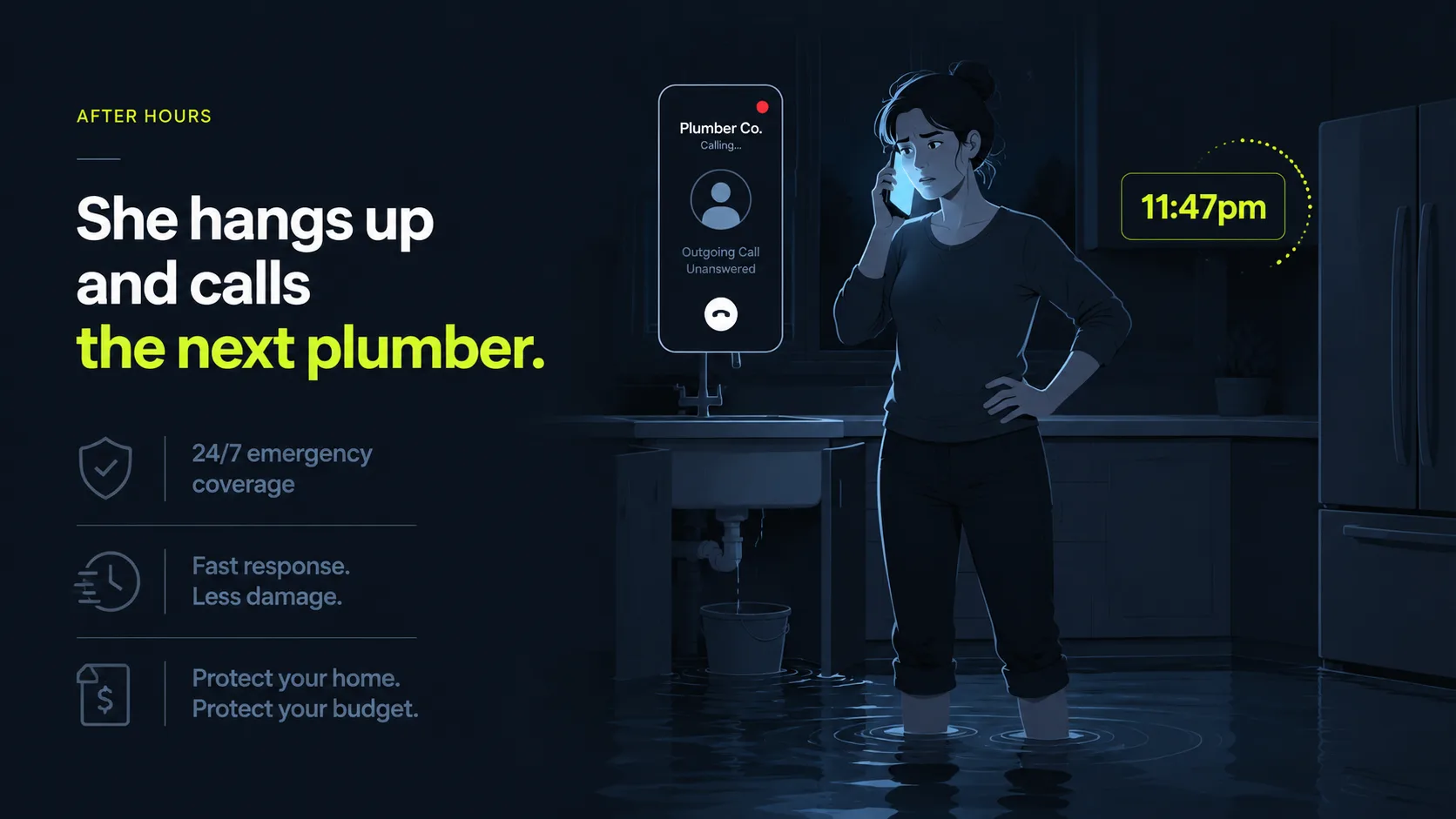
AI does not replace your technician, and it should not try to. Remember the woman standing in the water at 11:47pm? The strongest setup makes sure her call gets answered before she taps the next listing: an AI agent that handles the routine majority, plus an instant human handoff for the urgent few, all on flat pricing that holds steady on your busiest nights. Want to know what your after-hours calls are worth? Run the numbers in the calculator, or book a free call audit and we'll map your recovery, 20 minutes, no pressure.
Next steps: estimate your after-hours recovery with the revenue calculator, or book your free call audit.
Written and reviewed by Maksim Skorokhod, Founder of SkoreFlow, who builds AI answering and voice automation for small service businesses. Last reviewed: 2026-06-07.