How does overflow call routing work?
Overflow routing forwards a call to a backup answer point when your main line can't take it. The trigger is one of three conditions: the line is busy, no one answers, or the call has rung past a set number of rings. Once any condition fires, your phone system reroutes the call automatically, with no caller action required. This matters because fewer than 3% of callers pushed to voicemail actually leave a message, per Invoca (2024).
The mechanics are simple. Better still, most business phone systems already support them out of the box. You set conditional call forwarding rules, then point the overflow destination at your backup. The three common triggers map to three forwarding types: "forward on busy," "forward on no answer," and "forward after N rings." Stack them, and the coverage gets tight. A call that goes unanswered after four rings rolls to overflow. A call that hits an engaged line rolls instantly. The caller never feels the seam.
What is call forwarding on busy vs. no answer? Forward-on-busy reroutes a call the moment your line is engaged, before the caller hears a busy signal. Forward-on-no-answer reroutes after a set number of rings when no one picks up. Both send the call to your overflow destination instead of dropping it.
How to set up overflow call forwarding
- Pick your overflow trigger(s). Decide whether calls roll over when the line is busy, after a set number of rings, or both. Most desks use all three for full coverage.
- Choose your backup answer point. This is where overflow calls land: an AI voice agent, a call center, or a second staff line.
- Set the ring count. Four rings (about 20 seconds) is a common threshold before a no-answer rollover, fast enough that callers don't give up first.
- Enable conditional call forwarding. In your phone system or VoIP admin panel, turn on forward-on-busy and forward-on-no-answer, and enter the overflow number.
- Route the overflow line to your backup. Connect that forwarding number to your AI agent or service so it answers the moment a call rolls over.
- Test every trigger. Call your own line while it's busy, let it ring out, and confirm each path lands at the backup, not voicemail.
Citation capsule: Overflow call routing forwards a call to a backup answer point when the main line is busy, unanswered, or rings past a set count, using conditional call forwarding. It matters because fewer than 3% of callers pushed to voicemail leave a message, per Invoca (2024), so a rollover to a live answer point captures calls voicemail would lose.

Setting the rules is the easy part. The harder question is what happens to those rolled-over calls after hours, which we cover in our guide to the after-hours answering service.
Who needs overflow phone answering backup?
Any business that misses calls during busy stretches needs overflow backup, but three profiles need it most: high-call-volume front desks, businesses with seasonal peaks, and offices run by a single receptionist. The case is straightforward. Phone calls are the top-rated lead source for 66% of SMBs, ahead of forms, in-person, and email, per BIA/Kelsey (2014). A missed call is usually a missed job.
The common thread is a gap between call volume and staff capacity. One person can hold one conversation. A second call during that conversation hits a busy line, and a third rings out. The math gets brutal on your busiest days, too. Even general local businesses concentrate their calls heavily on weekdays, with 94% of Google Business Profile calls landing Monday to Friday, per BrightLocal (2019). That means peak weekday hours stack calls faster than a single desk can clear them.
High-call-volume front desks
A busy front desk loses calls to the second and third lines ringing at once. When your receptionist is mid-call, every other caller hits a busy signal or voicemail. Overflow backup answers those parallel calls instantly. An older small-sample audit found roughly 62% of small-business calls went unattended, per 411 Locals (2016 study, 85 businesses), a directional figure that points to the same parallel-call failure mode.
Seasonal and peak-time spikes
Demand isn't flat, and your peak weeks are exactly when calls overflow. An HVAC shop in a July heat wave or a plumber during a winter freeze gets a surge that no normal staffing plan covers. Hiring for the peak wastes money the other ten months of the year. So you're stuck choosing between overpaying for idle staff and eating the lost calls. Overflow backup breaks that tradeoff: it scales with the spike, then quiets down with it, no extra hires required.
Single-receptionist and small offices
A one-person front desk has zero redundancy. When that person is on a call, at lunch, or off sick, every inbound call is at risk. And patience is short: 54% of callers hang up after being on hold for up to eight minutes, per Nextiva (2025). Overflow backup gives a solo desk a second pair of hands that never takes a break, never goes to lunch, and never calls in sick.
Citation capsule: Overflow phone answering backup is most needed by high-call-volume front desks, seasonal-peak businesses, and single-receptionist offices. Phone calls are the top-rated lead source for 66% of SMBs, per BIA/Kelsey (2014), and weekday demand concentrates hard, with 94% of Google Business Profile calls landing Monday to Friday, per BrightLocal (2019). The gap between volume and staffing is where calls leak.

So what does that leak actually cost? Put a number on it with our missed-call revenue calculator, then keep reading, because the next section shows which backup recovers the most of it.
AI overflow vs. call-center overflow vs. voicemail: which is best?
For most front desks, AI overflow wins on cost, speed, and capacity; a call center wins on complex human-judgment calls; and voicemail loses almost every time. The reason voicemail fails is brutal in the data: fewer than 3% of callers pushed to voicemail leave a message, per Invoca (2024), and roughly 80% of callers sent to voicemail leave nothing at all, per destinationCRM citing Forbes (2014).
The choice hinges on what your overflow calls actually need. Most overflow is routine: hours, pricing, "are you open?", "can you come Tuesday?" Those are exactly the calls an AI voice agent handles instantly and cheaply, in parallel, at a flat monthly price. A call center handles the same calls with a human but bills per minute, so cost climbs with every call, precisely on your busiest days. Voicemail just records a message most callers never leave.
Speed is the deciding edge. Firms that respond within five minutes are 21 times more likely to qualify a lead than those who wait 30 minutes, per Harvard Business Review (2011). And callers don't wait around: 56% immediately try another channel after a missed response window, per Nextiva (2025). An AI agent answers the overflow call on the first ring, so there's no queue to abandon and no callback race to lose.
| Factor | AI overflow | Call-center overflow | Voicemail |
|---|---|---|---|
| Speed to answer | Instant, first ring | Fast, can queue at peak | N/A, no live answer |
| Calls handled at once | Many in parallel | One per agent | Unlimited but no response |
| Cost model | Flat monthly, ~$50-$300 typical, per CloudTalk (2025) | Per minute, $300-$2,000+/mo, per CloudTalk (2025) | Cheap but recovers <3% of callers, per Invoca (2024) |
| After-hours coverage | 24/7 at same price | Often a surcharge | Always on, but no live help |
| Books appointments | Yes, on the call | Sometimes | No |
| Best for | Routine, high-volume overflow | Complex, sensitive human calls | Last resort only |
Now here's the trap inside call-center overflow: timing. Your busiest call day, a heat wave for an HVAC shop, a storm for a roofer, is also your most expensive day on a per-minute plan, exactly when a surprise bill stings. AI overflow inverts that. The day you capture the most rolled-over jobs is the day the price stays flat. Cost and demand stop moving in lockstep, so a big day stays a good day instead of an expensive one.
[UNIQUE INSIGHT] In our work setting up overflow answering for service businesses, the most common mistake we see is treating voicemail as a safety net. Owners assume an unanswered call leaves a message and waits politely. It usually doesn't. Most callers hang up and dial the next shop on the list, and the "net" catches almost nothing. Once you see it framed that way, the choice gets simple: a net that catches under 3 callers in 100 isn't a net at all, and replacing it with a live answer point is an easy call.
Citation capsule: AI overflow beats call-center overflow and voicemail for routine, high-volume calls, answering instantly in parallel at a flat price, while a call center bills per minute and voicemail recovers almost nothing: fewer than 3% of voicemail-bound callers leave a message, per Invoca (2024), and roughly 80% leave nothing, per destinationCRM citing Forbes (2014).
To weigh each answer point for after-hours overflow specifically, see our after-hours answering service guide.
How does SkoreFlow handle overflow calls?
SkoreFlow's missed-call recovery agent sits behind your front desk as the overflow answer point, picking up in 0.4 seconds the moment a call rolls over from a busy line, an unanswered ring, or a set ring count. It answers in parallel, so a dozen calls at once never hit a busy signal, and it qualifies and books the estimate instead of taking a message. The design follows the evidence: fewer than 3% of voicemail-bound callers leave a message, per Invoca (2024), so a live rollover captures calls voicemail would lose.
Here's the difference that matters most. SkoreFlow books jobs, not messages. An answering service like Ruby takes a message and leaves you to call back, by which point the caller has already booked the next plumber on the list. SkoreFlow qualifies the caller and books the estimate on the call, while the lead is still warm and still yours. It's built for home-service trades, plumbers, HVAC, electricians, and inspectors, and it's TCPA-aware. Setup is fast: most teams go live in 48 hours.
The agent connects to the tools trades already run, including ServiceTitan, Jobber, Housecall Pro, and Google Calendar, so a booked overflow call lands straight on the dispatch schedule. No retyping, no lost slip of paper. Pricing is a flat monthly plan from $197 to $697/mo by call volume, not per minute, so cost stays predictable whether you take 50 overflow calls or 500. A call center bills per minute, so overflow gets most expensive on your busiest days, per CloudTalk (2025). And because some callers still want a human, the agent escalates sensitive or complex calls to a person with a clean handoff. That balance matters: 64% of customers would prefer companies didn't use AI in service, per Gartner (2024), so the routine overflow gets answered fast while the tough calls reach a person.
Illustrative example (industry-based scenario, not a real client): Picture a busy plumbing shop swamped during a winter freeze, where about 12 calls a day roll to voicemail during the rush. Do the math. With fewer than 3% of voicemail callers leaving a message, per Invoca (2024), nearly all 12 are simply gone, roughly 60 a week, week after week through the cold snap. As a representative benchmark, a trades shop recovering overflow calls this way can answer about 94% of them and return on the order of $14,200 a month in booked work, figures we use as an illustrative model, not a specific customer result. SkoreFlow backs the setup with a guarantee: 5 booked jobs in 30 days or your setup fee back. So the downside is capped and the math is yours to check. Run the missed-call revenue calculator, or book a free Call Audit and we'll map what your overflow calls are worth.
Citation capsule: SkoreFlow's missed-call recovery agent acts as your overflow answer point, picking up in 0.4 seconds on busy, no-answer, or after-N-rings rollover, qualifying and booking the estimate in parallel, with most trades teams live in 48 hours. It books jobs, not messages, unlike an answering service that just takes a message, and it's TCPA-aware with a flat monthly price, while a call center bills per minute and costs most on your busiest days, per CloudTalk (2025).

Curious where the math lands for your desk? Estimate your overflow savings with the missed-call revenue calculator.
The bottom line: stop letting overflow calls hit voicemail
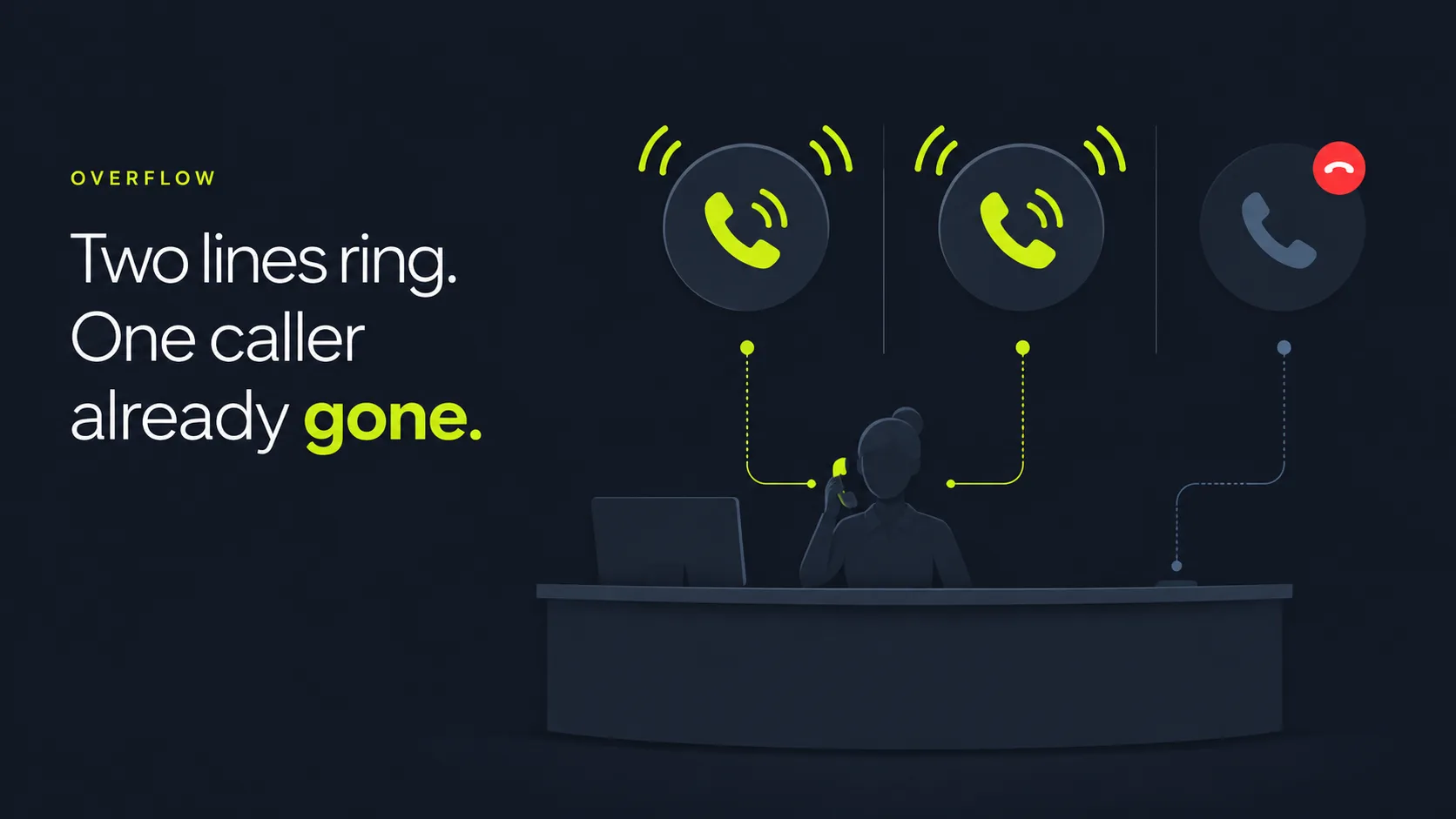
Overflow phone answering catches the calls your front desk can't: the busy-line, no-answer, and peak-hour calls that would otherwise dead-end at voicemail. Remember the two lines lighting up while your receptionist was mid-call? That's where the money leaks out, one hang-up at a time. The stakes are real: fewer than 3% of voicemail-bound callers leave a message, per Invoca (2024), and 56% immediately try another channel after a missed response window, per Nextiva (2025). An unanswered rollover is usually a lost job, not a delayed one.
AI overflow gives a front desk instant, parallel backup at a flat price, around the clock, with complex calls escalated to a person. For trades and service businesses, that captures the routine overflow majority while keeping human attention for the calls that truly need it. SkoreFlow's version books jobs, not messages, goes live in 48 hours, and is backed by a guarantee of 5 booked jobs in 30 days or your setup fee back. So the only real risk is leaving the voicemail trap in place. Want to see where the math lands for you? Run the missed-call revenue calculator, or book a free, no-pressure 20-minute Call Audit and we'll show you what your overflow calls are worth.
For the bigger picture, see our full missed-call recovery approach, or compare coverage options in the after-hours answering service guide.
Written and reviewed by Maksim Skorokhod, Founder of SkoreFlow, who builds AI answering and voice automation for small service businesses. Last reviewed: 2026-06-07. Learn more about SkoreFlow and our team, read our editorial and sourcing policy, or contact us with questions.