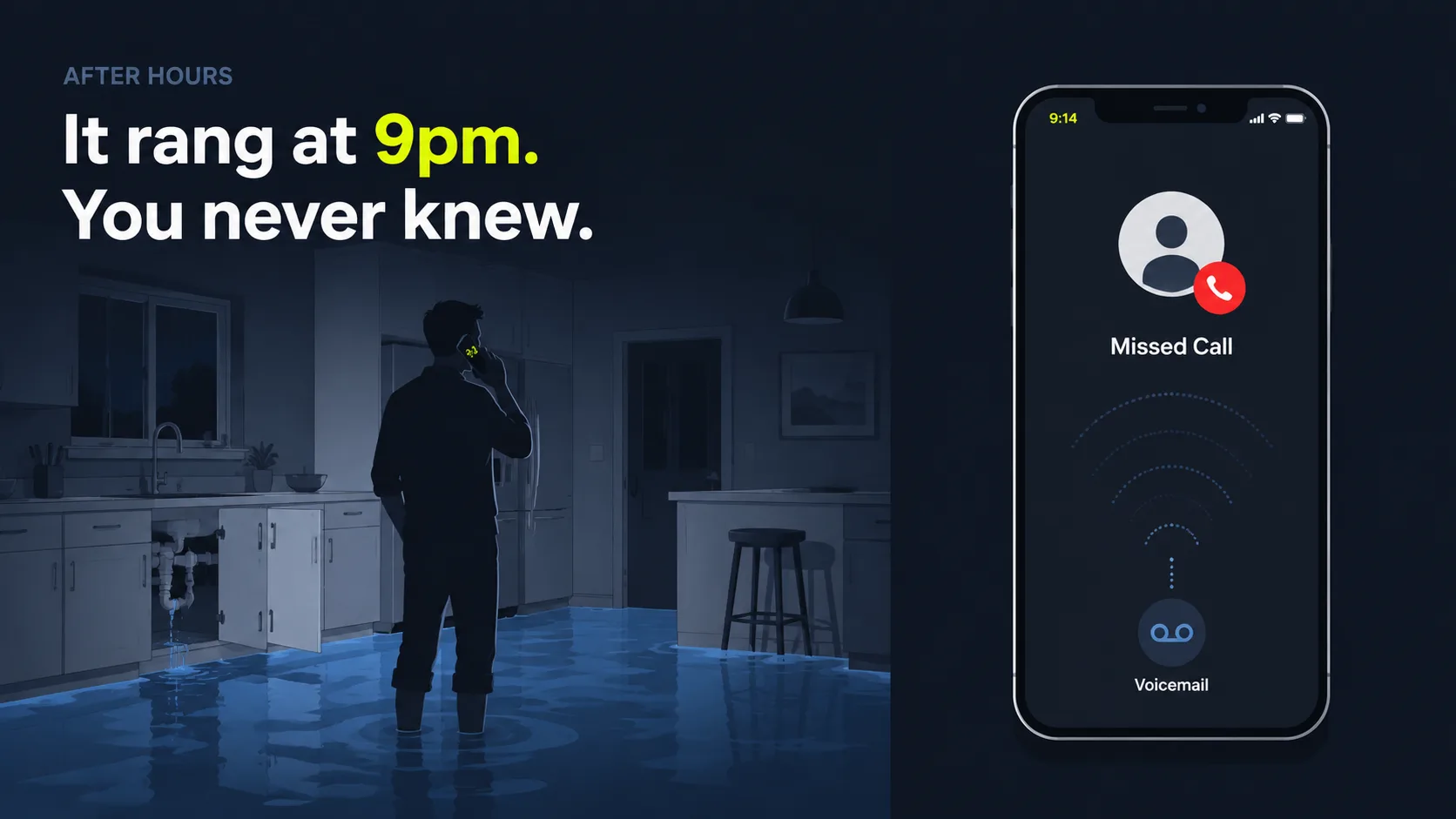
Why do plumbers lose money to missed calls?
Plumbers lose money to missed calls because a big slice of inbound calls never reaches a live person. For service trades specifically, Invoca (2024) found 27% of calls to home-services businesses go unanswered. That is more than a quarter of your inbound demand ringing out while crews are under a sink or out on a job.
And a missed call almost never comes back. Invoca (2024) reports that fewer than 3% of callers pushed to voicemail bother to leave a message. So picture our homeowner from a minute ago, water heater leaking, phone in hand. They don't wait around for a callback. They thumb to the next name on the list.
That math stings worse in plumbing than in almost any trade, because phone calls are your best leads, full stop. BIA/Kelsey (2014) found 66% of small businesses rate inbound calls a good or excellent lead source, the top-rated channel they have. These are buying-stage callers with a flooded floor, not browsers idly filling out a form.
Then speed decides everything. Firms that respond to a lead within five minutes are 21 times more likely to qualify it than firms that wait 30 minutes, per Harvard Business Review (2011). A voicemail you return two hours later? The homeowner has already had another truck in the driveway.
So do the arithmetic on your own shop. Twelve missed calls a week is 624 missed call attempts a year, and each one was someone ready to spend.
Worked example (representative scenario, not a client case) A 7-technician plumbing shop missing roughly 12 calls a week loses about 624 call attempts a year. In a representative scenario modeled on SkoreFlow's trades benchmarks, a shop that lifts its answer rate toward 94% (versus an industry baseline near 38%) can recover on the order of $14,200 a month in booked work. That matters more in plumbing, where repair tickets run well into the hundreds of dollars and the US plumbing market reached $166.5 billion in 2024 (IBISWorld, 2024). Plug your own numbers into the Missed Call Revenue Calculator to size your gap.
For service trades, 27% of calls to home-services businesses go unanswered, and fewer than 3% of callers sent to voicemail leave a message (Invoca, 2024). Since 66% of small businesses rate inbound calls their best lead source (BIA/Kelsey, 2014), each unanswered ring is a high-intent job handed straight to a competitor.
Want the deeper breakdown? Our article on how missed calls cost home-service shops walks through the full revenue math by trade.
How does SkoreFlow handle after-hours and overflow emergency calls for plumbers?
SkoreFlow handles after-hours and overflow calls by answering instantly, every time, instead of routing to voicemail or a phone tree. This matters because callers simply won't hold. Nextiva (2025) found 54% of callers hang up within eight minutes on hold, and 56% immediately try another channel the moment a response stalls.

Go back to that 9pm call. Here is what happens when it hits SkoreFlow instead of your voicemail:
- Instant pickup, day or night. The agent answers in about 0.4 seconds, including nights, weekends, and holidays, so no caller meets voicemail or a menu maze. It filters spam before it ever reaches you.
- Greet and identify. It greets the caller in your shop's name, confirms it's a plumbing issue, and gathers the address and contact details.
- Triage urgency. It asks targeted questions to separate a true emergency (burst pipe, no water, sewage backup) from a routine job (slow drain, faucet replacement).
- Quote your trip charge. When you've configured it, the agent states your service-call fee or trip charge before booking, so callers aren't surprised at the door.
- Book or route. Routine jobs get slotted into your schedule (ServiceTitan, Jobber, Housecall Pro, or Google Calendar). Emergencies trigger an immediate text or call to your on-call tech.
- Confirm and log. The caller gets a confirmation, and you wake up to a clean record of the job, the transcript, and the contact info.
Overflow works the same way. Your office line is already busy, two homeowners call within the same minute, and instead of the second one ringing out, the call rolls to the AI. That second caller, the one a lone receptionist would have lost, still gets answered and booked.
Why does this beat a phone menu? Because callers bail the instant a response stalls. Nextiva (2025) found 56% of customers immediately try another channel after a missed response window, and 28% abandon the company entirely. A conversational agent skips the menu maze and talks in plain language on the first ring.
Callers abandon fast: 54% hang up within eight minutes on hold, and 56% immediately try another channel after a missed response window (Nextiva, 2025). An always-on AI receptionist that answers on the first ring removes the hold queue and the voicemail that lose plumbing jobs after hours.
Coverage that never sleeps is the whole point. See how our 24/7 after-hours call answering works across nights, weekends, and holidays.
How the AI captures no-water emergencies and routes them to your on-call tech
The AI captures emergencies by triaging the caller's words against your rules, then escalating genuine no-water or burst-pipe calls to your on-call tech in real time. Speed is the entire game here: firms that respond to a lead within five minutes are 21 times more likely to qualify it than those waiting 30 minutes (Harvard Business Review, 2011).
In our experience configuring voice agents for trades, the gap between a good after-hours system and a useless one is the triage logic, not the voice. A homeowner saying "water is pouring through my ceiling" needs a very different path than "my kitchen faucet drips." The agent has to catch the difference and act on it, in seconds, before the caller gives up.
What counts as a plumbing emergency?
You define the triggers; the agent listens for them. Typical emergency keywords and conditions include:
- Burst or leaking pipe with active, uncontrolled water
- No water to the property
- Sewage backup or overflowing toilet
- No hot water in cold-weather months (often urgent for tenants)
- Gas smell near water heaters or lines (immediate escalation)
How the on-call routing works
For a flagged emergency, the agent collects the address and a callback number, then fires off an instant text or places a call to whichever tech sits at the top of the rotation you set. You decide the order: primary tech first, then a backup if there's no acknowledgment inside your chosen window. Routine jobs skip the alert and land quietly in your normal schedule.
Why route by text? Because techs answer texts. Nuance Communications found 95% of people consider text more convenient than voicemail (2014). A text with the address and the issue gets your on-call plumber pulling on his boots faster than a missed voicemail ever could.
Now here's the part most providers quietly skip. Most answering services treat an after-hours call as a message-taking chore: write it down, email it over, let the owner sort it out at 7am. For plumbing, that delay is the failure. The value was never the message. It's the live triage-and-dispatch loop that turns a 2am burst pipe into a booked, dispatched job before the homeowner can dial anyone else.
Texting beats voicemail for reaching your on-call tech: 95% of people find text more convenient than voicemail (Nuance Communications, 2014). Pairing instant triage with a text dispatch supports the five-minute response window that makes firms 21 times more likely to qualify a lead (Harvard Business Review, 2011).
The routing rules are yours to set. Learn more about emergency dispatch and on-call routing and how the rotation and backup order work.
AI vs. traditional answering service for plumbers: which is better?
An AI answering service usually wins on cost and coverage; a traditional live service can edge it on complex judgment calls. The cost gap is not subtle: live virtual receptionists run about $3.45 to $5.00 per receptionist-minute based on published plans (Ruby, 2026), while AI receptionists start far lower at a flat monthly rate.
A traditional answering service uses human agents, often offsite, who answer your calls and take messages or book appointments, typically billed per minute or per call. An AI answering service uses a voice agent to do the same work 24/7 at a fixed price, with no hold queue and no per-minute meter running in the background. The sharpest line between them is what happens at the end of the call. Ruby and services like it take a message and leave you to call the homeowner back. SkoreFlow books the job on the call.
The two models stack up very differently for a plumbing shop:
| Factor | AI answering service (SkoreFlow) | Traditional live answering service |
|---|---|---|
| Availability | 24/7/365, no shifts or gaps | Depends on staffing; after-hours often costs more |
| Pricing model | Flat monthly, no per-minute fees | ~$1.50 to $5.00 per minute (Ruby, 2026; AnswerConnect, 2025) |
| Speed to answer | About 0.4 seconds, every call | Can queue or hold at peak |
| Overflow handling | Unlimited simultaneous calls | Limited by agents on duty |
| Plumbing triage | Custom rules for burst pipe / no water | Agent reads a script; varies by training |
| End of call | Books the job into your schedule | Usually takes a message, then you call back |
| On-call dispatch | Instant text/call to your tech | Usually message-taking, then callback |
| Monthly plan range | $197 to $697 flat (SkoreFlow plans) | $300 to $2,000+ human tier (CloudTalk, 2025) |
One honest caveat, because pretending otherwise would insult you: some callers are wary of AI. Gartner (2024) found 64% of customers would prefer companies didn't use AI in service, and their top worry is that it gets harder to reach a person. The fix is design, not denial: a natural voice plus a clean, fast handoff to a human or your on-call tech. Built that way, the AI answers callers instead of walling them off.
Live human answering costs roughly $1.50 to $5.00 per receptionist-minute (Ruby, 2026; AnswerConnect, 2025), while AI receptionist plans across the market commonly run $50 to $300 per month flat (CloudTalk, 2025), with no meter and unlimited simultaneous answering. SkoreFlow's own plumbing plans sit in a flat $197 to $697 per month band by call volume.
Run a different trade? See how missed-call recovery works for other home-service crews on our missed-call recovery for service businesses overview before you decide.
What does a plumbing answering service cost, and what's the ROI?
SkoreFlow's plumbing plans run a flat $197 to $697 per month by call volume, versus $300 to $2,000+ for human-staffed services (CloudTalk, 2025). The ROI logic is almost embarrassingly simple: even one recovered emergency job a month usually covers the plan, because plumbing tickets run into the hundreds of dollars. In SkoreFlow's trades benchmarks, a typical shop reaches payback in roughly 11 days.
Now compare that to hiring the job out to a human. The median US receptionist earns $37,230 a year before benefits and payroll taxes (U.S. Bureau of Labor Statistics, 2024). That one person still can't cover nights, weekends, and two calls ringing at once. The role churns, too, with about 128,500 openings projected per year (BLS, 2024), so you'd be rehiring and retraining on a loop.
The ROI math, step by step
- Count your missed calls. Pull your call logs or your carrier's data. Most shops are quietly stunned by how many ring out after hours and during jobs.
- Apply a booking rate. Assume a conservative share of recovered calls turn into booked jobs.
- Multiply by your average ticket. Use your real average plumbing job value.
- Subtract the flat monthly plan. What's left is recovered revenue you weren't seeing before.
Run your own version in the Missed Call Revenue Calculator. As a representative scenario, a 7-technician shop recovering even a handful of the roughly 12 calls it misses weekly, at a typical plumbing repair ticket, clears the cost of a plan many times over. The plan price stays flat inside your tier no matter how busy the phone gets.
There's a broader tailwind under all of this. SMBs adopting AI are seeing it land on the P&L: Salesforce (2025) found 91% of SMBs using AI say it boosts revenue and 90% say it improves efficiency. Answering every call is one of the most direct ways that shows up for a plumbing shop.
An in-house receptionist costs a median $37,230 per year in base wages alone (U.S. Bureau of Labor Statistics, 2024) and still can't cover nights or simultaneous calls, while SkoreFlow's flat plumbing plans ($197 to $697/mo) answer every call 24/7 with no per-minute meter.
Ready to size the upside? Use the Missed Call Revenue Calculator to estimate your recoverable revenue in two minutes.
Why plumbers choose SkoreFlow for call answering
Plumbers choose SkoreFlow because it answers every call in about 0.4 seconds, triages real emergencies, books the job, and dispatches the on-call tech, all on a flat plan with no per-minute fees. The timing fits the market: 45% of consumers now use AI tools to find local services, up from 6% a year earlier (BrightLocal, 2026).
What we've found working with trades is plain: owners don't want a clever bot. They want the phone handled so they can stay on the job and close the truck door at 6pm without chasing voicemails at 9. A plumber flat on his back under a sink can't answer a ringing line, and that next ring might be a $2,000 water-heater replacement walking to a competitor. So SkoreFlow books jobs, not messages, and the whole thing goes live in about 48 hours.
The agent works with the field-service tools you already run, including ServiceTitan, Jobber, Housecall Pro, and Google Calendar, and the setup is TCPA-aware. We back it with a clear guarantee: 5 booked jobs in your first 30 days, or your setup fee back. Your risk on trying it is roughly zero.
We also keep our claims honest. We don't publish fabricated client names or invented results. Here instead is the modeled logic, clearly labeled as an illustrative scenario:
- A 7-technician plumbing shop misses about 12 calls per week, common when crews are on jobs and the office line is tied up.
- Service trades leave roughly 27% of calls unanswered (Invoca, 2024), and under 3% of voicemail callers leave a message.
- Lifting the answer rate toward 94% (from an industry baseline near 38%), at a real plumbing ticket, can return on the order of $14,200 a month. Treat that as a representative benchmark, not a specific customer result.
The market shift is real, not marketing noise. AI adoption among the smallest firms roughly doubled in six months (U.S. SBA Office of Advocacy / Census, 2025), and conversational AI is forecast to grow from $11.58 billion in 2024 to $41.39 billion by 2030 (Grand View Research, 2025). Early-adopting plumbers are quietly pocketing the jobs their slower competitors keep dropping.
Consumer behavior is shifting fast: 45% of consumers now use AI tools to find local services, up from just 6% a year earlier (BrightLocal, 2026). Plumbing shops that answer every call with a 24/7 AI receptionist capture high-intent jobs that voicemail and busy lines would otherwise lose to competitors.
Questions about setup, billing, or trust? Reach our team through the contact page, read about SkoreFlow, or review our editorial and sourcing policy for how we vet every statistic in this article.
Book a free call audit
Go back to that 9pm burst pipe one last time. Picture it ringing through to a calm voice that books the job, quotes your trip charge, and texts your on-call tech before the homeowner even thinks about searching for somebody else. That's the difference between a job won in your sleep and a job you never knew you lost. For service trades, 27% of calls go unanswered, and almost none of those callers leave a voicemail (Invoca, 2024). With up to 45% of consumers now finding plumbers through AI tools (BrightLocal, 2026), the shops that answer every call are the ones that win the work.
SkoreFlow covers nights, weekends, and overflow on a flat plan, triages true emergencies, and books the job into ServiceTitan, Jobber, Housecall Pro, or Google Calendar. It goes live in about 48 hours, backed by a 5-booked-jobs-in-30-days-or-setup-refund guarantee, so the downside is covered before you start. Want to see what you're missing first? Run your numbers in the Missed Call Revenue Calculator, then book a free call audit: a no-pressure 20-minute call to see your live missed-call number and a setup plan built for your shop.