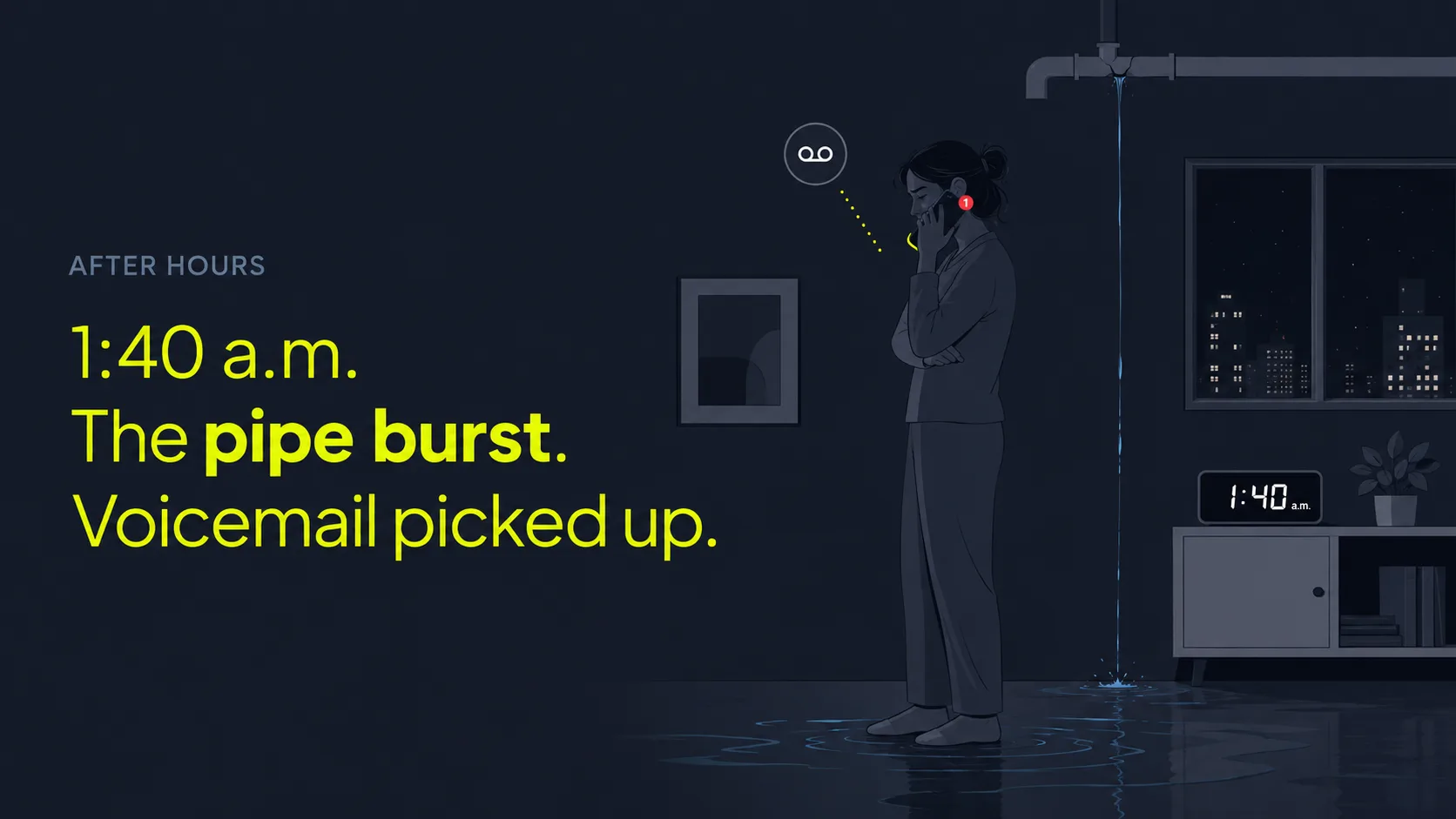
Why do property managers lose tenants and incur liability from missed after-hours calls?
Property managers lose tenants and risk liability because maintenance problems peak outside office hours, when no one is staffing the phone. After a missed response window, 56% of customers immediately try another channel and 28% abandon entirely, according to Nextiva (2025). For a tenant with water pouring through a ceiling, "abandon" can mean an emergency that escalates into real property damage.
The after-hours pattern is structural, not occasional. Local businesses receive 94% of their phone calls Monday through Friday, but service categories see heavy nights-and-weekends volume, with some verticals taking the majority of calls outside 9-to-5, per the BrightLocal Google My Business Insights Study (2019). Maintenance emergencies follow the same clock. Pipes burst at midnight. Heat fails on a Sunday. The phone rings exactly when nobody is sitting next to it.
And voicemail does not catch what staff miss. For service businesses, 27% of inbound calls go unanswered and fewer than 3% of voicemail-bound callers leave a message, per Invoca (2024). A tenant who can't reach you doesn't leave a tidy message. They stew. They screenshot the call log. Then they bring it all up when the lease is due.
Bad service experiences cost you directly, too. Across consumers, 78% have abandoned a transaction or not made an intended purchase because of a poor service experience, per the American Express Global Customer Service Barometer (2011). For a tenant, that abandonment shows up as a non-renewal. Run the math: a single non-renewal can mean a vacant unit for weeks, turnover costs, and a new lease at the same rent you were already collecting. That is the most expensive form of churn a manager faces, and it often starts with one unanswered ring.
Citation capsule: After a missed response window, 56% of customers immediately switch to another channel and 28% abandon entirely, according to Nextiva's 2025 Customer Patience Benchmark survey. For property managers, an unanswered after-hours maintenance call can let a minor leak escalate into costly damage and a tenant ready to leave.
There's a quieter cost most managers never connect to a missed call, and it can hurt worse than the leak itself. [UNIQUE INSIGHT] The liability is the missing paper trail, not just the unanswered ring. When a tenant reports a hazard and no one logs it, you can't prove the report happened or that anyone acted. In a habitability dispute, the absence of a record is the case against you. A timestamped, unit-tagged entry on every call is quietly the most valuable thing an answering service produces. That same record turns out to be your cheapest insurance policy, a point worth returning to later.

For the full breakdown, see how missed calls cost service businesses revenue across every after-hours category.
How does SkoreFlow log and triage tenant maintenance requests?
SkoreFlow's AI voice agent answers in about 0.4 seconds and runs a structured maintenance script, so every request is captured with the unit, property, and issue, every time, without a tired front desk dropping details. Speed is the whole point. Firms that respond within five minutes are roughly 100 times more likely to connect than those that wait 30 minutes, per Harvard Business Review (2011).
Here is the difference that matters. An answering service takes a message and leaves you to call back. SkoreFlow's agent books and routes the work on the call itself, while the tenant is still on the line. Setup is fast: most accounts go live in 48 hours, and the records flow into the dispatch and scheduling tools trades already run, like ServiceTitan, Jobber, Housecall Pro, and Google Calendar. The setup is built to be TCPA-aware from day one.
The intake flow follows a consistent order:
- Greet and identify the caller. The agent confirms the property name and asks whether the caller is a current tenant, a prospect, or a vendor.
- Locate the unit. Property address, building, and unit number, captured verbatim and matched to your records.
- Capture the issue. What's wrong, where, and since when, in the tenant's own words, with key details a tech needs.
- Triage urgency. Emergency, urgent, or routine, using rules you define (covered in the next section).
- Collect contact and access details. Best callback number, whether someone is home, pets on site, and entry permission.
- Route and dispatch. Emergencies notify the on-call tech or vendor immediately; routine requests queue for business hours.
- Log the record. A timestamped summary with unit and property details lands in your inbox or software within seconds.
[PERSONAL EXPERIENCE] In our experience setting up maintenance scripts, the biggest win is consistency under pressure. Think about a building-wide outage. A human answering ten frantic calls in a row will fumble a unit number, forget to ask about the dog, miss the access code. The eleventh caller gets a sigh. An AI agent asks the same access questions on call number 2 and call number 52, in the same calm voice, so the tech who shows up at midnight actually has what the job needs. No second trip. No "nobody told me about the pets."
Citation capsule: Firms that respond to an inbound contact within five minutes are roughly 100 times more likely to connect and 21 times more likely to qualify it than firms that wait 30 minutes, according to Harvard Business Review (2011). For property managers, instant pickup turns a frantic tenant into a logged, routed, and dispatched maintenance ticket.
Want to compare coverage across other verticals? Browse our answering service options by industry to see how the same intake flow adapts to each trade.
How does emergency vs. routine maintenance triage and vendor dispatch work?
Triage works by sorting every call against rules you set, so genuine emergencies reach a human in minutes and routine requests wait for business hours. This matters because consumer patience is thin: 75% of customers hang up after eight or more minutes on hold, per Nextiva (2025). An emergency caller can't sit in a queue, so the agent answers instantly and escalates the moment the issue qualifies.
The line between a 2 a.m. dispatch and a Monday-morning work order shouldn't be a guess made by whoever happens to pick up. You define it once. The agent applies it every time.
What counts as an emergency
Emergencies trigger immediate dispatch or notification to your on-call tech or vendor:
- Flooding or active water leaks that threaten the unit or neighboring units.
- No heat or no AC in dangerous weather, especially with vulnerable tenants.
- Gas smell, smoke, or fire-safety issues, which the agent also directs to 911 when appropriate.
- Lockouts that leave a tenant stranded outside.
- No power or major electrical hazards, such as sparking outlets.
- Sewage backups or no running water affecting habitability.
What counts as routine
Routine requests are logged and queued for the next business day:
- A dripping faucet, running toilet, or slow drain.
- A non-critical appliance issue, like a dishwasher that won't start.
- Cosmetic repairs, squeaky doors, or minor fixture problems.
- General questions about scheduling a non-urgent repair.
How vendor and on-call dispatch happens
Once a call is tagged an emergency, the agent follows your escalation tree. It can call or text the on-call maintenance tech, page a specific vendor by trade, or work down a contact list until someone confirms. The tenant gets told what to expect, so nobody is left wondering if help is coming. And you get a record showing exactly who was notified and when. Worried that automation makes it harder to reach a person? That's the top consumer worry about AI, per Gartner (2024), so the agent connects callers to a human whenever the situation calls for it.
Citation capsule: 75% of customers hang up after eight or more minutes on hold, according to Nextiva's 2025 survey. A property management answering service answers emergencies instantly instead of queuing them, then escalates floods, no-heat, and lockouts straight to the on-call tech using rules the manager defines.

AI vs. traditional property management answering service: which fits your portfolio?
The core trade-off is coverage versus nuance: an AI service answers every call instantly at a lower cost, while a traditional live service offers human judgment at a premium and limited capacity. Live virtual receptionist plans at one national provider run from $250/month for 50 minutes to $1,725/month for 500 minutes, per Ruby's pricing page (2026), which works out to roughly $3.45 to $5.00 per receptionist-minute.
Both models beat voicemail. The real question is which mix of cost, capacity, and triage fits your unit count and after-hours load.
| Factor | AI property management answering service | Traditional live answering service |
|---|---|---|
| Availability | 24/7, no hold time, answers on first ring | Business hours or after-hours desk; possible hold queue |
| Call capacity | Handles a building-wide outage surge without overflow | Limited by staffed agents on duty |
| Cost signal | Typically below live plans; AI receptionist tiers from ~$95/mo, per Smith.ai | $250-$1,725+/mo at ~$3.45-$5.00/min, per Ruby |
| Consistency | Same triage script and access questions every call | Varies by agent and shift |
| Maintenance logging | Structured unit/property records on every request | Depends on agent training and notes |
| Emergency dispatch | Rule-based escalation to on-call tech or vendor | Live agent judgment, message relay |
| Best for | High call volume, after-hours coverage, larger portfolios | Managers wanting a human voice on every call |
Most managers frame this as AI or human. [UNIQUE INSIGHT] We've found the better frame is AI plus human escalation, and one quieter difference underneath it usually settles the choice. A traditional answering service like Ruby takes a message and leaves you to call the tenant back. SkoreFlow's agent books and routes the work on the call. So picture a 50-unit boiler failure on the coldest night of the year. A live desk gets swamped in minutes and tenants start hitting a busy signal. An AI agent answers all 50 at once, logs each unit, and escalates only the genuine emergencies to your tech. You stop choosing between coverage and judgment. You get both.
Citation capsule: Live virtual receptionist plans cost roughly $3.45 to $5.00 per receptionist-minute, derived from Ruby's published 2026 pricing ($250/mo for 50 minutes to $1,725/mo for 500 minutes). AI answering tiers, starting near $95/month per Smith.ai (2026), let property managers cover every unit's calls for far less.
What does a property management answering service cost, and what is the ROI?
Pricing spans a wide band, but the ROI math is simple: avoiding one escalated emergency or one lost tenant usually pays for a year of coverage. SkoreFlow's Missed Calls Recovery plans run from $197/month (Starter, up to 75 calls, $497 setup) to $697/month (Enterprise, unlimited calls, $1,497 setup), which sits inside the industry AI range of about $50-$300/month and well under human services at $300-$2,000+/month, per CloudTalk (2025). Against avoidable turnover and after-hours overtime, that cost is a rounding error.
The return comes from calls and records you currently lose. Remember the data: 27% of service-business calls go unanswered and fewer than 3% of voicemail-bound callers leave a message, per Invoca (2024). A logged, triaged, dispatched call protects the property, the tenant relationship, and your paper trail all at once. Here is the dollar figure.
Illustrative example (industry-based scenario, not a real client): Picture a firm managing 400 units that misses 25 after-hours calls a week. Over a year that's roughly 1,300 missed calls, a mix of routine requests, prospect inquiries, and the occasional emergency that quietly turns into water damage. A SkoreFlow Professional plan at $397/month runs about $4,764 a year, inside the industry AI band of $50-$300/month per CloudTalk (2025) and far below human services. Spread across those 1,300 recovered calls, that's roughly $3.66 per captured call. Read that number again. Three dollars and change to answer a tenant before a leak becomes an insurance claim. As a representative SkoreFlow benchmark (illustrative, not a specific client result), service accounts reach about a 94% answer rate against a roughly 38% baseline. Run your own numbers with the calculator below.
Curious what your own gap is worth? Estimate your lost revenue with the calculator in under two minutes.
Citation capsule: Virtual receptionist pricing runs about $50-$300/month for AI versus $300-$2,000+/month for human services, per CloudTalk (2025). With 27% of service-business calls going unanswered (Invoca, 2024), a single recovered emergency dispatch or retained tenant can return the annual cost many times over.
Why do property managers choose SkoreFlow?
Property managers choose SkoreFlow because it closes the exact gap the data exposes: a live answer on every call, structured maintenance logging, rule-based triage, and instant escalation to a human when the issue is an emergency. With 27% of service-business calls going unanswered, per Invoca (2024), simply answering well across a whole portfolio is an edge most managers haven't claimed yet.
The offer is built to take the risk off your side of the table. Most accounts go live in 48 hours. The agent works with the tools trades already run, ServiceTitan, Jobber, Housecall Pro, and Google Calendar. The setup is TCPA-aware. And SkoreFlow backs it with a results guarantee: 5 booked jobs in 30 days or your setup fee is refunded. The point was never a message sitting in your inbox. The point is a booked, routed, dispatched job.
This is also how renters search now, and the shift is faster than most managers realize. Across consumers, 45% now use AI tools to find local services, up from 6% a year earlier, per BrightLocal (2026). A management company that captures, qualifies, and books every prospect, then keeps clean records of each maintenance request, wins in both phone and AI-driven discovery while competitors are still checking voicemail at noon.
Remember the paper-trail loop from earlier? Here's where it closes. We don't publish invented testimonials or named case results, so we'll say it plainly instead. The managers who benefit most are the ones currently sending nights-and-weekends callers to voicemail, then learning about the leak in the morning with no record of who called or when. Plug the after-hours leak first. That timestamped, unit-tagged log becomes your cheapest insurance policy and your fastest, most honest win. Optimize routing after.
Citation capsule: Consumer use of AI tools to find local services jumped to 45% in 2026, up from 6% a year earlier, per BrightLocal's Local Consumer Review Survey. Property managers who capture and document every tenant and prospect call are better positioned for both traditional and AI-driven renter discovery.

Stop sending tenant calls to voicemail
Go back to Unit 4C and the 1:40 a.m. call you never heard. The data says it wasn't a fluke. Most maintenance emergencies hit after hours, 27% of service-business calls go unanswered, and almost no one sent to voicemail leaves a message. A property management answering service closes that gap by answering every call, logging each request by unit, triaging real emergencies, and dispatching your on-call tech the moment it matters.
You don't have to choose between coverage and judgment. Let the agent catch the 2 a.m. flood call, log the unit, and escalate it to your tech, then hand routine requests to your team in the morning. Want to see what unanswered calls are costing your portfolio? Book a free Call Audit, a 20-minute, no-pressure walkthrough where we map where calls are slipping and what capturing them would be worth. No commitment, no script, just your real numbers.
Book a Free Call Audit, or estimate lost revenue with the calculator first.
Written and reviewed by Maksim Skorokhod, Founder of SkoreFlow, who builds AI answering and voice automation for small service businesses. Last reviewed: 2026-06-07.