Quick verdict: telephone answering service vs AI voice agent at a glance
The short answer: an AI voice agent scores higher on booking, speed, after-hours coverage, and flat cost, while a live telephone answering service scores on human nuance. That difference decides real money, because 66% of SMBs rate inbound phone calls as a good or excellent lead source, the top-rated channel ahead of forms and email, per BIA/Kelsey (2014). That high-intent phone traffic still arrives today, and it now sits alongside a fast-growing discovery channel: 45% of consumers use AI tools to find local services, up from 6% a year earlier, per BrightLocal (2026).
Use the decision table below to match each model to how your phone actually behaves. Both beat voicemail. What separates them is which one turns a ringing phone into a confirmed job.
| Factor | AI voice agent | Telephone answering service |
|---|---|---|
| Books vs. relays | Books, reschedules, and confirms on your calendar | Usually takes a message for your team to call back |
| Speed-to-answer | Answers on the first ring, every call in parallel | Live agents; possible hold queue at peak |
| After-hours | True 24/7, including holidays, at no extra rate | Often an after-hours desk, sometimes premium-priced |
| Calendar write-back | Writes the booking straight into your system | Relays a message; your team re-keys it |
| Cost shape | Typically flat monthly plans | Often metered per minute (~$1.50-$1.75/min) |
| Capacity at peak | Unlimited simultaneous calls | Limited by agents on duty; callers hold or drop |
| Consistency | Same intake and booking script every call | Varies by agent and shift |
| Human empathy | Natural voice; escalates to a person on request | Live human on every call |
| Best for | Booking volume, after-hours, flat cost | High-empathy calls, complex judgment every contact |
Here's the trap most owners fall into. They frame the choice as live or automated, and they pick the one that feels warmer. But warmth isn't the variable that pays your techs. We've found the sharper frame is "books vs. relays." A telephone answering service can be staffed by genuinely kind people and still bleed you jobs, because relaying a message just hands the work back to a team that's already underwater. The model that schedules the job on the call is the one that protects revenue. So that's the lens for everything below.
Grouped bar chart comparing an AI voice agent and a live telephone answering service across five capabilities. AI voice agent scores: books vs relays 5, speed 5, after-hours 5, calendar write-back 5, flat cost 5. Telephone answering service scores: books vs relays 1, speed 3, after-hours 3, calendar write-back 1, flat cost 2.
Citation capsule: 66% of SMBs rate inbound phone calls as a good or excellent lead source, the top channel ahead of online forms and email, per BIA/Kelsey (2014). An AI voice agent books those high-intent calls directly on the calendar, while a telephone answering service typically relays a message for a callback, leaving the booking to a team that may not reach the caller in time.
What is a telephone answering service and how does it work today?
A telephone answering service is a team of live, off-site operators who pick up your calls, follow your script, and pass along a message. It works as a relay: the operator gathers the caller's name, number, and reason for calling, then forwards that to your team. The model exists because so many calls go unanswered without help. For service businesses, 27% of inbound calls go unanswered, per Invoca (2024), and an older small-business audit found only 37.8% of calls reached a live person, per 411 Locals (2016).
A modern telephone answering service typically operates in six steps:
- Call routing. Your business line forwards to the service, all the time or only after hours and during overflow.
- Live pickup. An operator answers using a greeting and script you provide.
- Information capture. The operator records the caller's details and reason for calling.
- Light handling. Some services answer basic FAQs, take a payment, or follow a simple call-flow.
- Message relay. The operator sends the message to your team by text, email, or a web portal.
- Your callback. Someone on your team still has to call the customer back to book or quote the work.
Look at step six again. That's not a feature; that's the catch. The relay model only converts if a second touch happens, and that second touch fights for attention against a packed work van, a dispatcher's full screen, and a phone that won't stop ringing. The operator did everything right. The booking still depends on your busy team beating the clock.
In our experience, the callback gap is exactly where jobs quietly die. A message captured at 7 p.m. gets returned at 10 a.m. By then the caller has already booked the contractor who answered and scheduled them on the spot. Nobody fumbled. The relay just landed too late to matter. So the warm voice on the line solved the wrong half of the problem: it answered the call, but it never won the job.
Citation capsule: For service businesses, 27% of inbound calls go unanswered, per Invoca (2024), and an older audit put live pickup at just 37.8%, per 411 Locals (2016). A telephone answering service raises that pickup rate with live operators, but it works as a relay: it captures a message and forwards it, leaving the actual booking to a follow-up callback from your team.
How much does a telephone answering service cost compared to an AI voice agent?
A telephone answering service usually costs $300 to $500 a month for basic live answering at roughly 200 to 300 minutes, with live rates near $1.50 to $1.75 per minute, per AnswerConnect (2025). An AI voice agent is typically a flat monthly plan, so a busy month doesn't spike your bill the way per-minute billing does.
The pricing shapes differ as much as the prices. Live virtual receptionist provider Ruby lists plans from $250 a month for 50 minutes up to $1,725 a month for 500 minutes, which works out to roughly $3.45 to $5.00 per receptionist-minute, per Ruby (2026). Another live provider, Posh, lists plans from $65 to $1,900 a month with per-minute overage rates of $1.90 to $2.30, per Posh (2026).
AI answering software lists flat tiers well below those live plans. Smith.ai's AI receptionist runs about $95, $270, and $800 a month across tiers, per Smith.ai (2026). Across the market, virtual receptionist pricing runs roughly $50 to $300 a month for AI versus $300 to $2,000+ a month for human services, per CloudTalk (2025).
Hiring in-house isn't the cheap escape hatch either. The median receptionist earns $37,230 a year before benefits, payroll taxes, and overhead, per the U.S. Bureau of Labor Statistics (2024), and one person still can't cover nights, weekends, and the lunch rush at once.
| Cost factor | AI voice agent | Telephone answering service |
|---|---|---|
| Pricing model | Flat monthly plan | Often per-minute or per-call metered |
| Typical monthly range | ~$50-$300 (some plans to ~$800) | ~$300-$2,000+ |
| Per-minute fees | None | ~$1.50-$1.75/min (some live providers higher) |
| Cost on a busy month | Stays flat | Rises with call volume |
| 24/7 surcharge | Included | Sometimes premium |
Now sit with the part owners miss. Per-minute pricing punishes the exact thing you're paying to grow. Every extra call your marketing earns adds minutes to the meter, so the month you finally get traction is the month your answering bill jumps. [UNIQUE INSIGHT] You end up taxed on your own momentum. Flat AI pricing flips that math. The more calls it books, the lower your effective cost per job, and a banner month costs you nothing extra to handle.
Line chart comparing monthly cost as call volume grows. The AI voice agent line stays flat at roughly $270 per month across low, medium, and high call volume. The metered telephone answering service line rises from about $300 at low volume to roughly $1,200 at high volume.
Citation capsule: Basic live answering runs about $300 to $500 a month at roughly $1.50 to $1.75 per minute, per AnswerConnect (2025), while AI answering plans list flat tiers from about $95, per Smith.ai (2026). Because the live model meters by the minute, a high-call month costs more, whereas flat AI pricing holds steady as booking volume grows.
Books the call vs takes a message: what each model does with the caller
The core difference shows up in the last 20 seconds: an AI voice agent ends with a booked, confirmed appointment, while a telephone answering service ends with a message in a queue. That matters because most callers won't wait around. For service businesses, 27% of calls go unanswered, and fewer than 3% of callers pushed to voicemail leave a message, per Invoca (2024).
A typical inbound job call plays out very differently across the two models:
- Greeting. Both answer the call and identify your business by name.
- Need. Both ask what the caller wants: book a job, get a quote, or ask a question.
- The fork. The AI voice agent checks live availability and offers real open slots. The answering service writes down that the caller wants an appointment.
- Booking. The AI schedules the job on your calendar and reads back the time. The operator can't book; they capture contact details instead.
- Confirmation. The AI sends a confirmation and a reminder automatically. The answering service relays a message to your team.
- The callback gap. With the AI there is no callback gap. With the answering service, someone still has to call back and close the booking, often hours later.
Why does that callback gap cost so much? Because your caller is dialing a list, not just you. The relayed message competes with every other contractor whose phone the customer rings next, and the first shop to say "I can have a tech there Tuesday at 2" usually wins the job. Speed-to-lead research is blunt here: firms that respond within an hour are nearly 7 times more likely to qualify a lead than those that wait even an hour longer, per Harvard Business Review (2011). A callback that lands the next morning isn't a little late. It's outside the window entirely.
Put a price on that gap. Take a shop missing 16 calls a week. If even a third would have booked, that's roughly 5 jobs a week walking to a competitor, week after week. The operator captured all the right details. The shop just never called back fast enough to use them. [UNIQUE INSIGHT] A message-only service makes you feel covered while the actual loss keeps compounding off-screen.
Citation capsule: For service businesses, 27% of calls go unanswered and fewer than 3% of callers sent to voicemail leave a message, per Invoca (2024). An AI voice agent removes the callback gap by booking and confirming the job on the first call, while a telephone answering service relays a message that still needs a timely callback to convert into a scheduled job.
After-hours and speed-to-answer: how 24/7 coverage compares
After hours is where booking power separates the two models, because that's when a large share of high-intent calls arrives. In key service verticals, after-hours volume is huge: restaurants receive 51% of their calls after 5 p.m., and locksmiths get 34% after 5 p.m. plus another 8% before 9 a.m., per the BrightLocal Google My Business Insights Study (2019). An AI voice agent books those calls live; an after-hours desk usually takes a message.
Think about who's calling at 9 p.m. It's the homeowner standing in a cold kitchen, listening to a water heater that just gave up. She isn't browsing. She's rattled, and she'll keep dialing until someone says "we've got you." Speed is the whole game here, and callers have almost no patience for either model. 75% of callers hang up after eight or more minutes on hold, and 75% would rather have a scheduled callback than wait, per Nextiva (2025). After a missed response window, 56% immediately try another channel and 28% abandon the company entirely, per Nextiva (2025).
The AI voice agent answers in parallel, so a sudden rush never produces a hold queue. A telephone answering service is capped by how many operators are on shift, which is exactly when a storm-driven HVAC surge or a Monday-morning spike overwhelms the desk. Both can run around the clock. Only one books the call instead of logging it.
Where the AI voice agent pulls ahead after hours
The AI books a real appointment at 11 p.m. the same way it does at 11 a.m., with no premium and no callback gap. For the homeowner with the dead water heater, that instant booking is the line between your shop and the next listing on the search page. It also confirms and sends a reminder automatically, so the job you won at midnight still shows up on the calendar at 8 a.m.
Where a live telephone answering service still helps after hours
A telephone answering service shines when an after-hours call needs human judgment on every contact, such as a sensitive intake where empathy and discretion matter more than booking speed. A well-briefed operator can read tone, hear what isn't said, and adapt in ways a script doesn't always anticipate. That's a real strength, and it's worth paying for when the call truly calls for it.
Citation capsule: Restaurants receive 51% of calls after 5 p.m. and locksmiths 34% after 5 p.m., per the BrightLocal GMB Insights Study (2019), while 56% of customers try another channel after a missed response window, per Nextiva (2025). An AI voice agent books these after-hours calls instantly, whereas a telephone answering service typically takes a message that competes with a faster competitor.
When is a live telephone answering service better, and when is an AI voice agent better?
There's no single winner for every business, so match the model to your call mix and your callers. Consumer comfort still matters: 64% of customers would prefer companies didn't use AI in customer service, and 53% would consider switching if they learned a company uses AI for service, per Gartner (2024). That's why the best setups answer naturally and hand off to a person on request. The answer isn't always "automate," and pretending otherwise just costs you the calls that need a human.
Use the two lists below to decide quickly.
When a live telephone answering service is the better fit
- Every call needs human empathy. Crisis lines, sensitive intake, and emotionally charged calls where a warm human voice on every contact outweighs booking speed.
- Calls require heavy judgment, not scheduling. Conversations that branch unpredictably and rarely end in a simple appointment.
- You specifically want a human on the line. Some owners and clients prefer it, even at a higher per-minute cost.
- Compliance or scripting demands a trained person. Regulated verticals where someone must read disclosures and adapt live.
When an AI voice agent is the better fit
- You want calls booked, not just logged. The goal is appointments on the calendar, not messages in a queue.
- After-hours and weekend volume is real. You're losing nights-and-weekends calls to voicemail today.
- Call volume spikes. Storms, ad campaigns, and Monday rushes flood the phone, and you can't staff for the peak.
- You want predictable, flat costs. Per-minute metering would punish your busy months.
- Routine questions eat your time. "Are you open?", "Can I reschedule?", and "Is my job done?" repeat all day.
So here's the honest middle ground, and it closes the loop we opened up top. The question was never "live or automated." It's AI-first with human escalation. Let the AI book the routine and after-hours volume a live desk would have dropped to voicemail, then route the genuinely sensitive or complex calls to a real person. You stop paying premium per-minute rates to relay messages a script could have booked, and the caller who truly needs a human still gets one.
Decision matrix of recommended model by call type. Booking and scheduling: AI voice agent. After-hours and weekend volume: AI voice agent. High-volume spikes: AI voice agent. Routine questions: AI voice agent. High-empathy or sensitive calls: live telephone answering service. Complex human judgment: live telephone answering service.
| Call type | Recommended model |
|---|---|
| Booking and scheduling | AI voice agent |
| After-hours and weekend volume | AI voice agent |
| High-volume spikes (storms, ads) | AI voice agent |
| Routine repeat questions | AI voice agent |
| High-empathy or sensitive calls | Live answering service |
| Complex human judgment | Live answering service |
Citation capsule: Gartner (2024) found 64% of customers would prefer companies didn't use AI in customer service, and 53% would consider switching if they learned a company uses AI. The fit rule follows: choose a live telephone answering service when empathy and judgment lead every call, and an AI voice agent when booking volume, after-hours coverage, and flat cost matter most.
How SkoreFlow handles it: books jobs, not messages
SkoreFlow's Missed Calls Recovery runs as an AI voice agent that answers in 0.4 seconds, filters spam, qualifies the caller, and books the estimate, then transfers urgent calls to a live person. The aim is simple: it books jobs, not messages. That balance matters because the top consumer concern about AI in service is that it'll get harder to reach a person, per Gartner (2024). The agent connects callers to humans; it does not block them.
That's the core difference from a live answering service like Ruby. Ruby takes a message and leaves you to call back. SkoreFlow qualifies and books the estimate on the call. The agent answers on the first ring, checks live availability, and books or reschedules directly on your calendar. It writes the booking and notes back into your system, so nobody re-keys a slip the next morning. For anything urgent, an emergency job, an on-call dispatch, or a caller who simply wants a person, it transfers to your designated line and passes the context along.
Setup is fast and built for small trades teams, not enterprise rollouts. SkoreFlow connects to ServiceTitan, Jobber, Housecall Pro, and Google Calendar, and is live in 48 hours. The system is TCPA-aware and filters spam before it reaches you. Plans run from $197/mo (Starter, $497 setup) to $397/mo (Professional) and $697/mo (Enterprise), a flat band rather than per-minute metering. The guarantee is plain: 5 booked jobs in 30 days or your setup fee back. So the downside is small, and you find out fast whether it works for your phone.
It also fits how customers find local businesses now. 45% of consumers use AI tools to find local services, up from 6% a year earlier, per BrightLocal (2026). A shop that answers, books, and confirms instantly is built for both the phone and AI-driven discovery, not just one of them.
We don't publish invented testimonials or named client results. Here's what we'll say plainly instead. The businesses that benefit most are the ones currently sending after-hours and overflow calls to voicemail or a message-only desk. Switch those calls to a model that books on the spot and transfers the urgent ones, and the recovered jobs tend to show up fast.
Representative scenario (industry benchmark, not a real client): Picture a 6-tech HVAC shop taking about 80 calls a week and losing 20% to voicemail and after-hours gaps. That's roughly 16 missed calls weekly, about 832 a year. The average HVAC repair ticket reached about $1,205 in 2025, per Housecall Pro (2025). In a representative model, a trades shop recovering missed calls lifts its answer rate toward 94% and recovers on the order of $14,200 a month, with the setup paying back in roughly 11 days. Treat these as illustrative benchmarks, not a guaranteed result. Run your own numbers with the calculator below.
Citation capsule: The top consumer concern about AI in customer service is that it'll get harder to reach a person, per Gartner (2024). SkoreFlow's Missed Calls Recovery answers in 0.4 seconds, qualifies, and books the job, then transfers urgent or emergency calls to a live person, so it books jobs, not messages, unlike a relay-only answering service.
Pick the model that books, not just answers
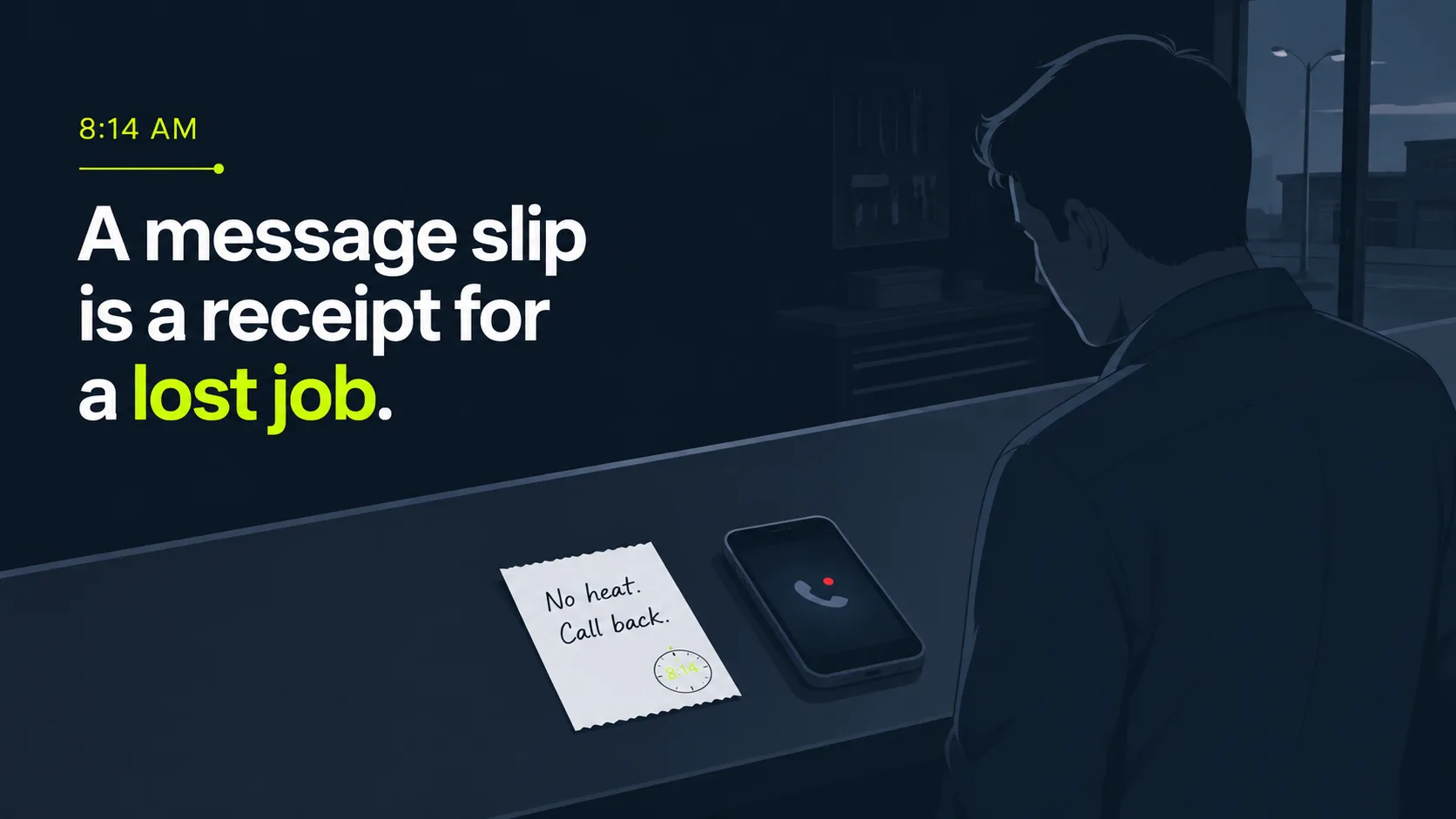
Go back to that 8:14 a.m. slip on the counter. The whole point of answering the phone is to fill the calendar, not the message pile. The verdict is consistent with the data: an AI voice agent books and confirms jobs 24/7 on your calendar, while a telephone answering service mostly relays messages for a callback. Because responding within five minutes makes you 21 times more likely to qualify a lead (Harvard Business Review, 2011), 56% of customers try another channel after a missed window (Nextiva, 2025), and fewer than 3% of voicemail callers leave a message (Invoca, 2024), the model that schedules the job on the call protects the most revenue.
You don't have to choose between booking power and a human touch. Let an AI voice agent catch the after-hours, overflow, and routine calls and book them on the spot, then transfer the urgent and sensitive ones to a live person. Want to see what your unanswered calls are actually worth this month? Book a Free Call Audit, a 20-minute, no-pressure call where we map exactly where jobs are slipping and what capturing them would add to your calendar. No slips on the counter. No callbacks you'll forget. Just booked work.
Written and reviewed by Maksim Skorokhod, Founder of SkoreFlow, who builds AI answering and voice automation for small service businesses. Last reviewed: 2026-06-07.