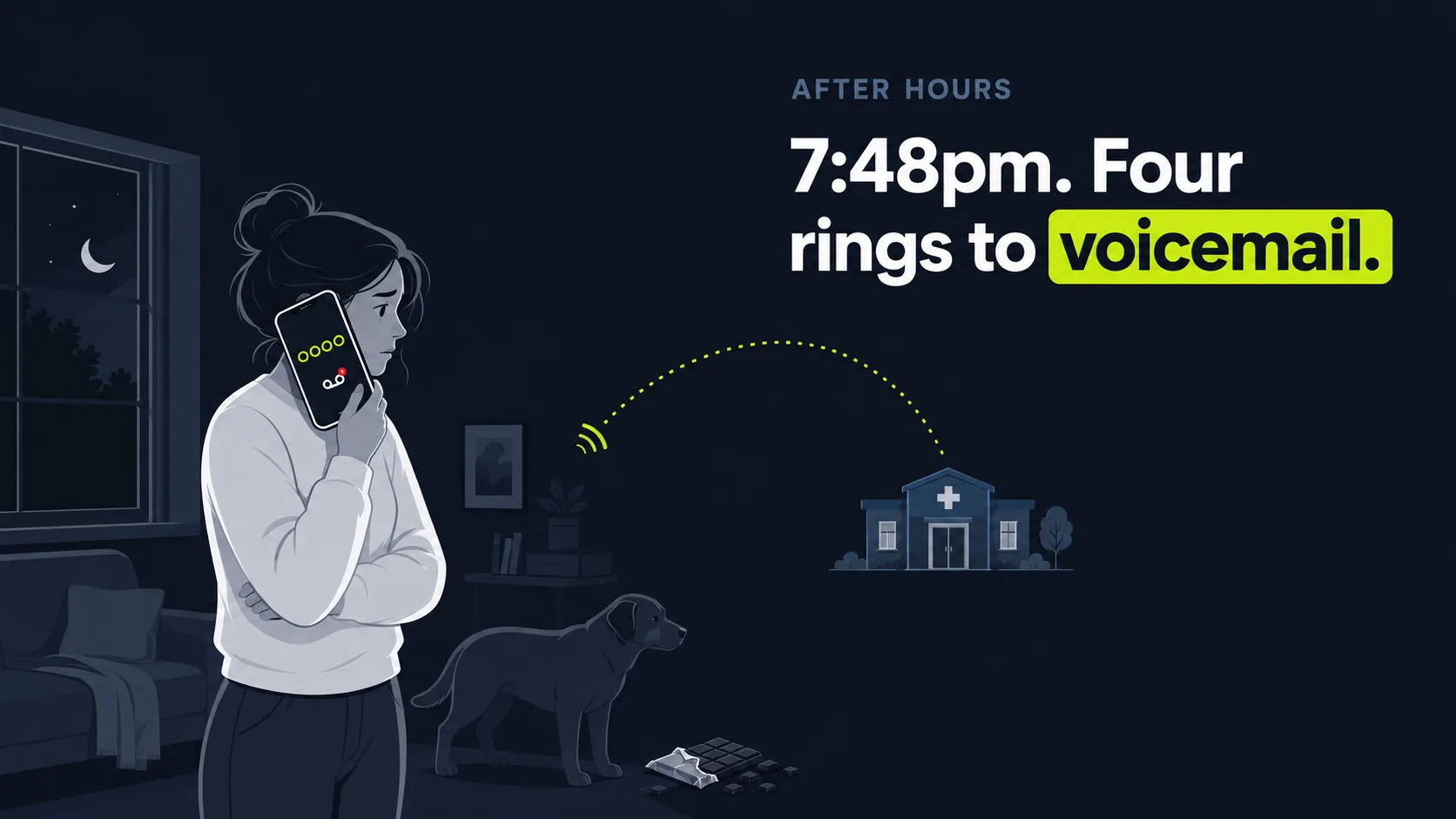
Why do vet clinics lose clients to missed and after-hours calls?
Vet clinics lose clients because the phone rings when staff can't answer, and most callers won't try again. For service businesses, 27% of inbound calls go unanswered, and fewer than 3% of callers sent to voicemail leave a message, according to Invoca (2024). A missed call to a clinic is rarely a delayed booking. It's usually a client gone elsewhere.
Picture the lobby at 4:30pm. A retriever is barking at the cat carrier by the door, two checkouts are stuck on a frozen card reader, and a vaccine room is running long. The phone is ringing, and it's the first thing to drop. Front-desk staff aren't lazy. They're outnumbered. And callers don't wait around. After a missed response window, 56% of customers immediately try another channel and 28% abandon the company entirely, per Nextiva (2025). For a clinic, that next channel is often the practice down the road.
So when does the phone ring hardest? Often when nobody's there. Roughly 11% of patient calls to healthcare providers happen during off-hours or weekends, according to Hyro (2023). For pets, those evening and weekend calls are exactly the moments owners panic and start dialing the next clinic on the list.
Speed decides who keeps the client. Firms that contact a lead within five minutes are 21 times more likely to qualify it, and roughly 100 times more likely to connect, than firms that wait 30 minutes, according to Harvard Business Review (2011). A new pet owner shopping for a vet rarely waits for tomorrow's callback. By the time you return the message, she's already in someone else's exam room.
And there's quieter money on the line. The average veterinary practice saw 15 patients a day in 2024, down from 16.6 in 2021, per the AVMA (2025). When daily volume softens, every captured call is a chair you'd otherwise leave empty. One dropped call a day, turned into one new client a week, fills a slot you already pay staff, rent, and equipment to keep open.
Citation capsule: For service businesses, 27% of inbound calls go unanswered and fewer than 3% of voicemail callers leave a message, per Invoca (2024). With roughly 11% of patient calls landing off-hours (Hyro, 2023), a clinic without after-hours coverage hands frightened owners and booked visits to a competitor.
Here's what we've found working with practices: the call you most want to catch is the one your team is least able to answer. A dog that ate something at 8pm. A cat straining in the litter box on a Sunday. Those owners are scared and ready to drive somewhere right now. The clinic that answers in that moment doesn't just keep one visit. It keeps the lifetime of vaccines, dentals, and senior care behind it.

For the full picture on how an AI voice agent recovers those dropped calls, read about our consultation booking voice agent for clinics.
How does SkoreFlow book appointments and handle prescription-refill requests?
SkoreFlow's Consultation Booking Voice Agent answers in under 30 seconds and runs a structured script grounded in your clinic's site, services, and brand, so it captures the same details your receptionist would, on every call, without fatigue. It's HIPAA-aware, works with your practice-management system, and goes live in about 5 days. Because firms that respond within five minutes are 21 times more likely to qualify a lead, per Harvard Business Review (2011), answering instantly is the single best move a clinic can make.
Think of it as a receptionist who never steps away to walk a patient back. The booking and refill flow follows a consistent order:
- Greet and identify the reason for the call. The agent confirms your clinic name and asks what the caller needs: a new appointment, a recheck, a refill, or an urgent concern.
- Capture the patient and client details. Owner name, phone, email, pet name, species, and reason for the visit, recorded verbatim.
- Match the visit type to your schedule. Wellness exam, vaccine, sick visit, recheck, or surgery consult, each mapped to the right appointment length.
- Triage for urgency. The agent distinguishes a routine booking from a symptom that needs same-day attention or escalation.
- Book or reschedule the appointment. It offers open slots and confirms the visit directly on your calendar.
- Handle the prescription-refill request. It logs the pet, medication, and pharmacy, then routes the request to your team for the required vet approval.
- Route and notify. A clean call summary lands with your front desk or in your practice software within seconds, and true emergencies escalate to the on-call vet.
Refills are the quiet win here. In our experience setting up scripts for clinics, refill calls are high-volume and low-complexity, and they pile up at the desk like junk mail. Each one interrupts a check-in. Letting the agent capture the pet, the medication, and the pharmacy, then hand the approval to a tech or DVM, frees your front desk to focus on the patients standing right in front of them. The payoff is calmer staff, a shorter hold queue, and one fewer reason for a client to give up and call elsewhere.
Citation capsule: Firms that contact a lead within five minutes are 21 times more likely to qualify it and 100 times more likely to connect than those waiting 30 minutes, per Harvard Business Review (2011). An AI agent answering on the first ring books the appointment and captures the refill while the owner is still on the line.
| Response time | Likelihood of qualifying the lead |
|---|---|
| Within 5 minutes | 21x more likely |
| After 30 minutes | Baseline (1x) |
Want to compare coverage for other practice types? Browse our consultation booking voice agent, built for med spas and dental, medical, and veterinary front desks.
Urgent-pet triage: routing the worried owner to the right level of care
Urgent-pet triage decides, by your protocols, whether a caller should wait for normal hours, come in today, or head straight to an emergency hospital. This matters because most after-hours pet calls are not true emergencies. In one survey of 475 vets and nurses, 71.7% of out-of-hours veterinary calls were judged "unnecessary," while 28.2% were genuine emergencies, according to Vet Times (2021). That figure is UK-based, so treat it as directional, but the lesson holds: a good triage filter protects both the client and your on-call vet.
The volume is meaningful, and so is the worry behind it. A peer-reviewed study of after-hours patient phone calls found an average of 8.6 calls per shift, with 40.3% concerning pain and 4.1% leading to a subsequent emergency visit, per Annals of Medicine and Surgery (2023). The human-medicine numbers mirror the pattern vets know cold: a lot of fear, a smaller slice of true crisis. The hard part is sorting one from the other at 11pm without dragging your DVM out of bed for a hairball.
How the agent triages an urgent pet call
The agent works from your written protocols, never improvising medical advice. It asks structured questions about the symptom, the species, and the timeline, then matches the answers to your rules. A clearly non-urgent question gets a next-business-day booking. An ambiguous case gets escalated to a human. The agent's job is to sort and route, not to diagnose. That line stays bright.
When to advise the client to seek emergency care
For red-flag symptoms you define, like difficulty breathing, suspected bloat, seizures, suspected poisoning, or trauma, the agent advises the client to seek emergency care immediately and provides the partner ER details you've set. It can connect the caller to your on-call vet at the same time. The owner gets a calm, fast answer in the worst moment of her week, which is exactly when a clinic earns loyalty that lasts years.
Most clinics frame after-hours triage as protecting the vet's sleep. We've found it cuts both ways. It also protects the client from a hefty ER bill she didn't need, and protects you from the no-shows and one-star reviews that follow a panicked, unnecessary referral. Remember that chocolate-Labrador call from the top of the page. Good triage is what turns that 7:48pm panic into a booked recheck instead of a lost client. Done well, it keeps clients, and it buffers your on-call vet at the same time.

Citation capsule: A survey of 475 vets and nurses found 71.7% of out-of-hours veterinary calls were "unnecessary" and 28.2% were genuine emergencies, per Vet Times (2021). Structured triage routes the worried-but-fine majority to a next-day visit while rushing the real emergencies to an ER or on-call DVM.
See why round-the-clock coverage matters in our guide to the 24/7 consultation booking voice agent.
AI vs. traditional veterinary answering service: which fits your clinic?
The core trade-off is coverage versus headcount: an AI service answers every call instantly at a lower cost, while a traditional live service offers human voices at a premium with limited capacity. Live virtual receptionist plans at one national provider run from $250/month for 50 minutes to $1,725/month for 500 minutes, per Ruby's pricing page (2026), which works out to roughly $3.45 to $5.00 per receptionist-minute.
Both models beat voicemail. The question is which mix of cost, capacity, and clinical-protocol handling fits your call volume and after-hours needs. The difference that tends to decide it: a live service like Ruby takes a message and leaves you to call back, while SkoreFlow's voice agent books the consult on the call. One hands you homework. The other hands you a confirmed appointment.
| Factor | AI veterinary answering service | Traditional live answering service |
|---|---|---|
| Availability | 24/7, no hold time, answers on first ring | Business hours or after-hours desk; possible hold queue |
| Call capacity | Handles simultaneous calls during a rush | Limited by staffed agents on duty |
| Cost signal | Typically below live plans; AI receptionist tiers from ~$95/mo, per Smith.ai | $250-$1,725+/mo at ~$3.45-$5.00/min, per Ruby |
| Consistency | Same triage and booking script every call | Varies by agent and shift |
| Appointment intake | Structured patient, species, and reason capture | Depends on agent training and script adherence |
| Triage | Follows your written protocols; escalates ambiguity | Generalist agents often lack veterinary protocols |
| Human escalation | Routes true emergencies to on-call vet or partner ER | Live agent judgment; may just take a message |
| Best for | After-hours coverage, refill volume, tight budgets | Clinics wanting a human voice on every routine call |
Most owners frame this as AI or human. We've found the better frame is AI plus human escalation. The AI catches the 11pm "my dog just ate chocolate" call a generic answering desk would have logged as a message, applies your protocol, and hands a real emergency straight to your on-call vet. You stop trading coverage for clinical judgment. You get both.
Citation capsule: Live virtual receptionist plans cost roughly $3.45 to $5.00 per receptionist-minute, derived from Ruby's published 2026 pricing ($250/mo for 50 minutes to $1,725/mo for 500 minutes). AI answering tiers, starting near $95/month per Smith.ai (2026), let clinics cover every call for far less.
What does a veterinary answering service cost, and what is the ROI?
Pricing spans a wide band, but the ROI math is simple: a handful of recovered appointments usually pays for months of coverage. Hiring a full-time receptionist instead means a median wage of $37,230 a year before benefits, per the U.S. Bureau of Labor Statistics (2024). An AI service covers the same calls around the clock for a fraction of that.
So where does the return actually come from? Calls you're losing right now. Remember the data: 27% of service calls go unanswered and fewer than 3% of voicemail callers leave a message, per Invoca (2024). And missed bookings aren't the only leak. The average no-show carries a documented cost of about $196 per appointment, with no-show rates averaging 18.8% across clinics, per BMC Health Services Research (2016). That figure comes from human medicine, so treat it as directional, but an agent that confirms and reschedules helps protect any clinic's schedule.
Illustrative example (industry-based scenario, not a real client): Picture a 2-DVM clinic missing 12 calls a week. Over a year that's roughly 624 missed calls. With 27% of service calls going unanswered and almost no one leaving a voicemail (per Invoca, 2024), even those numbers point one way. Against a median in-house receptionist wage of $37,230 a year (BLS, 2024), recapturing even a single booked visit a week would cover SkoreFlow's voice agent, which starts at $497/month, many times over. And the risk sits with us, not you: SkoreFlow backs the build with a guarantee, recover $3,000 in 30 days or your setup is refunded. Plug your own visit value into the calculator below.
Want a dollar figure for your practice? Use our missed-call revenue calculator to estimate what unanswered calls cost you.
Citation capsule: A single no-show carries a documented cost of about $196 per appointment, with no-show rates averaging 18.8% across clinics, per BMC Health Services Research (2016). Against a median in-house receptionist wage of $37,230/year (BLS, 2024), AI answering captures bookings and confirms appointments around the clock for far less.
Why do veterinary clinics choose SkoreFlow?
Clinics choose SkoreFlow because it closes the exact gap the data exposes: a live answer on every call, structured appointment and refill intake, protocol-based triage, and instant escalation to your on-call vet when a pet is in real trouble. Unlike a live answering service that takes a message, the voice agent books the consult on the call, and it's HIPAA-aware, works with your practice-management system, and goes live in about 5 days. With 27% of service calls going unanswered, per Invoca (2024), simply answering well is an edge most practices haven't claimed yet.
The approach fits how pet owners actually search now. Across consumers, 45% now use AI tools to find local services, up from 6% a year earlier, per BrightLocal (2026). Access shapes loyalty, too: 35% of patients say they would switch doctors over poor digital experiences, per a Software Finder survey reported by eMarketer (2026). That switching figure is from human medicine, so read it as directional, but pet owners weigh access the same way. A clinic that always answers protects the relationship before it's ever tested.
There's a fair objection here: nobody wants to be trapped talking to a robot. The agent respects that. 64% of customers would prefer companies didn't use AI in customer service, and their top concern is that it will get harder to reach a person, per Gartner (2024). So the agent sounds natural and hands off to a human the moment a caller needs one. It never traps a worried owner in a phone tree. That's the whole point: a fast answer that knows when to step aside.
One thing we'll say plainly: we don't publish invented testimonials or named clinic results. The practices that benefit most are the ones currently sending after-hours and refill calls to voicemail. Plug the leak first, then optimize. That order tends to produce the fastest, most honest wins.
Citation capsule: Consumer use of AI tools to find local services jumped to 45% in 2026, up from 6% a year earlier (BrightLocal), yet 64% still prefer companies didn't use AI in service, citing fear of not reaching a human (Gartner, 2024). A veterinary agent that answers naturally and escalates to a person wins both phone and AI-driven discovery.

Stop sending pet owners to voicemail
Go back to that 7:48pm chocolate-Labrador call. The pattern in the data is hard to ignore: 27% of service calls go unanswered, almost no one leaves a voicemail, and roughly 11% of patient calls arrive after hours when owners are most worried. A veterinary answering service closes that gap. It answers every call, books the visit, handles the refill, and triages by your protocols. Real emergencies go straight to your on-call vet.
You don't have to choose between caring for the patient in the room and answering the phone. Let the agent catch the overflow, refill, and after-hours calls, apply your triage rules, and hand you only the cases that need a DVM. Curious what those dropped calls are quietly costing you? Book a free consult audit, a 20-minute, no-pressure call where we map where clients are slipping and what capturing them would be worth. No script, no obligation, and the numbers are yours to keep either way.
For a quick estimate before you book, run your numbers in the missed-call revenue calculator.
Written and reviewed by Maksim Skorokhod, Founder of SkoreFlow, who builds AI answering and voice automation for small service businesses. Last reviewed: 2026-06-07.