Which virtual receptionist fits your small business: who wins and when?
The fast answer: choose AI for high call volume, after-hours coverage, and appointment booking; choose a live agent for low-volume, emotionally sensitive, or highly complex calls. Phone calls are the top-rated lead source for 66% of SMBs, ahead of forms, in-person, and email, per BIA/Kelsey (2014). Missing them is expensive either way.
That phone-as-top-channel finding is older, but the dynamic endures. Inbound callers are still high-intent buyers, and businesses still miss them. A 2024 secret-shopper audit found only 40% of law firms even answered the phone, per Clio (2024). The driver isn't the technology. It's what your calls demand. Most owners skip past one detail: most service-business calls are routine. Hours. Pricing. "Can you come Tuesday?" Those are exactly the calls AI handles well and cheaply. A smaller slice, distressed callers, complicated legal intake, delicate medical questions, need a human ear. So match the tool to the call instead of picking a side for every call you get.
Here is a quick decision table to point you in the right direction before we get into the details.
| If this describes you... | Lean toward |
|---|---|
| High call volume, mostly routine questions | AI virtual receptionist |
| Many calls after 5pm or on weekends | AI virtual receptionist (flat 24/7) |
| You need appointments booked, not messages | AI virtual receptionist |
| Tight or predictable monthly budget | AI virtual receptionist (flat fee) |
| Low volume, every call is high-stakes or emotional | Live virtual receptionist |
| Complex intake needing human judgment each time | Live virtual receptionist |
| A mix of both | Hybrid: AI answers, escalates to a human |
Citation capsule: For small businesses, an AI virtual receptionist wins on cost and 24/7 coverage while a live agent wins on nuance, since phone calls are the top-rated lead source for 66% of SMBs, per BIA/Kelsey (2014), yet only 37.8% of small-business calls are answered by a live person, per 411 Locals (2016). The best fit depends on call type and volume.

For the standalone option built around answering and booking jobs, see our missed-call recovery service overview.
Cost comparison: AI vs live virtual receptionist
AI is far cheaper at almost any real call volume. AI answering runs about $50 to $300 a month flat, while human virtual receptionist services run $300 to $2,000+ a month, per CloudTalk (2025). The reason is the billing model. Live agents charge per minute, so your cost rises with every call. AI plans hold flat.
The per-minute math is the whole gap. Live virtual receptionist services charge roughly $1.50 to $5.00 per receptionist-minute, per Ruby (2026) and AnswerConnect (2025). Ruby's published plans run $250/mo for 50 minutes up to $1,725/mo for 500 minutes, per Ruby (2026), while Posh charges $1.90 to $2.30 per minute in overage, per Posh (2026). AI receptionist plans, by contrast, start at $95/month and tier on call volume, per Smith.ai (2026). All vendor prices were checked on the providers' own pages as of June 2026. Confirm current rates before you sign, since pricing pages change.
The two models stack up like this on cost, line by line.
| Cost factor | AI virtual receptionist | Live virtual receptionist |
|---|---|---|
| Monthly range | ~$50-$300/mo flat, per CloudTalk (2025) | ~$300-$2,000+/mo, per CloudTalk (2025) |
| Per-minute charge | None on flat plans | ~$1.50-$5.00/min, per Ruby (2026) / AnswerConnect (2025) |
| Published plan example | From $95/mo by volume, per Smith.ai (2026) | $250/mo (50 min) to $1,725/mo (500 min), per Ruby (2026) |
| Overage | Tier upgrade as you grow | $1.90-$2.30/min, per Posh (2026) |
| Cost on a busy week | Stays flat | Rises with every minute |
The per-minute model has a timing flaw, and it bites at the worst moment. Your busiest call week, a heat wave for an HVAC shop or a cold snap for a plumber, is also your most expensive week on a live plan. The phone rings off the hook, your crews are slammed, and your answering invoice quietly doubles. Flat AI pricing inverts that. The week you capture the most jobs is the week the price stays put. Cost and demand stop moving together, so the busy season stops punishing you for being busy.
Citation capsule: An AI virtual receptionist costs about $50 to $300 a month flat, while a live virtual receptionist runs $300 to $2,000+ a month, per CloudTalk (2025). Live services bill $1.50 to $5.00 per receptionist-minute, per Ruby (2026) and AnswerConnect (2025), so the cost gap widens with every call you receive.
Estimate your own break-even with our missed-call revenue and ROI calculator.
Does it book appointments or just take messages?
This is where the models split sharply. A live virtual receptionist typically takes a message or, on higher plans, schedules into your calendar. An AI virtual receptionist is built to book and confirm appointments directly. That matters because callers rarely follow up: fewer than 3% of callers pushed to voicemail actually leave a message, per Invoca (2024).
Picture the message slip on your truck dash at the end of a long day. A name. A number. "Call back about a faucet." It looks like a captured customer. It isn't. A message is a task you still have to chase, and the caller may book elsewhere before you dial back. Speed is the deciding factor here. Firms that respond within five minutes are 21 times more likely to qualify a lead than those who wait 30 minutes, per Harvard Business Review (2011). An AI agent that books on the first call captures the job while the caller is still on the line, before that slip ever exists.
What does "books appointments" mean? It means the receptionist writes a confirmed appointment straight into your scheduling calendar or field-service software during the call, including the time, the service, and the customer details, rather than just recording a message for you to act on later.
In our work setting up answering for service businesses, the message-versus-booking gap is the single thing owners underestimate most. They assume a captured message equals a captured customer. In practice, a chunk of those messages never convert, because the caller already dialed the next shop on the list before anyone rang them back. Run the numbers on your own line. Ten messages a week, half of them already booked elsewhere by the time you call, at a few hundred dollars a job, is real money walking out the door every single week. Booking on the first call closes that leak.
| Capability | AI virtual receptionist | Live virtual receptionist |
|---|---|---|
| Take a message | Yes | Yes |
| Book appointments on the call | Yes, into your calendar | Sometimes, on higher plans |
| Confirm and send reminders | Yes, automated | Varies; often manual or extra |
| Write back to CRM / scheduler | Usually included | Often an add-on or message-only |
| Answer routine questions | Yes, from your script | Yes |
Citation capsule: An AI virtual receptionist books and confirms appointments directly into your calendar, while a live agent often only takes a message. This matters because fewer than 3% of voicemail-bound callers leave a message, per Invoca (2024), and firms answering within five minutes are 21 times more likely to qualify a lead, per Harvard Business Review (2011).

See exactly how missed-call recovery books jobs end to end.
After-hours coverage and speed to answer
AI wins decisively on both. An AI virtual receptionist answers on the first ring, 24/7, at the same flat price, while live desks staff limited hours and often surcharge nights and weekends. This matters because real demand lands after hours: restaurants receive 51% of their calls after 5pm, per BrightLocal (2019).
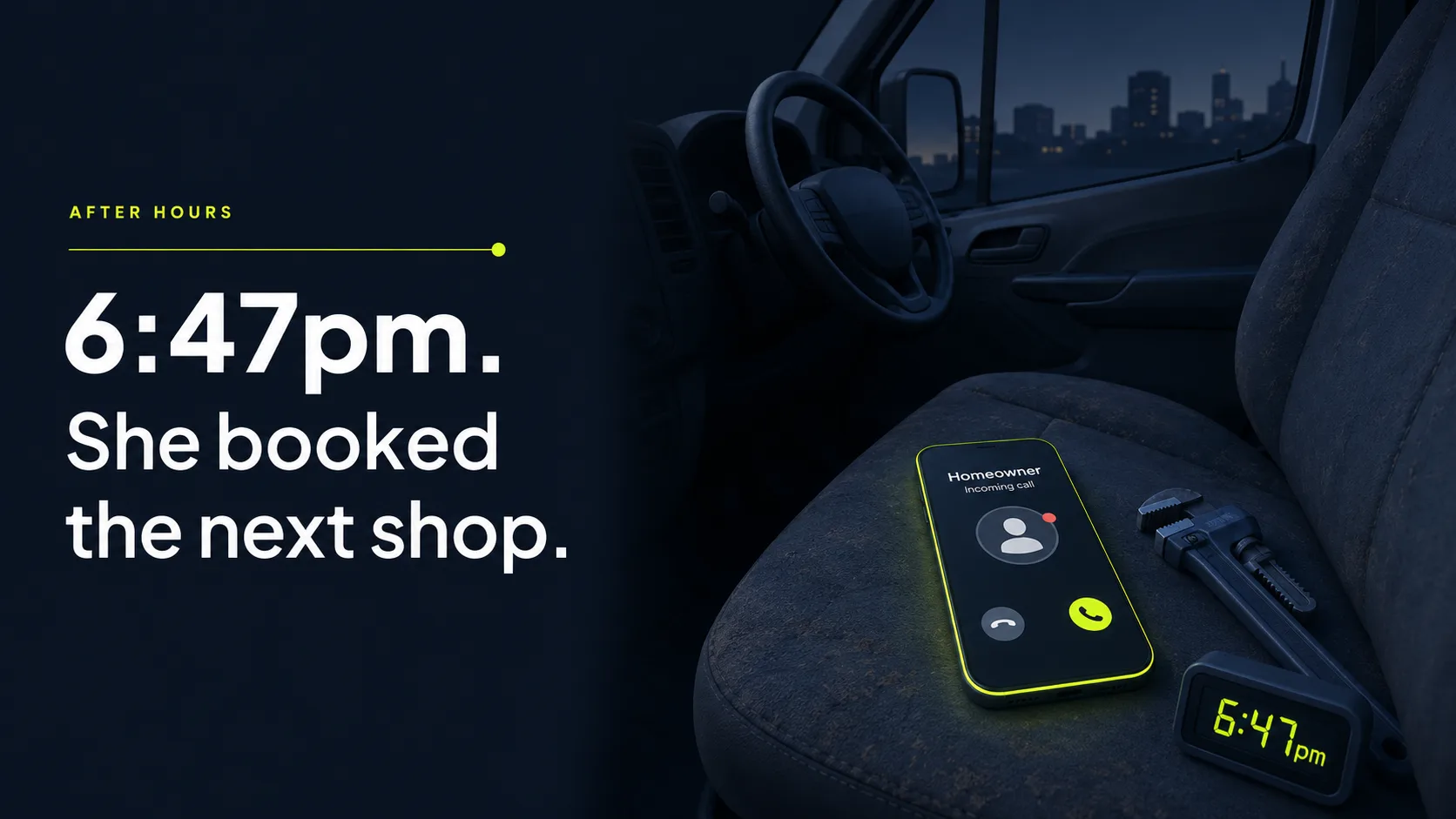
Remember that 6:47pm leaking water heater from the start of this piece? That's not an edge case. That's your real schedule. After-hours coverage is not a niche concern: even general local businesses get roughly 6% of calls on weekends, but service verticals run far higher. Locksmiths receive 34% of calls after 5pm plus another 8% before 9am, per BrightLocal (2019). A 9-to-5 live desk simply cannot catch that volume without paying for overnight staffing.
Speed is the other half, and customer patience is thin. A slow answer leaks straight to a competitor. 54% of callers hang up within eight minutes on hold, and 56% of customers immediately try another channel after a missed response window, both per Nextiva (2025). An AI agent answers instantly and never puts a caller in a queue, so there is no hold to abandon and no voicemail to ignore. The first ring is the whole ballgame.
| Factor | AI virtual receptionist | Live virtual receptionist |
|---|---|---|
| Hours covered | 24/7, including nights and weekends | Set hours; 24/7 costs more |
| After-hours pricing | Same flat rate | Often a surcharge |
| Speed to answer | Instant, first ring | Fast, but can queue at peak |
| Simultaneous calls | Many at once | One per agent |
| Hold time | None | Possible during busy windows |
Citation capsule: An AI virtual receptionist answers 24/7 at the same flat price, while live desks often surcharge after hours. This matters because restaurants get 51% of calls after 5pm, per BrightLocal (2019), and 54% of callers hang up within eight minutes on hold, per Nextiva (2025). Instant answering captures calls a 9-to-5 desk misses.
Read why 24/7 answering captures more jobs than a 9-to-5 desk.
When is a live virtual receptionist better, and when is AI better?
Neither tool wins every call. A live virtual receptionist is the better fit when conversations are sensitive, complex, or low in volume, while an AI virtual receptionist is the better fit when calls are routine, high in volume, after hours, or need a booking. One caveat shapes the whole choice: 64% of customers would prefer companies didn't use AI in customer service, per Gartner (2024), so clean human handoff is non-negotiable.
That skepticism number scares a lot of owners off AI entirely. It shouldn't. The top consumer worry about AI isn't the voice itself. It's that AI makes it harder to reach a human, per Gartner (2024). So the objection isn't really about AI answering. It's about AI trapping. Position AI as the thing that answers callers instantly, not the thing that blocks them, and the worry mostly dissolves. The strongest setup is usually hybrid: AI answers and books the routine majority, then escalates the sensitive minority to a person.
When a live virtual receptionist is the better choice
- Your call volume is low and every call is high-value enough to justify per-minute pricing.
- Calls are emotionally sensitive, such as distressed patients or grieving clients.
- Intake is genuinely complex and needs human judgment on each call.
- Your callers strongly prefer a human and will not tolerate automation.
- You handle a few nuanced calls a day rather than dozens of routine ones.
When an AI virtual receptionist is the better choice
- You take a high volume of mostly routine calls and want to control cost.
- A lot of your calls arrive after hours or on weekends.
- You need appointments booked and confirmed, not just messages logged.
- You want one predictable monthly bill instead of a per-minute meter.
- You need to answer several callers at once without missing anyone.
So the "AI versus live" framing is often a false choice for service businesses. Most shops do not need a human on every call. They need a human on the 5% to 15% that truly warrant one. Run AI on the routine majority, escalate the rest, and you get human-grade handling where it counts at AI-grade cost everywhere else. You stop paying premium rates to take a message about somebody's clogged drain.
Citation capsule: A live virtual receptionist suits low-volume, sensitive, or complex calls, while AI suits routine, high-volume, after-hours, and booking calls. Because 64% of customers would prefer companies didn't use AI in service and the top concern is reaching a human, per Gartner (2024), a hybrid that escalates cleanly to a person is usually the strongest setup.

Compare the missed-call recovery option in detail to see what it handles and when it hands off.
How does SkoreFlow approach the AI vs live decision?
SkoreFlow's missed-call recovery answers and books routine calls for home-service trades, then hands off to you for the ones a human should take. The design follows the evidence: only 37.8% of small-business calls are answered by a live person, per 411 Locals (2016), and a missed call rarely calls back. That study is older, but the pattern persists in newer data: a 2024 secret-shopper audit found only 40% of law firms answered the phone, with 48% effectively unreachable, per Clio (2024). The goal is to book every callable job, not take a message, without forcing a human onto every call.
The practical difference from a live answering service like Ruby comes down to this. A live desk takes a message and leaves you to call the customer back, after they've already moved on. SkoreFlow qualifies and books the estimate on the call, while the homeowner is still listening. It answers in 0.4 seconds, filters spam, and writes the confirmed job into your scheduler. Integrations cover ServiceTitan, Jobber, Housecall Pro, and Google Calendar. The setup is TCPA-aware and goes live in 48 hours, so the next heat wave isn't another lost weekend.
The flat monthly model is deliberate, and it solves the exact timing trap we covered earlier. Live virtual receptionists bill $1.50 to $5.00 per minute, per Ruby (2026) and AnswerConnect (2025), which spikes the bill on your busiest weeks. SkoreFlow plans run flat: Starter at $197/mo ($497 setup), Professional at $397/mo ($997 setup), and Enterprise at $697/mo ($1,497 setup). They cover nights and weekends at the same price, where verticals like restaurants and locksmiths see heavy demand, per BrightLocal (2019). Plans carry a guarantee: 5 booked jobs in 30 days or your setup fee back. You don't gamble on the result; the result is the deal.
Illustrative scenario (industry benchmark model, not a real client): Picture a 7-technician plumbing shop missing roughly 8 booking calls a week after hours. Across a year, that is about 400 missed booking attempts, and with under 3% of voicemail callers leaving a message, per Invoca (2024), nearly all are lost. A representative recovery benchmark for a shop this size is roughly $14,200/mo in returned jobs and a 94% answer rate, which can return many times a flat monthly fee. Want your own numbers? Run the missed-call revenue calculator, or book a free call audit and we'll map what those calls are worth.
Citation capsule: SkoreFlow's missed-call recovery answers and books routine trade calls on a flat monthly plan, then escalates to a human when needed. The approach follows the data: only 37.8% of small-business calls are answered live, per 411 Locals (2016), and fewer than 3% of voicemail callers leave a message, per Invoca (2024), so booking the job beats taking a message.

Estimate your savings with the missed-call revenue calculator.
The bottom line: match the receptionist to the call
The decision is simpler than it looks. An AI virtual receptionist wins on cost, after-hours coverage, and appointment booking, running flat at $50 to $300 a month versus $300 to $2,000+ for live services, per CloudTalk (2025). A live agent earns its per-minute rate on low-volume, sensitive, or genuinely complex calls. For most service businesses, AI handles the routine majority and a human takes the rest.
Picture that 6:47pm caller with the leaking water heater one more time. With only 37.8% of small-business calls answered live and fewer than 3% of voicemail callers leaving a message, her call was never a delayed job. It was a lost one, booked by the next shop before you reached the driveway. That's the ledger that matters. Capturing and booking even a handful of those calls a month typically dwarfs a flat AI subscription, which is why the math almost always points the same way. Want to know where your break-even lands? Run the missed-call revenue calculator, or book a free call audit, a 20-minute, no-pressure look at what your unanswered calls are worth, with the setup live in 48 hours and your setup fee back if you don't book 5 jobs in 30 days.
Estimate your cost and break-even with the missed-call revenue calculator, or see how missed-call recovery answers and books every call.
Written and reviewed by Maksim Skorokhod, Founder of SkoreFlow, who builds AI answering and voice automation for small service businesses. Last reviewed: 2026-06-07.