The short rule: who needs 24/7 and who doesn't
The short rule is simple: you need 24/7 when missed after-hours calls cost you real jobs, and you can skip it when they don't. The evidence that they do cost you is solid, because callers don't wait. After a missed response window, 56% of customers immediately try another channel and 28% abandon the purchase entirely, per Nextiva (2025). An unanswered call at 9pm usually becomes a competitor's job by 9:05.
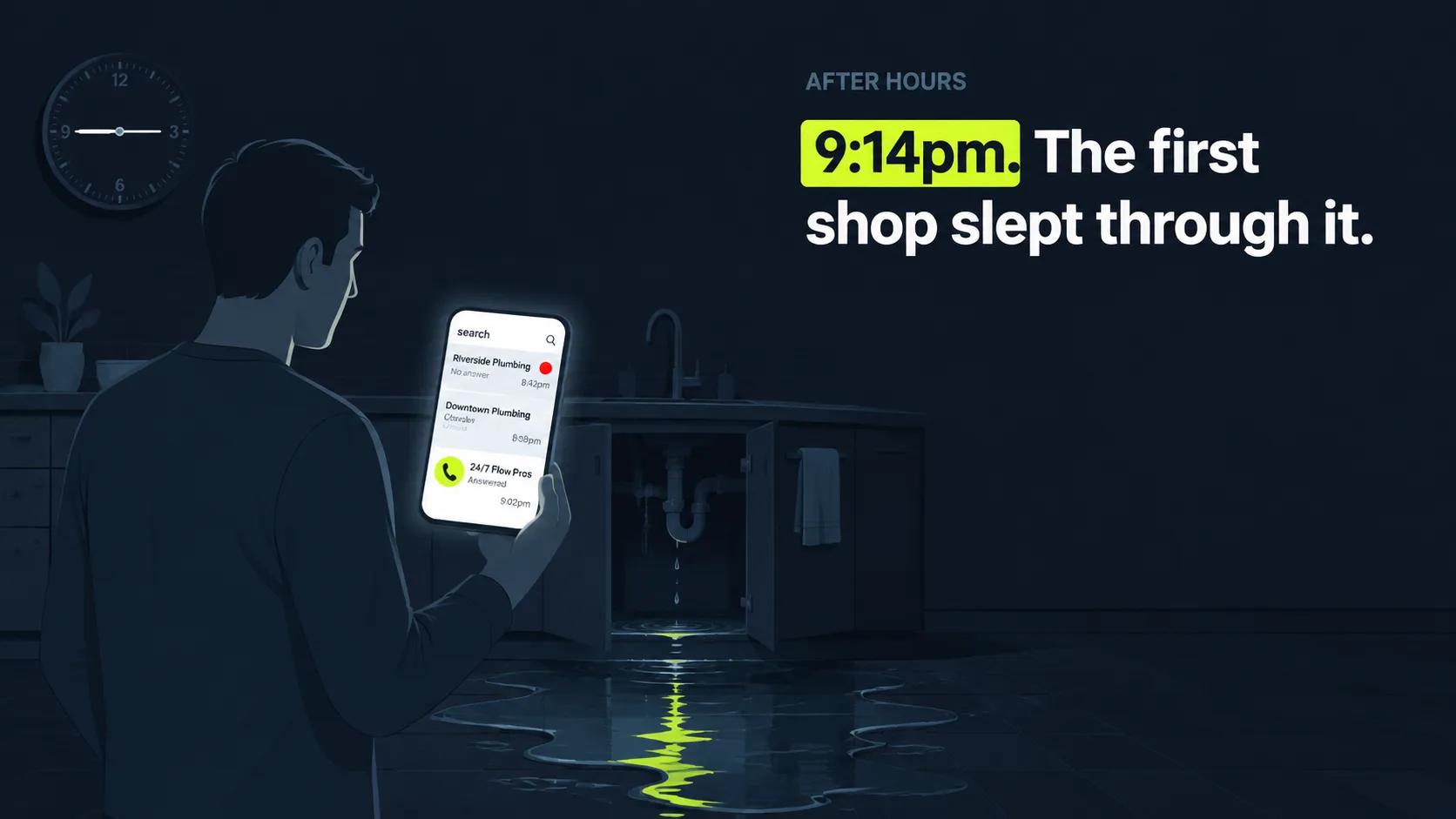
Most owners frame this as a staffing question. It isn't. Think about the woman in the flooded kitchen: she wasn't shopping for a receptionist, and neither were you. This is a revenue question with a yes-or-no test. If a call you can't answer tonight would have been a paying job, every one of those calls is money walking out the door. The decision tree below turns that test into something you can answer in two minutes.
Here's the trap, and it catches almost everyone. You judge after-hours demand by what you currently see, and you cannot see the calls you miss. The 9pm call rang out, hit voicemail, and the caller dialed the next listing without leaving a trace on your books. The calls you remember answering nudge you toward "we're fine." Measuring beats guessing. The industry timing data below is a faster proxy than waiting a year to collect your own.

Citation capsule: You need a 24/7 answering service when missed after-hours calls cost you jobs, because callers rarely wait: after a missed response window, 56% of customers immediately try another channel and 28% abandon the purchase entirely, per Nextiva (2025).
For the deeper version, read our guide on how AI handles after-hours calls for emergency trades.
Decision tree: do you need 24/7 coverage?
You need 24/7 coverage when after-hours calls are frequent, valuable, or urgent; you can usually skip it when they're rare and low-stakes. Getting this right matters because phone leads are high-intent: 66% of SMBs rate inbound calls a "good" or "excellent" lead source, the top channel ahead of forms and email, per BIA/Kelsey (2014). A missed call isn't a missed click. It's your best lead, hanging up. Run your situation through the two lists below.
You need 24/7 if...
- A real share of your calls land after 5pm or on weekends. If nights and weekends drive even 20-30% of inbound calls, missing them is missing a fifth of your pipeline.
- Your jobs are high-value. When one captured call is worth hundreds or thousands of dollars, a single recovered after-hours job can cover a month of coverage.
- Customers call you mid-emergency. Burst pipes, lockouts, no-heat nights, and outages don't wait for office hours, and the first business to answer usually wins the job.
- You're losing callers to voicemail. If your "after-hours plan" is a voicemail greeting, you're effectively closed, because most callers won't leave a message.
- You compete with shops that already answer. If a rival picks up at 8pm and you don't, the comparison happens without you in the room.
- Your callbacks are slow. Speed wins: firms that contact a lead within 5 minutes are 21 times more likely to qualify it than firms that wait 30 minutes, per Harvard Business Review (2011).
You probably don't if...
- Your calls cluster firmly inside business hours. If after-hours volume is a trickle, the math may not justify dedicated coverage yet.
- A missed call rarely walks. If your customers are loyal, scheduled well in advance, and happy to call back tomorrow, urgency is low.
- Your work isn't time-sensitive. No emergencies, no same-day expectation, no race to be first.
- A simple after-hours message genuinely works for your customers. Rare, but real for some appointment-only or referral-only businesses.
Land in the "probably don't" column? Good, you just saved yourself a monthly bill. But watch the trend. Demand shifts, and always-on answering has gotten cheap enough that the bar you need to clear keeps dropping. The shop that says "we're fine" today is often the shop scrambling next winter.
- You need 24/7 if → a real share of calls land after 5pm or on weekends; jobs are high-value; customers call mid-emergency; you're losing callers to voicemail; rivals already answer; or your callbacks are slow.
- You probably don't if → calls cluster firmly in business hours; a missed call rarely walks; your work isn't time-sensitive; or a simple after-hours message genuinely works for your customers.
- On the fence? → pull your call log by hour first, then re-run these two lists.
Citation capsule: You need a 24/7 answering service if after-hours calls are frequent, high-value, or urgent, and you can skip it if they're rare and low-stakes. The stakes are high because inbound phone calls are the top-rated SMB lead source: 66% of small businesses rate them a "good" or "excellent" lead source, per BIA/Kelsey (2014).
Still weighing options? Compare round-the-clock choices in our buyer's guide to answering services for small business.
Are you losing after-hours business? When calls come in by industry
You're likely losing after-hours business if you're in a vertical where calls skew late, and the data shows several do, hard. Local businesses get 94% of calls Monday to Friday on average, but restaurants pull 32% of calls on weekends and locksmiths 31%, per BrightLocal (2019). That average hides the businesses that bleed the most after dark.
The timing gets sharper when you look hour by hour. Restaurants receive 51% of their calls after 5pm, and locksmiths get 34% after 5pm plus another 8% before 9am, meaning a clear majority of locksmith calls arrive outside a standard desk shift, per BrightLocal (2019). If you run a vertical like that, a 9-to-5 phone plan ignores most of your demand. You're staffed for the slow half of the day and unstaffed for the busy half.
Healthcare shows the same pattern at a smaller scale. Roughly 11% of patient calls to providers occur during off-hours or weekends (10.0% weekday off-hours plus 1.3% weekends), based on an analysis of about 300,000 patient calls, per Hyro (2023). One in nine patient calls landing after hours is a lot of anxious people to send to a voicemail box.
| Industry | After-hours / weekend call share | Source |
|---|---|---|
| Restaurants | 51% of calls after 5pm; 32% on weekends | BrightLocal (2019) |
| Locksmiths | 34% after 5pm + 8% before 9am; 31% on weekends | BrightLocal (2019) |
| Local businesses (all, average) | ~6% on weekends; 94% Mon-Fri | BrightLocal (2019) |
| Healthcare providers | ~11% of patient calls off-hours/weekends | Hyro (2023) |
In our experience setting up call flows for trades and clinics, the after-hours leak is almost always bigger than the owner expects, and it's invisible on the books. There's no line item for "the lockout at 10pm who called the next listing." The dollars never show up as a loss, because they never showed up at all. Owners who finally pull their call logs by hour usually go quiet when they see how much demand arrives while the office is dark.

Citation capsule: After-hours call volume varies sharply by industry: restaurants receive 51% of their calls after 5pm and locksmiths get 34% after 5pm plus 8% before 9am, while local businesses overall get just ~6% of calls on weekends, per BrightLocal (2019). Roughly 11% of healthcare patient calls land off-hours, per Hyro (2023).
For the full vertical-by-vertical breakdown, see how AI answers after-hours calls for emergency trades.
What do 24/7 staffing options cost? Live night staff vs AI
A 24/7 answer costs anywhere from a flat monthly AI fee to multiple full-time salaries for live overnight staff, and the gap is wide. Start with the baseline labor cost: the median US receptionist earns $17.90 per hour, or $37,230 a year before benefits and payroll taxes, per the U.S. Bureau of Labor Statistics (2024). Then do the math on the clock. One person can't cover 168 hours a week. Covering nights, weekends, and holidays means several of those salaries, not one.
There are three realistic ways to cover the clock, and the economics could not be more different. Compare them before you sign anything.
| Option | Typical cost | What you get | Best for |
|---|---|---|---|
| In-house night staff | ~$37,230/yr base per FTE; multiple FTEs for full 24/7, per BLS (2024) | Full control, your own people, highest cost | High call volume that truly needs live humans on every shift |
| Live virtual receptionist | Plans ~$250/mo (50 min) to $1,725/mo (500 min), per Ruby (2026); that works out to ~$3.45-$5.00 per receptionist-minute (computed from listed plan price divided by included minutes, not a Ruby-published per-minute rate) | Live humans, pay per minute, scales with volume | Lower after-hours volume where you want a person on the line |
| AI voice agent | ~$95-$800/mo across tiers, per Smith.ai (2026) | Always-on, flat-rate, no overnight payroll | Coverage at predictable cost; books jobs and screens emergencies |
The per-minute spread tells the story. Live human answering runs roughly $3.45 to $5.00 per receptionist-minute when you compute it from published plans, per Ruby (2026). Industry-wide, virtual receptionist services land around $0.25-$2.25 per minute, with monthly human plans of $300-$2,000+ versus $50-$300 for AI, per CloudTalk (2025). And here's the problem with that. Overnight hours are usually quiet but they can't go unanswered, so you're paying premium live rates to staff a phone that mostly sits silent. That's the worst possible thing to pay by the minute.
Citation capsule: 24/7 coverage ranges from a flat AI fee to several salaries. The median US receptionist earns $37,230/yr before benefits, per the U.S. Bureau of Labor Statistics (2024), and live virtual receptionists cost ~$3.45-$5.00 per minute, per Ruby (2026), while AI plans run ~$50-$300/mo, per CloudTalk (2025).
Want your own numbers? Price your specific leak with the missed-call revenue calculator.
How does AI make 24/7 affordable? No overnight payroll
AI makes 24/7 affordable by removing overnight payroll entirely: it answers every call at a flat monthly rate instead of paying staff to sit through quiet shifts. Set it against the live alternative, where you pay ~$3.45-$5.00 per receptionist-minute, per Ruby (2026), and the gap is plain. An AI agent doesn't sleep, doesn't take holidays, and doesn't cost a dollar more at 3am than at 3pm. The 3am call that used to ring out now gets answered, at no extra cost.
This is why the model is spreading fast. Among customer service leaders, 85% will explore or pilot customer-facing conversational AI in 2025, with 44% already exploring a voice bot specifically, per Gartner (2024). Looking ahead, Gartner predicts agentic AI will autonomously resolve 80% of common customer service issues by 2029, cutting operational costs around 30%, per Gartner (2025). Treat that last figure as a forecast, not today's resolution rate.
Now for the honest caveat: not everyone loves AI on the phone. Gartner found 64% of customers would prefer companies didn't use AI in customer service, and their top concern is that it gets harder to reach a person, per Gartner (2024). The takeaway isn't "avoid AI." It's "use AI that sounds natural and hands off to a human cleanly," especially for true emergencies. Done badly, AI annoys callers. Done well, it's the difference between a booked job and a voicemail nobody hears.
Illustrative example (industry-based scenario, not a real client): Picture a 6-tech HVAC shop taking 25% of its calls after hours. Live overnight coverage adds up fast against per-minute rates of ~$3.45-$5.00, per Ruby (2026), or multiple FTE salaries at $37,230 each, per BLS (2024). A flat-rate AI agent at roughly $95-$800/mo, per Smith.ai (2026), covers the same hours. With the average HVAC repair ticket near $1,205, per Housecall Pro (2025), recovering even one no-heat call a month pays for the entire AI plan, with change left over. These are illustrative industry figures, not measured client results.

Citation capsule: AI makes 24/7 coverage affordable by replacing overnight payroll with a flat monthly fee, versus live rates of ~$3.45-$5.00 per minute, per Ruby (2026). Adoption is climbing: 85% of customer service leaders will explore or pilot conversational AI in 2025, per Gartner (2024).
See what an AI answering setup looks like in practice in our small-business answering guide.
How does SkoreFlow approach 24/7 coverage?
SkoreFlow approaches 24/7 coverage with a missed-call recovery agent that answers in 0.4 seconds, filters spam, qualifies the caller, and books the estimate, day or night. Remember the homeowner standing in the flood at 9:14pm? This is the shop that picks up before she can dial the next listing. It books jobs, not messages, unlike a service like Ruby that just takes a note and leaves you to call back. The design answers the top consumer worry head-on: 64% of customers say AI makes it harder to reach a person, per Gartner (2024).
The fit is strongest for home-service trades with after-hours demand and high-value jobs: plumbers, HVAC, electricians, and inspectors. Instead of a voicemail box that 56% of callers ignore in favor of the next business, per Nextiva (2025), the caller reaches a natural-sounding agent that books the appointment on the spot. And when it's a real emergency, the agent follows your escalation rules and reaches your on-call tech, so the burst pipe at midnight still gets a human dispatched.
Setup is fast, and the integrations are the ones trades already run. The agent goes live in 48 hours and connects to ServiceTitan, Jobber, Housecall Pro, and Google Calendar, so booked jobs land straight on your schedule, not in a notebook you have to retype. The approach is TCPA-aware, and your call data stays private.
Pricing is flat-rate, not per-minute, so a quiet 3am shift costs the same as a busy afternoon. Plans run from $197/mo (Starter, $497 setup, up to 75 calls) to $697/mo (Enterprise, $1,497 setup, unlimited), with a Professional tier at $397/mo ($997 setup, up to 250 calls). And the guarantee removes the risk from your side of the table: 5 booked jobs in 30 days or your setup fee back. You don't have to believe the data. You just have to give it a month.
Citation capsule: SkoreFlow's 24/7 approach uses a missed-call recovery agent that answers in 0.4 seconds, books jobs rather than taking messages, and escalates emergencies to your on-call tech, addressing the top consumer concern that AI makes it harder to reach a person, per Gartner (2024).
Ready to plug the leak? Explore the full missed-call recovery service, or book a Free Call Audit for a no-pressure 20-minute look at your after-hours leak.
Making the 24/7 call: a revenue test, not a staffing one
So which shop are you? Treat 24/7 coverage as a revenue decision, not a staffing one, and the answer gets clear. Run your business through the two lists. If after-hours calls are frequent, valuable, or urgent, your late-night phone is leaking jobs right now, tonight, because callers don't wait around for a voicemail callback. If they're rare and low-stakes, you can wait, but keep one eye on the trend.
Here's why the decision is easier than it used to be: cost. Live overnight answering means per-minute rates or full salaries, while an AI voice agent covers the same hours at a flat fee with no overnight payroll. For a trades business with high-value jobs, recovering even one after-hours call a month can cover the whole plan, and the woman in the flooded kitchen becomes your customer instead of your competitor's. Want to know what your after-hours calls are actually worth? Book a Free Call Audit, a no-pressure 20-minute call where we map your call timing and show what always-on answering could return. Worst case, you learn your phone is fine. Best case, you stop sleeping through paydays.
Next steps: see the full missed-call recovery service, or estimate your leak first with the missed-call revenue calculator.
Written and reviewed by Maksim Skorokhod, Founder of SkoreFlow, who builds AI answering and voice automation for small service businesses. Last reviewed: 2026-06-07.