Failure mode 1: Why does a voice agent botch the human handoff?
A voice agent botches the handoff when it fails to recognize that a call needs a person, or transfers without context, so the caller repeats everything. This is the failure customers fear most. According to Gartner (2024), the number one consumer concern about service AI is that it will get harder to reach a person.
Picture the caller. Her water heater just let go, the basement is filling, and she stabs at the phone with one wet hand. "I need to talk to a person." The agent, cheerful and deaf, replies, "I can help with that. What's your service address?" She says it again, louder. Same loop. By the third try she is not a lead anymore. She is a one-star review writing itself in her head.
That loop is one of three ways the handoff dies, and they are easy to spot once you listen. The caller asks for a human and the agent circles back to its script. Or it transfers, but the human picks up cold, no name, no reason, no notes, so the caller starts the whole story over and gets angrier. Or the transfer dead-ends at a busy line or a full voicemail, which defeats the entire point. Each version teaches the caller to distrust the agent, and that distrust spreads to your brand.
So why does it happen? Usually one of three gaps, and they stack. The agent has no clear escalation triggers, so it never decides to hand off. Or it has triggers but no warm-transfer path, so context evaporates in the jump. Or the fallback destination is broken: an unstaffed line, a stuffed voicemail box, a number that rings out into nothing. Notice that none of these is a "smart enough AI" problem. They are plumbing.
Symptoms of a broken handoff
- The agent ignores or deflects a direct "let me talk to someone" request.
- A transfer drops context, forcing the caller to re-explain the whole reason for calling.
- Escalation lands on voicemail or a busy line, so the caller is stranded.
- The agent transfers too eagerly, bouncing routine calls it should handle.
How to fix the handoff
- Define explicit escalation triggers. Anger, repeated confusion, a direct request for a person, or any topic outside scope should force a handoff, every time.
- Use a warm transfer with context. Pass the caller's name, intent, and a short summary to the human, so the person opens with "Hi, I see you're calling about a furnace repair."
- Guarantee a live fallback. Route escalations to a staffed line first, then to a callback or message capture, never to a dead voicemail box.
- Test the failure path. Deliberately try to break the agent and confirm it hands off cleanly when it should.
Citation capsule: A voice agent botches the human handoff when it fails to detect a call needs a person, or transfers without context. This matters because the number one consumer concern about service AI is that it will get harder to reach a human, per Gartner (2024). The fix is explicit escalation triggers plus a warm transfer that passes caller context to a staffed line.

Read the full breakdown of human handoff design.
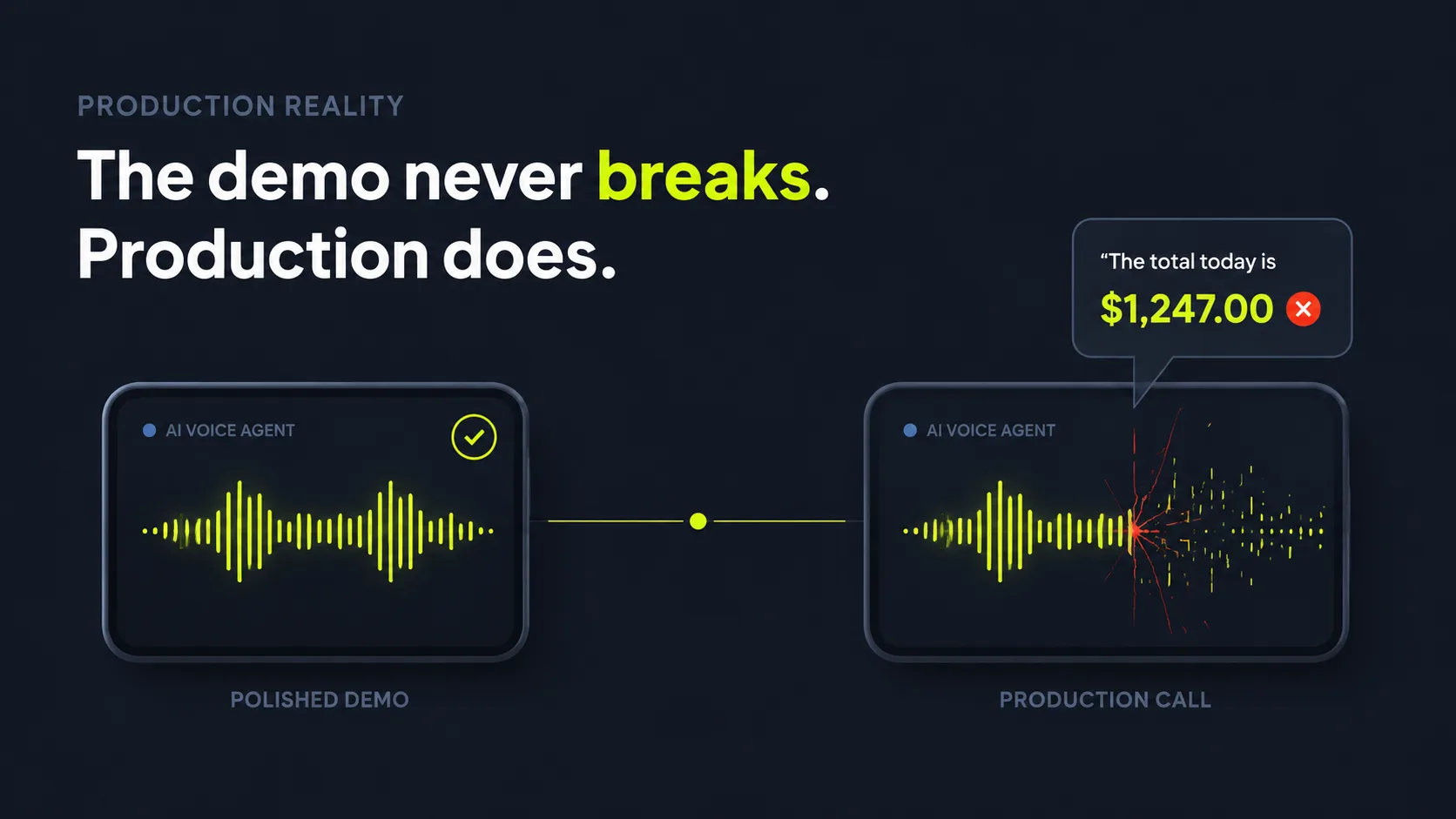
Failure mode 2: Why do AI voice agents hallucinate prices and availability?
AI voice agents hallucinate prices, availability, and policy when the underlying model generates a plausible answer instead of retrieving a verified one. The agent does not "know" your prices; it predicts likely words. Left ungoverned, it invents a number. That is dangerous on calls, because a quoted price or open slot becomes a customer expectation you have to honor.
Here is the mechanism in plain terms. A large language model is a prediction engine, nothing more. Ask it "how much is a drain cleaning?" with no wire connecting it to your price list, and it produces a confident, wrong figure, because filling the gap is exactly what it was trained to do. Same with "do you have an opening Tuesday at 2?" It will happily fabricate a yes. The model is not lying. It simply has nothing real to pull from, so it reaches for the most likely-sounding answer and delivers it like gospel.
The cost hides in plain sight, so do the math. A cleverer prompt will not save you, and the modeled numbers below show why the damage from one ungoverned figure adds up fast.
Modeled example (illustrative industry scenario, not a real client): Picture a voice agent handling 1,000 calls a month with a 6% hallucination rate on pricing. That is roughly 60 mis-quotes a month. At a 10% complaint-to-lost-job rate, that is about 6 jobs lost monthly. With an average HVAC repair ticket near $1,205, per Housecall Pro (2025), that is roughly $7,000 in lost work every month from one preventable defect. Annualize it and you are watching about $84,000 walk out the door, all because the agent was allowed to guess. The numbers are illustrative, but the mechanism is real.
No prompt fixes this, because the fix is architectural. You constrain the agent to a source of truth and forbid it from answering price, availability, or policy questions from memory. When asked a price, it queries your live price list. When asked about a slot, it checks your real calendar. When it has no verified answer, it says so and offers to check or transfer, instead of inventing one. Teams love to blame the model for hallucinations. The real defect is usually trust: the agent was allowed to improvise on the three things that cost money. Take that permission away, and the hallucination rate on revenue calls drops toward zero even if the model itself never changes.
Citation capsule: AI voice agents hallucinate prices and availability because the model predicts plausible words rather than retrieving verified facts. The fix is to constrain answers to a source of truth: query the live price list for prices and the real calendar for slots, and refuse to answer from memory. A 6% pricing-hallucination rate on 1,000 monthly calls is roughly 60 mis-quotes, worth thousands at an average HVAC ticket of $1,205, per Housecall Pro (2025).
The modeled funnel below shows how a small hallucination rate compounds into real lost revenue.
| Stage | Volume | Rate applied | Result |
|---|---|---|---|
| Monthly calls | 1,000 | - | Baseline |
| Pricing mis-quotes | 60 | 6% hallucination rate | 60 wrong quotes |
| Lost jobs | 6 | 10% complaint-to-loss | 6 jobs lost |
| Lost revenue | ~$7,000 | $1,205 average ticket | ~$7,000/month |
Modeled scenario using the average HVAC repair ticket of $1,205, per Housecall Pro (2025).
See how AI handles high inbound call volume in an AI call center setup.
Failure mode 3: How does bad or stale data break a voice agent?
Bad or stale data breaks a voice agent even when the agent itself works perfectly, because it confidently acts on wrong information. A flawless conversation built on an outdated calendar still books the wrong time. A perfect quote built on last year's price list still loses money. The agent is only as reliable as the data it reads and writes, and bad data sails through every demo.
That is what makes this failure so quiet and so cruel. In a controlled test, the calendar is fresh and the price list is current, so the agent looks flawless and everyone relaxes. Then a tech blocks off Thursday morning for his kid's recital. A price goes up. The CRM token silently expires at 2am on a Sunday. Nothing alarms. Nothing breaks. The agent simply keeps confidently selling yesterday's picture of the world, and the first person to discover the gap is a paying customer standing on a porch when no truck shows up.
Three faults cause most of the damage, and each one is a data-plumbing problem rather than an AI problem. A stale calendar offers slots that are already gone, so you get double-bookings and the furious callback that follows. Outdated pricing produces quotes you cannot honor, or quotes that quietly torch your margin. And a missing CRM sync means the agent treats a five-year repeat customer as a stranger, or never logs the call at all, so your team never follows up and the lead just dissolves. Worth asking: how would you even know the connection dropped? Without a freshness check, you would not, until a customer told you.
The three common data faults
- Stale calendar. The agent offers or books slots that no longer exist, creating double-bookings and angry callbacks.
- Outdated pricing. Quotes drift from your current price list, so you eat the difference or disappoint the customer.
- No CRM sync. Calls and bookings don't flow into your system, so follow-ups, history, and attribution all break.
How to keep the data honest
- Connect to live systems, not snapshots. The agent should read your real calendar and price list at call time, not a copy uploaded last month.
- Use two-way sync. Bookings the agent makes must write back instantly, and changes your team makes must appear to the agent immediately.
- Add freshness checks. Alert when a price list hasn't updated in a set window, or when a sync connection drops, before a caller hits it.
- Reconcile daily. A quick automated check that the agent's view matches your source systems catches drift early.
Citation capsule: Bad or stale data breaks a voice agent even when the agent works, because it acts confidently on wrong information: a stale calendar double-books, outdated pricing produces quotes you can't honor, and a missing CRM sync drops follow-ups. The fix is live two-way integration with the real calendar, price list, and CRM, plus freshness checks that flag drift before a caller hits it.

Estimate the cost of mis-booked and missed calls with the Missed Call Revenue Calculator.
Failure mode 4: Why do latency, interruptions, and noise sink a call?
Latency, interruptions, and poor accent or noise handling sink calls because they break the rhythm of human conversation, even when the agent's answers are correct. People hang up on awkward pauses. According to Nextiva (2025), 56% of customers immediately try another channel after a missed response window. A laggy or talk-over agent triggers that same exit, and your competitor's phone is one tap away.
Start with latency, the most common offender. A human reply lands in about half a second. When an agent takes two or three seconds, that silence feels like a dropped line. The caller says "hello? hello?" and then talks over the agent just as it finally speaks, and now both voices collide and neither lands. Long pauses do not read as thoughtful. They read as broken. Even a perfectly correct answer fails if it arrives too late to feel like a conversation.
Interruption handling is the second trap, and real callers are merciless with it. They cut in. They change their mind mid-sentence. They tack on a critical detail right after the question, the way people actually talk. A brittle agent that cannot be interrupted just plows through its script, ignoring the new input, and that feels less like talking to a person and more like shouting at a kiosk. Then layer in the real-world audio your studio test never had: a contractor on speakerphone in a running truck, wind across the mic, a kitchen clattering behind the voice, and the full range of accents your customers actually have. An agent tuned only on clean speech mishears, asks them to repeat, and bleeds a little trust on every loop. Stack enough loops and they are gone.
What to test for production audio
- End-to-end latency under one second from the caller finishing to the agent responding.
- Barge-in support so a caller can interrupt and the agent listens instead of talking over them.
- Accent and dialect coverage across the real range of your customer base.
- Noisy-environment accuracy with speakerphone, traffic, kitchens, and wind, not just quiet rooms.
Citation capsule: Latency, interruptions, and poor accent or noise handling sink calls by breaking conversational rhythm, even when answers are correct, because 56% of customers immediately try another channel after a missed response window, per Nextiva (2025). The fixes are sub-second response latency, barge-in interruption support, broad accent coverage, and accuracy tested in noisy real-world audio, not just quiet rooms.
The table below shows where response timing crosses from natural to broken.
| Latency band | Response time | Caller experience |
|---|---|---|
| Human baseline | ~0.5 seconds | Feels like a normal conversation |
| Acceptable agent | Under 1 second | Still reads as conversational |
| Failure zone | 2 to 3 seconds | Caller assumes a dropped line, talks over, or hangs up |
Human reply timing is roughly half a second; longer agent pauses trigger the channel-switch behavior measured by Nextiva (2025), where 56% of customers immediately try another channel after a missed response window.
See how AI call centers handle real-world audio across hundreds of daily calls in an AI call center setup.
What pre-launch checklist de-risks a voice agent go-live?
A pre-launch checklist de-risks go-live by forcing you to test every failure mode before a real customer hits it. This step is not optional. According to Gartner (2024), 53% of customers would consider switching to a competitor if they learned a company uses AI for service, so a sloppy launch carries real churn risk.
Think of it as choosing where the break happens. The break is coming either way. The only question is whether it happens in a test, where it costs you nothing and embarrasses no one, or on a paying caller's first impression, where it costs you the job and the next three referrals. Run this list before you point real calls at the agent. It maps straight to the four failure modes above, plus the basics that quietly cause trouble. Treat any failed item as a blocker, not a "we'll fix it later."
- Handoff works under stress. Confirm the agent escalates on anger, confusion, and direct requests, with a warm transfer to a staffed line.
- Prices come from the source of truth. Verify the agent quotes only from your live price list and refuses to improvise a number.
- Availability is real-time. Book a test slot and confirm it appears in your calendar instantly, and that the slot disappears for the next caller.
- CRM sync is two-way. Check that the call, contact, and booking all write back, and that a known caller is recognized.
- Latency is sub-second. Time the gap from caller-done to agent-response; anything past a second needs work.
- Interruptions are handled. Talk over the agent mid-answer and confirm it stops and listens.
- Noisy and accented audio passes. Test on speakerphone, with background noise, and across the accents your customers actually have.
- Failure fallback is safe. When the agent can't help, confirm it captures a message or callback rather than dropping the call.
In our experience grading early-stage voice agents, the two items teams skip are almost always handoff and stale data, because both sail through a clean demo and only break later, exactly the way we warned in failure modes one and three. We've found that deliberately trying to break the agent, demanding a person, quoting an edge-case service, talking over it mid-sentence, surfaces more real defects in an hour than weeks of happy-path testing ever will. The agents that survive launch are not the smartest ones. They are the ones a skeptic sat down and actively tried to break first.
Citation capsule: A pre-launch checklist de-risks a voice agent go-live by testing every failure mode, handoff, hallucination, stale data, latency, and fallback, before a real customer hits it. This matters because 53% of customers would consider switching to a competitor on learning a company uses AI for service, per Gartner (2024), so a failed launch carries churn risk, not just an awkward call.

Run a structured call-quality check with the Voice Agent Script Builder.
How does SkoreFlow build and grade a missed-call recovery voice agent?
SkoreFlow builds a missed-call recovery voice agent for trades and grades it against the failure modes covered here, on test calls before launch and on real calls after. The agent answers in 0.4 seconds, books the estimate instead of taking a message, and goes live in 48 hours. The market is moving fast: the conversational AI market is projected to reach USD 41.39 billion by 2030, per Grand View Research (2025).
The build targets the exact gaps in this article, one by one. The agent quotes prices and availability only from your live systems, never from memory, and books straight into ServiceTitan, Jobber, Housecall Pro, or Google Calendar. That is the core difference from a message-taking answering service like Ruby: it books the job on the call instead of leaving a slip for you to chase later. The setup is TCPA-aware and GDPR-aware, and your numbers, clients, and data stay private. The method is open; your book of business is not.
The grading is concrete, not a vibe. Every call is scored on whether the agent escalated when it should have, quoted prices and availability from the source of truth, booked against the real calendar, and held conversational timing. A failed criterion points to a specific fix, a missing escalation trigger, an ungoverned price lookup, a stale sync, instead of a shrug and "the agent felt off." After launch, the same grading runs continuously, so drift like an expired CRM token or a changed price list surfaces in hours rather than in complaints. Gartner predicts agentic AI will autonomously resolve 80% of common service issues by 2029, per Gartner (2025), and getting there safely depends entirely on grading the calls that need a human or a correction.
Pricing is transparent and built for small teams, not enterprise theater. Plans run from $297/mo ($1,500 setup, up to 80 calls) to $897/mo ($4,000 setup, unlimited calls), and the build is backed by a plain guarantee: 5 booked jobs in 30 days or your setup fee back. So the downside is capped, and the math is yours to check.
Illustrative example (representative trades scenario, not a real client): Picture a 6-technician HVAC shop launching a recovery voice agent on 1,000 calls a month. Pre-launch grading flags that the agent is quoting a flat repair price from memory. Constrain it to the live price list and those mis-quotes vanish. At the earlier modeled 6% rate, that is roughly 60 avoided mis-quotes and about 6 saved jobs a month, near $7,000 at a $1,205 average ticket, per Housecall Pro (2025). A well-run recovery agent can push answer rates toward 94% and recover roughly $14,200 a month in a shop this size, figures we treat as representative benchmarks, not a promise. Want your own read instead of a model? Book a Free Call Audit and we'll grade a sample of your real calls in about 20 minutes, no pressure, no pitch.
Citation capsule: SkoreFlow builds a missed-call recovery voice agent for trades that answers in 0.4 seconds, books into ServiceTitan, Jobber, Housecall Pro, or Google Calendar, goes live in 48 hours, and is graded against handoff, hallucination, stale-data, and latency failures before and after launch. The conversational AI market is projected to reach USD 41.39 billion by 2030, per Grand View Research (2025).

Estimate your recoverable revenue with the Missed Call Revenue Calculator, or see the full missed-call recovery voice agent approach.
The bottom line: failures are design gaps, not bad luck
Remember the demo that purred and then invented a price three weeks later? That was never bad luck. AI voice agents fail in production for reasons you can predict and prevent: broken handoffs, hallucinated prices and availability, stale data, and latency or noise problems. None of it is mysterious. Each failure has a clear cause and a concrete guardrail, source-of-truth answers, warm transfers, live two-way data sync, and conversation-speed audio. The agents that survive launch are simply the ones someone tested against these failures first.
The stakes cut both ways, and the gap between them is your opening. Adoption is surging, with 85% of service leaders set to explore or pilot conversational GenAI, per Gartner (2024), yet 53% of customers would consider switching after learning a company uses AI, per Gartner (2024). A tested, graded agent earns that trust. A rushed one burns it, and your competitor catches the call. Want to see exactly where yours stands before a customer finds out for you? Book a Free Call Audit and we'll grade a sample of your real calls in about 20 minutes, no pressure.
Estimate your recoverable revenue with the Missed Call Revenue Calculator, or see the full missed-call recovery voice agent approach.
Written and reviewed by Maksim Skorokhod, Founder of SkoreFlow, who builds AI answering and voice automation for small service businesses. Last reviewed: 2026-06-07.
Editorial note: As a solo founder, I review my own published work before release. The guardrails and checklist above come from hands-on call-grading work with live voice agents, not from theory. Every statistic links to its named primary source so you can verify each claim yourself.