What does an AI call center voice agent do on a call, step by step?
On a call, the agent answers instantly, identifies why the caller is calling, completes the task, and either confirms the outcome or routes to a human. It handles the whole interaction in one flow, not a menu tree. That matters because callers won't wait. Some 54% hang up after being on hold up to eight minutes, per Nextiva (2024). An agent that answers on the first ring removes the hold queue entirely.
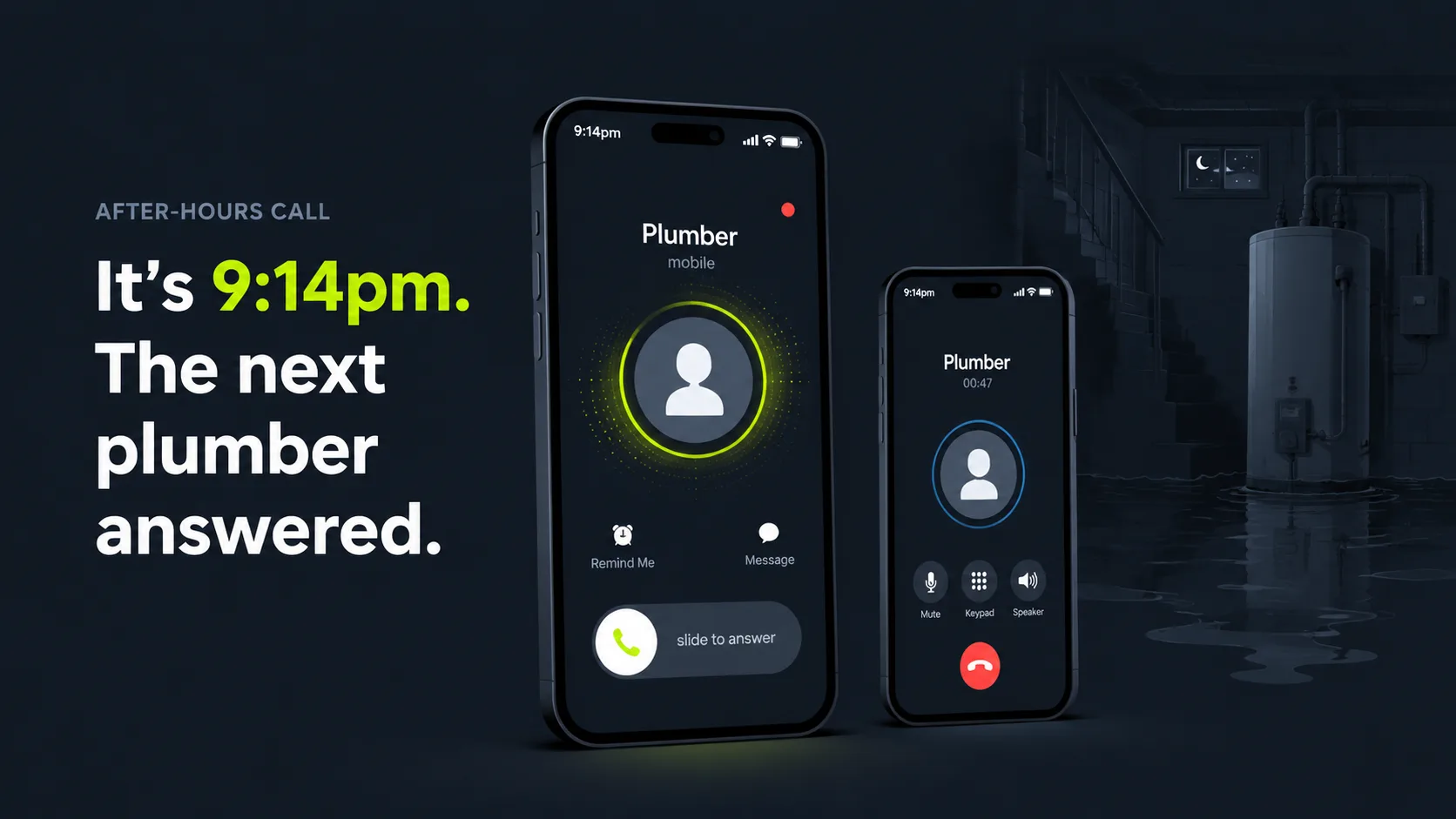
Think about that flooding basement again. The homeowner doesn't want a menu. She wants someone to say "we can have a tech out tonight." The full sequence that gets her there runs in order, like this.
- Answer immediately. The agent picks up on the first ring, day or night, with a natural greeting in your business's name.
- Understand intent. It listens to the caller's own words ("my AC stopped," "I need to reschedule") and identifies what they actually want.
- Pull up context. It checks your calendar, service area, hours, pricing rules, or customer record to answer accurately.
- Complete the task. It books the appointment, answers the question, takes the message, or qualifies the lead, then reads back the details.
- Route or escalate. Anything urgent, sensitive, or out of scope gets patched straight to a human, with the context already captured.
- Log everything. It writes a transcript, tags the intent and outcome, and creates a record or follow-up task automatically.
Most people get the next part wrong. The step that decides whether callers accept the agent isn't step two, it's step five. People will happily let software book a slot. What they won't tolerate is hitting a wall when they need a person, which is exactly why Gartner names "it gets harder to reach a human" as the top consumer concern about AI in service, per Gartner (2024). A clean handoff is the whole game. Hold that thought. It decides whether the deployment works, and the SkoreFlow section comes back to it.
Citation capsule: An AI call center voice agent runs a six-step flow on every call: answer, understand intent, pull context, complete the task, route or escalate, and log. It removes the hold queue, which matters because 54% of callers hang up after being on hold up to eight minutes, per Nextiva (2024).

To see how this differs from a legacy phone tree, read how conversational AI compares with a traditional IVR menu.
Who needs an AI call center voice agent?
You likely need an AI call center voice agent if you miss calls, run heavy after-hours or seasonal demand, or hit overflow your team can't cover. The clearest signal is missed-call leakage: 27% of calls to home-services businesses go unanswered, per Invoca (2024), and the calls you drop are often the ones worth the most. Below are the four patterns that point to a real need.
Read these like a checklist. If even one of them describes a normal week for you, the math is probably already working against you.
High call volume and overflow
Your phone rings while a tech is elbow-deep in a job, the office is at lunch, or three lines light up at once. Calls overflow to voicemail, and voicemail recovers almost nothing. Fewer than 3% of callers sent to voicemail leave a message, per Invoca (2024). So a busy hour quietly becomes a lost-leads hour. An agent answers every overflow call at once, which means the tenth simultaneous caller gets the same warm pickup as the first.
After-hours and weekend demand
A lot of buying-intent calls land outside 9-to-5, and nobody is there to take them. Restaurants receive 51% of their calls after 5pm, per BrightLocal's analysis of 45,264 local listings, the Google My Business Insights Study (2019). In healthcare, about 11% of patient calls come during off-hours or weekends, per Hyro (2023). A 24/7 agent captures that demand instead of donating it to the competitor who picks up on ring two.
Seasonal spikes
Trades, clinics, and restaurants all have surge periods: a heat wave for HVAC, the first hard freeze for plumbing, a holiday rush for a restaurant. Hiring and training seasonal staff for a few weeks rarely pencils out, and you end up either short-handed or paying people to wait for the phone. An agent scales to any volume the moment the spike hits and scales back down with zero severance, so you're never under- or over-staffed.
You're about to hire another agent
If your answer to more calls is "hire another receptionist," price the alternative first. The median US receptionist earns $37,230 a year before benefits and overhead, per U.S. Bureau of Labor Statistics (2024). That's one salary, one shift, one phone line. An AI agent can absorb the routine, high-volume calls so a single human handles only what genuinely needs judgment.
Citation capsule: Businesses that miss calls, run after-hours or seasonal demand, or hit overflow are the clearest candidates for an AI call center voice agent. The core driver is leakage: 27% of home-services calls go unanswered, per Invoca (2024), and fewer than 3% of callers sent to voicemail leave a message, also per Invoca (2024).

See how a voice agent fits your trades business on our missed-call recovery service page.
AI voice agent vs adding human agents: which makes sense when?
Use an AI voice agent for high-volume, repetitive, after-hours calls, and add humans for complex, emotional, or high-stakes conversations. They're complements, not rivals. The market is already moving toward the blend: 85% of customer service leaders will explore or pilot customer-facing conversational AI in 2025, per Gartner (2024). The table below maps each path to the call type it fits best.
| Factor | AI voice agent | Human agent |
|---|---|---|
| Best for | High-volume, repetitive, after-hours calls | Complex, emotional, or high-stakes calls |
| Availability | 24/7, nights, weekends, holidays | Limited to staffed hours, plus overtime cost |
| Concurrency | Answers many calls at once | One call at a time |
| Pickup speed | Instant, on the first ring | Depends on staffing and queue |
| Empathy and judgment | Limited; should escalate | Strong; the reason to keep humans |
| Cost | From around $95/month, per Smith.ai (2026) | $3.45-$5.00 per minute, per Ruby (2026) |
The table reads simply enough: route the routine majority to the agent, and reserve people for the exceptions. The same logic splits into two short lists.
Choose the AI voice agent when:
- Volume is high and predictable. Booking requests, hours, pricing, "are you open," and rescheduling are perfect for automation.
- The calls come after hours. An agent covers nights, weekends, and holidays without overtime or burnout.
- You face overflow you can't staff. It answers the 10th simultaneous call as well as the first.
- Speed is the deciding factor. Instant pickup beats a callback for time-sensitive leads.
Choose to add or keep humans when:
- The call needs judgment or empathy. Complaints, sensitive medical or legal matters, and upset callers belong with a person.
- The situation is genuinely complex. Custom quotes, edge cases, and negotiations need a human brain.
- The caller asks for one. A request for a human should always succeed, immediately.
The honest framing is hybrid. The agent handles the routine majority; your people handle the exceptions where they add the most value. That's also the safer choice with customers, because 53% of customers would consider switching to a competitor if they learned a company uses AI for service, per Gartner (2024). A natural voice with an easy human handoff is how you keep that risk low. Remember step five? This is where it earns its keep: the agent that hands off cleanly is the one customers forgive.
Citation capsule: Use an AI voice agent for high-volume, repetitive, and after-hours calls, and route complex, emotional, or high-stakes calls to humans. The model is hybrid, not either/or: 85% of customer service leaders will explore or pilot customer-facing conversational AI in 2025, per Gartner (2024).
For a wider view of how these tools work, read our guide to conversational AI agents for businesses.
How is an AI voice agent different from an old IVR phone menu?
An AI voice agent talks; an IVR makes you push buttons. The IVR ("press 1 for sales") forces callers down a rigid menu, while the agent understands plain speech and completes the task in one conversation. The difference shows up in abandonment: 85% of consumers have abandoned at least one call to an IVR system, per a Vonage survey of 2,010 US adults reported by Small Business Trends (2019). People don't quit because they hate phones. They quit because they hate menus.
The split is fundamental, not cosmetic. An IVR routes; an AI agent resolves. With an IVR, the caller does the work of navigating to the right department and often still waits on hold. With an agent, the caller just says what they need, and the agent handles it or connects them. The same Vonage survey, via Small Business Trends (2019), found 61% of consumers say IVR makes for a poor experience, and 51% have abandoned a company because of IVR.
The table below puts the two side by side on the things callers actually feel.
| What the caller experiences | Legacy IVR phone menu | AI voice agent |
|---|---|---|
| Input | Press buttons through a fixed menu | Speak naturally, in your own words |
| What it does | Routes you to a department | Resolves the request or connects a person |
| Hold time | Often still waits on hold | Answers on the first ring |
| Reported experience | 61% say IVR makes for a poor experience | Natural conversation, one step |
| Abandonment | 85% have abandoned a call to an IVR | Designed to complete, then escalate cleanly |
Source for IVR figures: Vonage survey, via Small Business Trends (2019).
[PERSONAL EXPERIENCE] In our experience deploying agents for service businesses, the fastest, most obvious win is killing the menu. Replace "press 1, press 2" with "Hi, what can I help you with?" and completed calls climb noticeably, because callers reach an answer in one step instead of guessing which button hides their question. The menu was always friction the business couldn't see. Only the lost callers felt it, and they felt it on the way to your competitor.
Citation capsule: An AI voice agent understands natural speech and completes the task, while an IVR forces callers through a button-press menu. The gap is measurable: 85% of consumers have abandoned at least one call to an IVR, and 51% have abandoned a company because of IVR, per a Vonage survey reported by Small Business Trends (2019).
For a full breakdown of IVR versus conversational AI, read our guide to phone menus and IVR.
Costs, limits, and where humans still win
An AI call center voice agent costs far less per minute than live answering, but it has real limits, and humans still win on judgment and empathy. AI receptionist plans start around $95 a month, per Smith.ai (2026), while live virtual-receptionist time runs roughly $3.45 to $5.00 per minute, per Ruby (2026). The cost case is strong. The honest case includes the limits below.
What it costs
The cost gap between AI and live answering is wide. A live human receptionist costs about $3.45 to $5.00 per receptionist-minute on published plans, per Ruby (2026), while AI receptionist software starts near $95 a month, per Smith.ai (2026). On the forward-looking side, Gartner predicts agentic AI will autonomously resolve 80% of common service issues by 2029, cutting operational costs roughly 30%, per Gartner (2025). Treat that 80% as a forecast, not today's measured rate.
The cost table below makes the per-call math concrete across the three common options.
| Option | Published price | Effective cost | Best when |
|---|---|---|---|
| AI receptionist software | From ~$95/month, per Smith.ai (2026) | Flat monthly, no per-call labor | High call volume, routine tasks, after hours |
| Live virtual receptionist | $250-$1,725/month, per Ruby (2026) | ~$3.45-$5.00 per minute | Lower volume needing a human touch |
| In-house receptionist | $37,230/year base, per U.S. Bureau of Labor Statistics (2024) | Plus benefits, taxes, overhead | A dedicated front desk during set hours |
Where it falls short
The limits are real, so here they are plainly. AI agents struggle with genuine ambiguity, strong emotion, heavy accents in noisy environments, and edge cases outside their training. They can misunderstand an unusual request or a frustrated caller. The fix is a confident escalation path, not pretending the agent handles everything. Consumer caution is real here: 64% of customers would prefer companies didn't use AI in customer service, per Gartner (2024).
Where humans still win
People win whenever the call needs empathy, negotiation, or accountability. An anxious homeowner whose ceiling is sagging, an angry customer, a complex custom quote, a judgment call on a tricky install: those belong with a human every time. [UNIQUE INSIGHT] The point of the agent isn't to replace your best people, it's to protect their attention. When software clears the routine majority, your sharpest closer isn't burning the day on "what are your hours" calls. They're on the phone that's actually worth winning.
Illustrative example (representative trades scenario, not a real client): Picture a 7-technician plumbing shop fielding heavy call volume, with roughly 27% of calls going unanswered, per Invoca (2024). Do the math on that gap. If even a quarter of those dropped calls were ready-to-book jobs, that's real money walking out the door every single week, week after week. Route the missed and overflow calls to an AI voice agent that books the estimate instead of taking a message, and a shop that size recovering missed calls can model around $14,200 a month in recovered work, a representative SkoreFlow benchmark, not a measured guarantee. Run your own numbers with the calculator below.
Citation capsule: An AI call center voice agent costs far less than live answering, around $95/month to start per Smith.ai (2026) versus $3.45-$5.00 per minute for live receptionists per Ruby (2026), but it has limits. Humans still win on empathy and judgment, and 64% of customers would prefer companies didn't use AI in service, per Gartner (2024).
Put real numbers on your own situation with our Missed Call Revenue Calculator.
How does SkoreFlow deploy a call center voice agent?
SkoreFlow deploys an AI missed-call recovery voice agent on your existing number that answers in 0.4 seconds, books and qualifies the estimate, and routes urgent calls to your team, on a flat monthly plan from $297/mo. It fits the core problem directly, because 27% of home-services calls go unanswered, per Invoca (2024), and a booked job beats a voicemail nobody leaves.
The difference comes down to one thing: it books jobs, not messages. An answering service like Ruby takes a message and leaves you to call back, by which point your prospect has already dialed the next plumber. The SkoreFlow agent qualifies and books the estimate right on the call, while the caller is still motivated and standing in the flooded basement. You keep your current number. We build the agent around your scripts, hours, service area, and booking rules, then go live in 48 hours, integrating with ServiceTitan, Jobber, Housecall Pro, and Google Calendar. It answers 24/7, filters spam, captures the caller's name, number, and intent, books or qualifies, and patches urgent calls to a human with context in hand. The setup is TCPA-aware and GDPR-aware. That handoff is the loop we opened earlier: it answers the top consumer worry about AI, not being able to reach a person, per Gartner (2024).
The plan is built for small trades teams, not enterprise theater: Starter at $297/mo, Growth at $497/mo, and Scale at $897/mo. The guarantee puts the risk on our side, not yours: 5 booked jobs in 30 days or your setup is refunded. You're not betting on a forecast, you're betting on booked work hitting your calendar in the first month. The whole space is growing fast, too: the conversational AI market is projected to reach $41.39 billion by 2030, per Grand View Research (2025).
Citation capsule: SkoreFlow deploys an AI missed-call recovery voice agent on your existing number that answers in 0.4 seconds, books jobs rather than taking messages, and goes live in 48 hours with ServiceTitan, Jobber, and Housecall Pro. It targets leakage directly, since 27% of home-services calls go unanswered, per Invoca (2024).
See everything the agent handles on our missed-call recovery voice agent service page.
The bottom line: answer every call, keep humans for judgment
Go back to that 9:14pm basement flood. The plumber who picked up won the job, and the one who didn't never knew it existed. That's the whole story of missed calls in one scene. An AI call center voice agent answers every call in a natural voice, completes the routine work end-to-end, and hands the hard calls to your people. The case is simple: plenty of calls never reach a human today, with 27% of home-services calls going unanswered, per Invoca (2024), and the agent closes that gap without you hiring for nights, weekends, and surges.
You need one if you miss calls, run after-hours or seasonal demand, or hit overflow you can't staff. You still need humans for empathy, complexity, and accountability, so build the agent with a clean escalation path and a flat, predictable cost. Want to see what your unanswered calls are worth? Run the numbers in our Missed Call Revenue Calculator, or book a free Call Audit and we'll map your recovery in 20 minutes, no pressure, no pitch. Backed by the 5-booked-jobs-in-30-days-or-refund guarantee, the only thing you risk is the calls you're already losing.
Ready to go deeper? See how the voice agent answers, books, and routes every call, then book your free Call Audit.
Written and reviewed by Maksim Skorokhod, Founder of SkoreFlow, who builds AI answering and voice automation for small service businesses. Last reviewed: 2026-06-07.