What you'll need before you set handoff rules
Before writing a single rule, gather four things: your escalation contacts, your hours, a fallback number, and a short list of what the bot must never handle alone. With those in place, you can map every call to either a completed task or a clean transfer, which matters because 53% of customers would consider switching to a competitor if they learned a company uses AI for service, per Gartner (2024). Smooth handoffs are how you keep that risk from turning into churn.
Skip this prep and you don't get a smarter bot. You get a faster way to lose people. Here's the full checklist before you configure anything.
- Escalation contacts. Who takes a live transfer for each scenario: front desk, on-call provider, nurse line, claims team, or owner's cell.
- Your hours and on-call rotation. When a human is actually reachable, and who covers nights and weekends so transfers don't ring an empty desk.
- A fallback number. Where a call goes when the primary contact doesn't pick up, plus a callback option when no one is available.
- A "never handle alone" list. The legal, medical, financial, or safety topics the bot must always hand off, regardless of how confident it sounds.
- A warm-transfer script. The short summary the agent speaks to the human, and what it tells the caller, so nobody repeats themselves.
Citation capsule: Before setting AI voice agent handoff rules, gather escalation contacts, hours, a fallback number, and a list of topics the bot must never handle alone. The reason to invest in smooth transfers is direct: 53% of customers would consider switching to a competitor if they learned a company uses AI for customer service, per Gartner (2024).
For the flip side of this checklist, read what causes voice agents to fail and how to prevent it.
Defining your AI voice agent handoff triggers
Define handoff triggers along three axes: intent, sentiment, and risk. The bot hands off when a caller asks for a human, when it detects frustration or anger, or when the topic carries legal, medical, financial, or safety risk. It should not hand off merely because it misheard a word. That distinction protects callers from dead ends, and it answers the top consumer concern about AI: that reaching a person gets harder, per Gartner (2024).
Most teams wire up two of these three correctly and quietly skip the one that saves the most calls. Hold that thought. We'll name it at the end of this section. Work through the triggers below in order. Each is a separate H3 with the rule stated first, then the reasoning.
Step 1: Hand off on explicit intent
The strongest trigger is the simplest: the caller asks for a human. "Can I talk to someone." "Get me a person." "Is anyone there." Any direct request should transfer immediately, no friction, no "let me try to help first." Make this a hard rule. Fighting a caller who has already asked for a person is the fastest way to lose them, and it confirms their worst fear about your bot.
Step 2: Hand off on negative sentiment
Next, transfer when the caller's tone turns frustrated, angry, or distressed. Repeated rephrasing, raised volume, sighs, or phrases like "this is ridiculous" signal that the bot has lost the room. Don't wait for an explicit request. A caller who is already upset rarely asks politely for a human. They just hang up. 56% of customers immediately try another channel after a missed response window, per Nextiva (2025), so catching frustration early keeps the call alive.
Step 3: Hand off on risk and scope
Then transfer any call that crosses into territory the bot must not own: legal advice, clinical guidance, a claim, a dispute, a payment problem, or a safety emergency. These are non-negotiable regardless of how confident the model sounds. Build them as a fixed "never handle alone" list. The cost of a bot guessing on a medical or legal question dwarfs the cost of a transfer, so the rule errs toward escalation here.
Step 4: Do NOT hand off on confusion alone
Finally, the inverse rule: don't transfer just because the bot didn't understand one phrase. Confusion calls for a clarifying question first. "I want to make sure I get this right, are you calling about a new booking or an existing one?" Only after a failed retry, or when confusion stacks with frustration, should it escalate. Reflexive handoff-on-confusion is how a bot becomes an expensive switchboard that resolves nothing.
[UNIQUE INSIGHT] In our experience, the trigger owners under-build is sentiment, and it's the one that prevents the angriest reviews. That's the gap we flagged at the top of this section. Teams happily wire up "ask for a human" and the risk list, then forget that most callers never ask. They just get quietly fed up and leave. We've found that adding a frustration trigger, two failed attempts plus any sharp tone, turns silent abandonments into saved calls more than any other single rule. So what does that buy you? Fewer one-star reviews that open with "the robot wouldn't let me reach a person," and more booked appointments from callers you would otherwise never hear from again.
Citation capsule: AI voice agent handoff triggers fall into three categories: intent (the caller asks for a human), sentiment (frustration or anger), and risk (legal, medical, financial, or safety topics). A bot should not hand off on confusion alone. This design directly answers the top consumer concern about AI, that reaching a person gets harder, per Gartner (2024).

To see how routine calls get resolved before any transfer, read how AI call handling works end to end.
Warm transfer vs cold transfer vs callback: which should you use?
Use a warm transfer by default, a cold transfer only for simple routing, and a callback when no human is free. A warm transfer passes the caller's context to the human before connecting; a cold transfer dumps them blind; a callback schedules a return call instead of a hold queue. The default matters because 75% of customers prefer a scheduled callback over waiting on hold, per Nextiva (2025), and almost nobody wants to repeat their story twice.
Picture the difference from the caller's chair. On a warm transfer, a real person picks up and already knows their name and why they called. On a cold transfer, a stranger answers "How can I help you?" and they start over from zero. Same call, opposite feeling. The table below shows when each fits. After it, a quick rule of thumb.
| Transfer type | What happens | Best used when | The risk if misused |
|---|---|---|---|
| Warm transfer | Agent briefs the human with caller name, reason, and context, then connects | The handoff is for a real need: emergency, claim, complaint, clinical question | Slightly slower; needs a reachable human |
| Cold transfer | Caller is routed straight to a number or queue with no briefing | Simple, low-stakes routing ("press to reach billing") | Caller repeats everything; feels like a dead end |
| Callback | Agent captures details and schedules a return call from staff | No human is currently available, or the matter isn't urgent | Caller waits for the return; set a clear time window |
What is a warm transfer? A warm transfer is when the voice agent first tells the receiving human who's calling and why, passing along the caller's name, reason, and any details collected, then connects them. The caller never has to start over, and the human picks up already informed.
What is a cold transfer? A cold transfer routes the caller straight to another line or queue with no handoff briefing. The receiving person answers with zero context, so the caller repeats their whole story. It's fast to build and fine for trivial routing, but frustrating for anything that matters.
The real choice isn't warm versus cold. It's whether you'd rather pay a few seconds now or lose the caller later. A cold transfer feels efficient because it's instant, but it silently shifts the cost onto the caller, who must re-explain, and onto the human, who starts blind. Across the verticals we configure, the warm-transfer summary, even a 10-second one, is the cheapest loyalty investment available. The seconds you "save" with a cold transfer come back as repeat-yourself frustration that 56% of customers answer by jumping channels, per Nextiva (2025). Ten seconds spent, one booking saved. That math is hard to beat.
Citation capsule: A warm transfer passes caller context to the human before connecting; a cold transfer routes the caller blind; a callback schedules a return call instead of a hold queue. Use warm by default. Customer preference backs it up: 75% of customers prefer a scheduled callback over waiting on hold, per Nextiva (2025).

Want to put a number on this? Estimate the value of calls you currently miss with our free tools.
Vertical-specific handoff rules for trades, clinics, and insurance
Handoff rules change by vertical because "urgent" means different things in each: trades escalate emergencies, clinics escalate clinical questions, and insurance or legal escalate claims and disputes. The same three-axis framework applies, but the risk list and the receiving human differ sharply. Getting it right is worth real money, since the average HVAC repair ticket reached about $1,205 in 2025, per Housecall Pro (2025), and a botched emergency handoff loses the whole job.
A rule tuned for a clinic will fail a plumber, and the reverse is just as true. Tune your rules to your trade using the patterns below.
Trades: escalate emergencies, book the rest
For plumbers, HVAC, and electricians, the handoff trigger that matters most is the safety or property emergency. A burst pipe at 9pm. No heat in a cold snap. A gas smell. Sparking wiring. Each should warm-transfer straight to your on-call tech, day or night. Everything routine, a quote, a maintenance booking, a non-urgent repair, the agent handles and schedules itself. Tune the bot to ask one or two fast urgency questions, then act. Misjudge one emergency and you trade a single $1,205 ticket for a flooded house and a customer who tells the neighbors.
Medical and dental: escalate clinical questions, book appointments
For clinics, the firmest rule is that the bot never answers a clinical question. Symptoms, medication, dosing, "should I come in," anything clinical hands off to your nurse line or on-call provider. The agent's lane is scheduling: booking, rescheduling, hours, and location. Keep collected details minimal, name, callback number, reason in broad terms, and route specifics to staff. The bot should book confidently and escalate clinical matters without hesitation, because the cost of a wrong clinical answer is unacceptable. This is also where a HIPAA-aware build earns its keep: the agent gathers only what it needs and passes the rest to a person.
Insurance and legal: escalate claims and disputes
For insurance agents and law firms, the handoff triggers are claims, disputes, and anything resembling advice. A new claim, a coverage dispute, or a legal question warm-transfers to the right specialist. Intake basics, contact details, appointment scheduling, and routine status questions can stay with the agent. The bot qualifies and routes. It never advises. Capturing intake while routing the substantive matter to a human is the balance these verticals need.
Citation capsule: Vertical handoff rules differ by what counts as urgent: trades escalate property and safety emergencies, clinics escalate any clinical question to a nurse line, and insurance or legal escalate claims and disputes. The stakes are concrete in trades, where the average HVAC repair ticket reached about $1,205 in 2025, per Housecall Pro (2025), so a mishandled emergency loses the whole job.
See how a botched escalation actually plays out in the most common voice agent failures and how to avoid them.
What are the most common handoff mistakes?
The three costliest handoff mistakes are handing off too late, passing no context, and routing to a dead end. Each one takes a caller who would have been saved and loses them anyway. They're avoidable, and avoiding them matters because 28% of customers abandon a product or service entirely after a missed response window, per Nextiva (2025). A clean handoff is often the difference between a kept customer and a churned one.
Do the math on that 28% for a second. If your line takes 1,000 calls a month and even a slice of them hit a mishandled handoff, the abandoned ones aren't lost calls. They're lost appointments, each worth far more than the call itself. Here are the mistakes we see most, and how to fix each.
- Handing off too late. Letting the bot grind through five failed attempts before escalating burns patience. Trigger on the second failure or the first clear sign of frustration, not the fifth.
- Passing no context (cold transfer by default). Connecting a caller blind forces them to repeat everything. Default to a warm transfer with a spoken summary, even a short one.
- Dead-end transfers. Routing to a line that rings out or hits voicemail strands the caller worse than the bot did. Always set a fallback number and a callback option.
- No human path at all. A fully automated line with no escalation confirms the top consumer fear. 64% of customers would prefer companies didn't use AI in service, per Gartner (2024), with the top concern being difficulty reaching a person.
- Handing off on confusion instead of clarifying. Transferring every misheard word makes the bot a glorified switchboard. Ask a clarifying question first, escalate only after a genuine failure.
[PERSONAL EXPERIENCE] Across the voice deployments we've configured, the single most common week-one fix is the dead-end transfer, the escalation that routes somewhere nobody answers. Owners wire up the triggers carefully, then forget to test whether the receiving number actually picks up after hours. The pattern is consistent. The handoff logic is right, but the human side rings empty. We now treat "call every escalation path and confirm a person answers" as a mandatory pre-launch step, because it catches the failure that hurts callers most.
Citation capsule: The three costliest AI voice agent handoff mistakes are escalating too late, passing no context, and routing to a dead end. Each loses a caller who could have been saved. The cost is measurable: 28% of customers abandon a product or service entirely after a missed response window, per Nextiva (2025).
For a deeper breakdown, read what makes voice agents fail and how to avoid it.
How does SkoreFlow configure handoff?
SkoreFlow configures handoff on the intent-sentiment-risk framework, with warm transfers by default and a callback fallback when no human is free. The Consultation Booking Voice Agent books consults, not messages, and escalates only what needs a person, briefing that person first so nobody repeats themselves. That matters because the #1 consumer concern about AI in service is that it gets harder to reach a human, per Gartner (2024).
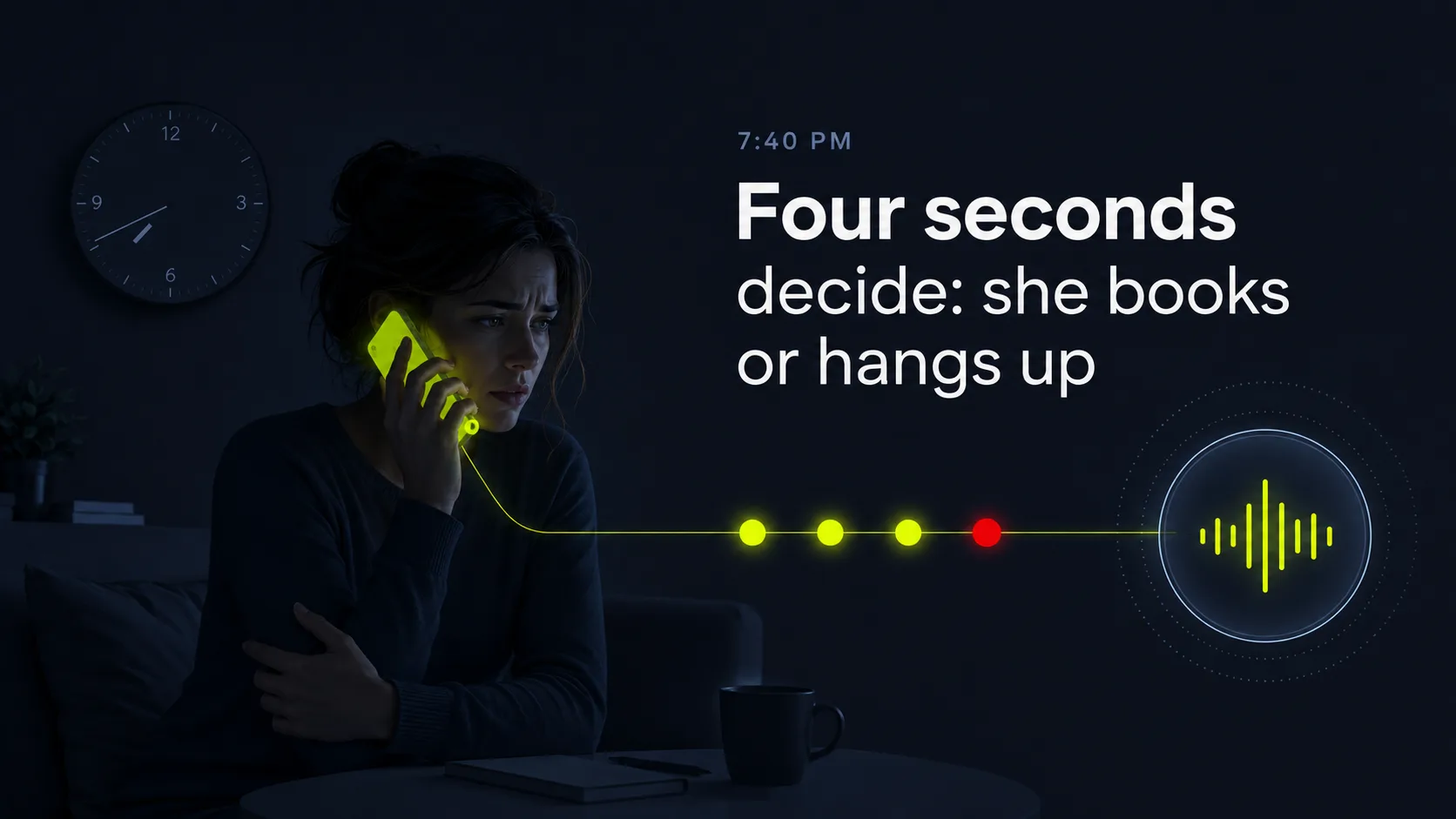
Remember the woman from the opening, tightening voice, 7:40pm, a question about her daughter's procedure? Here is what happens on a tuned line. Setup maps your escalation contacts, hours, and "never handle alone" list to specific triggers. The agent transfers instantly when a caller asks for a person, escalates on detected frustration, and hands off any clinical, legal, financial, or safety matter automatically. It runs 24/7, stays grounded in your own site and services, and works with your practice management system (PMS), so booked consults flow straight into your calendar. The build is HIPAA-aware and goes live in about 5 days, with plans from $497 to $1,497/mo. Unlike a message-taking answering service like Ruby, it books the consult on the call rather than leaving you to ring back.
When the primary human is unreachable, it captures details and schedules a callback rather than dropping the caller, which fits preference: 75% of customers prefer a scheduled callback over waiting on hold, per Nextiva (2025). And the offer carries a clear promise: recover $3,000 in 30 days or your setup fee is refunded.
Illustrative example (representative scenario, not a real client): Picture a med spa fielding about 1,200 calls a month, where the agent warm-transfers roughly 8%, about 96 calls, to a human. With full context passed on every transfer, the human picks up informed and the caller never repeats themselves. Benchmarks for this service model run to no-shows down about 68% and responses under 30 seconds, with the agent finishing the routine bookings itself. Treat those figures as representative ranges, not a guaranteed result. The gap good handoff design moves is the difference between a saved consult and one of the 28% who abandon after a poor experience, per Nextiva (2025). Run your own numbers with the tools below.
Citation capsule: SkoreFlow's Consultation Booking Voice Agent configures handoff on the intent-sentiment-risk framework, with warm transfers by default and a scheduled-callback fallback when no human is free. The approach answers the top objection to phone AI directly: the #1 consumer concern about AI in service is that it gets harder to reach a person, per Gartner (2024).
Ready to see your numbers? Book a free consult audit, a 20-minute, no-pressure call where we map your handoff rules with you, or model your call volume with our free tools.
The bottom line: hand off on intent, sentiment, or risk
Good handoff design comes down to one principle: transfer on intent, sentiment, or risk, never on the bot getting confused. Build the three triggers, default to warm transfers that pass context, and set a callback fallback so no caller ever hits a dead end. The reason this matters is consistent across every survey: the top consumer concern about AI on the phone is that reaching a person gets harder, per Gartner (2024). Clean escalation is how you prove that concern wrong.
So go back to the woman at 7:40pm. On a tuned line, the frustration trigger fires, a warm transfer briefs your on-call provider, and she books instead of hanging up. That's the whole game. Tune the rules to your vertical: trades escalate emergencies, clinics escalate clinical questions, insurance and legal escalate claims and disputes. Avoid the three big mistakes, handing off too late, passing no context, and dead-end transfers, and test every escalation path before launch. Want to see what your missed and mishandled calls are worth? Run the numbers in our free tools, or book a free consult audit, a 20-minute no-pressure call, and we'll map your handoff rules with you.
Model your call volume with our free tools, or see how the consultation booking voice agent answers, books, and escalates end to end.
Written and reviewed by Maksim Skorokhod, Founder of SkoreFlow, who builds AI answering and voice automation for small service businesses. Last reviewed: 2026-06-07.