How does an AI voice agent catch a missed call and book the job?
An AI voice agent catches a missed call by answering it directly: when your line is busy or unstaffed, the call routes to the agent, which picks up instantly and runs a real conversation. Speed is why this works. 5-minute responders are 21 times more likely to qualify a lead than firms that wait 30 minutes, per HBR (2011).
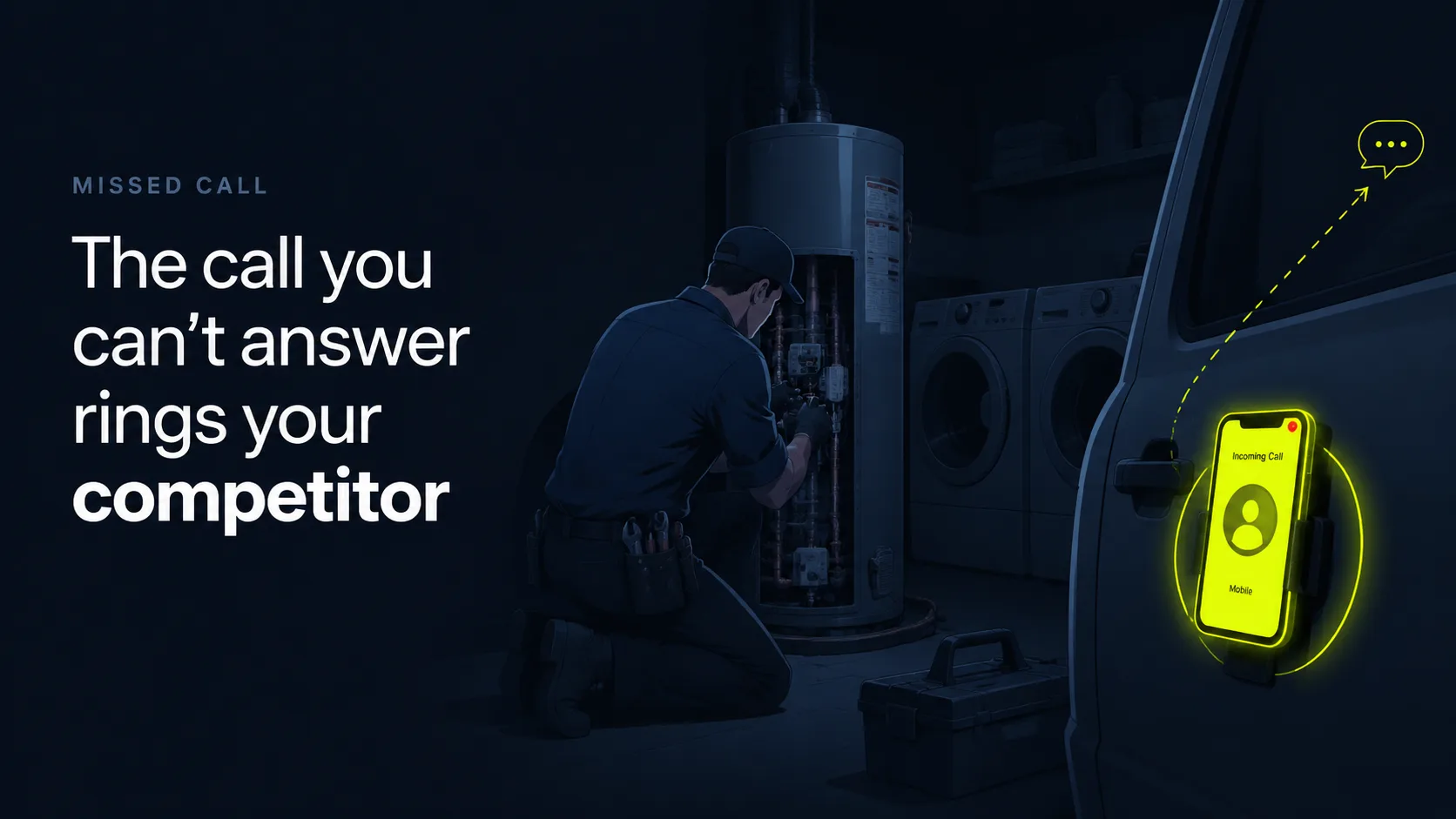
Picture the moment it saves. You're forty minutes into a water-heater swap, both hands wet, when the phone clipped to your truck door lights up and goes quiet. That caller had a burst valve and water creeping across the laundry-room floor. Five minutes later they've dialed the next plumber on the list, and the job is gone before you've torqued the last fitting. The agent exists to catch that exact caller, the one you physically cannot reach mid-job, and finish the booking while they still want you. The caller rarely notices the handoff. Here is the full path from ring to booked job.
- The call routes to the agent. When nobody picks up within a few rings, or all your lines are busy, the call forwards to the AI voice agent instead of voicemail.
- The agent answers and greets the caller. It picks up on the first ring in your business name, with a natural voice, so the caller starts talking instead of hanging up.
- It qualifies the lead. The agent asks for the service needed, the address, the urgency, and contact details, following your trade's script.
- It books the appointment. The agent checks your field-service software, ServiceTitan, Jobber, Housecall Pro, or Google Calendar, drops the job straight into an open slot, then confirms the time with the caller.
- It escalates true emergencies. If the caller has a burst pipe or no heat in winter, the agent recognizes the urgency and transfers them to your on-call tech.
- It logs everything. Name, number, service, and a call summary land in your system, so nothing depends on a callback list.
This matters because the alternative is silence. For service businesses, 27% of inbound calls go unanswered, per Invoca (2024), and the callers who hit voicemail rarely come back: fewer than 3% leave a message. They don't wait around, either. 56% immediately try another channel after a missed response window, per Nextiva (2025). So the real choice isn't "answer now or answer later." It's "book the job, or watch it ring your competitor."
[UNIQUE INSIGHT] In our experience, the step owners underestimate is the booking, not the answering. Plenty of tools can pick up a call. Far fewer finish the job by writing a real appointment into your calendar while the caller is still on the line. That live booking is the difference between a captured lead and another name you have to chase tomorrow, after the caller has already booked someone else.
Citation capsule: An AI voice agent answers a missed call on the first ring, qualifies the caller, books the appointment into your calendar, and transfers true emergencies to a human. It matters because 27% of service-business calls go unanswered and fewer than 3% of voicemail callers leave a message, per Invoca (2024), so a booked call beats a relayed one.
AI voice agent vs human answering service: when does each win?
An AI voice agent wins when you want every missed call answered instantly and booked at a flat cost; a human answering service wins when calls are complicated, emotional, or need judgment a script can't cover. The deciding factor is usually what happens to the call: AI books it, while most live services relay a message. Fewer than 3% of voicemail callers leave a message, per Invoca (2024), so a booked call wins.
Both options beat voicemail, but they solve different problems. A human answering service puts a real person on the line, which callers trust and which handles a complicated or distressed caller gracefully. The trade-offs are speed, capacity, and cost. A live agent can put callers on hold during a rush, can only take one call at a time, and bills you per minute. An AI voice agent answers unlimited calls at once, never holds anyone, books directly, and charges a flat monthly rate. Here's the head-to-head.
| Factor | AI voice agent | Human answering service |
|---|---|---|
| Typical cost | Flat $50-$300/mo, per CloudTalk (2025) | $1.50-$5.00/min, per Ruby (2026) / AnswerConnect (2025) |
| What it does with the call | Books the appointment live | Usually takes a message, relays it |
| Speed to answer | Instant; first ring | Variable; can hold during overflow |
| Simultaneous calls | Unlimited | Limited by agents on shift |
| Emergency routing | Yes, urgent transfer to on-call | Yes, per scripted protocol |
| Complex/emotional calls | Good for routine; hands off complex | Strong; human judgment |
| Cost predictability | Flat, same at 10 or 100 calls | Spikes with call volume |
Use the quick decision below to match the option to your reality.
When an AI voice agent wins
- Your missed-call volume is high or spikes unpredictably, so per-minute billing would balloon.
- Most of your calls are routine bookings: service requests, quotes, scheduling.
- You want predictable flat pricing and instant answering on every call.
- Speed-to-lead drives your revenue, and a callback an hour later loses the job.
When a human answering service wins
- Your calls are often complex, emotional, or need real human judgment.
- Your after-hours volume is low enough that per-minute billing stays cheap.
- Your customers strongly prefer a live human and won't tolerate AI.
- You need scripted triage that a person handles better than software.
[UNIQUE INSIGHT] Here's the framing that trips owners up: "AI or human," as if you have to pick a side. You don't. The strongest setup is AI first, human as backup. An AI agent that books the routine 90% of calls and instantly transfers the complex 10% to a person captures more revenue than either option alone. It also answers the biggest objection directly. The top consumer concern about AI in service is that it gets harder to reach a person, per Gartner (2024). A clean handoff puts the human back exactly when it counts. That hybrid is the quiet winner we promised up top, and the SkoreFlow section below shows how it deploys.
Citation capsule: An AI voice agent wins on speed, capacity, and flat cost, booking every routine call instantly, while a human answering service wins on complicated or emotional calls. Both beat voicemail, but AI books the job while most live services relay a message: fewer than 3% of voicemail callers leave one, per Invoca (2024), so the option that books live recovers more revenue.
Grouped bar chart comparing an AI voice agent and a human answering service across four capabilities. AI voice agent scores: speed-to-answer 5, simultaneous capacity 5, cost predictability 5, books the call 5. Human answering service scores: speed-to-answer 3, simultaneous capacity 2, cost predictability 2, books the call 1.
What does an AI voice agent cost, and where does it fall short?
An AI voice agent typically costs a flat $50-$300 a month, versus $1.50-$5.00 per minute for live answering, per CloudTalk (2025) and Ruby (2026). The math favors AI on volume, but it isn't a fit for every call. The honest weak spots are nuance, caller trust, and setup quality.
Start with the price, because it's where AI separates hardest. A flat plan costs the same whether your missed-call phone rings 10 times or 100, with published AI plans starting near $95/month, per Smith.ai (2026). A live service meters every minute. Industry per-minute rates run $1.50-$5.00, and live overage runs $1.90-$2.30 a minute, per Posh (2026). That meter climbs fastest during a rush, exactly when you'd most want every call answered. For context, the role AI offloads is expensive in-house too: the median receptionist wage is $17.90 an hour, or $37,230 a year before benefits, per the U.S. Bureau of Labor Statistics (2024).
Now the honest limits, because pretending there aren't any would insult you. An AI voice agent is built for routine, structured calls. It can stumble on a rambling, highly emotional, or unusual caller better served by a person, which is why a clean human handoff is non-negotiable. Caller trust is the other real constraint. 64% of customers would prefer companies didn't use AI in customer service, and 53% would consider switching to a competitor if they learned a company uses AI for service, per Gartner (2024). A natural-sounding agent and an easy "press 0 for a person" path matter. And the agent is only as good as its setup. A sloppy script or a calendar that isn't connected turns a strong tool into a frustrating one.
Illustrative example (industry-based scenario, not a real client): Picture a 2-van plumbing shop missing about 12 calls a week. With voicemail, almost all of those vanish, since fewer than 3% of callers leave a message, per Invoca (2024). Now run the math the other way. Suppose an AI voice agent recovers those 12 calls and books roughly 30% of them, about 3.6 jobs a week. At a representative service ticket, that recovered work runs into the tens of thousands of dollars a year, far more than a flat $50-$300/month plan, per CloudTalk (2025). The tool is rounding error next to the cost of the silence. Run your own numbers with the calculator below.
Citation capsule: An AI voice agent costs a flat $50-$300 a month versus $1.50-$5.00 per minute for live answering, per CloudTalk (2025) and Ruby (2026), so it wins on volume. Its limits are real: it's built for routine calls, not complicated ones, and 64% of customers would prefer companies didn't use AI in service, per Gartner (2024), making a natural voice and easy human handoff essential.
How does SkoreFlow handle missed-call recovery?
SkoreFlow recovers missed calls for home-service trades with a voice agent that books jobs, not messages: it answers, qualifies, and books the estimate, then transfers true emergencies to your on-call tech. The model is built for the core problem: fewer than 3% of callers sent to voicemail leave a message, per Invoca (2024), so a booked call beats a relayed one.
This is the hybrid the article kept hinting at, and here's where both earlier threads close. The agent runs 24/7 and keeps your existing number, so callers dial the same line they always have. When you can't pick up, the call routes to the agent instead of voicemail. It greets the caller in your business name, runs a script built for your trade, filters spam, captures the lead, and books the appointment straight into ServiceTitan, Jobber, Housecall Pro, or Google Calendar, with no callback list to chase. When a caller has a genuine emergency, the agent recognizes the urgency and patches them to your on-call person. That AI-plus-human handoff answers the most common objection head-on, because the top consumer worry about AI in service is not reaching a human, per Gartner (2024).
Here's the difference from a service like Ruby. An answering service takes a message and leaves you to call back, after the caller has already moved on. SkoreFlow's agent qualifies and books on the call, while the caller is still on the line and still wants you. Plans run on a flat monthly fee, starting at $297/mo ($1,500 setup, up to 80 calls) through $897/mo for unlimited, and the setup is TCPA-aware. The agent is typically live in 48 hours. And the offer carries the risk for you, not against you: 5 booked jobs in 30 days or your setup fee back. That flat price earns its keep on your busiest days, when per-minute live billing of $1.50-$5.00 a minute, per Ruby (2026) and AnswerConnect (2025), spikes exactly when call volume peaks.
Representative scenario (illustrative, not a real client): a busy plumbing or HVAC shop can reach roughly a 94% answer rate (versus about 38% with voicemail), recover on the order of $14,200 a month in booked work, and see ROI in around 11 days. These figures are benchmark models, not a specific customer result. Want to see where your break-even lands? Run the numbers in the calculator, or book a free call audit and we'll map what your missed calls are worth. Twenty minutes, no pressure.
Citation capsule: SkoreFlow recovers missed calls for trades with a 24/7 voice agent that books jobs rather than relaying messages, the way an answering service like Ruby does. It books because under 3% of voicemail callers leave a message, per Invoca (2024), and pairs AI with human handoff because the top consumer concern about AI in service is not reaching a person, per Gartner (2024).
The bottom line: book the missed call, don't lose it
A missed call is rarely a delayed job; it's usually a lost one. For service businesses, 27% of inbound calls go unanswered and fewer than 3% of callers sent to voicemail leave a message, per Invoca (2024). Worse, 56% of customers immediately try another channel after a missed response window, per Nextiva (2025). An AI voice agent closes that gap by answering instantly and booking the job, while voicemail and most live services hand you a message to chase.
So here's where the threads tie off. For most home-service trades in 2026, an AI voice agent on a flat plan that books routine calls and transfers true emergencies to a human delivers the most recovered revenue per dollar, especially as call volume climbs. A human answering service still earns its place for complicated, emotional, or unusual calls, and for owners whose customers won't tolerate AI. The strongest setup pairs both: AI first, human as backup. That was the quiet winner all along. Want to know what your missed calls are worth? Run the numbers in the calculator, or book a free call audit: a 20-minute, no-pressure look, backed by 5 booked jobs in 30 days or your setup fee back.
Written and reviewed by Maksim Skorokhod, Founder of SkoreFlow, who builds AI answering and voice automation for small service businesses. Last reviewed: 2026-06-07.