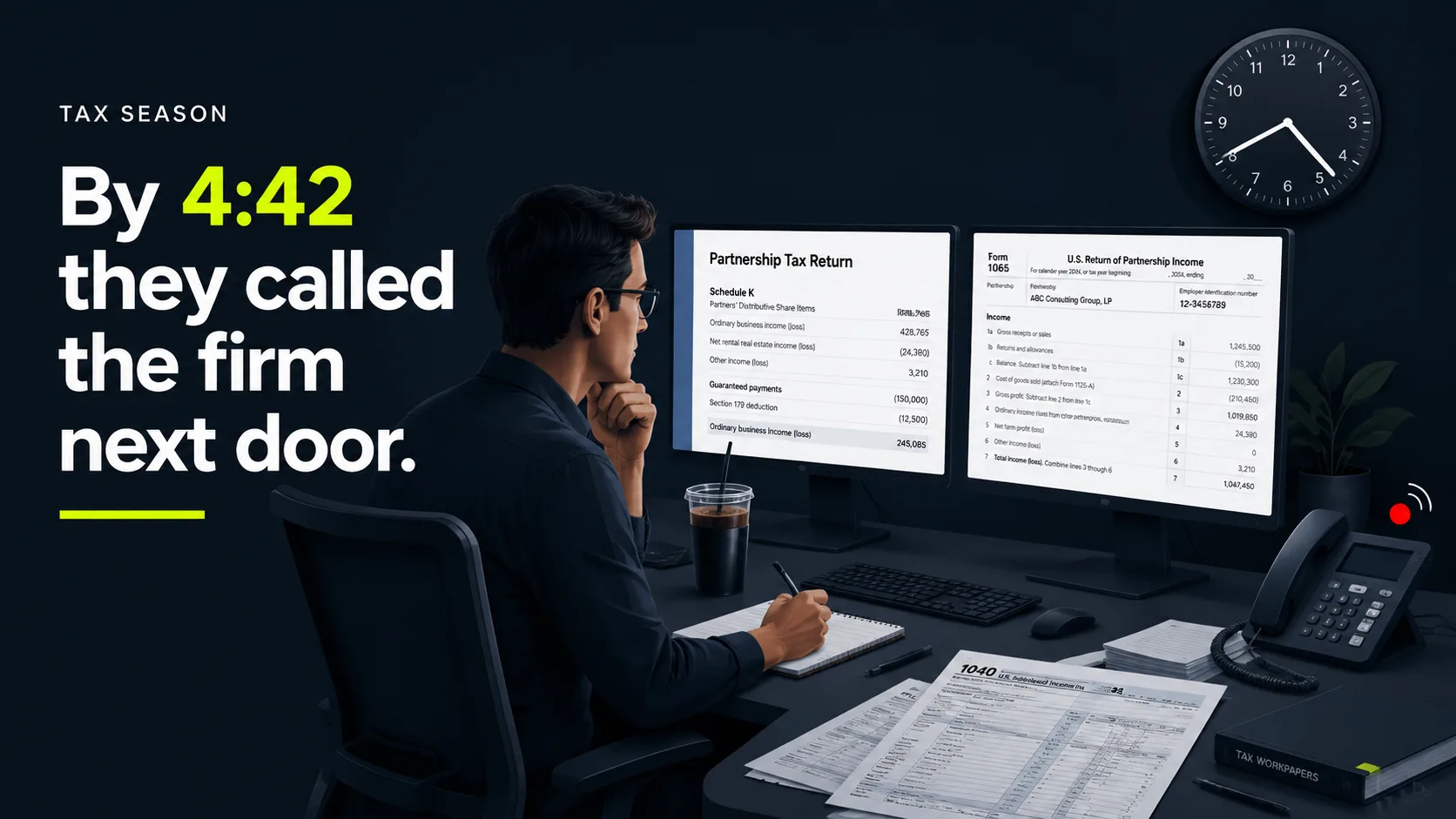
Why do accounting firms lose clients to unanswered calls during peak season?
Accounting firms lose clients because the phone rings hardest when nobody can answer it, and most callers will not try twice. On average, small businesses answer only 37.8% of inbound calls with a live person, leaving roughly 62% unanswered, according to 411 Locals (2016). That figure is directional and dated, but a more recent secret-shopper study confirms the pattern in professional services: only 40% of law firms answered the phone, and 48% were unreachable, per Clio (2024).
Think about who that caller is. A business owner with a shoebox of receipts and a deadline. A new homeowner whose return just got complicated. A prospect shopping for a CPA in March does not leave a message and wait by the phone. They dial the next firm on the list, and the one after that, until somebody picks up. The firm that answers wins the engagement before you have even finished the return on your screen.
Speed is the whole game for a high-value engagement. Firms that contact a prospect within an hour of an inquiry are nearly 7 times more likely to qualify the lead, and more than 60 times more likely than firms that wait 24 hours or more, per Harvard Business Review (2011). When you are mid-return and the call goes to voicemail, that hour is gone, and so is the edge.
Voicemail will not save the consult. For service businesses, 27% of inbound calls go unanswered, and fewer than 3% of callers pushed to voicemail actually leave a message, according to Invoca (2024). Read that again. Out of every hundred people who reach your voicemail, fewer than three leave a word. The new client who wants help filing before the deadline is not a patient caller. They want an answer now.
Here is the part most firms underrate: the phone is your best intake channel, not a nuisance. 66% of small businesses rate inbound phone calls as a good or excellent source of leads, the top-rated channel ahead of online forms, in-person, and email, per BIA/Kelsey (2014). A caller asking about your tax services is high-intent and ready to commit to an engagement. You are letting your hottest leads ring out.
Citation capsule: Only about 37.8% of small-business calls are answered live, per 411 Locals (2016), yet firms that respond within an hour are nearly 7x more likely to qualify a lead, per Harvard Business Review (2011). Because almost no one sent to voicemail leaves a message (Invoca, 2024), each missed tax-season consult call is a high-value engagement handed to a competitor.
From our build experience: The worst call drops happen during your most profitable weeks. February through April brings the most new-client consult calls, and it is also when no partner is free to answer. The firm that picks up at that moment books the engagement the busy practice never even heard ringing.

We break down the full revenue math in our guide to how missed calls cost local businesses real revenue.
How does SkoreFlow book consultations and screen new-client inquiries?
SkoreFlow's AI voice agent answers in 0.4 seconds and runs a structured intake script built for accounting firms, so it books the consult rather than just taking a message, on every call, without fatigue. Because firms that respond within five minutes are 21 times more likely to qualify a lead than those waiting 30 minutes, per Harvard Business Review (2011), answering instantly is the single best move a practice can make on the phone.
So what does 0.4 seconds actually buy you? The caller never hears a second ring. They never decide you are too busy for them. By the time a human would have reached the receiver, the agent has already greeted them in your firm's name and started qualifying the engagement.
Here is where it splits from the old model. Unlike a traditional answering service such as Ruby, which takes a message and leaves you to call back, the agent books and qualifies on the call itself. It connects to your calendar, filters spam, and is typically live in 48 hours. SkoreFlow backs the build with a guarantee: 5 booked jobs in 30 days or your setup fee back. You are not buying a message pad. You are buying a booked consult.
The intake flow follows a consistent order:
- Greet in your firm's name. The agent answers professionally and confirms the practice the caller reached.
- Identify the caller. It asks whether the caller is an existing client or a new prospect, then routes accordingly.
- Capture the service needed. Tax preparation, bookkeeping, payroll, IRS notice help, or advisory, so you know the engagement type before you ever pick up.
- Qualify the prospect. It collects entity type (individual, sole proprietor, S-corp, partnership), rough scope, and deadline pressure.
- Book the consultation. It offers open consult slots and books directly into your connected Google Calendar or scheduling tool.
- Collect contact and context. Name, phone, email, preferred contact method, and any documents the caller mentions.
- Confirm and notify. A clean summary of the consult and the captured service lands on your team's phone or in your software within seconds.
- Escalate when needed. An urgent existing-client issue, a complaint, or anything outside the script routes to a human per your rules.
What we have learned setting up accounting scripts: The quietest win is the screening layer. A large share of filing-season calls are existing clients asking "Did you get my W-2?" or "When is my return ready?" When the agent handles those and tags genuine new-prospect consults separately, partners stop getting pulled off returns for routine status checks, and the high-value intake calls actually get followed up fast.
Citation capsule: Firms that respond within five minutes are 21 times more likely to qualify a lead than those waiting 30 minutes, per Harvard Business Review (2011). An AI agent that answers on the first ring books the consult, captures whether the caller needs tax, bookkeeping, or advisory work, and screens existing clients from prospects while the lead is still deciding which CPA to hire.

Accountants are not the only practice that lives or dies by phone intake. See how the same approach plays out in our missed-call recovery voice agent overview.
How do you survive tax-season call volume without temp staff?
You survive it with an agent that answers unlimited simultaneous calls and never hits a busy signal, because filing-season demand arrives all at once and concentrates into weekday business hours. Local businesses receive 94% of their phone calls Monday through Friday, per BrightLocal (2019), and during tax season those weekdays stack new prospects on top of anxious existing clients. Hiring seasonal temps to absorb that spike is expensive, slow, and gone by May.
Picture the front desk at 11am on April 10th. Three lines lit, a fourth ringing, and the person answering can hold one phone to one ear. Callers will not wait on hold, and the season is when they are most likely to be parked there. 75% of callers hang up after eight or more minutes on hold, and after a missed response window 56% immediately try another channel while 28% abandon entirely, per Nextiva (2025). A single front-desk person cannot pick up six lines at once during the April crunch. The AI can, capturing each consult and each client question in parallel.
Now run the math on what that one parallel line is worth. The economics of even one recovered engagement justify the coverage. AICPA's National MAP Survey reported CPA firms' median net client fees grew 6.7% year over year, with net remaining per partner reaching $252,663 in FY2024, per AICPA (2025). Advisory relationships are worth even more: median client advisory services fees reached $156,250 per professional, up 29% over 2022, per AICPA & CPA.com (2024). One captured advisory client can outvalue a year of answering coverage. One. So the question is not whether you can afford the agent. It is whether you can afford to drop the call that pays for it.
What a tax-season call spike looks like on the phone
A season spike is a cluster of mixed calls in a short window: "Can you still take new clients before the deadline?", "Is my return filed yet?", "I just got an IRS notice", and "Do you do bookkeeping too?". The AI answers every one in parallel. It books the new consults, answers and tags the existing-client status checks, captures the service requested, and flags anything urgent for a human, so your phone line is never the bottleneck.
Overflow and triage without seasonal hires
Overflow coverage means the agent only catches what your team cannot, so you skip the cost and ramp time of temps. During normal weeks it handles after-hours and busy-line overflow. During the crunch it absorbs the full flood, screening current clients from prospects, prioritizing time-sensitive deadline questions, and routing urgent IRS or audit matters straight to a senior. Your capacity to do the work, not your phone, sets the only limit.
A contrarian take from the field: Most firms try to survive tax season by asking an admin or junior to "grab the phone between returns." We have found that is backwards. The season is too sharp for a human to multitask through, and pulling a preparer off a return to answer a status call is the most expensive way to answer a phone. An AI agent that scales to unlimited concurrent calls catches the consults and triages the routine questions, so billable staff stay on billable work.
Citation capsule: Local businesses receive 94% of their calls Monday through Friday, per BrightLocal (2019), and 75% of callers hang up after eight minutes on hold, per Nextiva (2025). With median net per CPA partner at $252,663 in FY2024 (AICPA, 2025), an AI agent that absorbs the filing-season weekday spike protects engagements without the cost of seasonal temps.
Filing deadlines are not a 9-to-5 problem, which is why round-the-clock missed-call recovery protects the evening and weekend consults a staffed desk never catches.
AI vs. traditional answering service for accountants
The core trade-off is coverage versus headcount: AI answers every call instantly at a flat cost, while a traditional live service offers human voices at a premium with limited capacity, often metered per minute. Live virtual receptionist plans at one national provider run from $250/month for 50 minutes to $1,725/month for 500 minutes, per Ruby's pricing page (2026), which works out to roughly $3.45 to $5.00 per receptionist-minute.
Do the per-minute math and it stings. At $3.45 to $5.00 a minute, a single eight-minute consult intake can run past $30 before the prospect even books. Stack twenty of those in one April week and the meter alone outruns a flat monthly plan. Both models beat voicemail. What an accounting firm has to weigh is which setup fits its call volume and service pattern: flat cost, capacity through the spike, and room to scale when April hits.
| Factor | AI answering service for accountants | Traditional live answering service |
|---|---|---|
| Availability | 24/7, no hold time, answers on first ring | Business hours or after-hours desk; possible hold queue |
| Tax-season capacity | Unlimited simultaneous calls during the spike | Limited by staffed agents on duty; callers hold or drop |
| Cost signal | Flat plans; SkoreFlow Missed Calls Recovery runs $197-$697/mo by call volume | $250-$1,725+/mo at ~$3.45-$5.00/min, per Ruby |
| Per-minute fees | Flat plans, no per-minute metering | Often metered per minute, which spikes during season volume |
| Consult booking | Books and qualifies on the call, into your calendar, every time | Varies; services like Ruby take a message for callback instead |
| Service screening | Captures tax vs. bookkeeping vs. advisory; screens clients from prospects | Depends on agent training and briefing |
| Consistency | Same intake script every call | Varies by agent and shift |
| Human escalation | Routes urgent IRS, audit, and complaint calls to a senior | Live agent judgment for nuance |
| Best for | Tax-season spikes, after-hours coverage, tight partner time | Firms wanting a human voice on every call |
How we frame the choice: Most firms treat this as AI or human. The better frame is AI plus human escalation. The AI catches the dozen season calls a live desk would have dropped during the crunch, then hands the tricky ones, like an active IRS audit or an upset long-term client, straight to a senior. You stop trading coverage for judgment.
Citation capsule: Live virtual receptionist plans cost roughly $3.45 to $5.00 per receptionist-minute, derived from Ruby's published 2026 pricing ($250/mo for 50 minutes to $1,725/mo for 500 minutes). SkoreFlow's Missed Calls Recovery runs flat at $197 to $697/month by call volume, so firms cover every tax-season consult call for far less, with no per-minute fees, and the agent books on the call instead of leaving a message.
Cost and ROI of an accountant answering service
Pricing spans a wide band, but the ROI math is simple: a single recovered client usually pays for a full year of coverage. Industry pricing for virtual receptionist services runs about $50-$300/month for AI and $300-$2,000+/month for human services, per CloudTalk (2025). Against the lifetime value of an accounting engagement, that cost is a rounding error.
The return comes from the calls you currently lose. Remember the data: 27% of calls go unanswered and fewer than 3% of voicemail callers leave a message, per Invoca (2024). Hiring a dedicated phone person instead means a median receptionist wage of $37,230 a year before benefits, per the U.S. Bureau of Labor Statistics (2024), and one person still cannot answer six lines during the April crunch. The AI covers every call around the clock for a fraction of that. One salary buys one set of hands. The agent covers every line, every hour.
Illustrative example (industry-based scenario, not a real client): Picture a small CPA firm missing 15 calls a week through March and April, the peak of filing season. Over those eight weeks that is roughly 120 missed calls. With 27% of calls going unanswered and almost no one leaving a voicemail (per Invoca, 2024), even a single recovered engagement reshapes the year. Median net remaining per CPA partner reached $252,663 in FY2024, and median client advisory fees hit $156,250 per professional, per AICPA (2025) and AICPA & CPA.com (2024). Against a SkoreFlow plan from $197 to $697 a month, one captured advisory relationship can cover years of coverage. For comparison, a representative trades shop recovering missed calls returns roughly $14,200/month on the same model, illustrative of the benchmark, not a specific firm's result. Run your own numbers with the calculator below, since per-client value varies by firm and service mix.
Plug your own call volume into our missed-call revenue calculator to see the range for your firm.
Citation capsule: Virtual receptionist pricing runs about $50-$300/month for AI versus $300-$2,000+/month for human services, per CloudTalk (2025). Against a median in-house receptionist wage of $37,230/year (BLS, 2024) and the high value of a CPA engagement (AICPA, 2025), an AI answering service covers every consult call around the clock at a fraction of the cost.
Why do accountants choose SkoreFlow?
Accountants choose SkoreFlow because it closes the exact gap the data exposes: a live answer on every call, structured consult booking, service capture, client-versus-prospect screening, and a clean handoff to a senior when a human is needed. Unlike an answering service like Ruby that takes a message, the agent books and qualifies on the call, is typically live in 48 hours, and is TCPA-aware. With only about 37.8% of small-business calls answered live, per 411 Locals (2016), simply answering well through tax season is a competitive edge most firms have not claimed.
The approach is built for how clients search for a CPA now. Across consumers, 45% now use AI tools to find local services, up from 6% a year earlier, per BrightLocal (2026). It also respects how people feel about AI on the phone: 64% of customers would prefer companies didn't use AI in customer service, per Gartner (2024). So the agent sounds natural and hands off to a person the moment a caller wants one. The build is backed by a guarantee: book real jobs in the first 30 days or get your setup fee back.
Remember the 4:40pm call from the top of this page, the prospect who walked to the firm down the street? That is the exact call this closes. The line gets answered in 0.4 seconds, the consult gets booked, and the engagement stays yours instead of the competitor's.
An honest note on results: We do not publish invented testimonials or named results. What we will say plainly is this. The firms that benefit most are the ones currently sending tax-season and after-hours consult calls to voicemail. Plug the leak first, then refine the intake script. That order tends to produce the fastest, most honest wins.
Citation capsule: Consumer use of AI tools to find local services jumped to 45% in 2026, up from 6% a year earlier (BrightLocal), yet 64% of customers still prefer companies didn't use AI in service (Gartner, 2024). A CPA answering agent that books consults naturally and escalates audits and complaints to a senior wins both phone intake and AI-driven discovery.
Stop sending consults to voicemail
The pattern in the data is hard to ignore: only about 37.8% of small-business calls are answered live, firms that respond fast are up to 7x more likely to qualify a lead, and almost no one leaves a voicemail. An answering service for accountants closes that gap by answering every call, booking consultations, capturing the service needed, screening clients from prospects, and absorbing the tax-season flood without temp staff.
You do not have to choose between filing returns and answering the phone. Let the agent catch the season and after-hours calls, then route the audits and urgent client matters that need a senior to your team. Want to see what unanswered calls are costing your firm? Book a Free Call Audit, a 20-minute, no-pressure call where we map where consults are slipping and what capturing them would be worth. The build is typically live in 48 hours and backed by our 5-jobs-in-30-days-or-setup-refund guarantee, so the risk sits with us, not you. Prefer to estimate it yourself first? Start with the missed-call revenue calculator.
To go deeper on setting up phone intake the right way, read our walkthrough on writing an AI call script for client intake.
Written and reviewed by Maksim Skorokhod, Founder of SkoreFlow, who builds AI answering and voice automation for small service businesses. Learn more about our team and editorial standards, or get in touch. Last reviewed: 2026-06-07.