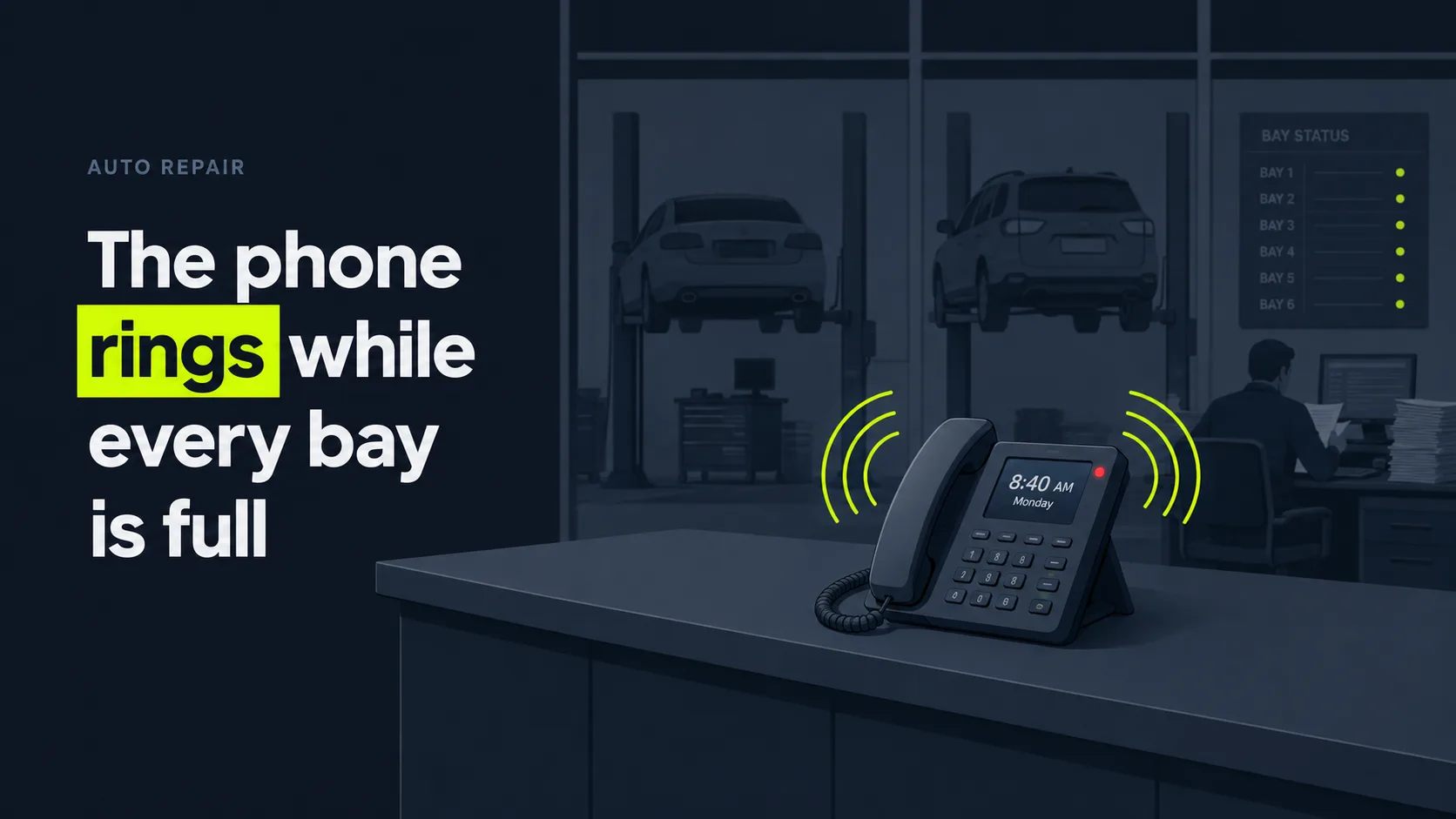
Why do auto repair shops lose jobs to missed calls while bays are busy?
Auto repair shops lose jobs because the phone rings hardest when the team is buried, and most callers never try twice. For service businesses, 27% of inbound calls go unanswered, per Invoca (2024), and an older small-business call audit pegged the live-answer rate at just 37.8%, per 411 Locals (2016, directional). A missed appointment call isn't a delayed booking. For a busy shop, it's a lost repair order.
Picture the counter at 8:40 on a Monday. Two customers are leaning on the desk, the air smells like coffee and brake dust, and the phone has rung four times in ten minutes. Your advisor lets it go. He has to. But the driver on the other end? She has a check-engine light, a meeting at nine, and a Google list of three shops. She hangs up and dials the next one.
Voicemail won't save that job. Fewer than 3% of callers pushed to voicemail actually leave a message, according to Invoca (2024), partly because 95% of people now find texting more convenient than voicemail, per a Nuance/Research Now survey (2014). Nobody with a dashboard warning light wants to recite their VIN into a robot and wait by the phone. They tap the next listing and book there.
Speed is the whole game. Firms that respond to a lead within five minutes are 21 times more likely to qualify it than firms that wait 30 minutes, and roughly 100 times more likely to make contact, per Harvard Business Review (2011). When a customer is shopping a quote across three shops, the one that answers first usually wins the work. The other two never even know they were in the running.
So why does this keep happening to good shops with full bays? Because the phone gets treated like an interruption, not the booking channel it actually is. 66% of small businesses rate inbound phone calls as a good or excellent source of leads, the top-rated channel ahead of online forms, in-person, and email, per BIA/Kelsey (2014). A caller describing a grinding noise or a warning light is about as high-intent as a lead gets. They're not browsing. They're ready to book.
Citation capsule: For service businesses, 27% of inbound calls go unanswered and fewer than 3% of voicemail callers leave a message, per Invoca (2024); an older audit put the live-answer rate near 37.8% (411 Locals, 2016, directional). Because firms responding within five minutes are 21x more likely to qualify a lead (Harvard Business Review, 2011), each missed call while bays are busy is a repair order lost to a faster shop.
The worst call drops happen on your busiest days, which is exactly backwards from what most owners assume. A packed Monday is when the most appointment and diagnostic calls land, and it's the same morning your advisor can't breathe and your techs can't stop. The shop that picks up at that exact moment books the jobs your busy bay never even heard ringing. We'll come back to what those silent rings are worth in dollars.
Related: how missed calls cost local service businesses revenue.
How does SkoreFlow book service appointments and capture vehicle details?
SkoreFlow's AI voice agent answers on the first ring and runs a structured intake built for auto repair, so it captures everything your best advisor would, on every call, without ever getting tired or distracted. Firms that respond within five minutes are 21 times more likely to qualify a lead than those waiting 30 minutes, per Harvard Business Review (2011). On the phone, answering instantly is the single best move a shop can make.
It books jobs, not messages. A traditional answering service like Ruby takes a note and leaves you to call back later, hoping the customer hasn't already booked elsewhere. The agent qualifies the caller and schedules the appointment while they're still on the line. The gap between a message slip and a confirmed slot is the gap between hoping and getting paid.
The call flow follows a consistent order:
- Greet and identify the need. The agent confirms your shop name and asks what the caller needs (a service appointment, an estimate, a status update, or a question).
- Capture the vehicle. Year, make, model, and mileage, plus the VIN or plate when the caller has it.
- Capture the issue in the customer's words. The symptom, warning light, noise, or requested service, noted so your advisor walks in with context.
- Answer routine FAQs instantly. Hours, location, services offered, drop-off and loaner policy, and whether you work on a given make get answered from your own information, with no hold.
- Check availability and book. It offers open slots and schedules the appointment directly in ServiceTitan, Jobber, Housecall Pro, or Google Calendar.
- Modify or cancel existing appointments. The agent can move a time, change the service, or cancel, then update the record.
- Confirm and notify. A clean summary of the vehicle, the issue, and the appointment lands on your advisor's phone or in your software within seconds.
- Escalate to a service advisor. Complex diagnostics, fleet accounts, warranty questions, or anything outside the script get routed to a human per your rules.
In our experience setting up auto repair scripts, the quietest win is the vehicle-and-symptom capture. When the agent collects the year, make, model, and the customer's own words for the noise or the light before the car ever rolls in, your advisor stops playing 20 questions at drop-off. The write-up moves faster. The diagnosis starts sooner. The bay turns the job quicker, and a faster turn is another car you can fit before close. Time you used to burn at the counter becomes billable labor in the bay.
Citation capsule: Firms that respond within five minutes are 21 times more likely to qualify a lead than those waiting 30 minutes, per Harvard Business Review (2011). An AI agent that answers on the first ring books the appointment, captures the vehicle year, make, model, and the reported issue, and answers hours-and-services questions while the customer is still deciding where to take the car.
See more: answering service options by industry.
Handling "is my car ready?" and status-update calls so advisors keep wrenching
The status call interrupts a repair shop's day more than any other call type, and the AI absorbs every one. Status checks ("Is my car ready?", "What's the total?", "Did you get the part?") arrive all day and yank your advisor off the counter and your techs out of the bay. The agent fields them from your live job data, so the people doing the work stay on the work.
Do the math on what those interruptions cost. Say a tech stops three times an hour, two minutes a pop, to answer "is it done yet?" That's six minutes an hour, roughly 48 minutes a shift, evaporating off jobs that are already on the clock. Across two techs over a week, you're losing the better part of a full billable day to the phone. The agent answers the status question instantly, reads back the stage the vehicle is in, gives the expected ready time, and relays the total or estimate exactly as your system shows it. Nobody leaves a lift to say "another hour."
Customers won't wait on hold for that update, either. 75% of callers hang up after eight or more minutes on hold, and 75% would rather have a scheduled callback than sit in a queue, according to Nextiva (2025). A status caller parked on hold during the lunch rush is already annoyed before anyone says a word. An instant, accurate answer keeps them calm and keeps your bays moving.
What the agent can tell a status caller
The agent pulls from the vehicle's current job status and answers what the customer actually called about: the stage the repair is in, the expected ready time, whether the part has arrived, and the running total or approved estimate. It speaks only what your system shows, and it routes anything it can't confirm to your advisor instead of guessing.
When a status call needs a human
A status call gets handed to a service advisor when it turns into a decision: approving extra work the tech just found, debating a warranty claim, or calming an upset customer. The agent recognizes those moments, captures the context, and routes the call to the right person so the conversation that needs judgment gets it.
Most shops treat status calls as unavoidable noise and just eat the lost wrench time as a cost of doing business. But this is arguably the single most automatable call type in the whole shop. The information already lives in your system. Letting the agent read it back on demand quietly hands your techs hours of focused bay time back every week, and those hours are billable labor you were giving away to the phone for free.
Citation capsule: 75% of callers hang up after eight or more minutes on hold and 75% prefer a scheduled callback to waiting, per Nextiva (2025). An AI agent that answers "is my car ready?" calls instantly from live job data gives accurate ready times and totals, so service advisors and technicians keep working instead of fielding the phone.
AI vs. traditional answering services for auto repair shops
The core trade-off is coverage versus headcount: AI answers every call instantly at a flat cost, while a traditional live service offers human voices at a premium with limited capacity, often metered by the minute. Live virtual receptionist plans at one national provider run from $250/month for 50 minutes to $1,725/month for 500 minutes, per Ruby's pricing page (2026), which works out to roughly $3.45 to $5.00 per receptionist-minute.
Both models beat voicemail, so that's not the real question. The real question for a shop is which mix of cost, capacity, and shop-specific knowledge fits your call volume and your service pattern.
| Factor | AI answering service for auto repair | Traditional live answering service |
|---|---|---|
| Availability | 24/7, no hold time, answers on first ring | Business hours or after-hours desk; possible hold queue |
| Peak-hour capacity | Unlimited simultaneous calls during the morning rush | Limited by staffed agents on duty; callers hold or drop |
| Cost signal | Typically below live plans; AI receptionist tiers from ~$95/mo, per Smith.ai (as of 2026) | $250-$1,725+/mo at ~$3.45-$5.00/min, per Ruby (as of 2026) |
| Per-minute fees | Flat plans, no per-minute metering | Often metered per minute, which spikes during busy volume |
| Vehicle detail capture | Structured every call: year, make, model, issue | Varies by agent; depends on the briefing provided |
| Status-update calls | Answers "is my car ready?" from live job data | Usually takes a message for a callback |
| Consistency | Same booking and intake script every call | Varies by agent and shift |
| Human escalation | Routes complex diagnostics, fleet, and warranty to your advisor | Live agent judgment for nuance |
| Best for | Busy bays, after-hours coverage, status-call overload, tight margins | Owners wanting a human voice on every call |
Most owners frame this as AI or human. The sharper frame is AI plus human escalation. The agent catches the dozen appointment and status calls a live desk would have dropped during the morning rush, then hands the nuanced ones, like a fleet account or a warranty dispute, straight to your advisor. You stop trading coverage for judgment and start getting both.
Citation capsule: Live virtual receptionist plans cost roughly $3.45 to $5.00 per receptionist-minute, derived from Ruby's published 2026 pricing ($250/mo for 50 minutes to $1,725/mo for 500 minutes). AI answering tiers, starting near $95/month per Smith.ai (2026), let auto repair shops cover every appointment and status call for far less, with no per-minute fees.
What does it cost, and what is the ROI?
Pricing spans a wide band, but the ROI math is almost embarrassingly simple: a handful of recovered repair orders usually pays for months of coverage. Industry pricing for virtual receptionist services runs about $50-$300/month for AI and $300-$2,000+/month for human services, per CloudTalk (2025). Against a single recovered brake job or diagnostic, that monthly cost is a rounding error.
The return comes from the calls you're losing right now. Remember the numbers: 27% of calls go unanswered and fewer than 3% of voicemail callers leave a message, per Invoca (2024). The obvious fix, hiring a dedicated phone person, means a median receptionist wage of $37,230 a year before benefits, per the U.S. Bureau of Labor Statistics (2024), and that one person still can't answer the morning rush and field status calls at the same time. The agent covers every call around the clock for a fraction of that.
SkoreFlow's missed-call recovery for trades is priced in flat monthly tiers: Starter at $197/mo (up to 75 calls), Professional at $397/mo (up to 250 calls), and Enterprise at $697/mo (unlimited), each with a one-time setup fee. Most shops are live in 48 hours. The offer carries a clear guarantee: 5 booked jobs in 30 days or your setup fee back. The math is meant to be obvious, not a leap of faith.
Illustrative example (industry-based scenario, not a real client): Picture a 6-bay shop missing 18 calls a week while the bays are full. Over a year that's roughly 936 missed calls. The most common average repair order (ARO) for general auto repair shops sits in the $500-$749 band, with 36% of shops reporting that range, per PartsTech (2024). Recover just two of those missed calls a week into booked jobs at the middle of that band, and you're looking at five figures a year in work that used to ring out into voicemail. Run your own numbers with the calculator below.
Estimate your lost revenue with the Missed Call Revenue Calculator.
Citation capsule: Virtual receptionist pricing runs about $50-$300/month for AI versus $300-$2,000+/month for human services, per CloudTalk (2025). With the most common auto repair order valued at $500-$749 (PartsTech, 2024), recovering even a few missed appointment calls per week far outweighs the monthly cost of AI answering.
Why do auto repair shops choose SkoreFlow?
Auto repair shops choose SkoreFlow because it plugs the exact leak the data exposes: a live answer on every call, structured vehicle-and-issue capture, instant status updates, automatic missed-call text-back, and a clean handoff to a service advisor when a human is needed. With 66% of small businesses rating inbound phone calls their best lead source, ahead of forms and email, per BIA/Kelsey (2014), simply answering well during the rush is a competitive edge most shops in your zip code haven't claimed yet.
The approach is built for how drivers actually search now. Across consumers, 45% now use AI tools to find local services, up from 6% a year earlier, per BrightLocal (2026). It also respects how people feel about it: 64% of customers would prefer companies didn't use AI in customer service, per Gartner (2024). So the agent sounds natural, and it hands off to a person the moment a caller wants one. Nobody gets stuck arguing with a robot.
We don't publish invented testimonials or named results, and you should be wary of anyone who does. What we will say plainly: the shops that benefit most are the ones currently dumping busy-bay and after-hours calls to voicemail while burning advisor time on status checks. Plug those two leaks first, then refine the script. That order tends to produce the fastest, most honest wins.
The offer is built to be low-risk on purpose. Setup is TCPA-aware, most shops are live in 48 hours, and the work is backed by a guarantee: 5 booked jobs in 30 days or your setup fee refunded. Representative scenario (illustrative, not a specific client): a 7-technician shop recovering its missed calls can answer roughly 94% of inbound calls and return on the order of $14,200 a month in work it was sending to voicemail. Your own numbers will be different, and they stay private. That's the whole pitch: keep the calls you're already paying to generate.
Citation capsule: Consumer use of AI tools to find local services jumped to 45% in 2026, up from 6% a year earlier (BrightLocal), yet 64% of customers still prefer companies didn't use AI in service (Gartner, 2024). An auto repair agent that answers naturally, books the job, and escalates fleet and warranty calls to an advisor wins both phone and AI-driven discovery.
Stop sending repair orders to voicemail
The pattern in the data is hard to argue with: for service businesses, 27% of inbound calls go unanswered and fewer than 3% of voicemail callers leave a message, per Invoca (2024). Those silent rings on your busiest mornings are the repair orders we opened with, the ones the busy bay never heard. An AI answering service for auto repair closes that gap by answering every call, booking appointments, capturing the vehicle year, make, model, and the issue, handling "is my car ready?" status calls, and texting back missed callers automatically.
You don't have to choose between turning bays and answering the phone. Let the agent catch the rush and after-hours calls and absorb the status checks, then route the fleet accounts, complex diagnostics, and warranty questions that need an advisor to your team. Want to see what your unanswered calls are actually worth? Book a Free Call Audit, a 20-minute, no-pressure call, and we'll map where appointments and repair orders are slipping and what capturing them would be worth to your shop. Live in 48 hours, with 5 booked jobs in 30 days or your setup fee back, so the only real risk is leaving the phone the way it is.
Book a Free Call Audit or estimate lost revenue with the calculator.
Written and reviewed by Maksim Skorokhod, Founder of SkoreFlow, who builds AI answering and voice automation for small service businesses. Last reviewed: 2026-06-07.