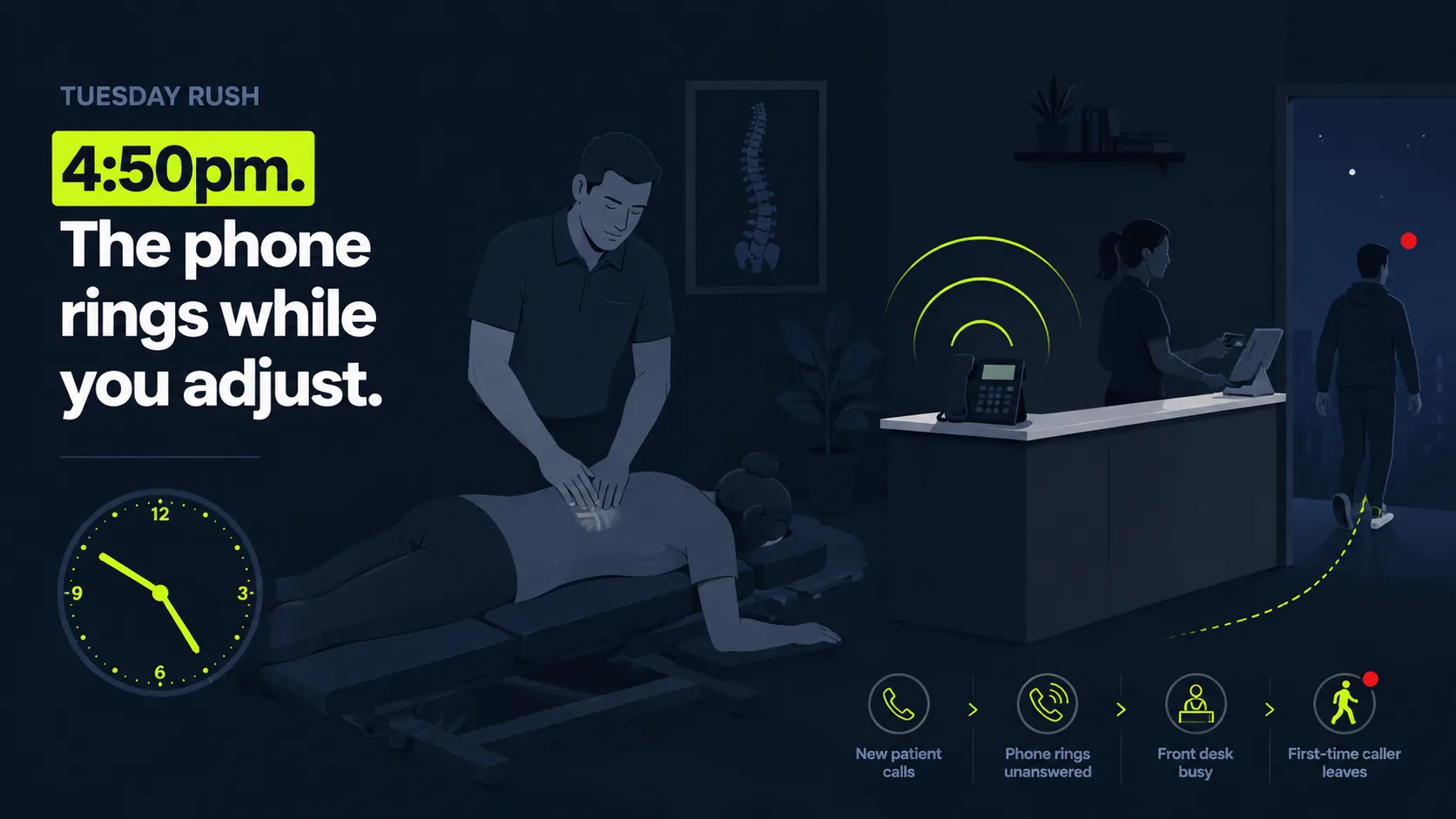
Why do chiropractors lose new patients to missed calls?
Chiropractors lose new patients because the phone rings at the exact moment nobody can pick it up: the doctor is in an adjustment, and the front desk is helping someone at the counter. In dentistry, a close proxy for chiropractic intake, the average practice misses about 20% of new-patient inbound calls, and of the 80% it answers, fewer than half convert, according to Dentistry IQ (2023). A missed new-patient call isn't a delayed booking. For most practices, it's a lost one.
The broader phone data is worse. On average, small businesses answer only 37.8% of inbound calls with a live person, leaving roughly 62% unanswered, per 411 Locals (2016). Read that again. Nearly two out of three rings go nowhere. Every one of them is a potential new patient deciding whether your practice is even reachable.
Maybe you're thinking the answering machine catches the rest. It doesn't. For service businesses, 27% of inbound calls go unanswered, and fewer than 3% of callers pushed to voicemail actually leave a message, according to Invoca (2024). Someone whose lower back locked up this morning is not going to leave a calm message and wait by the phone. They keep dialing down the list until somebody human-sounding picks up.
Now flip it. The phone isn't a chore to survive between patients. It's your best acquisition channel. 66% of small businesses rate inbound phone calls as a good or excellent source of leads, the top-rated channel ahead of online forms, in-person, and email, per BIA/Kelsey (2014). A first-time caller asking about back pain is the highest-intent lead you'll get all week, already half-decided to book.
And speed decides the rest. Firms that respond within five minutes are 21 times more likely to qualify a lead than those waiting 30 minutes, per Harvard Business Review (2011). On the phone, the practice that picks up first usually books the patient. Picking up second usually books nothing.
The numbers that matter: In dentistry, the closest measured proxy for chiropractic front desks, the average practice misses about 20% of new-patient calls and converts fewer than half of those answered, per Dentistry IQ (2023), while across all small businesses only 37.8% of calls are answered live, per 411 Locals (2016). Because almost no one sent to voicemail leaves a message (Invoca, 2024), each unanswered new-patient call is revenue handed to a competitor.
Here's the pattern we see, and it's the one that should keep you up at night. The most expensive missed call is the brand-new patient with acute pain, because that caller has the highest urgency and the lowest loyalty. An existing patient might forgive a missed ring and call back to reschedule. A first-timer who hits voicemail almost never does. They're choosing a chiropractor in the next five minutes, and availability decides it, not your Google reviews.

Want the full breakdown? See how a consultation booking voice agent answers every clinic call.
How SkoreFlow books new patients and reschedules recurring adjustment visits
SkoreFlow's Consultation Booking Voice Agent answers on the first ring, every time, and runs a structured script grounded in your site, services, and brand, so it captures the same details your front desk would, without fatigue and without the bad-afternoon shortcuts. Because firms that respond within five minutes are 21 times more likely to qualify a lead than those waiting 30 minutes, per Harvard Business Review (2011), answering instantly is the single highest-payoff move a practice can make on the phone. It books the consult. It doesn't just take a message. And it's typically live in 5 days.
So what actually happens when the phone rings? The new-patient and rescheduling flow follows a consistent order, every call:
- Greet and identify the caller. The agent confirms your practice name and asks whether the caller is a new or existing patient and what they need.
- Triage the reason for the visit. It captures the chief complaint in plain terms, such as low back pain, neck pain, headaches, or a recent accident, and notes urgency.
- Capture new-patient intake. Name, phone, email, reason for visit, how they heard about you, and any details you want collected before the first appointment.
- Pre-screen insurance or cash plan. It asks whether the patient is using insurance or a cash plan and collects carrier and basic plan details for your team to verify.
- Offer slots and book. It presents open appointment times and books the new-patient consult or adjustment directly into your practice management system (PMS).
- Reschedule or cancel recurring visits. For existing patients, the agent moves an adjustment time, books the next visit in a care plan, or cancels, then updates the record.
- Send confirmations and reminders. A clean confirmation goes to the patient, and the agent can send reminders for upcoming adjustments to cut no-shows.
- Escalate clinical questions. Anything that needs a doctor or a clinical judgment, such as red-flag symptoms or treatment questions, gets routed to your team per your rules.
In our experience setting up chiropractic scripts, the quietest win hides in step six. A care plan only works if the patient keeps coming back, but the front desk is usually too slammed mid-shift to chase a missed reschedule. So those visits silently fall off the calendar. When the agent rebooks a dropped adjustment and reminds patients automatically, the schedule starts filling itself in the gaps between new-patient calls. That's the line that separates this from a message-taking answering service like Ruby: the agent books the consult on the call instead of handing you a callback list to work after close.
The speed-to-lead math: Firms that respond within five minutes are 21 times more likely to qualify a lead than those waiting 30 minutes, per Harvard Business Review (2011). An AI agent that answers on the first ring books the new patient, captures intake, and reschedules recurring adjustments while the front desk stays focused on patients in the room.

Try it before you commit: build a sample script with the Voice Agent Script Builder.
New-patient intake scripting and insurance pre-screening
Intake scripting works by collecting the exact details your front desk needs before the first visit, so a booked patient walks in ready instead of hunched over a clipboard in your waiting room. After-hours coverage matters more than most owners assume here: about 11% of patient calls reach providers outside standard business hours or on weekends, per Hyro (2023). Those are exactly the calls a closed front desk can't take, and exactly the ones the AI can.
The agent runs the same intake on every call, so nothing gets skipped on a busy afternoon when your staffer is doing three things at once. It captures the chief complaint, onset, and whether the issue stems from an accident or injury, then collects contact details and how the patient found you. That structured capture is what turns a 90-second phone call into a complete new-patient record waiting in your system.
What the intake script captures
The intake layer is built around what a chiropractic front desk actually asks at the counter. The agent collects the patient's name and contact information, the reason for the visit and how long it's been going on, whether there was an accident, and any preferred appointment times. Because the script is identical every call, the record that lands in your system is complete and consistent, not whatever a rushed staffer managed to scribble between patients.
How insurance and cash-plan pre-screening works
The agent pre-screens coverage so your team isn't doing it cold at the desk while a patient waits. It asks whether the patient plans to use insurance or a cash plan, captures the carrier name and basic plan details, and flags anything that needs verification. It does not promise coverage or quote benefits, since that requires your team to verify. Instead, it hands your front desk a clean, pre-filled starting point so eligibility checks move faster and the awkward money conversation happens before the patient is on the table.
In setups we've configured, the field most practices forget to collect on the phone is "accident or injury." It's the single detail that changes how a case is documented and billed. Capturing it during the booking call, rather than discovering it at check-in, saves your team a frantic scramble before the first adjustment. Small detail, real money.
Worth quoting: About 11% of patient calls reach providers outside business hours or on weekends, per Hyro (2023). A chiropractic AI agent that runs a consistent intake script, captures the chief complaint, and pre-screens insurance or cash-plan details on every call, including after hours, delivers a complete new-patient record your front desk can verify and confirm.
For the broader clinic view, see how the Consultation Booking Voice Agent handles patient intake.
AI vs. traditional answering service for chiropractors: which fits your practice?
The core trade-off is coverage versus headcount. AI answers every call instantly at a flat cost. A traditional live service offers human voices at a premium, with limited capacity, often metered by the minute. Live virtual receptionist plans at one national provider run from $250/month for 50 minutes to $1,725/month for 500 minutes, per Ruby's pricing page (2026), which works out to roughly $3.45 to $5.00 per receptionist-minute.
Both models beat voicemail, no argument there. The real question for a practice is which mix of cost, capacity, scheduling depth, and HIPAA handling fits your call volume and your patient flow.
| Factor | AI answering service for chiropractors | Traditional live answering service |
|---|---|---|
| Availability | 24/7, no hold time, answers on first ring | Business hours or after-hours desk; possible hold queue |
| Peak-hour capacity | Unlimited simultaneous calls during busy clinic hours | Limited by staffed agents on duty; callers hold or drop |
| Cost signal | Typically below live plans; AI receptionist tiers from ~$95/mo, per Smith.ai | $250-$1,725+/mo at ~$3.45-$5.00/min, per Ruby |
| Per-minute fees | Flat plans, no per-minute metering | Often metered per minute, which spikes with call volume |
| Intake consistency | Same intake and pre-screen script every call | Varies by agent and shift |
| Scheduling and rebooking | Books new patients and reschedules adjustments in your system | Often takes a message for the front desk to action later |
| HIPAA handling | HIPAA-aware; BAA [CONFIRM] |
Depends on the provider's HIPAA program |
| Clinical escalation | Routes red-flag symptoms and clinical questions to your team | Live agent judgment for nuance |
| Best for | Busy clinic hours, after-hours coverage, tight margins | Owners wanting a human voice on every call |
Most owners frame this as AI or human, one or the other. We've found the better frame is AI plus human escalation. The AI catches the new-patient and rescheduling calls a live desk would have dropped during a packed adjustment block. Then it hands the clinical questions, the red-flag back pain, the complex injury case, straight to your team. You stop trading coverage for clinical judgment, because you get both.
The cost in one line: Live virtual receptionist plans cost roughly $3.45 to $5.00 per receptionist-minute, derived from Ruby's published 2026 pricing ($250/mo for 50 minutes to $1,725/mo for 500 minutes). AI answering tiers, starting near $95/month per Smith.ai (2026), let chiropractic practices cover every call for far less, with no per-minute fees.
What does a chiropractor appointment booking service cost, and what is the ROI?
Pricing spans a wide band, but the ROI math is brutally simple: a handful of recovered new patients usually pays for months of coverage. SkoreFlow's Consultation Booking Voice Agent runs $497/month (Starter, business hours), $897/month (Growth, 24/7), and $1,497/month (Scale, multi-location PMS), with no per-minute fees. For context, industry pricing for virtual receptionist services runs about $50-$300/month for AI and $300-$2,000+/month for human services, per CloudTalk (2025). Against the lifetime value of one chiropractic patient on a care plan, that monthly cost is a rounding error.
The return doesn't come from magic. It comes from the calls you're already losing. Remember the data: in dentistry, a comparable healthcare vertical, the average practice misses about 20% of new-patient calls, and fewer than 3% of voicemail callers leave a message, per Dentistry IQ (2023) and Invoca (2024). The obvious alternative, hiring a dedicated phone person, means a median receptionist wage of $37,230 a year before benefits, per the U.S. Bureau of Labor Statistics (2024). And even then, one person still can't answer two lines while you're mid-adjustment, and they go home at 5pm. The AI covers every call around the clock for a fraction of that wage.
Don't forget the no-show angle, either. Each missed appointment carries a real cost, with one peer-reviewed multi-clinic study estimating about $196 per no-show, per BMC Health Services Research (2016). An agent that confirms and reminds recurring adjustments protects the revenue already sitting on your schedule, not just the new bookings coming in.
Illustrative example (industry-based scenario, not a real client): Picture a solo chiropractor missing 8 new-patient calls a week while adjusting patients. Over a year that's roughly 416 missed new-patient calls. In dentistry, the closest measured benchmark, the average practice misses about 20% of new-patient calls and almost no one leaves a voicemail (per Dentistry IQ, 2023, and Invoca, 2024). A chiropractic patient on a care plan returns for repeat adjustments over months, so each recovered booking compounds well beyond a single visit. As a representative SkoreFlow benchmark for clinics, a consultation booking voice agent answers in under 30 seconds and can cut no-shows by roughly 68%. SkoreFlow backs setups with a guarantee to recover $3,000 in 30 days or refund the setup. Recovering even a small slice of those 416 calls covers a subscription many times over. Map your own numbers with the tools and calculators.
Why do chiropractors choose SkoreFlow?
Chiropractors choose SkoreFlow because it closes the exact gap the data keeps exposing: a live answer on every call, structured new-patient intake, insurance pre-screening, automatic rescheduling and reminders, and a clean handoff to your team for clinical questions. The agent books the consult on the call rather than taking a message like a service such as Ruby, it's HIPAA-aware, and it's typically live in 5 days. With dental practices, a close proxy, missing about 20% of new-patient calls, per Dentistry IQ (2023), simply answering well is a competitive edge most practices on your street haven't claimed yet.
The approach is built for how patients actually search now. Across consumers, 45% now use AI tools to find local services, up from 6% a year earlier, per BrightLocal (2026). That's a near-eightfold jump in twelve months. It also respects how people feel about AI: 64% of customers would prefer companies didn't use AI in customer service, per Gartner (2024). So the agent sounds natural and hands off to a person the moment a caller wants one. No fighting a robot to reach a human.
Patient experience drives retention, too, and the bar is lower than you'd think. 35% of patients say they would switch doctors over poor digital experiences, per a Software Finder survey reported by eMarketer (2026). An unanswered phone is the most basic digital experience there is. Answering it well keeps patients from drifting to a more reachable practice the moment they hit a wall.
We don't publish invented testimonials or named results, full stop. What we'll say plainly: the practices that benefit most are the ones currently sending new-patient and after-hours calls to voicemail. Plug that leak first, then refine the intake and rebooking scripts. That order tends to produce the fastest, most honest wins, and it's the order we'd run if it were our own clinic.
The takeaway: Consumer use of AI tools to find local services jumped to 45% in 2026, up from 6% a year earlier (BrightLocal), while 35% of patients would switch doctors over poor digital experiences (eMarketer, 2026). A chiropractic agent that answers naturally, books new patients, and escalates clinical questions wins both phone and AI-driven discovery.
Stop sending new patients to voicemail
Come back to that 4:50pm scene. Same Tuesday, same patient on the table, same phone ringing. The difference is what happens on ring one: the call gets answered, the back pain gets triaged, intake gets captured, insurance gets pre-screened, and the new patient gets booked into Thursday morning. You never even broke your rhythm in the adjustment.
That's the whole point. The pattern in the data is hard to ignore: in dentistry, a close proxy vertical, the average practice misses about 20% of new-patient calls, only about 37.8% of small-business calls are answered live, and almost no one leaves a voicemail. An AI answering service for chiropractors closes that gap by answering every call, booking new patients, capturing intake, pre-screening insurance, and rescheduling recurring adjustments, all while you're with a patient in the room.
You don't have to choose between treating patients and answering the phone. Let the agent catch the new-patient and after-hours calls, then route the clinical questions that need a doctor to your team. Want to see exactly what unanswered calls are costing you? Book a free consult audit, a 20-minute, no-pressure call, and we'll map where new patients and rebookings are slipping and what capturing them would be worth. No obligation, and you keep the map either way.
Next steps: Book a Free Consult Audit or explore the tools and calculators.
Written and reviewed by Maksim Skorokhod, Founder of SkoreFlow, who builds AI answering and voice automation for small service businesses. Last reviewed: 2026-06-07.