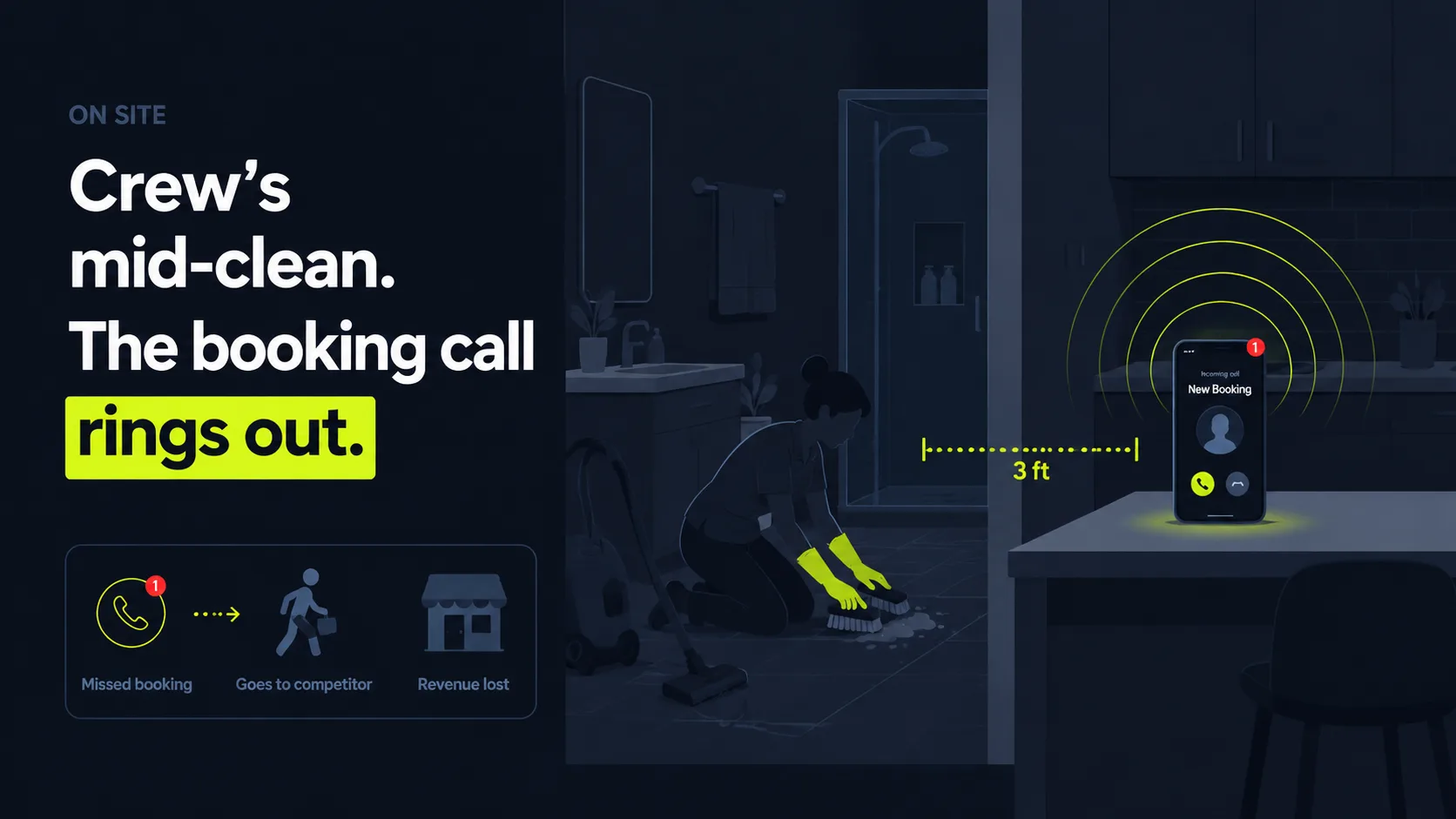
Why do cleaning businesses lose bookings to missed calls while crews are on site?
Cleaning businesses lose bookings because the people who could answer the phone are elbow-deep in someone else's bathroom, and most callers won't try a second time. For home-services businesses, 27% of calls go unanswered and fewer than 3% of callers pushed to voicemail leave a message, according to Invoca (2024). A missed quote call isn't a delayed lead. It's usually a lost one.
The structural problem is unique to this trade. Your billable staff are physically inside a home, gloves on, vacuum running, often with no signal or no free hand. So the math gets ugly fast: 27% of home-services calls go unanswered, per Invoca (2024), and an older small-business call audit pegged live-answer rates at just 37.8%, per 411 Locals (2016, directional). For a cleaning company, that miss rate lands squarely on the hours your crews are generating revenue.
Voicemail won't rescue the job. Fewer than 3% of callers pushed to voicemail leave a message, per Invoca (2024), and older survey work found roughly 80% never leave one at all, per a figure attributed to Forbes via destinationCRM (2014, dated). Think about how you act with a number that doesn't pick up. A homeowner who wants a quote for next Tuesday isn't going to record a message and wait by the phone. They tap the next listing, and the next crew gets the booking you earned the lead for.
Now flip it around, because the phone isn't the interruption you've learned to dread. It's your best booking channel. 66% of small businesses rate inbound phone calls as a good or excellent source of leads, the top-rated channel ahead of online forms, in-person, and email, per BIA/Kelsey (2014, dated). Someone calling for a cleaning quote is high-intent, wallet half-out, ready to put a job on the calendar.
Citation capsule: For home-services businesses, 27% of inbound calls go unanswered and fewer than 3% of voicemail callers leave a message, per Invoca (2024). Because cleaning crews are on site and physically unreachable during a job, each missed ring is a one-time or recurring clean handed to whichever competitor picked up first.
Here's the twist most owners miss until it stings: the more jobs you run, the more calls you drop. A solo cleaner can sometimes grab the phone between rooms. A four-crew operation has eight to twelve people all on site at once, every one of them unreachable. Growth in field hours and growth in missed calls move together. Scaling the crews quietly scales the leak. So what is one of those dropped calls actually worth to you? We'll put a dollar figure on it before the end.

Dig deeper into the numbers in our breakdown of how missed calls cost local service businesses revenue.
How does SkoreFlow book one-time and recurring cleans and quote by home size?
SkoreFlow's AI voice agent answers on the first ring and runs a structured quoting-and-booking script built for cleaning companies, so it captures the same details you would on every call, without fatigue. Because firms that respond within five minutes are 21 times more likely to qualify a lead than those waiting 30 minutes, per Harvard Business Review (2011), answering instantly is the single best move a cleaning business can make on the phone.
The call flow follows a consistent order, the same way every time:
- Greet and identify the need. The agent confirms your company name and asks what the caller needs: a quote, a one-time clean, a recurring plan, or a change to an existing job.
- Qualify the home. It collects bedrooms, bathrooms, square footage or home size, and the type of clean (standard, deep, move-out, or post-construction).
- Capture add-ons. Inside-fridge, inside-oven, interior windows, baseboards, laundry, or pet-related extras get logged so the quote is accurate.
- Set the frequency. One-time, weekly, biweekly, or monthly, which drives both the price and the recurring schedule.
- Quote from your rules. It produces a price or range from your own pricing logic, no guessing and no "someone will call you back."
- Check availability and book. It offers open slots, confirms the appointment, and writes it to your calendar or scheduling software.
- Set up the recurrence. For recurring plans, it locks the standing day and time so the job repeats automatically.
- Confirm and notify. A clean summary of the quote, the job, and the cadence lands on your phone or in your software within seconds.
- Escalate when needed. Commercial bids, large homes, special requests, or anything outside the script get routed to you per your rules.
In our experience setting up cleaning scripts, one detail makes or breaks the quote: home size and clean type, captured in the same words every single call. A human rushing between calls forgets to ask square footage, or skips the "is this a deep clean?" question. Then the quote is wrong and the job loses money. A structured agent never forgets. It asks the same qualifying questions on call one and call one hundred.
This is the core difference from a message-taking service, and it's the whole ballgame. SkoreFlow books jobs, not messages. An answering service like Ruby takes a message and leaves you to call back later, by which point a competitor often has the job. SkoreFlow's agent qualifies and books the clean on the call itself, while the homeowner is still excited and still on the line. It connects to the tools cleaning crews already run, including ServiceTitan, Jobber, Housecall Pro, and Google Calendar, and it goes live in about 48 hours. The service is TCPA-aware. Missed Calls Recovery plans start at $197/month ($497 setup, up to 75 calls), step to $397/month ($997 setup, up to 250 calls), and reach $697/month ($1,497 setup, unlimited), each backed by a guarantee: 5 booked jobs in 30 days or your setup fee back.
Citation capsule: Firms that respond within five minutes are 21 times more likely to qualify a lead than those that wait 30 minutes, per Harvard Business Review (2011). An AI agent that answers on the first ring quotes a clean by home size, frequency, and add-ons, then books the one-time or recurring job while the homeowner is still on the line.

See how the same call coverage works across trades on our missed-call recovery for home-service trades page.
Capturing recurring-plan sign-ups and last-minute reschedules
Recurring revenue is the prize in cleaning, and it lives or dies on a single ring. In an adjacent recurring home-service, structural pest control, residential recurring revenue accounts for 85.2% of residential service revenue, per the NPMA (2024). The economics rhyme for maid services. A single recurring clean isn't one job. It's a contract worth dozens of cleans a year, so missing that one call doesn't cost you a clean. It costs you the whole stream.
So the agent is built to do the one thing a voicemail never could: turn a one-time caller into a standing client. When a homeowner calls for a single clean, the script offers the weekly, biweekly, or monthly cadence and the price difference, then sets the standing day and time the moment they say yes. That converts a one-off booking into a recurring schedule on the same call, at the exact instant buyer intent is highest. A callback an hour later would have lost it.
Reschedules are where recurring plans quietly bleed out. A standing client texts to move Thursday's clean. The message lands while your crews are out. Nobody handles it, and an unanswered reschedule curdles into a cancellation by the weekend. Customer patience is short: 56% of customers immediately try another channel and 28% abandon entirely after a missed response window, per Nextiva (2025). The agent answers the reschedule call live, moves the single appointment, and keeps the recurrence intact.
How the agent handles a reschedule without breaking the recurrence
A reschedule is a one-time move inside a repeating series, nothing more. The agent confirms which clean is moving, offers the next open slots, books the new date, and leaves the standing weekly or biweekly schedule untouched. The homeowner gets an immediate confirmation, your calendar updates, and the recurring contract keeps running instead of unraveling over one shifted Thursday.
Why last-minute cancellations need a live answer
A cancellation call is a retention moment, not an admin task. Answered live, the agent can offer the next available slot or a different cadence instead of letting the client walk out the door. Sent to voicemail, that same call becomes silent churn, and remember, fewer than 3% of voicemail callers leave a message, per Invoca (2024). Catch the call and you get a shot at saving the contract. Miss it and you find out it's gone when the crew shows up to a locked door.
Most cleaning owners obsess over winning new leads and underrate the reschedule line. We've found the cheaper revenue is defensive. A recurring client who can't reach you to move one clean is far more likely to cancel the whole plan than a brand-new caller is to book in the first place. Answering reschedules instantly protects the contracts you already bled to win. That's the leak nobody puts on a whiteboard.
Citation capsule: Recurring revenue dominates subscription home-services: in pest control it's 85.2% of residential service revenue, per NPMA (2024). For cleaning, a missed reschedule call risks the whole contract, since 56% of customers try another channel and 28% abandon after a missed response window, per Nextiva (2025), and under 3% leave a voicemail, per Invoca (2024).
See why round-the-clock pickup matters in our note on protecting recurring revenue with 24/7 call coverage.
AI vs. traditional answering service for cleaning businesses: which fits?
The core trade-off is coverage versus headcount: AI answers every call instantly at a flat cost and quotes from your own pricing, while a traditional live service offers human voices at a premium with limited capacity, usually metered per minute. Live virtual receptionist plans at one national provider run from $250/month for 50 minutes to $1,725/month for 500 minutes, per Ruby's pricing page (2026, accessed June 2026). Divide those plans by their included minutes and the effective rate works out to roughly $3.45 to $5.00 per receptionist-minute, a figure derived from Ruby's published tiers rather than quoted by Ruby.
Both models beat voicemail. The real question for a cleaning business is which mix of cost, capacity, and quoting accuracy fits how many calls you field while your crews are on site.
| Factor | AI answering service for cleaning businesses | Traditional live answering service |
|---|---|---|
| Availability | 24/7, no hold time, answers on first ring | Business hours or after-hours desk; possible hold queue |
| Quoting | Quotes by home size, frequency, and add-ons from your own pricing | Often takes a message; quote depends on agent briefing |
| Recurring plans | Sets up weekly/biweekly/monthly cadences and reschedules | Usually relays the request for you to handle later |
| Concurrent calls | Unlimited simultaneous calls while every crew is on site | Limited by staffed agents; callers hold or drop |
| Cost signal | Typically below live plans; AI receptionist tiers from ~$95/mo, per Smith.ai (2026) | $250-$1,725+/mo at a derived ~$3.45-$5.00/min, per Ruby (2026) |
| Per-minute fees | Flat plans, no per-minute metering | Often metered per minute, which spikes with volume |
| Consistency | Same qualifying and quoting script every call | Varies by agent and shift |
| Human escalation | Routes commercial bids, large homes, and complaints to you | Live agent judgment for nuance |
| Best for | Crews on site all day, recurring-plan capture, tight margins | Owners wanting a human voice on every call |
Most owners frame this as AI or human. We've found the better frame is AI plus owner escalation. The AI books the standard three-bed deep clean and the biweekly maid plan, the routine calls a live desk would have dropped while your crews worked, then hands the nuanced ones, like a 6,000-square-foot estate or an office RFP, straight to you. You stop trading coverage for judgment and start keeping both.
There's a sharper line worth drawing, and it's the one that decides who keeps the booking. A traditional service like Ruby answers in a human voice, but it takes a message and leaves you to call the homeowner back. SkoreFlow books jobs, not messages. It qualifies the clean and writes the appointment to your calendar on the same call, while buyer intent is at its peak. For a cleaning crew that can't return calls until the truck is back in the lot, that difference isn't a feature. It's the booking.
Citation capsule: Live virtual receptionist plans cost roughly $3.45 to $5.00 per receptionist-minute, derived from Ruby's published 2026 pricing ($250/mo for 50 minutes to $1,725/mo for 500 minutes). AI answering tiers, starting near $95/month per Smith.ai (2026), let cleaning businesses quote and book every call for far less, with no per-minute fees.
What does an answering service for a cleaning business cost, and what is the ROI?
Pricing spans a wide band, but the ROI math is simple: a few recovered cleans, or one saved recurring contract, usually pays for months of coverage. Industry pricing for virtual receptionist services runs about $50-$300/month for AI and $300-$2,000+/month for human services, per CloudTalk (2025). Against a full schedule of weekly homes, that cost is a rounding error.
Now let's close the loop we opened earlier and do the math on a dropped call. The return comes from the jobs you currently lose without ever seeing them. Recall the data: 27% of home-services calls go unanswered and fewer than 3% of voicemail callers leave a message, per Invoca (2024). Hiring a dedicated phone person instead means a median receptionist wage of $37,230 a year before benefits, per the U.S. Bureau of Labor Statistics (2024). And even then, that one person still can't answer every line while a dozen crew members are scattered across town. The AI covers every call around the clock for a fraction of that wage.
SkoreFlow's own Missed Calls Recovery plans sit inside that band: Starter at $197/month ($497 setup), Professional at $397/month ($997 setup), and Enterprise at $697/month ($1,497 setup, unlimited calls). Each carries a guarantee of 5 booked jobs in 30 days or your setup fee refunded. The downside is capped. The recovered-job upside compounds week after week.
Illustrative example (representative scenario, not a real client): Picture a 4-crew cleaning company missing 12 quote and booking calls a week while crews are on site. Over a year that's roughly 624 missed calls. In representative trades scenarios, a recovery agent lifts the answer rate to around 94% (versus a typical 38%), can return on the order of $14,200/month in otherwise-lost work, and pays for itself in roughly 11 days. Treat those as illustrative benchmark figures, not a quoted result. With 27% of home-services calls going unanswered and almost no one leaving a voicemail (per Invoca, 2024), even recovering a small share into booked jobs usually outweighs an answering-service subscription many times over, and a single recovered recurring plan is not one job but dozens of cleans a year. The real number depends on your own per-clean price, your recurring mix, and your conversion rate. Run those against your call volume in the calculator below.
Plug in your own numbers with our Missed Call Revenue Calculator.
Citation capsule: Virtual receptionist pricing runs about $50-$300/month for AI versus $300-$2,000+/month for human services, per CloudTalk (2025). Against a median in-house receptionist wage of $37,230/year before benefits (BLS, 2024), an AI answering service quotes and books every cleaning call around the clock at a fraction of the cost.
Why do cleaning businesses choose SkoreFlow?
Cleaning businesses choose SkoreFlow because it closes the exact gap the data exposes: a live answer on every call, accurate quoting by home size and frequency, recurring-plan setup, instant reschedules, and a clean handoff to the owner when a human is needed. With 27% of home-services calls going unanswered, per Invoca (2024), and older audits putting live-answer rates near 37.8%, per 411 Locals (2016, directional), simply answering well while your crews are on site is an edge most cleaners haven't claimed.
The approach is built for how homeowners actually search now, which is shifting faster than most owners realize. Across consumers, 45% now use AI tools to find local services, up from 6% a year earlier, per BrightLocal (2026). It also respects how people feel about AI on the phone: 64% of customers would prefer companies didn't use AI in customer service, per Gartner (2024). So the agent sounds natural, and it hands off to a person the second a caller asks for one.
Setup is fast and the risk is bounded. SkoreFlow gets a cleaning agent live in about 48 hours, integrates with ServiceTitan, Jobber, Housecall Pro, and Google Calendar, and stands behind a guarantee: 5 booked jobs in 30 days or your setup fee back. The agent is TCPA-aware, and your numbers, clients, and call data stay private.
We don't publish invented testimonials or named results, and we won't start now. Here's what we'll say plainly: the cleaning companies that benefit most are the ones currently sending on-site and after-hours calls to voicemail. Plug the leak first. Refine the quoting script second. That order tends to produce the fastest, most honest wins, and it's the order we'd run if it were our own crews on the calendar.
Citation capsule: Consumer use of AI tools to find local services jumped to 45% in 2026, up from 6% a year earlier (BrightLocal), yet 64% of customers still prefer companies didn't use AI in service (Gartner, 2024). A cleaning agent that quotes naturally and escalates commercial bids and complaints to the owner wins both phone and AI-driven discovery.
Stop sending cleaning bookings to voicemail
Go back to that kitchen counter, the phone buzzing three feet from a crew that can't answer. The pattern in the data is hard to ignore: 27% of home-services calls go unanswered, only about 37.8% of small-business calls are answered live, and almost no one leaves a voicemail. An AI answering service for cleaning businesses closes that gap by answering every call, quoting by home size and frequency, booking one-time and recurring cleans, and handling reschedules and cancellations, all while your crews stay focused on the work in front of them.
You don't have to choose between running the crews and answering the phone. Let the agent catch the on-site and after-hours calls, book the recurring plans, and route the commercial bids and odd jobs that need you to your phone. Want to see what those unanswered rings are quietly costing you? Book a Free Call Audit, a 20-minute, no-pressure session where we map exactly where one-time and recurring bookings are slipping and what capturing them would be worth. No setup, no risk, and you keep the numbers either way.
Next steps: Book a Free Call Audit or estimate lost revenue with the calculator.
Sources: Invoca (2024) · 411 Locals (2016) · destinationCRM (2014) · BIA/Kelsey (2014) · Harvard Business Review (2011) · NPMA (2024) · Nextiva (2025) · Ruby (2026) · Smith.ai (2026) · CloudTalk (2025) · U.S. Bureau of Labor Statistics (2024) · BrightLocal (2026) · Gartner (2024)
Written and reviewed by Maksim Skorokhod, Founder of SkoreFlow, who builds AI answering and voice automation for small service businesses. Last reviewed: 2026-06-07. Learn more on our about page or contact us.