Why do electricians lose jobs to missed calls?
Electricians lose jobs because they physically can't answer mid-install, and most callers won't try twice. For service businesses, 27% of inbound calls go unanswered, and fewer than 3% of callers sent to voicemail leave a message, according to Invoca (2024). A missed call isn't a delayed lead. It's usually a dead one.
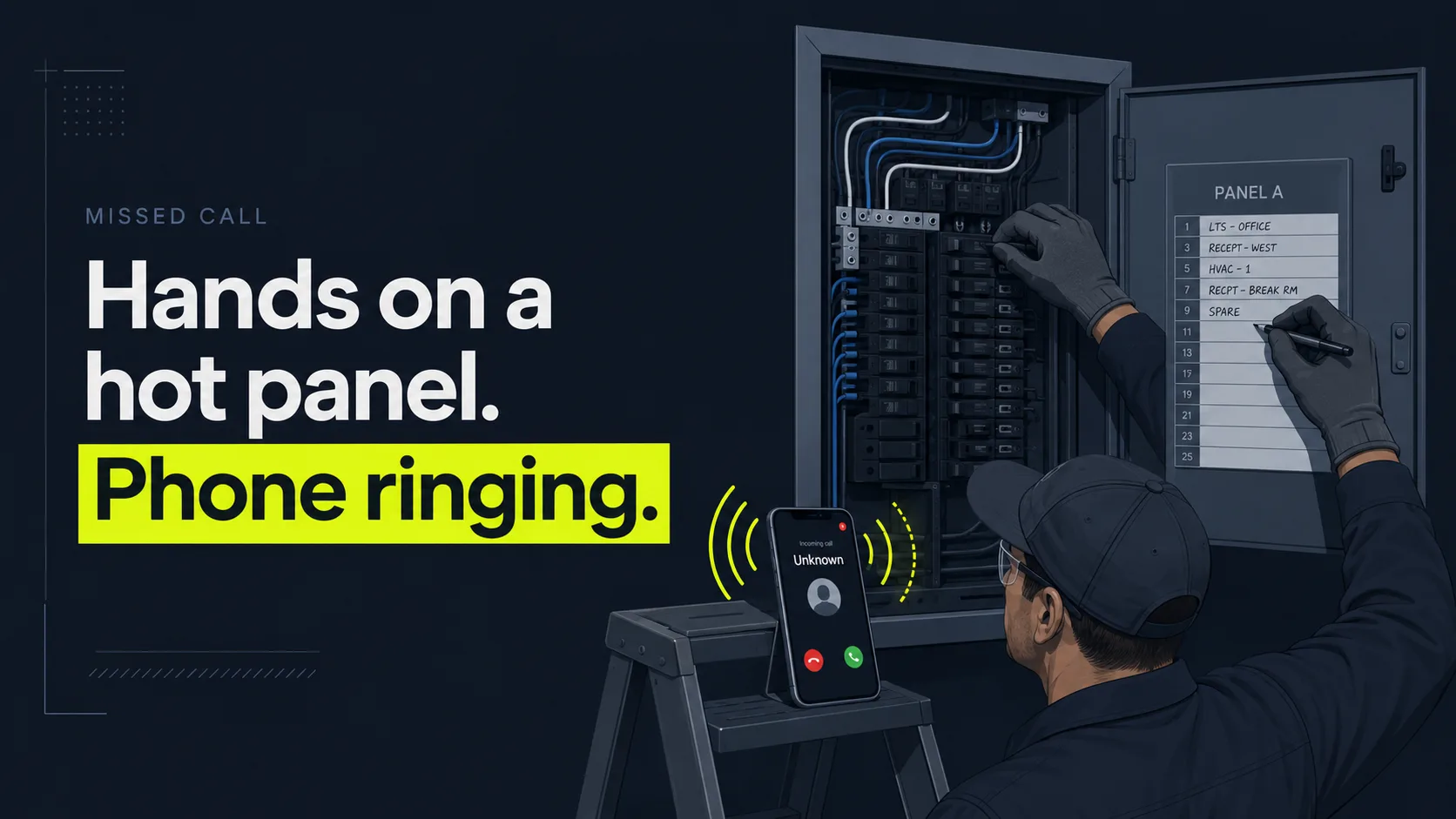
Picture the moment it happens. You're forty minutes into terminating a sub-panel, both hands occupied, breaker labels half-written in marker on the deadfront. The phone buzzes against the rung of the ladder. You can't stop. You can't strip a hot lug to chase a ringtone. By the time you peel off your gloves, the caller has already scrolled to the next name on the map. That's not a hypothetical. That's a Tuesday.
The phone is also your single best lead source, which makes the leak hurt more. 66% of small businesses rate inbound phone calls as a good or excellent source of leads, the top-rated channel ahead of online forms, in-person, and email, per BIA/Kelsey (2014). That benchmark is over a decade old, yet it still holds for trades, where the high-intent homeowner ready to book is exactly the one you drop while pulling cable.
Speed decides who wins the work. Firms that contact a lead within five minutes are 21 times more likely to qualify it, and roughly 100 times more likely to connect, than firms that wait 30 minutes, according to Harvard Business Review (2011). A homeowner who just lost power to half the house won't wait for tomorrow's callback. They'll call until someone picks up.
So how much money is actually leaking? Run the math, because a vague ache is easy to shrug off and a dollar figure is not. Miss ten calls a week and you've missed roughly 520 a year. With fewer than 3% leaving a voicemail, almost none of those callers reach you a second time. If even a fraction were service calls, panel upgrades, or rewire estimates, you've handed a five-figure stack of work to the shop down the road. The dollar figure is the wedge. Hold that thought, because we'll run it all the way through later.
It's a big market to leak revenue in. US electricians' industry revenue ran roughly $240 billion in 2024, a large, highly fragmented, SMB-heavy trade, per IBISWorld (2024). In a field that fragmented, the shop that simply answers consistently pulls ahead of the dozens nearby that don't.
Citation capsule: 27% of calls to home-services businesses go unanswered, and fewer than 3% of callers pushed to voicemail leave a message, according to Invoca (2024). Because 66% of SMBs rate inbound phone calls their best lead source (BIA/Kelsey, 2014), every unanswered ring is high-intent electrical work handed to a competitor.
Here's what we've found working with trades: the worst call drop happens at peak demand. A tripped main that won't reset, a scorched outlet, a dead panel after a storm. Those calls land when your crew is already buried in another job. The shop that answers at that exact moment books the work the busy 9-to-5 office never even sees.
See the full breakdown of how missed calls cost service businesses revenue.
How does SkoreFlow book service calls and estimates while you're on a job?
SkoreFlow's AI voice agent answers on the first ring and runs a structured booking script built for electrical work, so it captures the same details your office manager would, on every call, without fatigue. Because firms that respond within five minutes are 21 times more likely to qualify a lead (per Harvard Business Review, 2011), answering instantly is the highest-impact move you can make.
Think of it as the office manager who never steps away from the desk. No lunch break, no second line ringing through, no "I was on the other call." The booking flow follows a consistent order:
- Greet and identify the job type. The agent confirms your business name and asks what the caller needs (service call, repair, panel upgrade, EV charger install, inspection, estimate).
- Capture contact details. Full name, phone, email, and the service address, recorded verbatim.
- Qualify the job. Service-area fit, property type (residential or commercial), and the problem in the caller's own words.
- Flag urgency. The agent separates a routine outlet swap from a no-power or safety emergency that needs same-day attention.
- Quote the service fee. It states your service-call or diagnostic fee up front, so callers self-qualify before a truck rolls.
- Book the visit. It offers open slots and confirms the service call directly on your calendar.
- Route and notify. A clean job summary lands on your phone or in your field-service app within seconds.
- Escalate emergencies. True power-out and safety calls get connected or pushed to the on-call electrician immediately, per your rules.
Confirmed visits sync straight into ServiceTitan, Jobber, Housecall Pro, or Google Calendar, so a captured call becomes a scheduled job with no re-keying. No one retypes an address at the end of the day. No sticky note gets lost on the dash. Setup is fast: most shops are live in 48 hours, and the plan is backed by a guarantee of 5 booked jobs in the first 30 days or your setup fee back.
In our experience setting up booking scripts for electrical shops, the biggest win is quoting the diagnostic fee on the call. When the agent states the service-call charge up front, price shoppers self-select out and the booked visits that remain are real work, not free-quote tire-kickers. So the calendar fills with jobs that pay, not errands that don't.
Citation capsule: Firms that contact a lead within five minutes are 21 times more likely to qualify it and 100 times more likely to connect than those waiting 30 minutes, per Harvard Business Review (2011). An AI agent answering on the first ring books the service call while the homeowner is still motivated to fix the problem.
See how SkoreFlow handles missed-call recovery for related trades like plumbers and HVAC shops.
How does it triage power-out and safety emergencies and route them to the on-call electrician?
It triages by urgency on the call, then escalates real emergencies to your on-call electrician instantly while booking routine work for later. This matters because consumer tolerance for AI hinges on reaching a person when it counts: the number-one consumer concern about AI in customer service is that it will get harder to reach a human, per Gartner (2024). A good electrical agent answers, then connects.
It's 9:14pm and a woman calls because half her house went dark and there's a faint smell of hot plastic near the panel. That call cannot go to a generic message pad. It cannot wait for a 7am callback. It needs to be recognized as a hazard in the first ten seconds, handled calmly, and put in front of a real electrician fast. That recognition is the whole game.
Electrical calls aren't all equal, and triage is what separates this vertical from a generic answering service. A whole-house outage, a burning smell, sparking, or a hot panel is a same-day safety issue. A flickering light, a dead outlet, or a quote for recessed cans can wait for the next open slot. The agent classifies each call by the words the caller uses and the questions it asks, then acts on your rules.
For genuine emergencies, the agent moves fast. It captures the address, confirms the nature of the hazard, gives the caller basic safety guidance you've pre-approved, and either warm-transfers the call or texts and dials your on-call electrician right away. After a missed response window, 56% of customers immediately try another channel and 28% abandon entirely, per Nextiva (2025). Fast routing keeps a scared homeowner from dialing the next shop while yours sleeps.
What counts as a power-out or safety emergency
A safety emergency is anything that can't wait without risk: no power to the home or a critical circuit, a burning or melting smell, visible sparks or arcing, a hot or smoking panel, exposed live wiring, or power loss affecting medical equipment. The agent is scripted to recognize these phrases and treat them as immediate escalations, not routine bookings.
How escalation to the on-call electrician works
Escalation follows the rules you set. The agent can warm-transfer a live call, dial your on-call number in sequence, or fire a text with the address, hazard, and callback number, then keep trying the next tech if the first doesn't pick up. Routine calls never trigger an after-hours escalation, so your on-call electrician only gets woken for true emergencies. No 2am buzz over a flickering bulb.
Most shops think after-hours coverage is purely about emergencies. We've found the bigger payoff is the routine evening booking: the homeowner who finally has a free minute at 8:30pm to schedule a panel upgrade or a whole-home rewire estimate. That's high-ticket, non-urgent work the next-morning callback usually loses. So the agent earns its keep twice, once on the hazard you'd dread missing, and once on the quiet evening estimate you never knew you lost.
Citation capsule: The top consumer concern about AI in customer service is that it gets harder to reach a person, per Gartner (2024), and after a missed response window 56% of customers try another channel while 28% abandon entirely, per Nextiva (2025). An electrical agent that triages and instantly routes no-power emergencies to the on-call tech answers both concerns.
AI vs. traditional answering service for electricians: which fits your shop?
The core trade-off is coverage versus headcount: AI answers every call instantly at a lower cost, while a traditional live service offers human voices at a premium with limited capacity and often per-minute billing. Live virtual receptionist plans at one national provider run from $250/month for 50 minutes to $1,725/month for 500 minutes, per Ruby's pricing page (2026), which works out to roughly $3.45 to $5.00 per receptionist-minute.
There's a bigger difference than price, though, and it's the one that decides who books the job. A service like Ruby takes a message and leaves you to call the homeowner back. SkoreFlow books jobs, not messages: it qualifies the caller and schedules the visit on your calendar during the call, so the work is locked in before the homeowner can dial the next shop. Both models beat voicemail. The real question is which mix of cost, capacity, electrical triage, and escalation fits your call volume and your storm-season spikes.
| Factor | AI answering service for electricians | Traditional live answering service |
|---|---|---|
| Availability | 24/7, no hold time, answers on first ring | Business hours or after-hours desk; possible hold queue |
| Call capacity | Handles simultaneous calls during a storm rush | Limited by staffed agents on duty |
| Billing model | Flat plans, no per-minute fees | Often per-minute; $3.45-$5.00/min, per Ruby |
| Cost signal | SkoreFlow Missed Calls Recovery $197-$697/mo | $250-$1,725+/mo, per Ruby |
| Outcome on the call | Books the job on your calendar, not just a message | Often takes a message and leaves you to call back |
| Consistency | Same qualifying script every call | Varies by agent and shift |
| Job intake | Structured job-type, address, and scope capture | Depends on agent training and script adherence |
| Emergency triage | Scripted to flag no-power/safety calls and escalate | Depends on agent's electrical knowledge |
| Service-fee quoting | States your diagnostic fee up front, every call | Inconsistent unless heavily scripted |
| Best for | Storm spikes, after-hours coverage, tight budgets | Owners wanting a human voice on every call |
Most owners frame this as AI or human. We've found the better frame is AI plus human escalation. The AI catches the 11pm no-power call a live desk would have missed entirely, then hands the genuine safety emergency straight to your on-call electrician. You stop trading coverage for judgment, and you stop paying by the minute for either one.
Citation capsule: Live virtual receptionist plans cost roughly $3.45 to $5.00 per receptionist-minute, derived from Ruby's published 2026 pricing ($250/mo for 50 minutes to $1,725/mo for 500 minutes). SkoreFlow's Missed Calls Recovery, from $197/month with no per-minute fees, lets electricians cover every call for far less, and it books the job on the call instead of taking a message.
What does an answering service for electricians cost, and what is the ROI?
Pricing spans a wide band, but the ROI math is simple: one booked service call usually pays for months of coverage. SkoreFlow's Missed Calls Recovery runs $197/month (Starter, up to 75 calls), $397/month (Professional, up to 250 calls), or $697/month (Enterprise, unlimited), with no per-minute fees. For context, industry pricing for virtual receptionist services runs about $50-$300/month for AI and $300-$2,000+/month for human services, per CloudTalk (2025). Against the value of a single won job, that cost barely registers.
Back to the math we promised earlier. The return comes from calls you currently lose. Remember the data: 27% of home-services calls go unanswered and fewer than 3% of voicemail callers leave a message, per Invoca (2024). Hiring a receptionist instead means a median wage of $37,230 a year before benefits, per the U.S. Bureau of Labor Statistics (2024). The AI covers the same calls around the clock for a fraction of that, with no per-minute surprises and no payroll.
Illustrative example (industry-based scenario, not a real client): Picture a 3-van electrical shop missing 10 calls a week. Over a year that's roughly 520 missed calls, and with fewer than 3% of voicemail callers leaving a message (per Invoca, 2024), most of those never call back. Now compare the two ways to catch them. An in-house receptionist runs a median wage of $37,230 a year before benefits, per the U.S. Bureau of Labor Statistics (2024), and still clocks off at 5pm. SkoreFlow's Missed Calls Recovery starts at $197/month, about $2,364 a year, and covers all 520 calls around the clock. In a representative trades scenario, a shop recovering missed calls can return on the order of $14,200/month in booked work (illustrative benchmark, not a guaranteed result), so catching even a handful of those calls as booked service jobs pays for the year many times over. Run your own job values through the calculator below to see your number.
So the choice on the table is roughly $2,364 a year for coverage that never sleeps, against a five-figure pile of work that quietly walks. Run the numbers for your shop with the Missed Call Revenue Calculator.
Citation capsule: Virtual receptionist pricing runs about $50-$300/month for AI versus $300-$2,000+/month for human services, per CloudTalk (2025). Against a median in-house receptionist wage of $37,230/year (BLS, 2024), SkoreFlow's Missed Calls Recovery, from $197/month, covers every electrical call around the clock at a fraction of the cost.
Why do electricians choose SkoreFlow?
Electricians choose SkoreFlow because it closes the exact gap the data exposes: a live answer on every call, structured job intake, a quoted service fee, and instant escalation to your phone when a panel is hot or the power is out. With 27% of home-services calls going unanswered, per Invoca (2024), simply answering well is a competitive edge most shops haven't bothered to claim.
The approach is built for how homeowners actually search now. Across consumers, 45% now use AI tools to find local services, up from 6% a year earlier, per BrightLocal (2026). It also respects how people feel about AI: 64% of customers would prefer companies didn't use AI in customer service, per Gartner (2024). So the agent sounds natural and hands off to a human the moment a caller needs one. That's the tightrope, and it's walkable.
It's also built to be low-risk to try, which matters when you've been burned by software before. SkoreFlow's Missed Calls Recovery is usually live in 48 hours, connects to ServiceTitan, Jobber, Housecall Pro, and Google Calendar, and is TCPA-aware so your outreach stays inside the rules. The plan is backed by a simple guarantee: 5 booked jobs in the first 30 days or your setup fee back. If it doesn't book work, you don't eat the setup.
We don't publish invented testimonials or named job results. What we'll say plainly: the electricians who benefit most are the ones currently sending after-hours and overflow calls to voicemail. Plug the leak first, then optimize. That order tends to produce the fastest, most honest wins.
Citation capsule: Consumer use of AI tools to find local services jumped to 45% in 2026, up from 6% a year earlier (BrightLocal), yet 64% still prefer companies didn't use AI in service (Gartner, 2024). An electrical agent that answers naturally and escalates safety calls to a human wins both phone and AI-driven discovery.
Stop sending jobs to voicemail
The pattern in the data is hard to ignore: 27% of home-services calls go unanswered, almost no one leaves a voicemail, and the shop that responds first usually wins the job. An AI answering service for electricians closes that gap by answering every call, qualifying the job, quoting your service fee, booking the visit, and escalating no-power and safety emergencies to your phone.
You don't have to choose between finishing the install and answering the phone. Let the agent catch the overflow and after-hours calls, then hand you the emergencies that need an electrician on site now. Remember the 9:14pm no-power call from earlier? With coverage in place, that one gets answered, triaged, and routed to your tech while you're still asleep, and the routine evening estimate gets booked instead of lost. Want to see what unanswered calls are costing you? Book a free, no-pressure call audit (about 20 minutes), and we'll map where jobs are slipping and what capturing them would be worth.
Ready to plug the leak? Book a Free Call Audit, or estimate your lost revenue with the calculator first.
Written and reviewed by Maksim Skorokhod, Founder of SkoreFlow, who builds AI answering and voice automation for small service businesses. Last reviewed: 2026-06-07.