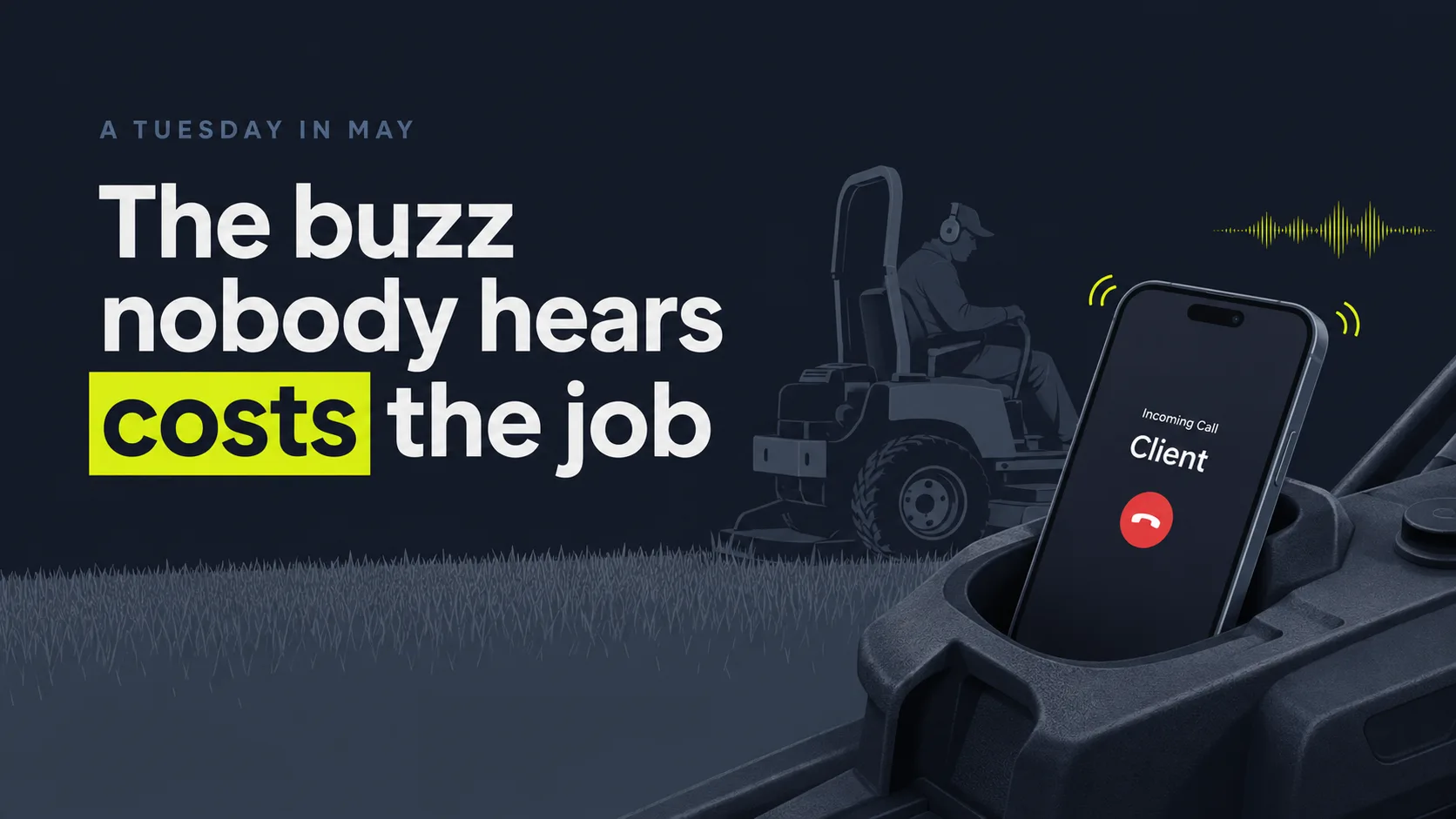
Why do landscapers lose jobs to missed calls while crews are in the field?
Landscapers lose jobs because the phone rings when nobody can answer it, and most callers will not try twice. About 27% of calls to home and field-services businesses go unanswered, and fewer than 3% of callers sent to voicemail leave a message, per Invoca (2024). Your mower drowns out the ring, and the lead just dials the next company.
Picture a normal Tuesday in May. The grass is wet, the smell of cut clippings and two-stroke exhaust hangs in the air, and both crews are heads-down on a corner lot. The owner is on the ride-on, earplugs in, throttle wide open. Somewhere in a cup holder, a phone lights up, buzzes twice against the plastic, and goes dark. A homeowner three miles away wanted a spring cleanup quote. By the time you check at lunch, that homeowner has already signed with whoever picked up first.
Here is the uncomfortable part. The lead did not vanish because your work is bad. It vanished because nobody answered fast enough. After a missed response window, 56% of customers immediately try another channel and 28% abandon the search entirely, per Nextiva (2025). For a trade that runs almost entirely on inbound estimate calls, a phone nobody answers is revenue walking out the door. You can dig into the wider pattern in our guide to missed-call recovery for service businesses.
What stings most is the channel involved. Inbound phone calls are the top-rated lead source for 66% of small businesses, ahead of online forms at 58.2% and email at 43.7%, per BIA/Kelsey (2014). Read that again. Your single best source of work is the one your crew physically cannot answer mid-job.
Speed decides who wins. Firms that contact a lead within 5 minutes are about 100x more likely to reach that person and 21x more likely to qualify them than firms that wait 30 minutes, per Harvard Business Review (2011). A landscaper checking voicemail at 6pm has already lost the race that started at 9am.
So how much is this actually costing you? Do the math on one busy week. Say you miss 10 calls, and half of those callers wanted a quote. That is five estimate conversations gone. If even one would have become a recurring maintenance account worth a few thousand dollars across the season, a single quiet phone just cost you more than a month of payroll on a part-timer. Hold that number in your head, because most owners underestimate it badly, and we will put a real figure on it later.
[UNIQUE INSIGHT] Most trades treat the missed call as a callback problem. We see it differently. In our work with field-service operators, it is really a speed problem. The lead who hangs up on your voicemail is not waiting for your evening callback. They are already on the phone with crew number two.

Citation capsule: Inbound calls are the top-rated lead source for 66% of small businesses, yet roughly 27% of calls to home and field-services firms go unanswered and under 3% of voicemail-bound callers leave a message (BIA/Kelsey, 2014; Invoca, 2024). For landscapers whose crews work hands-on in the field, that gap is the difference between a booked estimate and a lead lost to a competitor.
How does SkoreFlow book estimates and recurring maintenance calls?
SkoreFlow answers the call in 0.4 seconds, qualifies the job, and books it straight onto your schedule, all without pulling a single crew member off a mower. Because answering within 5 minutes makes you about 21x more likely to qualify a lead than waiting 30 minutes, per Harvard Business Review (2011), instant pickup turns ringing phones into confirmed estimates instead of voicemails nobody returns. In a representative trades scenario, that lift takes answer rates from roughly 38% to around 94%.
Here is what happens the moment a homeowner dials. The phone rings once. Before your thumb could even find the screen, the call is answered, the property is being qualified, and a slot is going onto your calendar. The flow runs the same way on every call, start to finish:
- Answers in 0.4 seconds, 24/7, and filters spam. Every real call gets picked up, including the after-hours and weekend calls that land while crews are home. Local businesses still take about 94% of their calls Monday to Friday, but the leftover evenings and weekends are pure upside when nobody else is answering, per BrightLocal (2019).
- Qualifies the property and service. It asks whether the property is residential or commercial, the lot size, and the service needed: mowing, cleanup, design, irrigation, or snow.
- Quotes the next step, not a fake price. Rather than guessing a number, it explains your estimate process and books the on-site visit so your quote stays accurate.
- Books the estimate or maintenance start. It offers real open slots and writes the appointment to your Google Calendar or scheduling tool, with address and gate or pet notes attached.
- Captures recurring-contract interest. When a caller wants weekly mowing or a seasonal plan, it flags the recurring opportunity so you follow up while intent is hot.
- Texts and logs everything. You get an instant text summary, and the full call detail syncs to Jobber, Housecall Pro, or ServiceTitan. Nothing lives in a voicemail you forget to check.
[PERSONAL EXPERIENCE] In our experience working with field-service operators, the qualifying step matters more than the booking step. A scheduled estimate for a half-acre commercial property is worth far more of your drive time than a quarter-acre residential mow, and the agent can sort those before you ever load the trailer. That triage is where the agent earns its keep, because it protects the one thing you can never make more of: hours in the truck.
Here is the difference that matters most. A traditional answering service like Ruby takes a message and leaves you to call back later, by which point the lead has booked someone else. SkoreFlow books the job on the call. And if a caller wants a human, the agent hands off or takes a detailed message and pings you immediately. That matters because 64% of customers would prefer companies did not use AI in customer service, and the top concern is that AI makes it harder to reach a person, per Gartner (2024). Easy escalation keeps the technology on your side instead of in the caller's way.
The booking funnel is simple to picture: an inbound call becomes a qualified lead, a qualified lead becomes a booked on-site estimate, and a booked estimate becomes a signed recurring contract. See how the same flow plays out in other trades in our answering service by industry overview.
| Funnel stage | What the agent does |
|---|---|
| Inbound call | Picks up on the first ring, 24/7 |
| Qualified lead | Confirms property type, lot size, and service needed |
| Booked estimate | Offers real slots and writes the appointment to your calendar |
| Recurring contract | Flags weekly mowing or seasonal interest for fast follow-up |
Citation capsule: SkoreFlow answers every call, qualifies the property and service, and books the estimate while crews stay in the field. Because contacting a lead within 5 minutes makes a firm about 21x more likely to qualify it than waiting 30 minutes (Harvard Business Review, 2011), instant answering converts ringing phones into scheduled jobs.
How do landscapers capture the spring rush and snow-removal calls?
Landscapers capture seasonal demand by having one consistent voice answer every call during the surge, when call volume spikes far past what a crew can field by hand. The U.S. landscaping services industry pulled in roughly $158.9 billion in revenue in 2024, per IBISWorld data summarized by Aspire (2024), and a large slice of that turns over in a few intense weeks each spring and fall, exactly when phones ring hardest.
Spring rush: too many calls, too few hands
The first 70-degree Saturday is a war on your phone. Every homeowner in the neighborhood woke up, looked at the weeds, and decided today is the day. The calls stack up faster than you can clear voicemail, and your crews are already buried in work you booked last week. Calls that hit a busy phone do not wait politely. After a missed response window, 56% of customers immediately try another channel and 28% abandon entirely, per Nextiva (2025). During the rush, an unanswered phone is a direct gift to the competitor down the road.
An answering service absorbs the spike. It handles ten simultaneous callers as easily as one, books the estimates onto your calendar, and stacks your spring pipeline while you mow. No busy signal. No "we'll call you back." Just a full schedule waiting when you finally climb out of the truck that evening.
Recurring contracts: where the real money lives
Recurring maintenance and seasonal plans are the contracts that smooth out cash flow all year. These callers ask different questions: weekly versus biweekly, what is included, whether you handle fertilization. The agent can capture that intent, confirm the service area, and book a start date, so a recurring inquiry never dies in a voicemail. One of these signatures is worth twenty one-off mows.
Snow removal and shoulder-season demand
For firms that plow, snow calls arrive on the worst possible schedule: nights, weekends, and the middle of a storm at 2am with the wind howling. That after-hours volume is precisely what live human staffing struggles to cover. A 24/7 agent signs up seasonal snow contracts before the first flake and answers storm-night calls while you are out clearing routes with the plow down.
Illustrative example (industry-based scenario, not a real client): Picture a 2-crew landscaping firm missing 10 calls per week during a roughly 30-week active season. That is about 300 missed calls a year. If even a fraction convert to recurring maintenance accounts worth several thousand dollars each over a season, the forgone recurring revenue easily runs into the tens of thousands of dollars annually. The exact figure depends on your average contract value, which is why we point operators to the missed-call revenue calculator rather than quote a single number as fact.

Citation capsule: The US landscaping industry generated about $158.9 billion in 2024, much of it concentrated in seasonal surges (IBISWorld, 2024). Because 56% of customers immediately try another channel after a missed response (Nextiva, 2025), an answering service that absorbs the spring rush and answers snow-removal calls captures contracts crews physically cannot field.
AI vs traditional answering service for landscapers compared
Cost, speed, and field knowledge separate the two models. A traditional live answering service routes your calls to remote human operators who may not know a French drain from a flowerbed, while an AI answering service answers instantly, scales through the spring rush without hold times, and runs at a fraction of the price. Live virtual receptionist plans commonly run hundreds to nearly $2,000 a month, versus roughly $65 to $800 for AI plans, per Ruby, Posh, and Smith.ai (all 2026).
| Factor | AI answering service | Traditional live answering service | DIY voicemail / your cell |
|---|---|---|---|
| Typical monthly cost | ~$65-$800 (Smith.ai, 2026) | ~$250-$1,900+ (Ruby / Posh, 2026) | $0, but missed calls |
| Answers during spring rush | Unlimited simultaneous calls | Limited by staffed agents; hold times | Goes to voicemail |
| After-hours / storm-night coverage | 24/7, every call | Often extra cost or limited hours | None |
| Knows landscaping terms | Trained on your services | Generic script, may misroute | N/A |
| Books to your calendar | Yes, in real time | Sometimes, varies by plan | No |
| Cost per minute | Low, fixed per plan | ~$3.45-$5.00/min (Ruby, 2026) | N/A |
| Effort to set up | Quick onboarding | Account setup + scripting | None |
Now look at that last column again, because it is the one most landscapers are actually living with today. Not Ruby. Not Smith.ai. Their own voicemail. And voicemail barely works: fewer than 3% of callers pushed to voicemail leave a message, per Invoca (2024). Hold queues are not much better, since 75% of callers hang up after eight or more minutes on hold, per Nextiva (2025).
[UNIQUE INSIGHT] Here is the insight most owners miss. The decision is rarely AI versus human in absolute terms. It is consistent coverage versus gaps. A live service still has gaps: limited hours, hold times, agents who do not know your routes. The setup we recommend answers everything with AI and escalates the genuinely complex calls to you, since the top consumer concern is simply being able to reach a person, per Gartner (2024).
Citation capsule: AI answering plans for small service businesses run roughly $65 to $800 per month, versus $250 to $1,900-plus for live virtual receptionist plans at about $3.45 to $5.00 per minute (Smith.ai, 2026; Ruby, 2026). For landscapers, AI also scales through the spring rush without hold times, where 75% of callers abandon after eight minutes (Nextiva, 2025).
What does it cost, and does the ROI add up?
An AI answering service for landscapers typically costs a few hundred dollars a month, and the math turns positive after just one or two saved jobs. A full-time receptionist runs about $37,230 a year in base wages before benefits and payroll taxes, per the U.S. Bureau of Labor Statistics (2024). SkoreFlow's missed-call recovery runs $197/mo (Starter, up to 75 calls), $397/mo (Professional, up to 250 calls), or $697/mo (Enterprise, unlimited), so you are replacing a salary, or replacing nothing, with a tool that answers every call. In a representative trades scenario, that investment returns its cost in roughly 11 days.
Run the ROI on contract value, not just plan price. One recurring maintenance account often covers a year of service in a single signature. Because phone calls are the top-rated lead source for 66% of small businesses, per BIA/Kelsey (2014), every recovered call is a recovered chance at exactly the revenue you depend on most.
Remember that quiet-week math from earlier? This is where it closes. The plan price is the small, visible number. The leak is the big, invisible one, and it usually dwarfs the subscription. To see your own figure instead of a guess, plug your missed-call estimate and average contract value into our missed-call revenue calculator. It shows the recurring revenue slipping past your voicemail right now, and for most owners the number is bigger than the entire annual cost of answering.
Citation capsule: A live receptionist costs about $37,230 a year in base wages (U.S. Bureau of Labor Statistics, 2024), while AI answering plans run roughly $65 to $800 a month (Smith.ai, 2026). With inbound calls the top lead source for 66% of small businesses (BIA/Kelsey, 2014), one recovered recurring contract usually pays for a year of answering.
Why do landscapers choose SkoreFlow?
Landscapers choose SkoreFlow because it answers every call the way a sharp office manager would, then proves the lift in plain numbers. The case is built on sourced industry data, not hype: about 27% of home and field-services calls go unanswered today, per Invoca (2024), and SkoreFlow's job is to close that gap by booking the jobs those calls represent.
Remember the phone buzzing in the cup holder from the start? Here is how that story ends differently. The call gets answered on the first ring. The half-acre property gets qualified. The estimate lands on your calendar before you finish the row you are mowing. The competitor down the road never gets the chance to ring back.
Our proof plan stays honest. Rather than parade a fabricated testimonial, we start every engagement by showing your own lost-lead picture. We look at your missed and after-hours call volume, apply your real average contract value, and put a number on what is leaking. Then the agent goes live and answers the calls your crew cannot.
[PERSONAL EXPERIENCE] We have found that landscapers trust the audit more than any review, because it uses their own phone data. When an owner sees that voicemail is eating a dozen estimate calls a week during the spring rush, the decision makes itself. No exaggerated case study required. The setup goes live in 48 hours and carries a plain guarantee: 5 booked jobs in 30 days or your setup fee is refunded. You can compare the same approach across trades in our answering service by industry overview.
The setup respects how callers feel about AI, too. With 64% of customers preferring companies skip AI in service and the top worry being trouble reaching a human, per Gartner (2024), SkoreFlow is tuned to sound natural and hand off cleanly when a caller needs you directly.

Citation capsule: SkoreFlow positions on sourced data, not invented testimonials: about 27% of home and field-services calls go unanswered (Invoca, 2024). It starts with an honest lost-lead audit of a landscaper's own call volume and average contract value, then answers and books the estimates that voicemail would otherwise lose.
Stop losing jobs to a ringing phone
Your crew can't run a mower and answer the phone at the same time, and the lead that hits your voicemail rarely calls back. With roughly 27% of home and field-services calls going unanswered, per Invoca (2024), and phone calls ranking as the top lead source for 66% of small businesses, per BIA/Kelsey (2014), every missed ring is a booked job handed to a competitor. SkoreFlow closes that gap, books jobs instead of taking messages, and goes live in 48 hours.
See exactly what you're leaving on the table. Book a Free Call Audit, a 20-minute, no-pressure call where we show you your own lost-lead numbers using your real call volume and average contract value. No fabricated case studies, just your data, and you keep the figures whether or not you ever sign.
Written by Maksim Skorokhod, Founder of SkoreFlow, who builds AI answering and voice automation for landscaping and other small field-service businesses. Reviewed by Daria Melnyk, an operations specialist with hands-on experience running phone intake and scheduling for home-services crews. Last reviewed: 2026-06-07.
Sources:
- Invoca, "How Much Do Missed Sales Calls Cost Home Services Businesses?" (2024)
- BIA/Kelsey, "Phone Calls Are the New Click" (2014)
- Harvard Business Review, "The Short Life of Online Sales Leads" (2011)
- Nextiva, Customer Patience Benchmark Study (2025)
- BrightLocal, Google My Business Insights Study (2019)
- Gartner, "64% of Customers Would Prefer Companies Didn't Use AI for Customer Service" (2024)
- IBISWorld landscaping revenue data, via Aspire (2024)
- U.S. Bureau of Labor Statistics, Receptionists (2024)
- Smith.ai AI Receptionist Pricing (2026)
- Ruby Pricing (2026)
- Posh Pricing (2026)