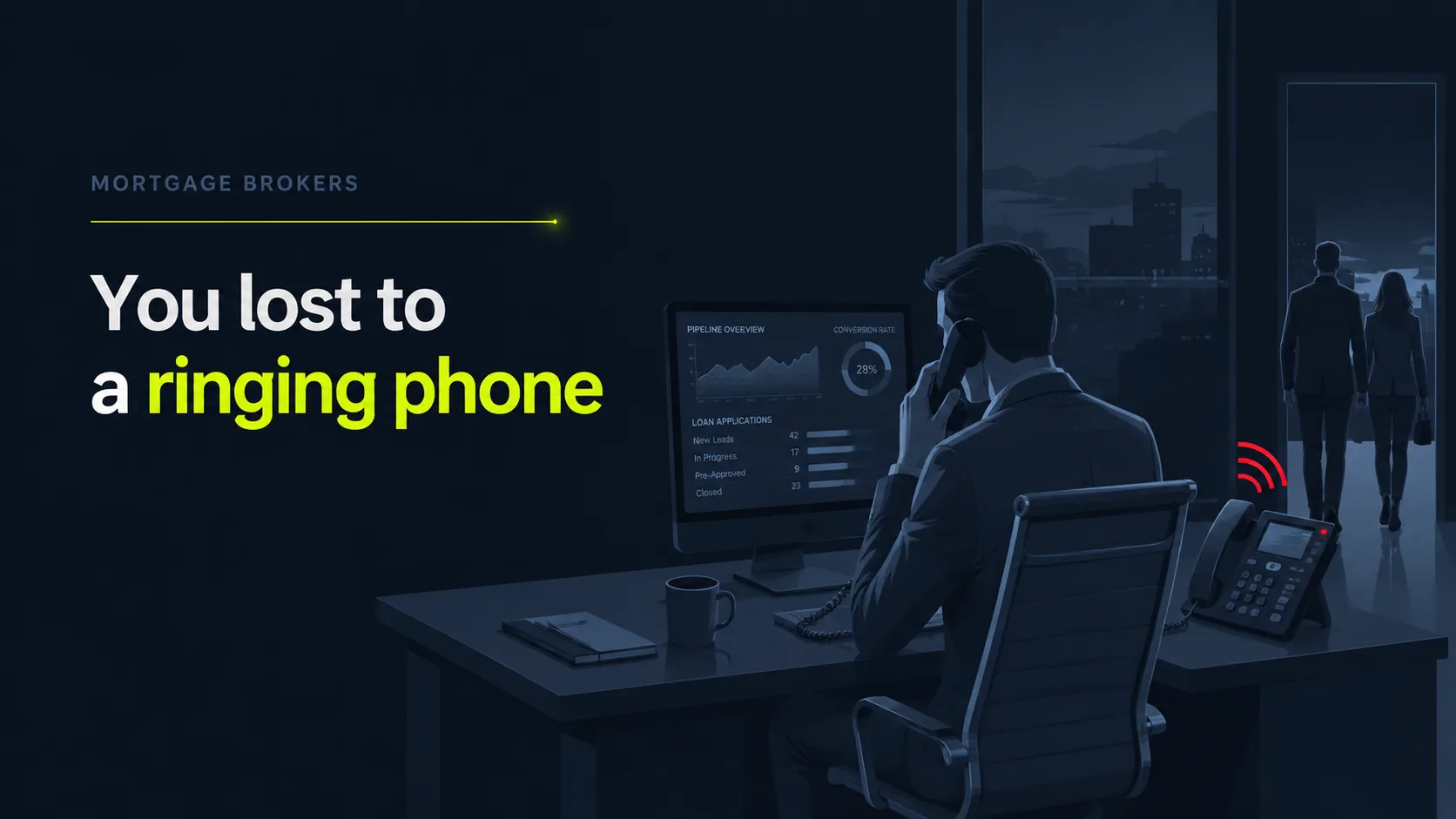
Why do mortgage brokers lose deals to slow lead response?
Mortgage brokers lose deals because rate-shoppers don't wait, and slow response hands the loan to a faster lender. Firms that contact a web lead within five minutes are 21 times more likely to qualify it, and roughly 100 times more likely to connect, than firms that wait 30 minutes, according to Harvard Business Review (2011). A borrower comparing rates is already dialing the next name on the list.
Picture the moment. It's 6:40pm, you're walking a buyer through their loan estimate line by line, and your second office line lights up. You can't pick up. The caller, a couple who just went under contract and need a pre-approval by Friday, hits four rings and a flat voicemail greeting. They hang up. They don't leave a message. They tap the next broker in their search results, and that broker answers on the second ring.
That couple is gone, and you'll never see their name. Here's the part that stings: you didn't lose to a better rate or a slicker pitch. You lost to a ringing phone.
The window is brutally short. An hour's delay matters: firms that contacted a prospect within an hour were nearly 7 times as likely to qualify the lead as those who waited just one hour longer, and more than 60 times as likely as firms that waited 24+ hours, per Harvard Business Review (2011). "I'll call them back this afternoon" is often a dead lead by lunch.
Almost nobody actually answers that fast. Lead-to-conversion rates are about 8 times greater when a lead is engaged within the first five minutes versus the five-minute-to-24-hour window, yet only 0.1 percent of inbound leads are engaged in under five minutes, according to the XANT (InsideSales) Lead Response Study (2021). Read that again. One in a thousand. The bar to beat your competition is on the floor, and most brokers still trip over it.
And mortgage conversion is already thin, so leakage hurts more. Internet mortgage leads convert at roughly 2 to 5 percent, per Banking Bridge (2024). When only a sliver of leads ever fund, dropping the ones who phoned you, the highest-intent ones in your whole pipeline, is the most expensive mistake a broker can make.
Citation capsule: Firms that respond to a lead within five minutes are 21 times more likely to qualify it and 100 times more likely to connect than those waiting 30 minutes, per Harvard Business Review (2011). With internet mortgage leads converting at only 2 to 5 percent (Banking Bridge, 2024), every slow callback compounds an already thin funnel.
Working with brokers, we keep seeing the same pattern: the lead you "missed" usually wasn't missed, it was answered, by someone else. A rate-shopper who reaches voicemail rarely leaves one. They simply move to the next lender and start the conversation there. By the time you call back, they've already handed their income, timeline, and loan amount to a competitor who is now mid-application. So how do you answer every call when you're already maxed out? That's where the math flips, and we'll get to it.
See how much unanswered calls add up to with our missed-call revenue calculator.
How does SkoreFlow capture and pre-qualify loan inquiries?
SkoreFlow's missed-call recovery voice agent answers in about 0.4 seconds and runs a structured intake script built for mortgage, so it captures the same details your processor would, on every call, without fatigue or a missed line. Because firms that respond within five minutes are 21 times more likely to qualify a lead (per Harvard Business Review, 2011), answering instantly is the single highest-impact move a broker can make. The agent books the consultation on the call. It does not just take a message and leave you to call back the way Ruby and other answering services do.
Here's what that looks like at 9pm on a Tuesday. The same couple under contract dials your number again. This time the phone is answered before the second ring. A calm, natural voice confirms your brokerage, asks what they need, learns they're under contract closing in three weeks, captures a self-reported credit range, and books them with your loan officer for 8:15 the next morning. They sleep easy. You wake up to a booked, pre-qualified appointment instead of a voicemail you'll never get.
The intake flow follows a consistent order:
- Greet and identify the need. The agent confirms your brokerage name and asks what the caller wants (purchase pre-approval, refinance, rate quote, or a general loan question).
- Capture contact details. Full name, phone, email, and the best time to reach the borrower, recorded verbatim.
- Determine loan purpose. Purchase vs. refinance, and for a purchase, whether they're shopping, under contract, or already pre-approved elsewhere.
- Capture timeline. Closing target, contract date if any, or "just exploring," so you can sort hot from warm.
- Ask ballpark credit and income. A self-reported credit range and rough income or loan amount, enough to gauge fit before the LO spends time.
- Flag urgency and source. It separates an under-contract buyer needing a fast pre-approval from a casual rate-shopper, and notes where they heard about you.
- Book the consultation. It offers open slots and confirms the loan officer appointment directly on your calendar.
- Route and notify. A clean lead summary lands on your phone or your connected calendar within seconds, and hot leads get escalated to the on-call LO immediately, per your rules. Direct sync into a mortgage LOS such as Encompass, Arive, or Floify is [CONFIRM]; the agent's confirmed integrations are Google Calendar plus the trades-stack tools it ships with.
In our experience setting up mortgage scripts, the biggest win is sorting under-contract buyers from tire-kickers before anyone calls back. When the agent captures contract status and closing timeline up front, your loan officers spend their callbacks on borrowers who need a pre-approval this week, not on someone three months from looking. The build is fast: a missed-call recovery voice agent is typically live in 48 hours, and the offer is backed by a guarantee of 5 booked appointments in 30 days or your setup fee back. Two days to plug the leak. Thirty days to prove it pays. The risk sits with us, not you.
Citation capsule: Lead-to-conversion rates are about 8 times greater when a lead is engaged within the first five minutes, yet only 0.1 percent of inbound leads are engaged that fast, per the XANT (InsideSales) Lead Response Study (2021). An AI agent answering on the first ring captures and pre-qualifies the loan inquiry while the borrower is still on the line.
| Response time | Relative odds of qualifying the lead |
|---|---|
| Within 5 minutes | 21x |
| After 30 minutes | 1x (baseline) |
See the deeper voice-agent framing on our missed-call recovery voice agent page.
What does mortgage pre-qual intake capture before routing to the LO?
Pre-qual intake captures loan purpose, timeline, and ballpark credit and income, so the loan officer opens every callback already knowing the deal. This matters because phone calls convert to revenue at roughly 10 to 15 times the rate of web or form leads for local businesses, per BIA/Kelsey (2014). A caller is high-intent. Capturing the right details turns that intent into a qualified consultation, not a phone-tag loop.
The agent collects the fields that decide whether a lead is worth the LO's time. It records loan purpose (purchase or refi), where the borrower is in the process, the closing or refinance timeline, a self-reported credit range, and rough income or target loan amount. None of this replaces a full application or a credit pull. It's the front-door triage that tells your loan officer who to call first.
This protects your loan officers from low-value callbacks. Picture the alternative: your senior LO sips cold coffee and dials back twelve voicemails, one by one, only to find ten were rate-shoppers, one was a wrong number, and the single real deal closed with someone else an hour ago. Now flip it. Your LO opens a ranked list: an under-contract buyer who needs a pre-approval by Friday sits at the top, a casual "what are rates today" inquiry sits at the bottom. The structured notes drop straight onto your connected calendar and into supported tools, so no one re-keys a borrower's details by hand. Native sync into a specific LOS is [CONFIRM].
Purchase vs. refinance, sorted at the door
The agent asks loan purpose first, because purchase and refi callbacks are completely different conversations. A purchase lead under contract is time-sensitive and needs a pre-approval fast. A rate-and-term refi may hinge on whether today's rate clears their break-even. Tagging purpose at intake lets your team route each lead to the right LO with the right urgency.
Timeline and rough qualification, before the credit pull
Timeline and ballpark numbers separate "ready now" from "someday." The agent captures a closing target, a self-reported credit band, and a rough income or loan amount. That's enough to gauge fit and priority without a hard pull or a full 1003. Your LO walks into the callback knowing roughly what they're working with, instead of starting from a blank screen.
Most brokers treat intake as data collection. We've found the bigger value is triage. The dollars aren't in capturing more fields, they're in your senior LO never again burning a morning on callbacks that a 90-second qualifying script would have flagged as not-yet-ready. So what does that actually buy you? Hours back, sharper callbacks, and a closer who finally spends his best energy on the deals that fund. Pre-qual intake is really loan-officer time protection wearing an intake script's clothes.
Citation capsule: Phone calls convert to revenue at roughly 10 to 15 times the rate of web or form leads for local businesses, per BIA/Kelsey (2014). Pre-qual intake that captures loan purpose, timeline, and ballpark credit and income turns a high-intent mortgage call into a ranked, LO-ready consultation instead of a voicemail.
Run your own numbers first with the missed-call revenue calculator to size what those captured leads are worth.
AI vs. traditional answering service for mortgage brokers: which fits?
The core trade-off is coverage versus headcount: AI answers every loan call instantly at a flat cost, while a traditional live service offers human voices at a premium with limited capacity, often metered per minute. Live virtual receptionist plans at one national provider run from $250/month for 50 minutes to $1,725/month for 500 minutes, per Ruby's pricing page (2026), which works out to roughly $3.45 to $5.00 per receptionist-minute.
Both models beat voicemail, and voicemail loses badly. On average, small businesses answer only 37.8 percent of inbound calls with a live person, leaving roughly 62 percent unanswered, per 411 Locals (2016). Sit with that for a second: six of every ten people who try to reach a small business hit dead air. So the broker's choice was never whether to answer. It's which mix of cost, capacity, and mortgage-specific intake fits your lead volume.
| Factor | AI answering service for mortgage brokers | Traditional live answering service |
|---|---|---|
| Availability | 24/7, no hold time, answers on first ring | Business hours or after-hours desk; possible hold queue |
| Concurrent-call capacity | Unlimited simultaneous calls during a rate-drop spike | Limited by staffed agents on duty; callers hold or drop |
| Cost signal | Flat plans below live pricing; SkoreFlow's voice agent runs ~$297 to $897/mo, and AI receptionist tiers start near $95/mo, per Smith.ai | $250 to $1,725+/mo at ~$3.45 to $5.00/min, per Ruby |
| Per-minute fees | Flat plans, no per-minute metering | Often metered per minute, which spikes during rate-shopper volume |
| Pre-qual consistency | Same purpose / timeline / credit / income script every call | Varies by agent and shift; generic message-taking |
| Mortgage intake depth | Structured purchase-vs-refi, timeline, ballpark credit and income | Depends on agent training and script adherence |
| LOS/CRM routing | Pushes structured notes into your CRM automatically | Often a typed message emailed for manual re-entry |
| Human escalation | Routes hot, under-contract leads to your line | Live agent judgment for nuance |
| Best for | Rate-drop spikes, after-hours leads, tight budgets, deep intake | Owners wanting a human voice on every call |
Most owners frame this as AI or human. We've found the better frame is AI plus human escalation. The AI catches the rate-shopper calls a live desk would have dropped during a rate drop, runs full pre-qual on each, then hands the genuine hot lead, like an under-contract buyer who needs a pre-approval today, straight to your on-call LO. You stop trading coverage for judgment, and you stop paying by the minute when the market moves and everyone calls at once.
There's a sharper distinction underneath the cost gap, too. A live answering service like Ruby takes a message and leaves you to call the borrower back, by which point the rate-shopper has often already started an application with a faster lender. The voice agent books the consultation on the call. It returns booked appointments, not messages, which is the whole point for a vertical where the first lender to connect usually funds the loan.
| Model | Published cost | Per-minute structure |
|---|---|---|
| AI receptionist (entry tier) | From ~$95/month | Flat plan, no per-minute metering |
| Live virtual receptionist | $250 to $1,725+/month | ~$3.45 to $5.00 per receptionist-minute |
Citation capsule: Live virtual receptionist plans cost roughly $3.45 to $5.00 per receptionist-minute, derived from Ruby's published 2026 pricing ($250/mo for 50 minutes to $1,725/mo for 500 minutes). AI answering tiers, starting near $95/month per Smith.ai (2026), let mortgage brokers pre-qualify every loan call for far less, with no per-minute fees.
What does it cost, and what is the ROI?
Pricing spans a wide band, but the ROI math is simple: a single funded loan usually pays for years of coverage. SkoreFlow's missed-call recovery voice agent runs on flat monthly plans, roughly $297/month at the Starter tier up to $897/month for unlimited call volume, with setup fees by tier and no per-minute metering. For broader context, industry pricing for virtual receptionist services runs about $50 to $300/month for AI and $300 to $2,000+/month for human services, per CloudTalk (2025). Against the commission on one closed mortgage, that monthly cost is a rounding error.
Walk the math out loud, because that's where the decision really sits. The return comes from the leads you currently lose. Remember the conversion math: internet mortgage leads convert at only 2 to 5 percent, per Banking Bridge (2024), so recovering even a handful of high-intent phone leads moves real volume. Hiring a receptionist instead means a median wage of $37,230 a year before benefits, per the U.S. Bureau of Labor Statistics (2024), and one person still can't cover nights, weekends, or a rate-drop rush. The AI covers every call around the clock for a fraction of that.
Illustrative example (industry-based scenario, not a real client): Picture a broker missing 8 loan inquiries a week. Over a year that's roughly 416 missed calls. A voice agent that lifts the live-answer rate toward the high-90s, versus the roughly 38 percent many small businesses answer today, recovers most of that volume. With internet mortgage leads converting at just 2 to 5 percent (per Banking Bridge, 2024) and most rate-shoppers never leaving a voicemail, recovering even a handful of those high-intent phone leads and funding one or two extra loans a year typically returns many times a voice-agent subscription. These answer-rate figures are representative benchmarks, not a specific customer result. Because broker commission per funded loan swings widely by loan size and lender split, plug your own commission figure into the missed-call revenue calculator to see the dollar return for your book.
There's a less obvious way to read this. The voice agent isn't really a "cost," and it isn't even a receptionist replacement. It's an insurance policy against the single most expensive event in your funnel: a high-intent borrower reaching voicemail and funding with the lender who picked up. Priced against that risk, the monthly fee stops looking like a line item and starts looking cheap.
Citation capsule: Virtual receptionist pricing runs about $50 to $300/month for AI versus $300 to $2,000+/month for human services, per CloudTalk (2025). Against a median in-house receptionist wage of $37,230/year (BLS, 2024) that still can't cover nights and weekends, an AI answering service pre-qualifies every loan call around the clock at a fraction of the cost.
| Option | Annual cost | Coverage |
|---|---|---|
| AI answering service | ~$600 to $3,600/year ($50 to $300/month) | 24/7, every call, nights and weekends |
| In-house receptionist | $37,230/year base wage, before benefits | Business hours only; one person, one line |
Why do mortgage brokers choose SkoreFlow?
Mortgage brokers choose SkoreFlow because it closes the exact gap the data exposes: a live answer on every loan call, structured pre-qualification of purpose, timeline, and rough credit and income, and instant escalation to the LO when a lead is hot. With internet mortgage leads converting at only 2 to 5 percent, per Banking Bridge (2024), capturing and qualifying every inbound call is an edge most brokers haven't claimed. The agent books the consultation on the call rather than taking a message, the build is live in about 48 hours, and the offer carries a guarantee: 5 booked appointments in 30 days or your setup fee back. The setup is TCPA-aware, built around how inbound borrower calls and follow-up are handled.
The approach is built for how borrowers search now. Across consumers, 45 percent now use AI tools to find local services, up from 6 percent a year earlier, per BrightLocal (2026). It also respects how people feel about AI: 64 percent of customers would prefer companies didn't use AI in customer service, per Gartner (2024). So the agent sounds natural and hands off to a human loan officer the moment a borrower needs one. You win the AI-driven discovery and the phone call without making borrowers feel managed by a machine.
Remember that couple under contract from the start of this piece? That's who you're really protecting. We don't publish invented testimonials or named loan results. What we'll say plainly: the brokers who benefit most are the ones currently sending after-hours and rate-shopper calls to voicemail. Plug the leak first, then optimize the script. That order tends to produce the fastest, most honest wins.
Citation capsule: Consumer use of AI tools to find local services jumped to 45 percent in 2026, up from 6 percent a year earlier (BrightLocal), yet 64 percent still prefer companies didn't use AI in service (Gartner, 2024). A mortgage agent that answers naturally and escalates hot, under-contract leads to a human LO wins both phone and AI-driven discovery.
Stop sending loan leads to voicemail
The pattern in the data is hard to ignore: mortgage leads convert at only 2 to 5 percent, rate-shoppers rarely leave a voicemail, and the broker who responds first usually funds the loan. An AI answering service for mortgage brokers closes that gap by answering every call, capturing the lead, pre-qualifying purpose, timeline, and rough credit and income, booking the LO consultation, and escalating hot leads to your phone.
You don't have to choose between working a borrower and answering the next ring. Let the agent catch the after-hours and rate-shopper calls, pre-qualify them, and hand your loan officers a ranked, ready-to-call list. The couple under contract at 9pm gets booked instead of lost. Your senior LO gets his mornings back. And you stop funding your competitors' pipelines for free.
Want to see what unanswered calls are costing you? Book a free call audit, a 20-minute, no-pressure walkthrough where we map where loan leads are slipping and what capturing them would be worth. You're live in about 48 hours, and the build is backed by 5 booked appointments in 30 days or your setup fee back. The leak is already costing you. Closing it shouldn't wait.
Ready to plug the leak? Book a Free Call Audit, or first estimate your lost revenue with the calculator.
Written and reviewed by Maksim Skorokhod, Founder of SkoreFlow, who builds AI answering and voice automation for small service businesses. Last reviewed: 2026-06-07.