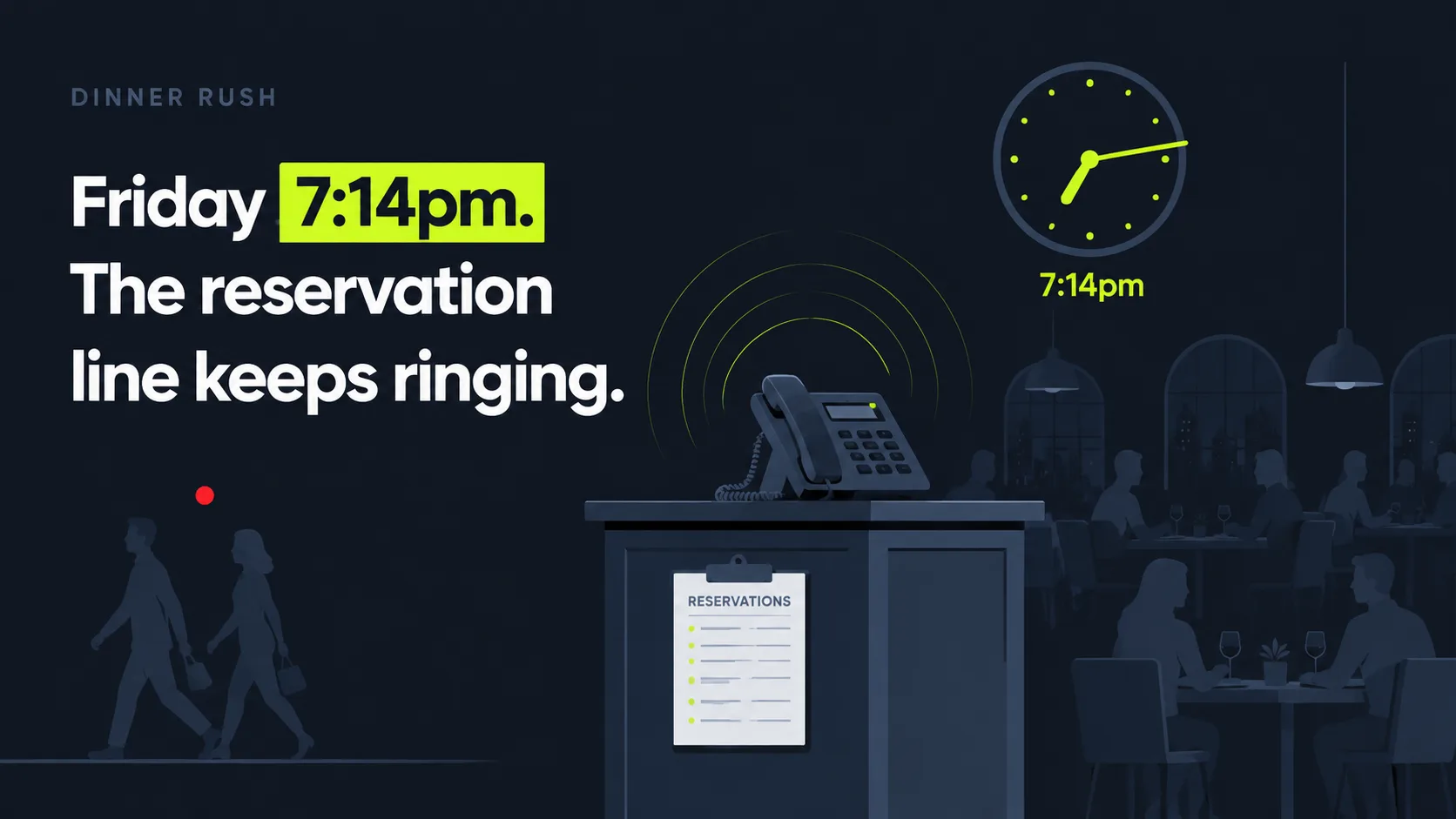
Why do restaurants lose covers and orders to unanswered calls during peak service?
Restaurants lose covers because the phone rings hardest when staff can't answer it, and most callers won't try twice. On average, small businesses answer only 37.8% of inbound calls with a live person, leaving roughly 62% unanswered, according to 411 Locals (2016, directional). A missed reservation call isn't a delayed booking. For a busy restaurant, it's usually a lost one.
The timing makes it worse. Restaurants receive 51% of their calls after 5pm and 32% of their weekly calls on weekends, per BrightLocal (2019). Those are your highest-revenue hours and your most chaotic. The Friday-night caller trying to book a birthday dinner is calling at the exact moment your host stand is slammed.
So what does voicemail do for you here? Almost nothing. For service businesses, 27% of inbound calls go unanswered, and fewer than 3% of callers pushed to voicemail actually leave a message, according to Invoca (2024). A diner who wants a 7:30 table tonight isn't going to leave a message and wait by the phone. They tap the next listing and they're gone.
And the phone is your best booking channel, not a nuisance. Two-thirds of small businesses, 66%, rate inbound phone calls as a good or excellent source of leads, the top-rated channel ahead of online forms, in-person, and email, per BIA/Kelsey (2014). A caller asking for a table is high-intent and ready to commit a whole party, not a single cover.
Let's do the math on what that leak is worth. Say you miss 30 reservation calls a week during peak service. Even if only a third of those would have become a booked table, that's ten parties a week walking to a competitor, week after week, all year. The exact dollars depend on your average check, but the pattern is brutal. The restaurants bleeding the most revenue aren't the slow ones. They're the popular ones whose phones get buried at exactly the hour the bookings are worth the most.
Citation capsule: Restaurants receive 51% of their calls after 5pm and 32% on weekends, per BrightLocal (2019), yet small businesses answer only about 37.8% of calls live, per 411 Locals (2016). Because almost no one sent to voicemail leaves a message (Invoca, 2024), each unanswered dinner-rush call is a reservation handed to a competitor.
The worst call drops happen on your best nights. A packed Friday is when the most reservation and to-go calls come in, and it's also when no one is free to answer. The restaurant that picks up at that exact moment fills the tables the busy kitchen never even heard ringing.
Dig deeper into the numbers in our breakdown of how missed calls cost local businesses revenue.
How does SkoreFlow take reservations and answer FAQs about hours, location, and the menu?
SkoreFlow's AI voice agent answers on the first ring and runs a structured script built for restaurants, so it captures the same details your host would, on every call, without fatigue. Because firms that respond within five minutes are 21 times more likely to qualify a lead than those waiting 30 minutes, per research cited by Harvard Business Review (2011), answering instantly is the single highest-return move a restaurant can make on the phone.
The call flow follows a consistent order:
- Greet and identify the need. The agent confirms your restaurant name and asks what the caller needs (reservation, to-go or catering order, or a question).
- Answer routine FAQs instantly. Hours, location and parking, dress code, dietary options, and menu questions get answered from your own information, with no hold.
- Capture reservation details. Date, time, party size, name, phone, and any special requests like a high chair, allergy note, or birthday.
- Check availability and book. It offers open slots and confirms the reservation directly in your system or on your calendar.
- Modify or cancel existing bookings. The agent can move a time, change a party size, or cancel, then update the record.
- Take to-go and catering orders. It captures items, quantities, pickup or delivery time, and contact details, then routes the order to the kitchen.
- Confirm and notify. A clean summary of the reservation or order lands on your team's phone or in your software within seconds.
- Escalate to a manager. Large parties, special events, complaints, or anything outside the script get routed to a human per your rules.
Now here's the quiet win most owners miss. When we set up restaurant scripts, the biggest relief is almost never the bookings. It's the FAQ layer. A huge share of dinner-rush calls are just "Are you open?", "Do you have parking?", or "Can you do gluten-free?" When the agent answers those instantly, your host stand stops getting interrupted mid-seat, and the genuine reservation calls actually get the attention they deserve.
Setup is fast and TCPA-aware. SkoreFlow connects to your booking and scheduling stack, gets the script live in about 48 hours, and answers in under half a second per call. The agent books and confirms directly into a connected calendar (Google Calendar is supported out of the box), so a captured call becomes a confirmed reservation without a staff member retyping anything. [CONFIRM: native OpenTable/Resy/POS connectors; SkoreFlow's published integrations are ServiceTitan, Jobber, Housecall Pro, and Google Calendar, so restaurant-specific reservation platforms may need a calendar bridge or custom connector.]
Citation capsule: Firms that respond within five minutes are 21 times more likely to qualify a lead than those waiting 30 minutes, per research cited by Harvard Business Review (2011). An AI agent that answers on the first ring books the table, takes the order, and answers hours-and-menu questions while the diner is still deciding where to eat.
Compare setups across trades on our answering service by industry overview.
How do you handle the dinner rush, taking to-go and catering calls while staff serve tables?
You handle it with an agent that answers unlimited simultaneous calls and never hits a busy signal, because dinner-rush demand arrives all at once. After a missed response window, 56% of customers immediately try another channel and 28% abandon the purchase entirely, according to Nextiva (2025). When the 7pm wave hits and your staff are carrying plates, a live answer is the only thing that keeps those orders from leaking to the place down the block.
Callers won't wait on hold, and the rush is when they're most likely to be parked there. 75% of callers hang up after eight or more minutes on hold, and 75% would rather have a scheduled callback than sit in a queue, per Nextiva (2025). A human host can't pick up six lines at once during a turn. The AI can, taking each to-go order and booking each table while the rest of the market sends callers to a busy tone.
The volume is also concentrated in your busiest windows. Restaurants get 51% of their calls after 5pm and 32% of their calls on weekends, per BrightLocal (2019). That's the dinner service and the Friday-Saturday peak, the exact hours when your team has the least slack to grab the phone.
What a dinner-rush spike looks like on the phone
A rush spike is a cluster of mixed calls in a short window: "Table for four at eight?", "Can I add fries to a pickup order?", "What time do you close?", and "Do you cater?". The AI answers every one in parallel, books the tables, takes the orders, answers the FAQs from your own information, and tags anything that needs a manager, so your phone line is never the bottleneck.
How the agent prioritizes during the rush
During the rush, the agent works by need. A straightforward reservation or to-go order gets handled end to end. A large party, a special event, a substitution the kitchen must approve, or a complaint gets routed to a manager. Each caller hears a calm, structured conversation instead of a busy tone, so your seating and kitchen capacity, not your phone, sets the only limit.
Most owners try to fix dinner-rush call chaos by asking a server or host to "grab the phone when you can." That's backwards. The rush is too sharp for a human to multitask through, and the half-answered call dies the second a tray needs running. An AI agent that scales to unlimited concurrent calls catches the orders and tables in the first hour of service, which is exactly when being available wins the business.
Citation capsule: After a missed response window, 56% of customers immediately try another channel and 28% abandon entirely, per Nextiva (2025). With restaurants receiving 51% of calls after 5pm (BrightLocal, 2019), an AI agent that answers unlimited dinner-rush calls in parallel keeps reservations and to-go orders from leaking to competitors.
See why round-the-clock pickup matters in our note on protecting after-hours revenue with 24/7 coverage.
AI vs. traditional answering service for restaurants: which fits your business?
The core trade-off is coverage versus headcount: AI answers every call instantly at a flat cost, while a traditional live service offers human voices at a premium with limited capacity, often metered per minute. Live virtual receptionist plans at one national provider run from $250/month for 50 minutes to $1,725/month for 500 minutes, per Ruby's pricing page (2026, accessed June 2026), which works out to roughly $3.45 to $5.00 per receptionist-minute.
Both models beat voicemail. The real question for a restaurant is which mix of cost, capacity, and dinner-rush scaling fits your call volume and your service pattern.
| Factor | AI answering service for restaurants | Traditional live answering service |
|---|---|---|
| Availability | 24/7, no hold time, answers on first ring | Business hours or after-hours desk; possible hold queue |
| Dinner-rush capacity | Unlimited simultaneous calls during the peak | Limited by staffed agents on duty; callers hold or drop |
| Cost signal | Typically below live plans; AI receptionist tiers from ~$95/mo, per Smith.ai (2026) | $250-$1,725+/mo at ~$3.45-$5.00/min, per Ruby (2026) |
| Per-minute fees | Flat plans, no per-minute metering | Often metered per minute, which spikes during rush volume |
| Consistency | Same reservation and FAQ script every call | Varies by agent and shift |
| Menu and hours knowledge | Answers from your own menu, hours, and location info | Depends on agent training and the briefing provided |
| Human escalation | Routes large parties, events, and complaints to a manager | Live agent judgment for nuance |
| Best for | Dinner-rush spikes, after-hours coverage, tight margins | Owners wanting a human voice on every call |
Most owners frame this as AI or human. In our experience the better frame is AI plus human escalation. The AI catches the dozen rush calls a live desk would have dropped during the turn, then hands the nuanced ones, like a 20-person private event or an upset regular, straight to a manager. You stop trading coverage for judgment, and you stop paying per minute to do it.
Citation capsule: Live virtual receptionist plans cost roughly $3.45 to $5.00 per receptionist-minute, derived from Ruby's published 2026 pricing ($250/mo for 50 minutes to $1,725/mo for 500 minutes, accessed June 2026). AI answering tiers, starting near $95/month per Smith.ai (2026), let restaurants cover every rush call for far less, with no per-minute fees.
What does it cost, and what is the ROI?
Pricing spans a wide band, but the ROI math is simple: a handful of recovered reservations usually pays for months of coverage. Industry pricing for virtual receptionist services runs about $50-$300/month for AI and $300-$2,000+/month for human services, per CloudTalk (2025). Against a full Friday dining room, that cost is a rounding error.
The return comes from the calls you currently lose. Remember the data: 27% of calls go unanswered and fewer than 3% of voicemail callers leave a message, per Invoca (2024). Hiring a dedicated phone person instead means a median receptionist wage of $37,230 a year before benefits, per the U.S. Bureau of Labor Statistics (2024), and one person still can't answer six lines during a turn. The AI covers every call around the clock for a fraction of that.
SkoreFlow's own pricing sits inside that band. Missed-call recovery runs Starter at $197/mo ($497 setup, up to 75 calls), Professional at $397/mo ($997 setup, up to 250 calls), and Enterprise at $697/mo ($1,497 setup, unlimited), with no per-minute metering. The plan is backed by a guarantee: five booked jobs in the first 30 days or your setup fee comes back. ROI on the trades benchmark typically lands around 11 days. So the downside is capped, and the payback window is short.
Illustrative example (industry-based scenario, not a real client): Picture a 60-seat restaurant missing 30 reservation calls a week during peak service. Over a year that's roughly 1,560 missed calls. With 27% of calls going unanswered and almost no one leaving a voicemail (per Invoca, 2024), even recovering a small share of those into booked covers usually outweighs an answering-service subscription many times over. We avoid quoting a single dollar figure here, because the true number depends on your own average check and party size. Run those against your call volume in the calculator below, and you'll see the leak in your own currency.
Plug in your own numbers with our Missed Call Revenue Calculator.
Citation capsule: Virtual receptionist pricing runs about $50-$300/month for AI versus $300-$2,000+/month for human services, per CloudTalk (2025). Against a median in-house receptionist wage of $37,230/year (BLS, 2024), an AI answering service covers every reservation and to-go call around the clock at a fraction of the cost.
Why do restaurants choose SkoreFlow?
Restaurants choose SkoreFlow because it closes the exact gap the data exposes: a live answer on every call, structured reservation and order capture, instant FAQ answers, and a clean handoff to a manager when a human is needed. With only about 37.8% of small-business calls answered live, per 411 Locals (2016, directional), simply answering well during the rush is a competitive edge most restaurants haven't claimed.
The approach is built for how diners search now. Across consumers, 45% now use AI tools to find local services, up from 6% a year earlier, per BrightLocal (2026). It also respects how people feel about AI: 64% of customers would prefer companies didn't use AI in customer service, per Gartner (2024). So the agent sounds natural and hands off to a person the moment a caller wants one.
Now, back to that birthday party of eight from the top of this article. With SkoreFlow on the line, their 7:14pm call doesn't ring out into a busy dining room. It gets answered on the first ring, the party size and time get captured, the table gets confirmed, and a clean summary lands on your manager's phone before the next ticket prints. That's the whole point: SkoreFlow books jobs, not messages. A traditional desk like Ruby takes a note and leaves you to call the diner back, by which point the table is gone. Our agent qualifies and books the reservation on the call, goes live in about 48 hours, runs TCPA-aware, and stands behind a guarantee of five booked jobs in 30 days or your setup fee refunded.
We don't publish invented testimonials or named results. Here's what we'll say plainly. The restaurants that benefit most are the ones currently sending dinner-rush and after-hours calls to voicemail. Plug the leak first, then refine the script. That order tends to produce the fastest, most honest wins.
Citation capsule: Consumer use of AI tools to find local services jumped to 45% in 2026, up from 6% a year earlier (BrightLocal), yet 64% of customers still prefer companies didn't use AI in service (Gartner, 2024). A restaurant agent that answers naturally and escalates large parties and complaints to a manager wins both phone and AI-driven discovery.
Stop sending reservations to voicemail
The pattern in the data is hard to ignore: restaurants get 51% of their calls after 5pm, only about 37.8% of small-business calls are answered live, and almost no one leaves a voicemail. An AI answering service for restaurants closes that gap by answering every call, booking and modifying reservations, answering hours-and-menu questions, taking to-go and catering orders, and absorbing the dinner-rush flood without a busy signal.
You don't have to choose between running the floor and answering the phone. Let the agent catch the rush and after-hours calls, then route the parties and events that need a manager to your team. Want to see what unanswered calls are costing you? Book a Free Call Audit. It's a 20-minute, no-pressure walkthrough where we map where reservations and orders are slipping and what capturing them would be worth. Worst case, you walk away with a number. Best case, you stop handing tables to the place down the street.
Next steps: Book a Free Call Audit or estimate lost revenue with the calculator.
Sources: BrightLocal (2019) · 411 Locals (2016) · Invoca (2024) · Harvard Business Review (2011) · Nextiva (2025) · Ruby (2026) · Smith.ai (2026) · CloudTalk (2025) · U.S. Bureau of Labor Statistics (2024)
Written and reviewed by Maksim Skorokhod, Founder of SkoreFlow, who builds AI answering and voice automation for small service businesses. Last reviewed: 2026-06-07. Learn more on our about page or contact us.