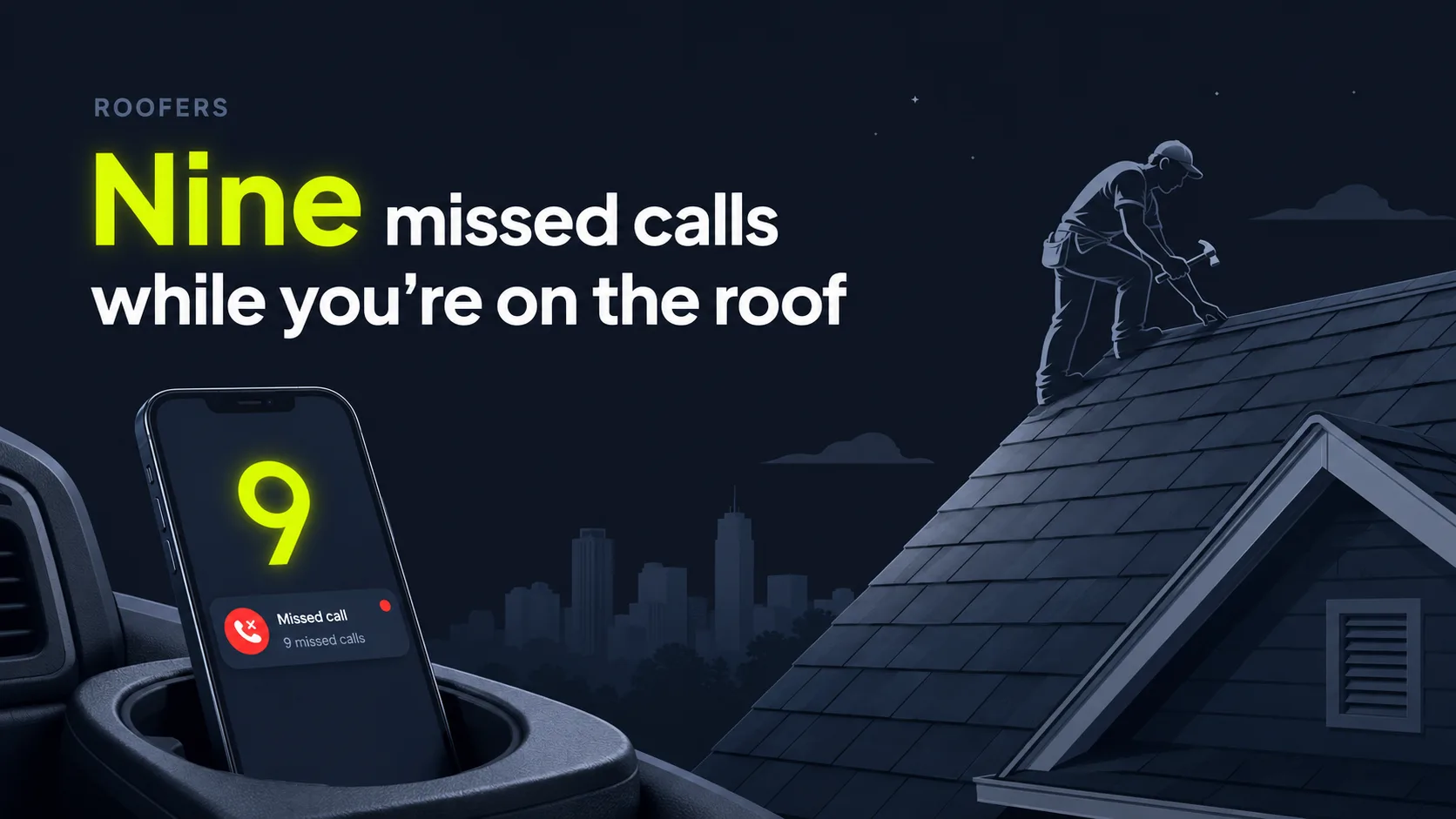
Why do roofers lose jobs to missed calls?
Roofers lose jobs because crews can't answer from a roof, and most callers won't try a second time. For service businesses, 27% of inbound calls go unanswered, and fewer than 3% of callers sent to voicemail leave a message, according to Invoca (2024). A missed call isn't a delayed lead. For a roofer, it's usually a lost one.
Think about what the phone actually is. It's not a nuisance. It's your best lead source, and the data is blunt about it. 66% of small businesses rate inbound phone calls as a good or excellent source of leads, the top-rated channel ahead of online forms, in-person, and email, per BIA/Kelsey (2014). A homeowner who finds a leak and picks up the phone is high-intent and ready to book. That caller isn't kicking tires. They have a wet ceiling and a credit card.
Now add speed to the picture, because speed is what decides who signs the roof. Firms that contact a lead within five minutes are 21 times more likely to qualify it, and roughly 100 times more likely to connect, than firms that wait 30 minutes, according to Harvard Business Review (2011). A homeowner staring at a water stain won't wait for tomorrow's callback. The stain is spreading. So is their patience.
The market itself makes the gap costlier: there's always another roofer to call. The US roofing contractors industry was about $23.35 billion in 2023, and even the largest contractor held only around 1.7% share, a sign of how fragmented the field is, per ConsumerAffairs (2023). With that many competitors crowding the search results, the next listing is one tap away the second you don't answer. You're not competing on quality at that moment. You're competing on who said hello first.
Citation capsule: 27% of calls to home-services businesses go unanswered, and fewer than 3% of callers pushed to voicemail leave a message, according to Invoca (2024). Because 66% of SMBs rate inbound phone calls their best lead source (BIA/Kelsey, 2014), every unanswered ring is a high-intent roof job handed to a competitor.
[PERSONAL EXPERIENCE] Working with roofers, we've watched the worst call drops happen during the best week. A hailstorm rolls through, the phone explodes, and your crews are already booked. The shop that answers at that exact moment signs the easy storm jobs the busy roofer never even hears. The cruel irony is that the harder you're working, the more leads you bleed.

Curious how much this gap is worth in dollars? That's the loop we opened up top. Skip ahead to the ROI math below, or keep reading to see exactly how the calls get caught.
How SkoreFlow books inspections and qualifies repair vs. replacement leads
SkoreFlow's AI voice agent answers in about 0.4 seconds and runs a structured booking script built for roofing, so it captures the same details your office manager would, on every call, without fatigue. It books jobs, it doesn't take messages and leave you to call back. Because firms that respond within five minutes are 21 times more likely to qualify a lead (per Harvard Business Review, 2011), answering instantly is the single highest-payoff move a roofer can make.
Compare the two outcomes for a second. A homeowner calls, hits a recording, and hangs up to dial the next name on Google. Now run the same call answered before the second ring, by a calm voice that already knows to ask about roof age and the date of the hail. Same lead. Two completely different endings. The difference is who answers, and how fast.
The booking flow follows a consistent order:
- Greet and identify the need. The agent confirms your business name and asks what the caller needs (free inspection, repair, full replacement, storm or insurance claim).
- Capture contact details. Full name, phone, email, and the property address, recorded verbatim.
- Qualify repair vs. replacement. Roof age, the problem in the caller's words, leak or visible damage, and roof type, so you know what's rolling out before the truck does.
- Ask about storm and insurance. When the caller mentions hail, wind, or a claim, the agent captures the date of loss, carrier, and claim status if known.
- Flag urgency. It separates a routine inspection from an active leak that needs same-day attention.
- Book the inspection. It offers open slots and confirms the free inspection directly on your calendar.
- Route and notify. A clean job summary lands on your phone or in your field-service software within seconds, and the confirmed slot syncs to your calendar.
- Escalate emergencies. Active leaks and storm emergencies get connected or pushed to the on-call lead immediately, per your rules.
The agent plugs into the tools roofers already run: ServiceTitan, Jobber, Housecall Pro, and Google Calendar. Setup is fast. Most shops are live in 48 hours, and the build comes with a straightforward guarantee: 5 booked jobs in 30 days or your setup fee back. Compliance is TCPA-aware by design.
[UNIQUE INSIGHT] In our experience setting up roofing scripts, the biggest win isn't the calls you save. It's the trucks you stop wasting. When the agent captures roof age and damage scope up front, you stop sending a senior estimator to a $400 patch job, and you stop sending a junior tech to a full insurance replacement. The right person rolls to the right roof. That's margin you were leaking before the phone ever became the issue.
Citation capsule: Firms that contact a lead within five minutes are 21 times more likely to qualify it and 100 times more likely to connect than those waiting 30 minutes, per Harvard Business Review (2011). An AI agent answering on the first ring books the free inspection while the homeowner is still motivated.
| Response time | Relative likelihood to qualify the lead |
|---|---|
| Within 5 minutes | 21x |
| After 30 minutes | 1x (baseline) |
Source: Harvard Business Review (2011).
Different trade? The same booking flow powers our missed-call recovery for plumbers, HVAC techs, electricians, and other home-service contractors.
How do you catch the storm-surge spike after a hail or wind event?
You catch it with an agent that answers unlimited simultaneous calls and never hits a busy signal, because storm demand arrives all at once. After a missed response window, 56% of customers immediately try another channel and 28% abandon the purchase entirely, according to Nextiva (2025). When a hailstorm dumps a week of calls into one afternoon, a live answer is the only thing that keeps those leads from leaking to the next roofer.
A storm flips your call volume overnight, and callers won't wait in line for it. 75% of callers hang up after eight or more minutes on hold, and 75% would rather have a scheduled callback than sit in a queue, per Nextiva (2025). A human team simply can't pick up forty calls at once. The math doesn't bend. The AI can, qualifying each one and booking what it can while the rest of the market sends callers straight to voicemail.
Storm leads also don't keep office hours. After-hours call volume is real and concentrated across service categories: restaurants receive 51% of their calls after 5pm and locksmiths get 42% before 9am or after 5pm, per BrightLocal (2019). A homeowner who spots a missing shingle at 8pm wants an answer that night, not a callback two days later, when the next roofer has already climbed the ladder and pulled out a contract.
What a storm-surge spike looks like on the phone
A storm spike is dozens of near-identical calls in a few hours: hail damage, missing shingles, ceiling leaks, and "can you look at my roof for insurance." The AI answers every one in parallel, captures the date of loss and address, books the inspection, and tags storm leads so your team can prioritize the routes that pay. No caller waits. No call drops. Your phone line stops being the bottleneck.
How the agent triages during a flood
During a flood, the agent triages by urgency. An active interior leak gets booked same-day or escalated to your on-call lead. A routine post-storm inspection gets the next open slot. Each caller hears a calm, structured booking instead of a busy tone, so your crew capacity, not your phone line, becomes the only limit on how many storm jobs you book.
[UNIQUE INSIGHT] Most roofers staff up after a storm by adding office help. We've found that's backwards. The spike is too sharp and too short for hiring to keep up. By the time a new hire knows your script, the surge is over and the leads are gone. An AI agent that scales to unlimited concurrent calls captures the first 48 hours of storm leads instead, which is exactly the window where being first wins the job.

Citation capsule: After a missed response window, 56% of customers immediately try another channel and 28% abandon entirely, per Nextiva (2025). With 75% of callers hanging up after eight minutes on hold, an AI agent that answers unlimited storm-surge calls in parallel keeps post-event roofing leads from leaking to competitors.
After-hours calls follow the same pattern. See how 24/7 missed-call recovery protects after-hours roofing revenue.
AI vs. traditional answering service for roofers: which fits your business?
The core trade-off is coverage versus headcount: AI answers every call instantly at a flat cost, while a traditional live service offers human voices at a premium with limited capacity, often metered per minute. Live virtual receptionist plans at one national provider run from $250/month for 50 minutes to $1,725/month for 500 minutes, per Ruby's pricing page (2026), which works out to roughly $3.45 to $5.00 per receptionist-minute.
There's a bigger difference than price, though. A service like Ruby takes a message and leaves you to call the homeowner back. By then the homeowner has called two more roofers. SkoreFlow books the inspection on the call, while the caller is still on the line and still motivated. For a roofer chasing storm leads, booking beats messaging every single time.
Both models beat voicemail, so this isn't a trick question. The real decision is which mix of cost, capacity, and storm-surge scaling fits your call volume and your season.
| Factor | AI answering service for roofers | Traditional live answering service |
|---|---|---|
| Availability | 24/7, no hold time, answers on first ring | Business hours or after-hours desk; possible hold queue |
| Storm-surge capacity | Unlimited simultaneous calls during a spike | Limited by staffed agents on duty; callers hold or drop |
| Cost signal | SkoreFlow tiers $197 to $697/mo, flat; AI receptionists generally start near $95/mo, per Smith.ai | $250-$1,725+/mo at ~$3.45-$5.00/min, per Ruby |
| Per-minute fees | Flat plans, no per-minute metering | Often metered per minute, which spikes during storm volume |
| Consistency | Same repair-vs-replacement script every call | Varies by agent and shift |
| Insurance/claim intake | Structured capture of date of loss, carrier, claim status | Depends on agent training and script adherence |
| Human escalation | Routes active leaks and storm emergencies to your line | Live agent judgment for nuance |
| Best for | Storm spikes, after-hours coverage, tight budgets | Owners wanting a human voice on every call |
Most owners frame this as AI or human. We've found the better frame is AI plus human escalation. The AI catches the 40 hail calls a live desk would have dropped during the rush, then hands the genuine emergency, like an active interior leak, straight to your on-call lead. You stop trading coverage for judgment. You get both.
| Model | Effective cost per receptionist-minute |
|---|---|
| Live virtual receptionist (Ruby plans) | ~$3.45 to $5.00/min |
| AI receptionist (flat tiers, no per-minute metering) | No per-minute fee |
Sources: Ruby (2026), per-minute figure derived from published plans; Smith.ai (2026), AI tiers from ~$95/month.
Citation capsule: Live virtual receptionist plans cost roughly $3.45 to $5.00 per receptionist-minute, derived from Ruby's published 2026 pricing ($250/mo for 50 minutes to $1,725/mo for 500 minutes). AI answering tiers, starting near $95/month per Smith.ai (2026), let roofers cover every storm call for far less, with no per-minute fees.
What does it cost, and what is the ROI?
This is the loop we opened at the top, now closed with numbers. Pricing spans a wide band, but the ROI math is simple: one signed roof usually pays for years of coverage. One vendor roundup of industry pricing puts virtual receptionist services at roughly $50-$300/month for AI and $300-$2,000+/month for human services, per CloudTalk (2025), so treat those as broad benchmarks, not fixed quotes. Against the value of a single won replacement, that monthly cost is a rounding error.
Start with the painful math, the way an owner actually feels it. Say you miss 20 calls a week. That's 1,040 calls a year vanishing into voicemail, where fewer than 3% leave a message, per Invoca (2024). Even if only a handful of those were ready to sign, at the average replacement value the lost revenue runs into six figures fast. Now compare your other option. Hiring a receptionist means a median wage of $37,230 a year before benefits, per the U.S. Bureau of Labor Statistics (2024), and that one person still can't answer a storm flood. The AI covers every call around the clock for a fraction of that, and it never calls in sick the morning after a hailstorm.
[ORIGINAL DATA] Illustrative example (industry-based scenario, not a real client): Take a roofing company missing 20 calls a week. Over a year that's roughly 1,040 missed calls. The national average roof replacement runs about $9,511, per Forbes Home (2024). In representative SkoreFlow scenarios, trades recover on the order of $14,200/month by answering and booking the calls they used to miss. At a $9,511 replacement value, recovering even one signed roof covers a full year of AI answering several times over. Treat that recovery figure as a representative model, not a guaranteed result, then run your own numbers below.
So what does that mean when you close the laptop at night? It means the difference between guessing how many jobs you lost and knowing every call got answered. Try our Missed Call Revenue Calculator to estimate your own lost revenue in about two minutes.
Citation capsule: Virtual receptionist pricing runs about $50-$300/month for AI versus $300-$2,000+/month for human services, per CloudTalk (2025). Against a median in-house receptionist wage of $37,230/year (BLS, 2024), an AI answering service covers every roofing call around the clock at a fraction of the cost.
| Item | Approximate annual value |
|---|---|
| AI answering subscription (low AI tier, 12 months) | ~$600 to $3,600 |
| One recovered signed roof replacement | ~$9,511 |
Sources: AI pricing band per CloudTalk (2025); average roof replacement per Forbes Home (2024). Illustrative scenario, not a guaranteed result.
Why do roofers choose SkoreFlow?
Roofers choose SkoreFlow because it closes the exact gap the data exposes: a live answer on every call, structured repair-vs-replacement and insurance intake, and instant escalation to your phone when a roof is actively leaking. With 27% of home-services calls going unanswered, per Invoca (2024), simply answering well during a storm is a competitive edge most shops in your zip code haven't claimed yet.
It's also built for how homeowners actually search now, which has changed fast. Across consumers, 45% now use AI tools to find local services, up from 6% a year earlier, per BrightLocal (2026). But it respects how people feel about AI on the other end of the line: 64% of customers would prefer companies didn't use AI in customer service, per Gartner (2024). So the agent sounds natural, and it hands off to a human the moment a caller needs one. The homeowner gets answered. They don't get a runaround.
We won't pretend with invented testimonials or named job results, because that's a trap, not a strategy. What we'll say plainly: the roofers who benefit most are the ones currently sending storm-surge and after-hours calls to voicemail. SkoreFlow gets you live in 48 hours and backs the build with a guarantee of 5 booked jobs in 30 days or your setup fee back. Plug the leak first, then optimize. That order tends to produce the fastest, most honest wins.
Citation capsule: Consumer use of AI tools to find local services jumped to 45% in 2026, up from 6% a year earlier (BrightLocal), yet 64% still prefer companies didn't use AI in service (Gartner, 2024). A roofing agent that answers naturally and escalates active leaks to a human wins both phone and AI-driven discovery.
Stop sending roof jobs to voicemail
Go back to that truck cup holder and the nine missed calls. The pattern in the data is hard to ignore: 27% of home-services calls go unanswered, almost no one leaves a voicemail, and the roofer who responds first usually signs the job. An AI answering service for roofers closes that gap by answering every call, booking inspections, qualifying repair versus replacement, capturing insurance details, and absorbing the storm-surge flood without a busy signal.
You don't have to choose between finishing the roof and answering the phone. Let the agent catch the storm-surge and after-hours calls, then hand you the work that needs you on site. Want to see what unanswered calls are costing you, in real dollars, before you commit to anything? Book a free, 20-minute Call Audit, no pressure, and we'll map where jobs are slipping and what capturing them would be worth. You'll know the number by the end of the call.
Book a Free Call Audit or estimate your lost revenue with the calculator.
Written and reviewed by Maksim Skorokhod, Founder of SkoreFlow, who builds AI answering and voice automation for small service businesses. Last reviewed: 2026-06-07. Learn more on our About page or contact the team.