What makes an outreach tool worth a seat?
A tool earns a seat when it does a distinct job, integrates with your CRM, and pays for itself in booked meetings, not features you'll never use. The bar is high right now because outbound is harder: B2B cold email reply rates dropped to 5.8% in 2024, per Belkins (2025). A tool that doesn't move that number is overhead with a logo.
Here's a quick gut check before you renew anything. When was the last time you pointed at a single seat and named the meetings it booked? If the answer is "I'm not sure," you've found a candidate to cut. Most bloated stacks aren't built on bad decisions. They're built on renewals nobody questioned.
Use four selection criteria, in order. They keep the stack lean and honest.
- It owns one layer cleanly. The tool should be the best at data, sequencing, prospecting-agent work, or deliverability, not a mediocre jack-of-all-trades that overlaps three others you already pay for.
- It writes to your CRM both ways. Most SDR teams run on HubSpot or Salesforce. A tool that can't sync activity and statuses back to the CRM creates blind spots and double entry.
- It improves data quality or response speed. These are the two levers that still move outbound. Better contact data lifts deliverability and relevance. Faster follow-up lifts conversion.
- The ROI is legible per seat. You should be able to point at meetings, replies, or qualified leads the tool produced, not just "it's nice to have."
Why does the CRM criterion matter so much? Because adoption is already mainstream, and the winners are the ones that connect their tools instead of stacking them. About 81% of sales teams now use or are experimenting with AI, per Salesforce (2024), and 83% of teams using AI saw revenue growth versus 66% of those without. A disconnected tool can't contribute to that lift. It just spends.
Citation capsule: With B2B cold email reply rates down to 5.8% in 2024, per Belkins (2025), an outreach tool only earns a seat if it owns one layer cleanly, syncs both ways with the CRM, improves data quality or response speed, and shows legible per-seat ROI. Tools that fail those four tests add cost without moving meetings booked.

If you want a deeper category breakdown, you can compare dedicated AI SDR platforms alongside this lean-stack approach.
How do the outreach tool layers compare?
The four layers split cleanly by job, and most SDR teams only need one strong tool per layer, sometimes one tool covering two. The table below maps what each layer does, what it roughly costs, and what it replaces. Every dollar range is an illustrative estimate, not a quoted vendor price. List prices change often and vary by seat count and tier, so verify current pricing on each provider's page before you buy.
| Layer | What it does | Per-seat range (illustrative estimate, verify current) | What it replaces |
|---|---|---|---|
| Data & enrichment | Finds verified emails, phone numbers, and account/contact data; flags job changes and intent signals | ~$50-$150/mo (illustrative) | Manual list-building, scattered free lookups |
| Sequencing | Sends multi-step, multi-channel sequences (email, LinkedIn, call tasks) and tracks replies | ~$50-$100/mo (illustrative) | Manual send-and-remember, spreadsheets of who to chase |
| AI prospecting agent | Researches accounts, drafts personalized outreach, prioritizes who to contact next | ~$50-$200/mo (illustrative) | Hours of manual research and generic templating |
| Deliverability | Warms inboxes, monitors spam placement, rotates sending so mail lands | ~$30-$80/mo (illustrative) | Burned domains, mail silently going to spam |
Read that table from the bottom up. Data and deliverability are non-negotiable, because a perfect sequence sent to bad addresses from a burned domain reaches no one. Sequencing is the engine. The AI prospecting agent is the multiplier that makes each touch relevant. Many modern sequencing tools now bundle a prospecting-agent layer, so three seats often cover all four jobs.
Now, that layer I flagged in the intro. It's deliverability, and it's the one almost nobody funds first. We've found teams pour money into a fourth data source while their main sending domain quietly lands in spam. So they keep buying contacts and keep wondering why replies won't move. Run the math. If half your mail never reaches the inbox, your real reply rate isn't 5.8%, it's closer to 2.9% on the volume you actually paid to send. Fix inbox placement first and you often lift replies more than any new prospecting tool would, because it makes every touch you already send actually arrive.
Citation capsule: A lean SDR stack splits into four layers, data/enrichment, sequencing, AI prospecting agent, and deliverability, and three tools usually cover all four because sequencing tools increasingly bundle a prospecting-agent layer. With B2B cold email reply rates at 5.8% in 2024, per Belkins (2025), spending on data and deliverability protects every touch the sequencing layer sends.

Which tools belong in each layer, tool by tool?
No single tool wins every category, so the right pick depends on your CRM, your motion, and your budget per seat. Any prices you find are moving targets, so treat every figure as an illustrative estimate and verify it on the vendor's public page before buying. What stays stable is the job each layer does and how to judge a tool inside it. Score each candidate against the job, not the demo.
Data and enrichment tools
The job here is verified, current contact and account data with useful signals. Look for high email-verification accuracy, phone coverage if you cold call, and signal triggers like job changes or hiring that tell you who to reach now. The upside of a strong data tool is relevance and deliverability. The downside is cost, because the best data isn't cheap. Best for: any team where bounce rates or stale lists are hurting sends. Verify current pricing before you commit, since data tiers shift with credit volume.
Sequencing tools
The job is running multi-step, multi-channel sequences and tracking every reply. Look for email plus LinkedIn and call tasks, reply detection that stops the sequence, and clean two-way CRM sync. The upside is consistency: nobody forgets a follow-up. The catch is that a powerful sequencer makes it just as easy to send bad outreach faster. Best for: any SDR doing more than a handful of touches a day. Pricing varies by tier and seat count, so confirm the current rate before you commit.
AI prospecting agent tools
The job is research and personalization at scale, plus prioritizing who to contact next. Look for genuine account research, drafts you'd actually send, and signal-based prioritization rather than blast-everyone logic. The upside is time saved and sharper messaging. The risk is that a weak agent just automates generic spam. Best for: teams where reps spend more time researching than talking. Confirm current pricing and what's included per seat, since agent features and limits change fast.
Deliverability tools
The job is making sure mail lands in the inbox, not spam. Look for inbox warming, spam-placement monitoring, and sending rotation across domains and mailboxes. The upside is that it protects every other dollar in the stack. The downside is that it's invisible, so it's easy to skip until a domain burns. Best for: any team sending real cold volume. This is the layer to fund first, not last. Check current pricing per mailbox, as most tools bill by inbox or domain.
When we audit SDR stacks, the recurring pattern is overlap, not gaps. Two tools both enrich. Two both sequence. And nobody owns deliverability. Cut to one strong tool per layer and the bill usually drops while the reply rate climbs, because the team finally runs one clean motion instead of three half-configured ones fighting each other.
Citation capsule: Across the four layers, the right tool depends on CRM, motion, and per-seat budget, but the judging criteria stay fixed: data accuracy, reply-stopping sequencing, genuine AI research over blast logic, and inbox placement. Vendor pricing changes often, so verify current public pricing before buying. Adoption is mainstream: 81% of sales teams now use or are experimenting with AI, per Salesforce (2024).
Once the layers are picked, the next step is to automate the whole SDR workflow end to end.
AI prospecting agents: what works beyond AI SDR spam?
AI prospecting agents are worth it for research and personalization, but only when they make each touch more relevant, not when they just send more generic mail faster. The risk is real, because the channel is already drowning. With B2B cold email reply rates at 5.8% in 2024, per Belkins (2025), automating bad outreach at scale pours gasoline on the fire.
Think about the last cold email that actually made you reply. It named something specific about your world. The pattern that earns an agent its seat is exactly that, and it's narrow. Use the agent for the parts humans do slowly and inconsistently: reading an account, finding a reason to reach out, drafting a first line that proves you did the homework. Buyer behavior backs this up. B2B buyers spend only about 17% of their buying journey meeting with potential suppliers, per Gartner (2023). So the few touches you get have to be relevant. And 61% of B2B buyers say they'd prefer a rep-free buying experience, per Gartner (2025), which means low-pressure, well-researched outreach beats high-volume pitching every time.
What doesn't work is "AI SDR" tooling pointed at a static list with a generic template. That's the spam everyone's drowning in, just sent faster. The agent should change what you say and who you say it to, based on signals. If it only changes how fast you say the same thing to everyone, it isn't earning its seat. It's renting you a louder megaphone in a room that's already too loud.
Here's the honest line on AI prospecting agents: they're a research-and-personalization multiplier, not a replacement for judgment. We've found the teams that win use the agent to draft, then a human edits and decides. The teams that lose flip it to fully autonomous send, then wonder why reply rates crater. The agent raises the floor on quality only if a person still owns the ceiling.
Citation capsule: AI prospecting agents work when they sharpen relevance, not volume. B2B buyers spend only about 17% of their journey with suppliers, per Gartner (2023), and 61% prefer a rep-free buying experience, per Gartner (2025). Use the agent to research and personalize; pointing it at a static list with a generic template just scales the spam buyers already ignore.
Where does SkoreFlow fit in a lean stack?
SkoreFlow sits one layer past your tools. It's a read-only control layer for HubSpot-first agencies, RevOps consultancies, and B2B service teams that watches what happens after a lead is assigned. It monitors post-assignment state, SLA breaches, orphaned leads, and routing trust, surfacing the first real routing leak in 24-48 hours. It doesn't replace your data source or your sequencer, and it makes zero changes to your stack.
Now back to that busy-versus-productive gap from the top. This is where it lives. A hot reply lands, gets routed, and parks on a rep who's heads-down on a demo. By the time anyone touches it, the window is gone. Contacting a web lead within 5 minutes makes a firm 21x more likely to qualify it and 100x more likely to connect than waiting 30 minutes, per Harvard Business Review (2011). A stack full of tools still loses if a hot reply dies on a rep's plate. SkoreFlow's job is to make that breakage visible inside HubSpot, so the lead a tool surfaced doesn't quietly go cold after handoff.
The payoff lines up with the broader data. Salesforce found 83% of sales teams using AI saw revenue growth versus 66% of those without, per Salesforce (2024). Visibility is how a lean stack turns surfaced leads into actual booked meetings instead of records that stall after assignment and clog the funnel.
Illustrative example (industry-based scenario, not a real client): Picture a HubSpot portal where the tools are working but the routing isn't. A representative B2B portal carries roughly 47 orphaned leads sitting unworked after assignment, with speed-to-lead drifting to about 340 minutes and missed SLAs near 62% of handoffs. With a read-only control layer flagging each leak, that portal models speed-to-lead pulled back toward 8 minutes and missed SLAs down toward 4%, no new tools added. SkoreFlow plans run $297-$997/mo plus setup depending on portal count and RevOps depth ([CONFIRM] current pricing). These are modeled, industry-style benchmark figures for illustration, not measured client results, and your numbers depend on your portal and routing rules.
In the portals we've reviewed, the win is rarely a new tool. It's seeing the leads that already went silent after assignment, so a stalled record gets worked instead of forgotten. That's the moment the speed advantage above stops being a stat and starts being booked meetings on the calendar. SkoreFlow backs the work with a plain guarantee: catch a real routing leak in 48 hours or a full refund. You see your first dead lead before you commit to anything, which makes the decision low-risk and quick.
Citation capsule: SkoreFlow is a read-only control layer for HubSpot that monitors post-assignment state, SLA breaches, and orphaned leads, surfacing the first routing leak in 24-48 hours with no stack changes. Contacting a web lead within 5 minutes makes a firm 21x more likely to qualify it, per Harvard Business Review (2011), and 83% of AI-using sales teams saw revenue growth versus 66% without, per Salesforce (2024).
Want to put numbers on it? You can run the HubSpot Leak Auditor and AI Outreach ROI Calculator to estimate what each leaked lead is costing your team.
Build the stack around data, speed, and the inbox
The takeaway is simple. A lean AI outreach stack beats a bloated one because it spends on the layers that still move outbound. Fund clean data and deliverability first. Run one strong sequencer with a prospecting agent. Connect it all to your CRM so a reply triggers the next step instead of sitting in a tab. More tools don't fix a hard channel. Better data, sharper personalization, and faster response do.
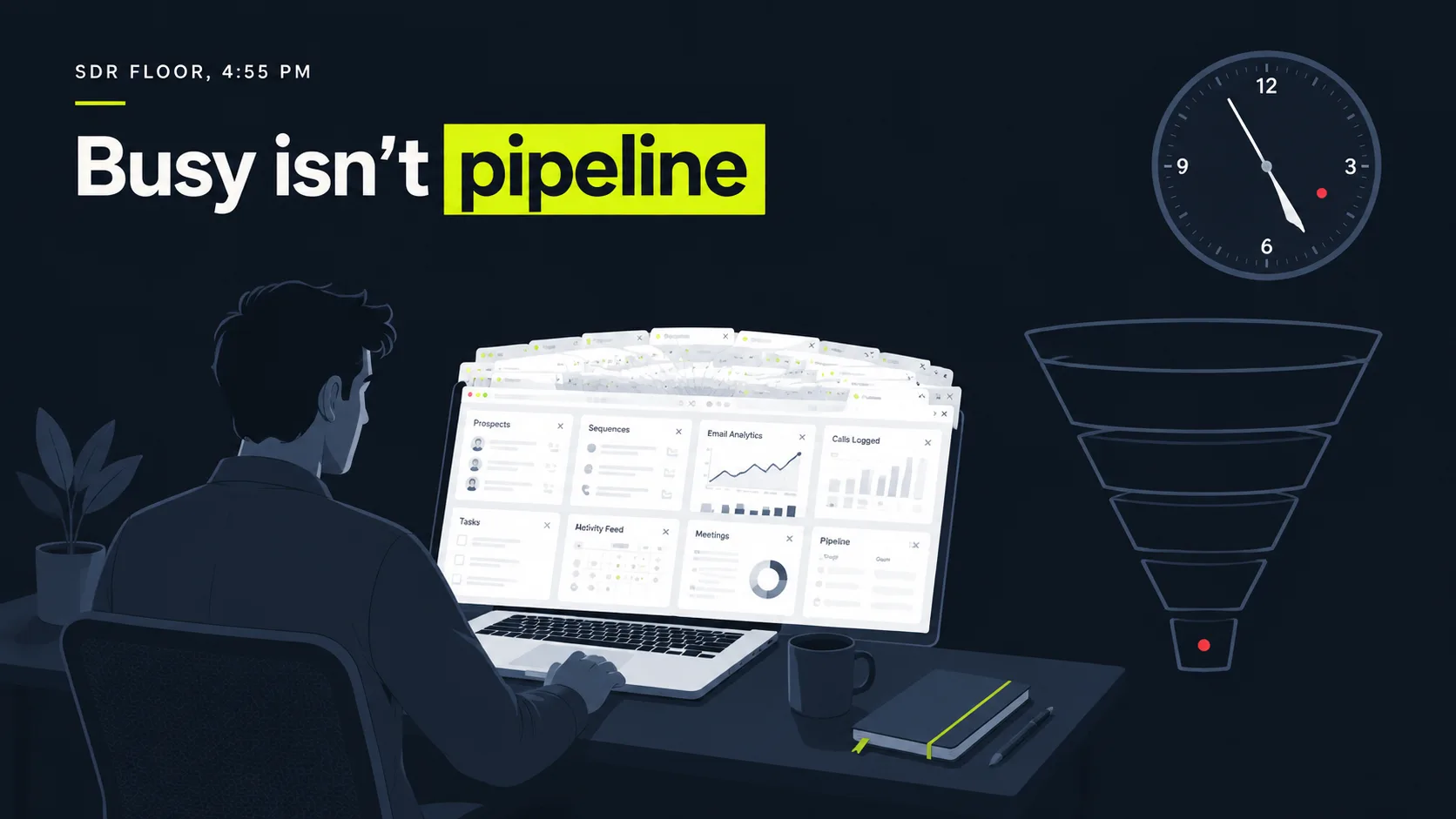
So here's where the two threads tie together. That busy-versus-productive floor from the opening, and the deliverability layer everyone underfunds, are the same story: effort leaking out of a stack that only looks full. You don't need ten seats to compete. You need three that own their jobs, and a way to see the leads that go silent after assignment so none get forgotten. Want to know where your HubSpot routing is leaking right now? Find Your First Dead Lead in a 20-minute, no-pressure session, and we'll surface a real orphaned lead in your portal within 24 to 48 hours, or it's a full refund. Low risk, fast answer, real money back on the table.
Next, see the full HubSpot Outbound Orchestration approach, or compare dedicated AI SDR platforms if you're weighing an all-in-one tool.
Written and reviewed by Maksim Skorokhod, Founder of SkoreFlow, who builds AI answering and outreach orchestration for service businesses. Last reviewed: 2026-06-07.