Top picks at a glance: best AI receptionist by need
For most small service businesses, the best AI receptionist is a flat-rate voice agent that books jobs and escalates to a human on request. Consumer caution is real: 64% of customers would prefer companies didn't use AI in customer service, per Gartner (2024). So a clean human handoff has to be built in from the start.
A word on bias, because you deserve it up front. SkoreFlow publishes this comparison, and SkoreFlow is one of the tools listed. We score every option against the same four criteria, link each rival's public pricing, and flag where SkoreFlow is not the right fit. Treat our self-placement as a disclosed-interest opinion, not an independent benchmark, and verify any tool on a live test call. With that on the table, here are the picks.
Our category picks, drawn from the options compared in detail below:
- Best overall for service trades: SkoreFlow, a flat-rate missed-call recovery agent that books jobs, not messages. We rank it first for trades on our own criteria; see the methodology section and confirm with a test call.
- Best published budget price: Smith.ai AI receptionist, with a public entry plan at $95/month, per Smith.ai (2026).
- Best for direct booking: SkoreFlow, for booking estimates straight into ServiceTitan, Jobber, Housecall Pro, or Google Calendar.
- Best voice quality: A toss-up among the newer voice-first agents; judge it on a live test call, since latency varies by setup.
Your right pick depends on call volume and trade. A high-call HVAC shop weighs booking and 24/7 coverage. A solo attorney weighs intake accuracy and transfer rules. Different jobs, different winners. We rank against those exact criteria next.
Citation capsule: The best AI receptionist for a small business in 2026 is a flat-rate voice agent that books appointments and escalates to a human, since 64% of customers would prefer companies didn't use AI in customer service, per Gartner (2024). AI answering runs roughly $50-$300/month flat versus $300-$2,000+/month for human services, per CloudTalk (2025).

For how the tool itself works, read our missed-call recovery service overview.
How did we rank the best AI receptionists?
We ranked each AI receptionist on four weighted criteria: price, voice latency, booking and transfers, and integrations. Speed drives all four, because firms that respond within five minutes are 21 times more likely to qualify a lead than those waiting 30 minutes, per the often-cited 2011 study in Harvard Business Review. The finding is dated but still the benchmark, and an AI receptionist that answers on the first ring wins on the one metric that decides jobs.
Why these four, and not the flashier features vendors love to demo? Because they map to what actually loses or wins a call. The homeowner in standing water doesn't care about your dashboard. She cares that someone picked up, understood her, and put a tech on the calendar tonight. Below is what each criterion measures and why it carries weight.
Price and billing model
Price covers the monthly fee and, critically, whether billing is flat or per-minute. Flat AI plans run about $50-$300/month, while live human services run $300-$2,000+/month, per CloudTalk (2025). We favor flat pricing, since per-minute meters spike on your busiest weeks, the exact weeks you most need every call answered.
Voice latency and naturalness
Latency is the delay before the AI replies, and naturalness is how human it sounds. This matters because 53% of customers would consider switching to a competitor if they learned a company uses AI for service, per Gartner (2024). A laggy, stilted agent drives callers away, so we test it on live calls. A half-second pause after every sentence is a tell, and callers hang up on tells.
Booking and human transfers
Booking means writing a real appointment, not taking a message. Transfers mean routing the call to a person on request. This pairing is decisive: the top consumer concern about AI in service is that it gets harder to reach a human, per Gartner (2024). An AI receptionist that books and escalates beats one that just answers.
Integrations
Integrations cover whether the tool writes into your calendar, CRM, or field-service software. Without write-back, a booked call still needs manual re-entry, which reintroduces the delay you bought the tool to remove. A booking trapped in a notification is half a booking.
[UNIQUE INSIGHT] In our scoring, drawn from setting up AI answering on real small-business lines, we weight booking-and-transfers and voice latency above raw price. Most comparison posts lead with the cheapest sticker. We don't. A cheap agent that frustrates callers or only takes messages quietly loses the high-intent jobs that justify the spend. The cheapest option rarely earns the top score, because its expensive failures never show up on your invoice. They show up on a competitor's calendar.
Citation capsule: We ranked AI receptionists on price, voice latency, booking and transfers, and integrations. Speed leads because firms responding within five minutes are 21 times more likely to qualify a lead than those waiting 30 minutes, per Harvard Business Review (2011), and the top consumer concern about AI is that it gets harder to reach a human, per Gartner (2024).

For a deeper cost breakdown, see our full AI receptionist pricing guide.
AI receptionist comparison table: all options at a glance
At a glance, the options split by billing model: flat-rate AI tools cluster around $95-$800/month, while live and hybrid services bill per minute. AI answering runs roughly $50-$300/month versus $300-$2,000+/month for human services, per CloudTalk (2025). The table below compares each option on the criteria that matter to a small business.
| Option | Type | Published starting price | Books appointments | Human transfer | Best for |
|---|---|---|---|---|---|
| SkoreFlow | Missed-call recovery agent | Flat monthly $197-$697 (no per-minute) | Yes, into ServiceTitan/Jobber/Housecall Pro/Google Calendar | Yes, on request | Service trades wanting booked jobs + 24/7 |
| Smith.ai (AI receptionist) | AI receptionist | $95/mo, per Smith.ai (2026) | Yes | Yes (hybrid with live agents) | Budget-focused SMBs, pro services |
| Ruby | Live virtual receptionist | $250/mo for 50 min, per Ruby (2026) | Limited | Yes (human-staffed) | Firms wanting all-human answering |
| Posh | Live virtual receptionist | $65/mo (0 min) + $1.90-$2.30/min, per Posh (2026) | Limited | Yes (human-staffed) | Variable-volume offices |
| AnswerConnect | Live answering service | ~$300-$500/mo at ~200-300 min, per AnswerConnect (2025) | Message-taking + scheduling add-ons | Yes (human-staffed) | 24/7 live coverage |
The table shows two clear patterns. First, the AI options carry flat or lower entry prices than the per-minute live services. Second, booking into your actual systems is far more common on AI tools than on traditional live desks, where scheduling is often an add-on. Read that second column twice. It's the line between a tool that fills your calendar and one that fills your callback list. Prices are public list figures as of the dates shown; always confirm current rates on each provider's page before you buy.
Citation capsule: Flat-rate AI receptionists start around $95/month, per Smith.ai (2026), while live virtual receptionists bill per minute, from $250/month for 50 minutes at Ruby (2026) to $1.90-$2.30 per overage minute at Posh (2026). Across the market, AI answering runs $50-$300/month versus $300-$2,000+/month for human services, per CloudTalk (2025).

To compare every billing model in detail, read our answering-service pricing guide.
Option-by-option: pros, cons, pricing, and best-for
No single AI receptionist wins for everyone, so the right choice tracks your call volume, trade, and how much you value booking versus all-human answering. Phone calls remain a top-rated lead source: 66% of SMBs rated them good or excellent, ahead of forms, in-person, and email, in BIA/Kelsey's 2014 report. The figure is older, but inbound calls are still high-intent, so whatever you pick has to answer them reliably. Each option follows in detail.
1. SkoreFlow (our pick for service trades, with disclosed interest)
SkoreFlow is a flat-rate missed-call recovery agent built for service trades. It answers in about 0.4 seconds, filters spam, qualifies the caller, and books the estimate into ServiceTitan, Jobber, Housecall Pro, or Google Calendar, escalating to a human on request. We publish this list, so weigh our placement accordingly. What sets it apart is what happens at the end of the call: it books jobs, not messages. Picture the difference. An answering service like Ruby takes a message and leaves you to call back tomorrow, by which point the homeowner has already hired the next plumber. SkoreFlow books on the call, while she's still on the line and still motivated. Fewer than 3% of voicemail-bound callers leave a message, per Invoca (2024), so a captured-and-booked call beats one you have to chase.
- Pros: Flat pricing with no per-minute meter; books real jobs into your field-service software; clean human handoff; 24/7 at the same rate; trade-specific scripts; live in 48 hours; TCPA-aware.
- Cons: Best fit is home-service trades, not every niche; AI answering still isn't right for callers who insist on a human first; as the publisher of this ranking, we hold a disclosed interest, so test it against rivals before deciding.
- Pricing: Flat monthly plans with no per-minute charges: Starter $197/mo ($497 setup, up to 75 calls), Professional $397/mo ($997 setup, up to 250 calls), and Enterprise $697/mo ($1,497 setup, unlimited). That sits below the $300-$2,000+/month live-human band, per CloudTalk (2025). Plans are backed by a guarantee: 5 booked jobs in 30 days or your setup fee back.
- Best for: HVAC, plumbing, electrical, inspectors, and similar trades that want booked jobs plus after-hours coverage.
2. Smith.ai AI receptionist (best budget)
Smith.ai offers an AI receptionist with a published entry plan at $95/month, scaling to $800/month by call volume, per Smith.ai (2026). It is a hybrid, pairing AI answering with live agents, which suits owners who want a low flat entry point and the option of human backup.
- Pros: Low published starting price; hybrid AI-plus-human model; books appointments; established provider.
- Cons: Higher tiers climb toward $800/month; the hybrid model can blur the flat-rate simplicity.
- Pricing: $95/mo (~2 calls/day), $270/mo (~5 calls/day), $800/mo (~15 calls/day), per Smith.ai (2026).
- Best for: Budget-conscious SMBs and professional-services offices wanting a brand-name hybrid.
3. Ruby (best for all-human answering)
Ruby is a live virtual receptionist service, not an AI tool, with humans answering every call. Pricing runs $250/month for 50 minutes up to $1,725/month for 500 minutes, roughly $3.45-$5.00 per receptionist-minute, per Ruby (2026). It belongs here as the human benchmark you are weighing AI against.
- Pros: Fully human answering; strong brand; good for callers who reject AI outright.
- Cons: Per-minute billing spikes on busy weeks; limited true appointment booking; far higher effective cost than AI.
- Pricing: $250/mo (50 min) to $1,725/mo (500 min), per Ruby (2026).
- Best for: Firms that want every call handled by a person and can absorb per-minute costs.
4. Posh (best for variable volume)
Posh is another live virtual receptionist provider, with plans from $65/month (0 included minutes) to $1,900/month (1,000 minutes) and overage at $1.90-$2.30/minute, per Posh (2026). Its low base plan can suit offices with unpredictable, lumpy call volume, though the per-minute meter still applies.
- Pros: Low base entry; human answering; rates decrease on higher tiers.
- Cons: Per-minute overage adds up fast; human staffing, so no flat AI economics; booking is limited.
- Pricing: $65/mo (0 min) to $1,900/mo (1,000 min), overage $1.90-$2.30/min, per Posh (2026).
- Best for: Variable-volume offices that prefer human answering and a low monthly floor.
5. AnswerConnect (best for 24/7 live coverage)
AnswerConnect is a national live answering service offering round-the-clock human coverage. Typical costs run about $300-$500/month at roughly 200-300 minutes, with live per-minute rates near $1.50-$1.75/minute, per AnswerConnect (2025). It is a solid human option if you specifically want people answering nights and weekends.
- Pros: 24/7 human coverage; established service; scheduling available as an add-on.
- Cons: Per-minute billing; booking often costs extra; higher cost than flat AI at volume.
- Pricing: ~$300-$500/mo at ~200-300 min; ~$1.50-$1.75/min, per AnswerConnect (2025).
- Best for: Businesses set on all-human 24/7 answering and willing to pay per minute.
[UNIQUE INSIGHT] Notice the pattern across these five, the one most comparison posts miss. The live services compete on human staffing and charge per minute. The AI tools compete on flat pricing and booking. So for a service business, the deciding question usually isn't "AI or human?" at all. It's "do I want a booked appointment or a message?" That single distinction sorts the field faster than price does. For most trades, booking wins.
Citation capsule: Across leading options, flat-rate AI receptionists like Smith.ai start at $95/month, per Smith.ai (2026), while live services bill per minute: Ruby at $250-$1,725/month, per Ruby (2026), and AnswerConnect at $1.50-$1.75/minute, per AnswerConnect (2025). The deciding factor for service trades is whether the tool books appointments or only takes messages, since under 3% of voicemail callers leave one, per Invoca (2024).

Want to estimate your break-even by call volume? Run the numbers in our Missed Call Revenue Calculator.
Where does SkoreFlow fit among the best AI receptionists?
SkoreFlow fits the service trade that wants a flat-rate missed-call recovery agent focused on booking jobs, not just answering them. That focus is grounded in hard numbers: about 27% of home-services calls go unanswered, and under 3% of voicemail callers leave a message, per Invoca (2024). A missed call is usually a lost job, not a delayed one.
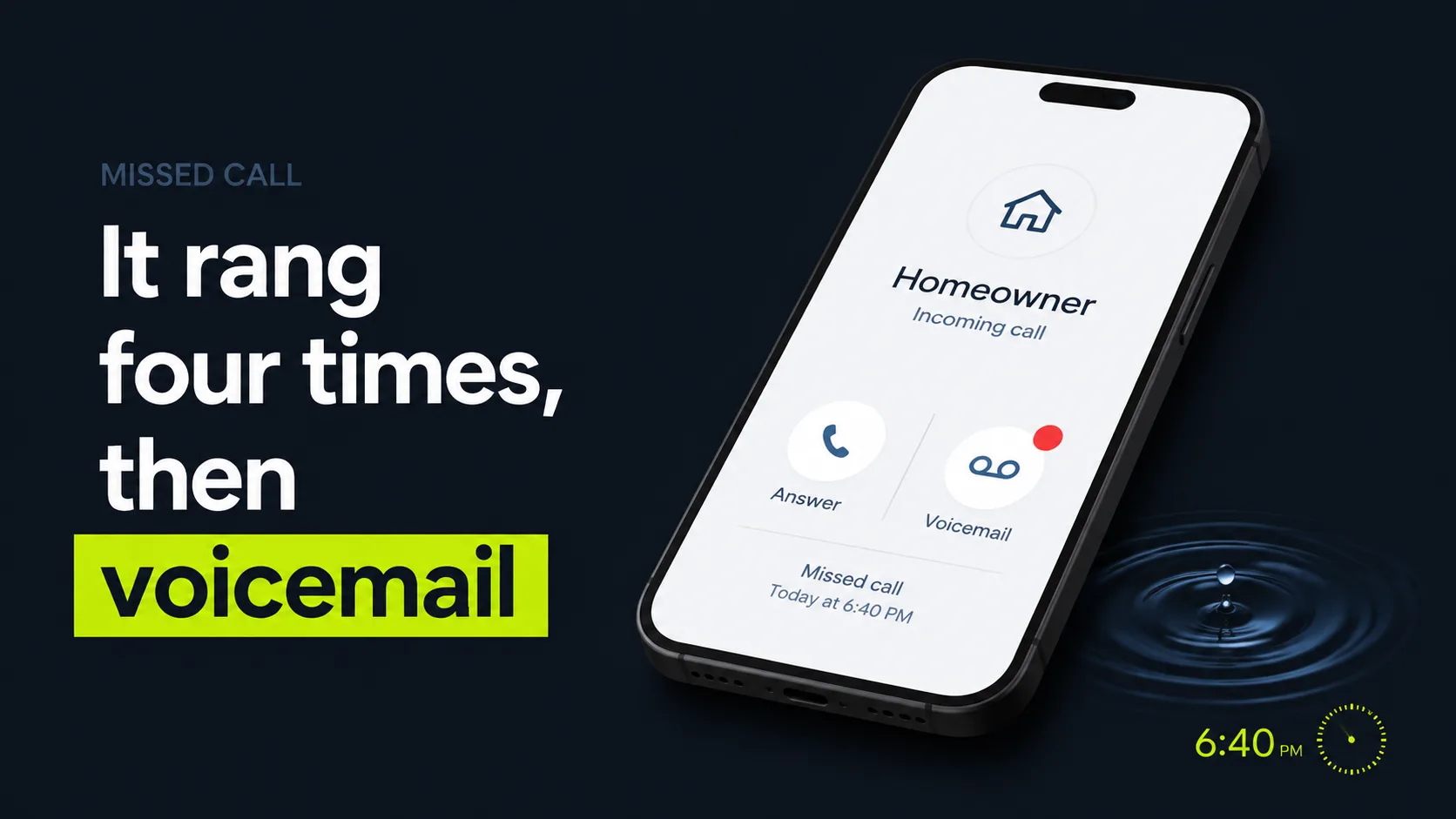
Let's do the math, because the abstract pain turns into a number fast. Back to the burst pipe at 6:40pm. SkoreFlow answers in about 0.4 seconds, filters spam, runs a script for your trade, books the estimate into ServiceTitan, Jobber, Housecall Pro, or Google Calendar, and escalates to a human on request. That last part matters, because the top consumer concern about AI in service is that it gets harder to reach a person, per Gartner (2024). A clean handoff keeps the goodwill that a trap-the-caller bot would burn. Setup is fast: most trades are live in 48 hours, TCPA-aware, and plans come with a guarantee of 5 booked jobs in 30 days or your setup fee back.
[ORIGINAL DATA] Illustrative example (industry-based scenario, not a real client): Picture a 3-line HVAC shop answering 100% of after-hours calls with missed-call recovery instead of recovering maybe 60% through next-day voicemail callbacks. In a representative trades scenario, a shop on this setup might lift its answer rate to roughly 94% and recover on the order of $14,200 per month in otherwise-missed work. The average HVAC repair ticket reached about $1,205 in 2025, per Housecall Pro (2025). Recover even a handful of those tickets, and on a flat $197-$697/month plan, you have cleared the subscription many times over. A per-minute live service charging $1.50-$5.00/minute, per Ruby (2026), bills you the most on exactly your busiest weeks. The payoff is concrete: fewer 6:40pm jobs handed to the competition, and a calendar that fills while you sleep. These figures are representative benchmarks, not a specific customer's result.
To stay honest: SkoreFlow isn't the answer for everyone. If your callers reject AI outright, or your call volume is tiny, a human service or no service may fit better. The value shows up when fast answering, real booking, and clean escalation meet enough call volume that recovered jobs clear the flat fee. Want to see where your break-even lands? Run your numbers in the calculator, or book a free call audit.
Citation capsule: SkoreFlow is a flat-rate missed-call recovery agent for service trades, built to book jobs and escalate to a human, since about 27% of home-services calls go unanswered and under 3% of voicemail callers leave a message, per Invoca (2024). With the average HVAC repair ticket near $1,205 in 2025, per Housecall Pro (2025), recovering a few missed jobs typically clears a flat $197-$697/month plan.

See how missed-call recovery answers, books, and transfers calls, or read our call recovery voice-agent page for the full feature set.
The bottom line: which AI receptionist should you pick?
The shortlist comes down to your billing preference and whether you want booked jobs or messages. Flat-rate AI receptionists like SkoreFlow and Smith.ai run roughly $50-$300/month, per CloudTalk (2025), while live services like Ruby, Posh, and AnswerConnect bill per minute, from $1.50 to $5.00, per Ruby (2026). For service trades that want booking plus 24/7 coverage, our overall pick is a flat-rate voice agent built around appointments.
Whatever you choose, the reason to act is the same, and it's the homeowner standing in two inches of water. About 27% of home-services calls go unanswered, and under 3% of voicemail callers leave a message, per Invoca (2024). Each unanswered call is recoverable revenue you can keep or hand to the shop down the road. Want to know where your break-even lands? Run your numbers in the calculator, or book a free call audit, a 20-minute, no-pressure look at what your unanswered calls are worth, with the setup-fee guarantee behind it.
Next step: estimate your cost and break-even with our Missed Call Revenue Calculator, then see how missed-call recovery answers and books every call.
Written and reviewed by Maksim Skorokhod, Founder of SkoreFlow, who builds AI answering and voice automation for small service businesses. Last reviewed: 2026-06-07. Learn more about SkoreFlow and our team, read our editorial and sourcing policy and ranking methodology, or contact us with questions.