What do conversational AI agents actually do?
Conversational AI agents answer questions, book and reschedule appointments, qualify leads, take messages, and route calls, across both voice and chat. They handle the routine work that eats staff time, then escalate anything complex to a person. This isn't a niche experiment anymore: 75% of SMBs are experimenting with or using AI, per Salesforce (2025), and conversational agents are a common first use.
Picture the work that fills a small office line. One caller asks if you're open Sunday. The next wants to reschedule. A third is a tire-kicker, and a fourth is a $4,000 job ready to book. A human juggles those one at a time and drops a few. An agent takes them in parallel, all day, without a coffee break. Here's what it handles, grouped by function. Notice the same capability shows up in both voice and chat.
- Front-desk answering. Pick up every call or message instantly, greet the caller, and answer common questions about hours, location, services, and pricing.
- Booking and scheduling. Check live availability, book, reschedule, or cancel appointments, and send confirmations, by phone or in a chat widget.
- Lead qualification. Ask the right questions, capture contact details, and flag high-intent leads for fast follow-up.
- Message taking and routing. Collect a clear message, then route or warm-transfer the call to the right person or department.
- FAQ and support deflection. Resolve repeat questions ("Do you take my insurance?", "Are you open Sunday?") so staff handle only the exceptions.
- After-hours coverage. Keep answering, booking, and capturing leads overnight and on weekends, when no one is at the desk.
So what changed in 2026? Not that these agents talk well. That they act. An older chatbot could answer "What are your hours?" but couldn't put a customer on the calendar. The agentic generation closes that loop and turns a conversation into a booked job. That's why Gartner frames agentic AI as resolving issues autonomously rather than just routing them, per Gartner (2025). For a small business, "answers and books" beats "answers" every single time. Hold onto that distinction. It decides which tool is worth paying for, and we'll come back to it when the bill arrives.
Citation capsule: Conversational AI agents for businesses answer questions, book appointments, qualify leads, take messages, and route calls across voice and chat. Adoption is mainstream among small firms: 75% of SMBs are experimenting with or using AI, per Salesforce (2025), with conversational agents a common entry point.

Want the mechanics? Here is how AI call handling works end to end.
Where do conversational AI agents fit a small business?
Conversational AI agents fit best in four spots where contacts slip through: the front desk during busy stretches, after hours, call overflow, and follow-up. These are exactly the moments a small team can't cover, and the cost is real. In a longstanding industry benchmark, 66% of SMBs rated inbound phone calls a good or excellent lead source, the top channel, per BIA/Kelsey (2014). A more recent signal confirms callers stay valuable: 56% immediately try another channel and 28% abandon entirely after a missed response, per Nextiva (2025). A missed call is usually a missed customer.
Think of your phone as a bucket with four holes in it. Water leaks out the same four places for almost every small shop. Plug them in order, and revenue stops draining onto the floor.
Front desk: catch calls while staff are busy
When your one receptionist is already on a call or helping a walk-in, the next caller hits voicemail, and most won't leave one. For service businesses, 27% of calls go unanswered and fewer than 3% of callers pushed to voicemail leave a message, per Invoca (2024). Do the math on that. Roughly one in four people trying to hand you money never reaches a human. A conversational agent answers that second and third caller in parallel, so nobody waits and nobody hangs up.
After hours: answer nights and weekends
A large share of calls arrive when the lights are off and the trucks are parked. Restaurants receive 51% of their calls after 5pm, per the BrightLocal (2019) study of 45,264 listings, and many service categories see heavy weekend demand. The burst pipe doesn't wait for Monday. An agent that answers, books, and captures leads overnight turns those after-hours calls into appointments on tomorrow's schedule, instead of jobs that went to whoever picked up first.
Overflow: handle spikes without hiring
A heat wave, a storm, a marketing push, or one busy Monday morning can flood your lines faster than staff can answer. Hiring for the peak is expensive and slow, and the peak is gone by the time the new hire is trained. Route overflow to the agent instead. It scales instantly to many simultaneous conversations, and customer patience is short anyway: 54% of callers hang up after being on hold up to eight minutes, per Nextiva (2024).
Follow-up: respond before the lead goes cold
Speed wins deals, and a crew on a job site is slow to call back. The foundational benchmark still cited today found firms that contact a web lead within five minutes are 21 times more likely to qualify it than firms that wait 30 minutes, per Harvard Business Review (2011). Later large-scale data backs the pattern: conversion rates are about 8 times greater when a lead is engaged within five minutes, per InsideSales (2021). A conversational agent responds in seconds, every time, so leads don't cool off while your tech is under a sink.
Citation capsule: Conversational AI agents fit four small-business gaps: front desk, after hours, overflow, and follow-up. The stakes are concrete: in a longstanding benchmark, 66% of SMBs rated inbound phone calls a good or excellent lead source, the top channel, per BIA/Kelsey (2014), and 27% of service-business calls still go unanswered, per Invoca (2024).

Serving a mixed-language area? See how to serve callers in more than one language.
How do you choose a conversational AI agent in 2026?
Choosing a conversational AI agent comes down to four decisions: build vs buy, voice vs chat, integrations, and language coverage. Match each to your business, not the flashiest demo. This matters because customers are wary: 64% would prefer companies didn't use AI in customer service, per Gartner (2024), so the agent you pick has to sound natural and hand off cleanly.
Work through the list below in order. Skip a step and you'll buy the wrong tool, then blame the technology for a decision you made.
- Build vs buy. A platform you build on gives control but needs developers and ongoing upkeep. A done-for-you service is faster to launch and tuned to your vertical. Most small businesses should buy, not build.
- Voice vs chat (or both). Pick voice if your customers call, chat if they message, both if they do each. Don't pay for a channel your customers don't use.
- Integrations. Confirm it connects to your calendar, CRM, and phone system. An agent that can't write to your booking system just takes messages.
- Human handoff. Verify there's an easy, clean path to a real person. The top consumer concern about AI in service is that it gets harder to reach someone, per Gartner (2024).
- Language coverage. If you serve a multilingual community, confirm the agent handles those languages naturally, not just an awkward translation.
- Naturalness and setup time. Call the demo yourself. If it sounds robotic to you, it sounds robotic to your customers.
The table below compares the two most common channel choices for a small business.
| Factor | Voice agent | Chat agent |
|---|---|---|
| Best for | Customers who call: trades, clinics, restaurants | Customers who message: web visitors, after-hours browsers |
| Where it lives | Your business phone line | Website widget, SMS, social messaging |
| Handles | Phone bookings, urgent calls, lead capture by voice | Quick questions, form-style booking, support deflection |
| Customer expectation | Fast, natural speech and easy human handoff | Instant text replies, no waiting on hold |
| Watch-out | Voice naturalness is harder to get right | Complex or urgent issues still need a voice or human path |
[UNIQUE INSIGHT] In our experience, the decision owners get wrong most often is integrations, not the agent itself. Here's how it plays out. An owner falls in love with how natural a demo sounds. He signs up. Then he learns the "booking" agent can't write to his actual calendar, so it just takes messages someone still has to type in by hand. He bought a robot receptionist and got a slightly fancier voicemail. We've found the right order is reversed: confirm it talks to your calendar, CRM, and phone system first, then judge how it sounds. A natural voice that books nothing is a demo, not a tool.
Citation capsule: Choosing a conversational AI agent in 2026 means deciding build vs buy, voice vs chat, integrations, and language coverage, and verifying an easy human handoff. The handoff is critical because 64% of customers would prefer companies didn't use AI in customer service, per Gartner (2024), so naturalness and an easy path to a person are non-negotiable.
Weighing software against a service? Here is how to compare AI and human call answering.
Conversational AI agent costs and limits, explained
Conversational AI agents typically cost $50-$300 per month for an AI plan versus $300-$2,000+ for human answering, per CloudTalk (2025). The savings are real, but so are the limits: these agents handle routine, high-volume tasks well and struggle with rare, emotional, or high-stakes calls. Set expectations accordingly, because 91% of SMBs using AI say it boosts revenue, per Salesforce (2025), and that lift comes from automating the routine, not everything.
Line the options up and the gap is hard to ignore. A national live virtual receptionist provider lists plans from $250/month for 50 minutes up to $1,725/month for 500 minutes, per Ruby (2026), which works out to roughly $3.45-$5.00 per receptionist-minute. An in-house hire is heavier still: the median US receptionist earns $37,230 a year before benefits and overhead, per the U.S. Bureau of Labor Statistics (2024). AI receptionist software, by contrast, lists DIY plans from around $95/month, per Smith.ai (2026). Same job. Different decimal place.
[ORIGINAL DATA] Illustrative example (industry-based scenario, not a real client): Picture a 10-employee service business handling about 800 routine inquiries a month. If a conversational agent deflects 60% of those, it frees roughly 50 staff-hours a month. Model that time against the median receptionist wage of $17.90/hour, per the U.S. Bureau of Labor Statistics (2024), and the recovered labor is on the order of $895/month, before counting a single lead saved from the calls that used to die in voicemail. The hard number, the labor, is only half the win. The leads are the other half. Run your own figures with the calculator below.
Now the honest part, because anyone who tells you a bot handles everything is selling you something. A conversational agent is not a human, and pretending otherwise backfires. The real boundaries:
- Emotional or sensitive calls belong with a person; a bot reading a frustrated tone should escalate, not push through.
- Rare, complex requests outside its training will stump it; that's what the human handoff is for.
- Customer skepticism is real. 53% of customers would consider switching to a competitor if they learned a company uses AI for service, per Gartner (2024), so transparency and an easy human path matter.
- Setup quality decides everything. A poorly configured agent that can't reach your calendar or a human is worse than voicemail.
[PERSONAL EXPERIENCE] Across the deployments we configure, the most common expectation gap isn't capability, it's scope. Owners swing to one of two extremes. Some expect the agent to handle 100% of calls, which it shouldn't, because the emotional and rare ones need a person. Others limit it to a bare greeting and waste most of what they paid for. The sweet spot we land on repeatedly is roughly 70-85% of routine contacts fully resolved by the agent, with the rest warm-transferred. Setting that expectation up front is what separates a deployment that pays off from one that disappoints. Remember the distinction we flagged earlier, "answers" versus "answers and books"? This is where it cashes out. The agents that book are the ones that earn back the monthly fee in the first week.
Citation capsule: Conversational AI agents typically cost $50-$300 per month versus $300-$2,000+ for human answering, per CloudTalk (2025). They excel at routine, high-volume tasks and should escalate emotional or high-stakes calls. The payoff is documented: 91% of SMBs using AI say it boosts revenue, per Salesforce (2025).
Curious what your gap is worth? Estimate the value of calls you currently miss with the Missed Call Revenue Calculator.
How does SkoreFlow approach conversational AI?
SkoreFlow builds done-for-you missed-call recovery agents for home-service trades like plumbers, HVAC, electricians, and inspectors. The agent answers in 0.4 seconds, filters spam, qualifies the caller, and books the estimate on your calendar. It books jobs, not messages, unlike answering services such as Ruby that take a message and leave you to call back. Plans run $197 to $697 per month and the agent is live in 48 hours.
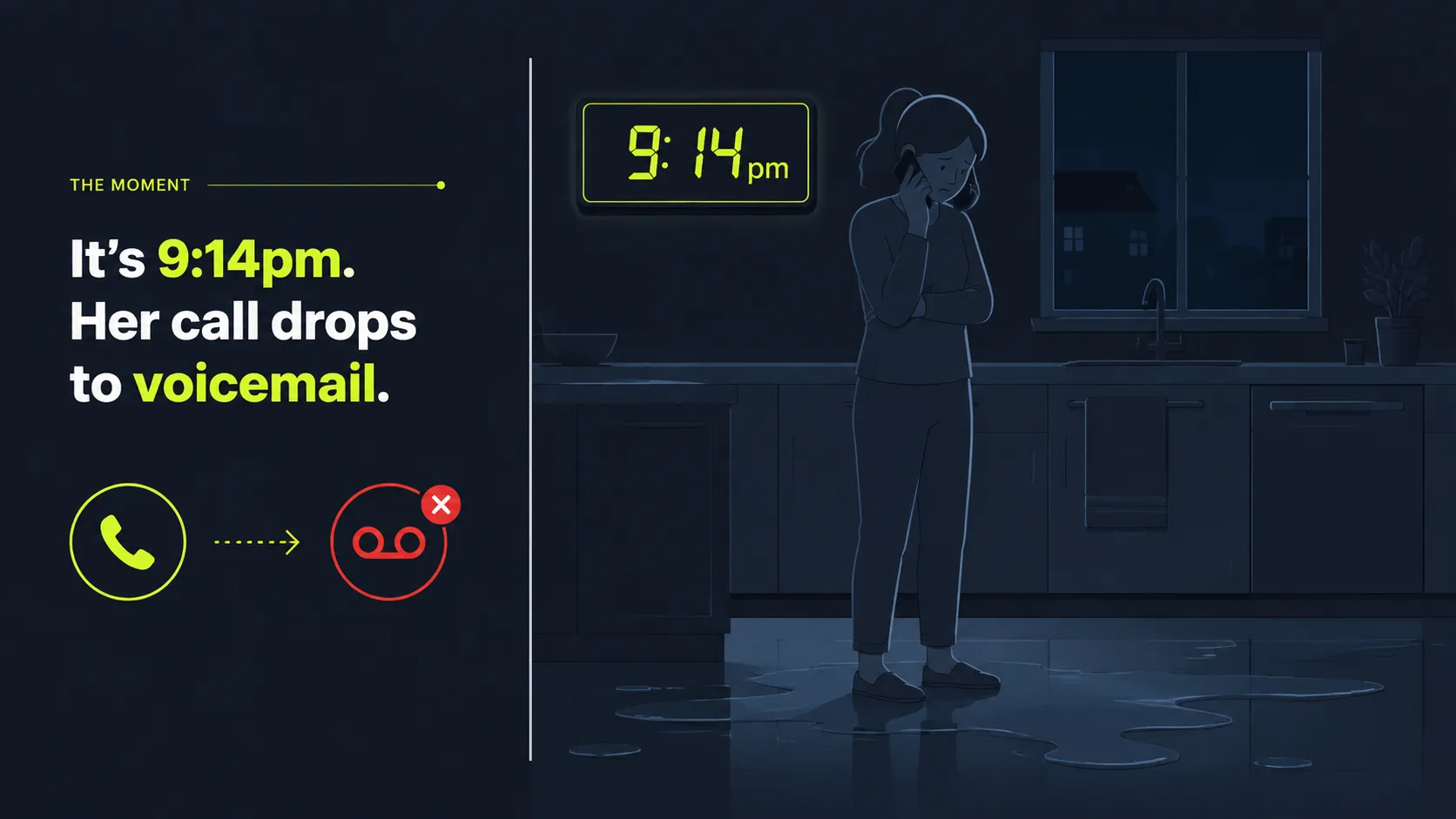
Go back to that flooding kitchen at 9:14pm. With a SkoreFlow agent on the line, the call gets answered before the second ring finishes, the spam gets filtered, the caller gets qualified, and the estimate lands on your calendar while she's still mopping. You read it over coffee. That's the gap between a missed call and a booked job, and it's the whole point. Rather than ship a generic chatbot, setup connects the agent to ServiceTitan, Jobber, Housecall Pro, or Google Calendar, then maps which calls it books and which it escalates. Routine bookings and FAQs the agent handles itself; anything emotional, urgent, or high-stakes warm-transfers to a person with context. The build is TCPA-aware, and your numbers, clients, and data stay private. SkoreFlow backs it with a guarantee: 5 booked jobs in 30 days or your setup fee is refunded. So the downside is capped and the upside shows up on your schedule. Capture every call without making a single customer feel trapped by a robot.
Citation capsule: SkoreFlow builds done-for-you missed-call recovery agents for home-service trades that answer in 0.4 seconds, qualify the caller, and book the estimate, integrating with ServiceTitan, Jobber, Housecall Pro, and Google Calendar. Plans run $197 to $697 per month, the agent is live in 48 hours, and setup is TCPA-aware. It books jobs, not messages.
See in detail how the missed-call recovery agent answers, qualifies, and books on the SkoreFlow pillar page.
The bottom line: pick the agent that answers and books
Remember the homeowner in the flooding kitchen. Conversational AI agents earn their keep by catching exactly that contact, and the three others your team can't: the second caller on a busy morning, the after-hours booking, the overflow spike, the lead that would have gone cold by noon. Choose one by matching channel to your customers, confirming integrations, and insisting on an easy human handoff. The market is moving fast, with 85% of customer service leaders set to explore or pilot conversational GenAI in 2025, per Gartner (2024). The slow movers won't lose loudly. They'll just keep wondering why the phone goes quiet.
Keep expectations honest. These agents shine at routine, high-volume work and should hand off anything emotional or high-stakes to a person. Done right, that balance is why 91% of SMBs using AI say it lifts revenue, per Salesforce (2025). Want to see what your missed and after-hours calls are worth? Run the numbers in the calculator, or book a free call audit, a 20-minute, no-pressure call where we map the right setup with you. No commitment, and you keep the math either way.
Next steps: estimate your recovery with the missed-call revenue calculator, or see how the missed-call recovery agent answers, qualifies, and books.
Written and reviewed by Maksim Skorokhod, Founder of SkoreFlow, who builds AI answering and voice automation for small service businesses. Last reviewed: 2026-06-07.