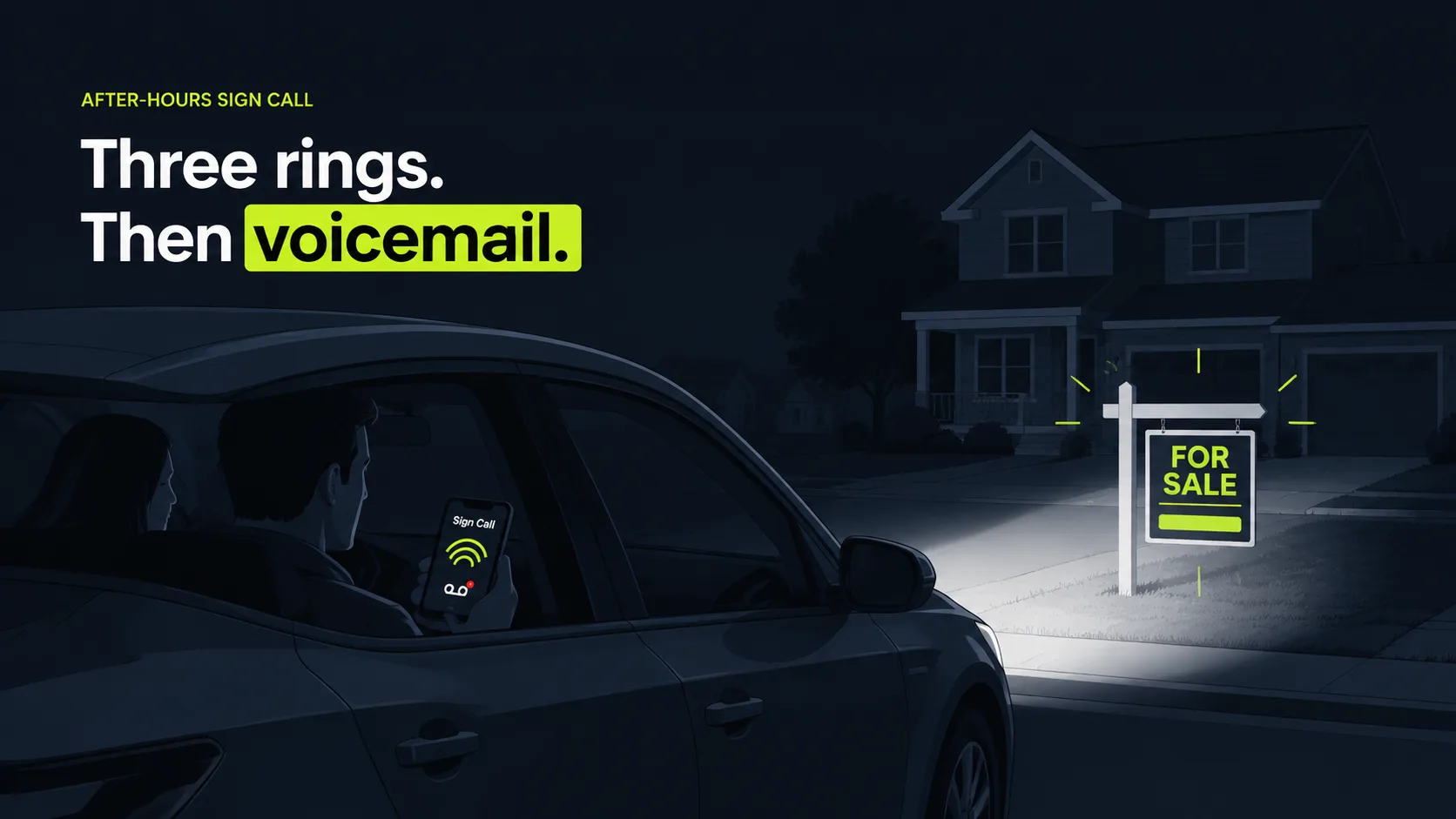
Why do real estate teams lose leads to missed and after-hours calls?
Real estate teams lose leads because buyers call the second something catches their eye, usually nights and weekends, and a missed call rarely calls back. For service businesses, 27% of inbound calls go unanswered, and fewer than 3% of callers pushed to voicemail leave a message, according to Invoca (2024). For agents, every unanswered ring is a buyer dialing the next sign.
Here's the part that stings. Speed is the entire game. Firms that contact a web lead within five minutes are 21 times more likely to qualify it than firms that wait 30 minutes, according to Harvard Business Review (2011). A buyer parked outside a listing will not wait until Monday for a callback. They are comparing agents right now, in real time, from the front seat.
Voicemail does not rescue the call either. Roughly 80% of callers sent to voicemail hang up without leaving a message, and 95% say texting is more convenient than voicemail, per a Nuance survey reported by destinationCRM (2014). So a missed call is not a delayed lead. It is usually a gone one.
The timing twists the knife. Local businesses get only about 6% of their Google Business Profile calls on weekends, yet that share spikes in some categories, per the BrightLocal Google My Business Insights Study (2019). Real estate demand clusters at evenings, lunch breaks, and open-house weekends. That is precisely when a 9-to-5 desk is dark.
So how much is one quiet phone actually costing you? Hold that question. We do the math a few sections down, and the number is bigger than most agents guess.
Citation capsule: NAR's 2024 Profile of Home Buyers and Sellers found that 88% of buyers and 90% of sellers used an agent, and most contacted only one. Because buyers and sellers rarely interview a second agent, the one who answers first usually wins the business, and a single missed inquiry can cost a full commission.
Here's what we've found working with service teams: real estate has almost no second chance. A plumber's customer might call back at noon. A buyer who taps "call" on a Zillow listing is weighing three agents in the same minute. Whoever picks up first books the showing, and the showing usually books the client. That is the brutal, useful truth of this business.

Want the full breakdown of what each missed ring is worth? Read how missed calls cost service businesses revenue.
How does SkoreFlow capture buyer/seller leads and book showings?
SkoreFlow's AI voice agent answers in about 0.4 seconds, filters spam, and runs a structured script built for real estate, so it captures the details a great assistant would gather, on every call, without fatigue. Because 27% of inbound calls to service businesses go unanswered, per Invoca (2024), capturing the call cleanly is the highest-impact step in the funnel. Older industry research from BIA/Kelsey also rated inbound phone calls SMBs' top lead source. The agent books the showing on the call; it does not just take a message for you to chase later. Most setups go live in 48 hours.
Think about your best front-desk hire on their sharpest morning. Now picture that person never tiring and never letting a call slip to voicemail, lunch break or not. That is the standard the script holds. The flow follows a consistent order:
- Greet and identify intent. The agent confirms the team name and asks whether the caller is buying, selling, or asking about a specific listing.
- Capture the property or area. Listing address, MLS number, or the neighborhood and price range the caller wants.
- Collect contact details. Full name, phone, email, and best callback time, captured verbatim.
- Qualify the lead. Pre-approval status, financing, timeline, budget, and whether they already work with an agent (see the next section).
- Book the showing or consult. The agent offers open slots and confirms the appointment directly on the team's calendar.
- Route and notify. Hot leads route to the right agent on a rotation; a clean lead summary lands in the team's inbox or CRM within seconds.
- Escalate when it's hot. A ready-to-tour, pre-approved buyer gets connected or flagged for an immediate callback, not parked in a queue.
In our experience setting up these scripts, the biggest win is consistency. A human front desk has great days and slammed days during an open-house rush. The AI agent asks the same qualifying questions on call number 3 and call number 30. So agents stop chasing half-captured leads with no callback number, and the dreaded "I think someone called about the Maple Street listing" mystery disappears.
Citation capsule: In BIA/Kelsey's "Phone Calls Are the New Click" report (2014), 66% of small businesses rated inbound phone calls a good or excellent lead source, the top-rated channel ahead of online forms (58.2%) and email (43.7%). For a real estate team, a cleanly captured call is the most valuable lead the marketing budget produces.

Comparing options for your vertical? See how our missed-call recovery voice agent handles real estate inbound calls.
Speed-to-lead: answering sign calls and listing inquiries in seconds
In real estate, speed-to-lead is the single biggest predictor of who books the showing, because buyer interest is fleeting and shared across agents. The same Harvard Business Review analysis (2011) found firms that respond within five minutes are about 100 times more likely to actually connect with a web lead than firms that wait 30 minutes. On a sign call, "in seconds" beats "next business day" every time.
What is speed-to-lead? Speed-to-lead is the elapsed time between a prospect reaching out and your team responding. In real estate it covers sign calls, portal inquiries from Zillow or Realtor.com, and form fills. Shorter is better: the faster you respond, the more likely you connect and qualify.
Phone leads also tend to outperform forms. Older BIA/Kelsey analysis (2014) estimated inbound phone calls convert at many times the rate of web-form leads for local businesses, a figure worth treating as directional rather than precise. Still, the logic holds. A buyer who calls is further down the funnel than one who fills a form, so answering that call instantly is worth far more than another lead-magnet download.
Most teams miss this. Everyone measures speed-to-lead on web forms and quietly ignores the phone. We'd argue the phone is where the bleeding is worst. A form auto-responder fires in seconds. The buyer standing on the curb who calls the sign at 7 p.m. hits voicemail, and that is the higher-intent lead by a wide margin. Fix the phone first, then polish the rest.
Citation capsule: Speed wins deals. Harvard Business Review's 2011 study of roughly 100,000 leads showed a five-minute response makes firms about 100 times likelier to connect than a 30-minute wait. An AI agent that answers sign calls and portal inquiries in seconds captures the buyer interest a callback-tomorrow approach loses.

For more on turning fast answers into recovered revenue, see how speed-to-lead drives missed-call recovery.
AI vs. traditional real estate answering service: which fits your team?
The core trade-off is coverage versus nuance: AI answers every call instantly at a lower cost, while a traditional live service offers human judgment at a premium and limited capacity. Live virtual receptionist plans at one national provider run from $250/month for 50 minutes to $1,725/month for 500 minutes, per Ruby's pricing page (2026), which works out to roughly $3.45 to $5.00 per receptionist-minute.
Both models beat voicemail. The real question is which mix of cost, capacity, and routing fits your call volume and your roster.
| Factor | AI real estate answering service | Traditional live answering service |
|---|---|---|
| Availability | 24/7, no hold time, answers on first ring | Business hours or after-hours desk; possible hold queue |
| Call capacity | Handles simultaneous open-house calls without overflow | Limited by staffed agents on duty |
| Cost signal | Typically below live plans; AI receptionist tiers from ~$95/mo, per Smith.ai | $250-$1,725+/mo at ~$3.45-$5.00/min, per Ruby |
| Consistency | Same qualifying script every call | Varies by agent and shift |
| Lead qualification | Structured pre-approval, timeline, and budget capture | Depends on agent training and script adherence |
| Agent routing | Round-robin or rotation to the right agent automatically | Manual transfer or message-taking |
| Best for | High call volume, after-hours coverage, tight budgets | Teams wanting a human voice on every call |
Most teams frame this as AI or human. We've found the sharper frame is AI plus human escalation. The AI catches the Sunday-night sign call a live desk would have missed, qualifies the buyer, then hands a hot, pre-approved lead straight to the agent on rotation. You stop choosing between coverage and judgment, and start having both.
There's a second difference worth naming bluntly. A traditional answering service like Ruby usually takes a message and leaves you to call the buyer back. By then the buyer has dialed the next sign. SkoreFlow's agent qualifies and books the showing on the call itself, so you wake up to a confirmed appointment, not a callback list and a cold trail.

Citation capsule: Live virtual receptionist plans cost roughly $3.45 to $5.00 per receptionist-minute, derived from Ruby's published 2026 pricing ($250/mo for 50 minutes to $1,725/mo for 500 minutes). AI answering tiers, starting near $95/month per Smith.ai (2026), let real estate teams cover every call for far less.
Curious how the trade-offs shift by vertical? See the full missed-call recovery service before you commit.
What does a real estate answering service cost, and what is the ROI?
Pricing spans a wide band, but the ROI math is simple: one closed deal usually pays for years of coverage. SkoreFlow's missed-call recovery plans run $197/month (Starter, $497 setup), $397/month (Professional, $997 setup), and $697/month (Enterprise, $1,497 setup). For context, industry pricing for virtual receptionist services runs about $50-$300/month for AI and $300-$2,000+/month for human services, per CloudTalk (2025). Against the commission on a single transaction, that monthly cost barely registers.
Here is the math we promised earlier. The downside risk is small. SkoreFlow backs setup with a guarantee: 5 booked jobs in the first 30 days or your setup fee is refunded. In a representative missed-call recovery scenario, answer rates reach roughly 94% (versus about 38% before), with payback around 11 days. Treat those as illustrative benchmarks, not a specific customer result.
The return comes straight from the calls you currently lose. A typical existing-home sale generates a buyer-agent commission near $9,000 to $10,000+, using 2024 median home prices and prevailing rates, per Redfin and NAR commission data (2025). When most buyers contact only one agent, capturing the call is the whole ballgame. Miss it, and that $9,000 is sitting in a competitor's pipeline.
Illustrative example (industry-based scenario, not a real client): Picture a 5-agent team missing 8 buyer calls a week. Over a year that is roughly 416 missed calls. At a buyer-agent commission near $9,000 to $10,000+ per closed deal, per Redfin/NAR (2025), converting even a handful of those missed calls into closings would dwarf a full year of answering-service cost. Recover just one, and the service has paid for itself many times over. Run your own numbers with the Missed Call Revenue Calculator.
Citation capsule: A single closed existing-home transaction generates a buyer-agent commission of roughly $9,000 to $10,000+ at 2024 median prices, per Redfin/NAR commission data (2025). Against AI answering plans that run about $50-$300/month (CloudTalk, 2025), one recovered lead can return a year of coverage many times over.

Why do real estate teams choose SkoreFlow?
Teams choose SkoreFlow because it closes the exact gap the data exposes: a live answer on every call, real lead qualification, and a booked showing, not a message to call back. With 27% of inbound calls to service businesses going unanswered, per Invoca (2024), simply answering well is a competitive edge most teams have not claimed yet. Setups go live in 48 hours and carry a guarantee: 5 booked jobs in 30 days or the setup fee back.
It's also built for how clients search now. In BrightLocal's 2026 survey, 45% of consumers said they use AI tools to find local services, up from 6% a year earlier, per BrightLocal's Local Consumer Review Survey (2026). A team that captures, qualifies, and books every caller, then keeps clean records of each lead, is positioned to win in both phone and AI-driven discovery. The buyers are already searching differently. Your intake should keep up.
The agent also knows its lane, and that matters more than the hype suggests. A Gartner survey (2024) of 5,728 customers found 64% would prefer companies did not use AI in customer service, and their top concern is that it gets harder to reach a person. So SkoreFlow's agent qualifies and books, then hands hot leads to a real agent fast, rather than trapping callers in a loop. The buyer feels helped, not stonewalled.
We don't publish invented testimonials or named case results, and we never will. Here's what we can say plainly: the teams that benefit most are the ones currently sending after-hours sign calls to voicemail. Plug the leak first. Then optimize routing and scripts. That order tends to produce the fastest, most honest wins.
Citation capsule: Consumer use of AI tools to find local services jumped to 45% in 2026, up from 6% a year earlier, per BrightLocal's Local Consumer Review Survey (n=1,002 US adults). Real estate teams that capture and document every buyer and seller call are better positioned for both traditional and AI-driven client discovery.

Stop sending buyers to voicemail
Remember the couple at the curb. The lights are off, the sign is glowing, and your number is on their screen. The only thing between you and that commission is whether the phone gets answered. The pattern in the data is hard to ignore: more than a quarter of inbound calls to service businesses go unanswered, most buyers and sellers contact only one agent, and the agent who responds first usually wins. A real estate answering service closes that gap by answering every call, qualifying the lead, booking the showing, and routing hot buyers to the right agent.
You don't have to choose between coverage and judgment. Let the agent catch the after-hours sign call, qualify the buyer, then hand you the leads ready to tour. Want to see what unanswered calls are costing your team? Book a Free Call Audit, a 20-minute, no-pressure call where we map where leads are slipping and what capturing them would be worth. Setup is backed by a guarantee: 5 booked jobs in 30 days or your setup fee back. Prefer to run the math yourself first? Try the Missed Call Revenue Calculator.
Written and reviewed by Maksim Skorokhod, Founder of SkoreFlow, who builds AI answering and voice automation for small service businesses. Last reviewed: 2026-06-07.
Questions or corrections? Contact our team or read about SkoreFlow and our editorial standards.