What does SDR stand for?
SDR stands for Sales Development Representative. In one line: an SDR is the rep who finds and qualifies new leads, then hands the promising ones to a closer. The acronym shows up constantly in sales-job listings, CRM dashboards, and tool marketing, and it almost always means this same front-of-the-funnel role. Speed is a big part of why it exists: contacting a web lead within 5 minutes makes a firm 21x more likely to qualify it than waiting 30 minutes, per Harvard Business Review (2011).
Broken down word by word, the acronym is simpler than it looks.
- Sales - the function the role belongs to. An SDR works inside the revenue team, not marketing or support, even though they touch both.
- Development - the part of the funnel they own. They "develop" raw leads into qualified opportunities, warming up interest rather than closing it.
- Representative - what they are: a person (the prospect's first human contact with the company) who represents the brand on that first touch.
Put together, a Sales Development Representative is the early-stage rep who turns cold or curious leads into sales-ready conversations. You'll also see the term written as "sales dev rep" or just "sales development." All three point to the same job.
The word that trips people up is "Development." It does not mean software development. It does not mean business growth in the abstract. In this context it means developing a lead, taking someone from "maybe interested" to "worth a meeting." Once that clicks, every other SDR title (BDR, LDR) becomes easy to read.
Citation capsule: SDR stands for Sales Development Representative: a sales rep who finds and qualifies leads, then hands them to a closer rather than signing the deal themselves. Speed defines the role, since contacting a web lead within 5 minutes makes a firm 21x more likely to qualify it than waiting 30 minutes, per Harvard Business Review (2011).

For a deeper look at the role and the numbers behind it, read the full breakdown of the SDR role and its metrics.
Why does the SDR role exist?
The SDR role exists to split selling into two jobs: one rep prospects and qualifies, another closes. That division lets each person get good at their half instead of doing both badly. It pays off, too: 83% of sales teams using AI saw revenue growth versus 66% of teams without it, per Salesforce (2024), and that gain rides on a well-fed pipeline an SDR helps build.
The problem: closing and prospecting fight for the same hours
Picture one rep at 4:55pm. A signed contract is one phone call away on a hot deal, but forty cold prospects also need a first touch today. Guess which one waits. Before the split, that single salesperson did everything: chasing cold leads, answering inbound, qualifying, demoing, and closing. The trouble is that prospecting and closing pull in opposite directions. Closing rewards deep focus on a few warm deals. Prospecting rewards high-volume, repetitive outreach. Mash them together and the urgent closing work always wins, so the pipeline quietly dries up. Cold outreach is also getting harder: in an analysis of 16.5 million cold emails, sales agency Belkins (2025) reported the average B2B reply rate fell to 5.8% in 2024, down from 6.8% the year before. It is vendor-reported data, so read it as directional rather than a neutral benchmark.
The fix: SDRs feed the funnel, closers work the deals
Splitting the work fixes the tug-of-war. SDRs own the top of the funnel: outreach, inbound response, and qualification. Account Executives (the closers) take qualified leads and run them to a signed deal. The SDR's job is volume and filtering; the AE's job is depth and persuasion. Each role gets simpler, more measurable, and easier to coach. It also protects expensive closer time, since reps already spend limited hours in front of buyers.
Why speed and coverage matter so much
The handoff only works if leads get touched fast. Buyers rarely wait, and most of their journey happens without a rep: B2B buyers spend only about 17% of their buying time meeting with potential suppliers, per Gartner (2023). So the few minutes a buyer does give you are precious. When a lead raises a hand and the reply lands hours later, that window has already closed, and closed usually means closed by whoever answered first. That's the core reason every modern sales team obsesses over response time, and why SDR work increasingly runs around the clock.
Citation capsule: The SDR role exists to separate prospecting and qualifying from closing, so each rep specializes. It matters because B2B buyers spend only about 17% of their buying time with suppliers, per Gartner (2023), and cold email reply rates fell to 5.8% in 2024, per Belkins (2025), making fast, focused first-touch work essential.

For the metrics that measure SDR pipeline performance, see the four SDR numbers that actually matter.
SDR vs BDR vs LDR vs AE: what's the difference?
The quick version: SDRs and BDRs both prospect and qualify (SDRs usually handle inbound, BDRs usually handle outbound), an LDR focuses narrowly on triaging marketing leads, and an AE is the closer who signs the deal. The titles overlap and companies define them differently, so always read the job description, not just the acronym. Demand for self-serve is reshaping all of them: 61% of B2B buyers say they'd prefer a rep-free buying experience, per Gartner (2025).
The four roles compare like this at a glance.
| Term | Full name | Main job | Closes deals? | Typical focus |
|---|---|---|---|---|
| SDR | Sales Development Representative | Find and qualify leads | No | Often inbound leads |
| BDR | Business Development Representative | Find and qualify leads | No | Often outbound, cold prospecting |
| LDR | Lead Development Representative | Triage and route marketing leads | No | Inbound marketing leads |
| AE | Account Executive | Run and close the deal | Yes | Qualified opportunities |
A few notes that keep these straight.
- SDR vs BDR is mostly inbound vs outbound. SDRs tend to work leads who already showed interest; BDRs tend to start cold. Many companies use the two titles interchangeably.
- LDR is the narrowest. An LDR usually just sorts and routes inbound marketing leads to the right rep, doing lighter qualifying than an SDR.
- AE is the closer. The AE takes the qualified handoff and owns the deal through to signature. SDRs feed AEs; AEs don't usually prospect.
Don't over-index on the acronym. We've found that two companies can use "SDR" and "BDR" to mean the exact opposite things. The reliable signal is one question: does this role close deals? If no, it's a development or prospecting role (SDR, BDR, or LDR). If yes, it's a closing role (AE). Everything else is local vocabulary.
Citation capsule: SDR and BDR both qualify leads without closing (SDRs lean inbound, BDRs lean outbound); an LDR triages marketing leads; an AE closes deals. Titles vary by company. The shift toward automation is real: 61% of B2B buyers prefer a rep-free buying experience, per Gartner (2025).

Trying to pick tools for each side of the funnel? See which AI SDR tools handle inbound versus outbound.
What does "AI SDR" mean in 2026?
An AI SDR is software that does the first-touch sales work an SDR does: reaching out, answering inbound, qualifying leads, and booking the good ones for a human closer, all automatically. It's not a person; it's a system that runs around the clock. The momentum is real: 85% of customer service leaders said they would explore or pilot customer-facing conversational GenAI in 2025, per Gartner (2024).
What is an AI SDR? An AI SDR is an automated tool that performs sales development tasks (outreach, inbound response, lead qualification, and meeting booking) without a human doing each step. It works 24/7, handles many conversations at once, and passes qualified leads to a human AE.
So what does an AI SDR actually do all day? In practice, it takes over the repetitive front-of-funnel work that burns humans out.
- Reaches out at scale. It sends and personalizes outbound messages or calls far more prospects than one person could in a day.
- Answers inbound instantly. When a lead fills a form or calls, it responds in seconds instead of hours, which is where most leads are won or lost.
- Qualifies with questions. It asks the same qualifying questions a human SDR would (need, fit, timing) and scores the lead.
- Books and hands off. It schedules qualified leads straight onto a closer's calendar and logs everything in the CRM.
Here's the honest framing, though: an AI SDR is best at the boring, high-volume half of the job, not the judgment-heavy half. It shines at instant response and tireless follow-up, which directly attacks the speed problem (21x more likely to qualify within 5 minutes vs 30, per Harvard Business Review (2011)). It's weaker at nuanced, relationship-driven conversations. The smart setup uses AI for first touch and humans for the close, not AI for everything. Anyone pitching you "fully autonomous sales" is selling the half that doesn't work yet.
Citation capsule: An AI SDR is software that automates first-touch sales development: outreach, instant inbound response, qualification, and booking, then hands qualified leads to a human closer. Adoption is climbing fast, with 85% of service leaders set to explore or pilot conversational GenAI in 2025, per Gartner (2024).

Ready to compare the options? See the leading AI SDR tools for 2026.
How does SkoreFlow approach SDR work?
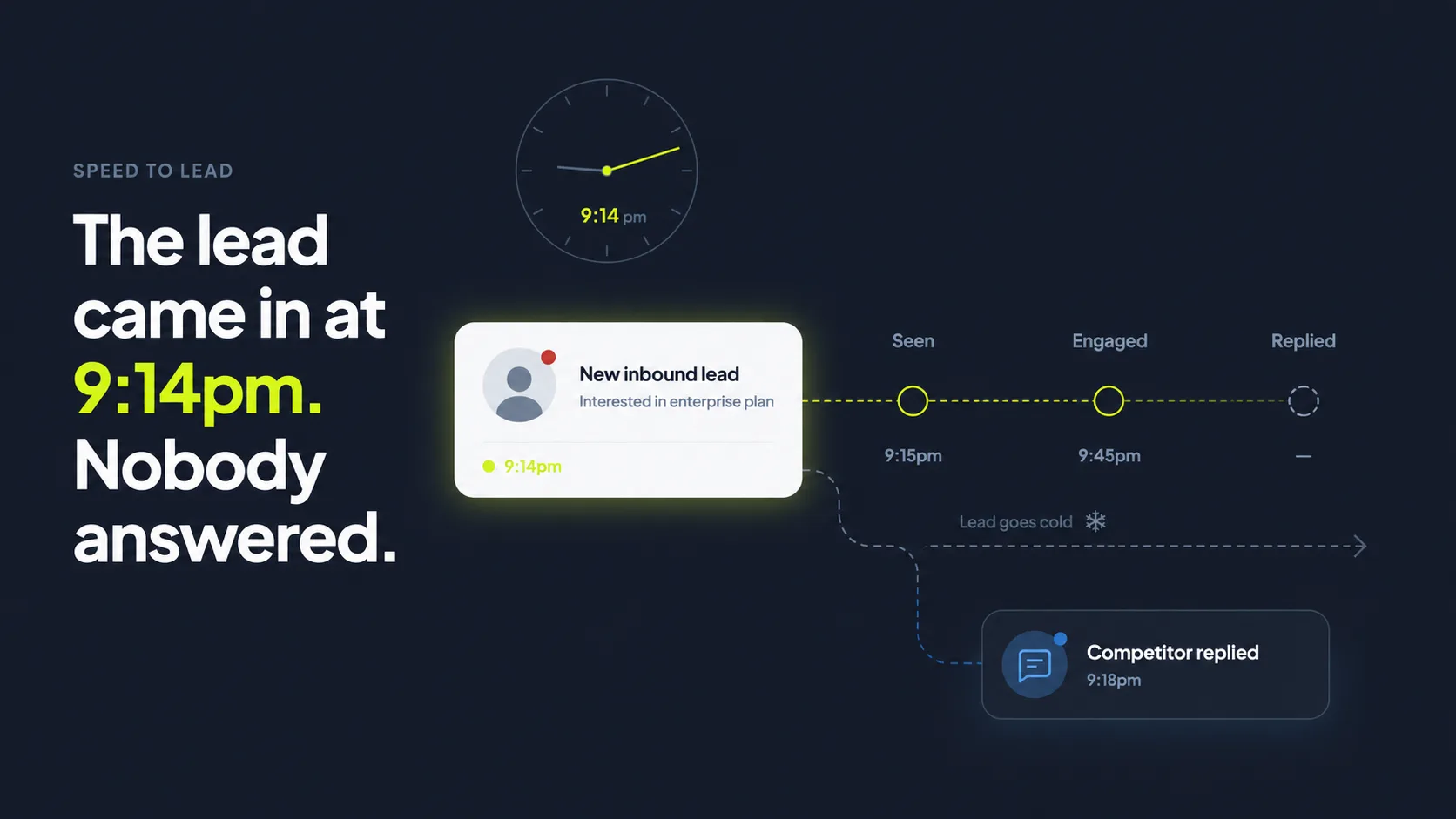
Remember that 9pm form from the intro? Here is where it actually dies. Not during outreach, and not in the demo, but in the quiet hours after a lead gets assigned and then sits, untouched, behind a routing rule nobody is watching. SkoreFlow focuses on exactly that blind spot: orphaned records, missed SLAs, and routing that silently drops the ball. Its read-only orchestration layer watches the post-assignment state and surfaces the leaks, with no stack changes required. That matters because speed wins: contacting a lead within 5 minutes makes you 21x more likely to qualify it than waiting 30 minutes, per Harvard Business Review (2011).
The shape of it is simple. SkoreFlow monitors your HubSpot portal for leads that got assigned but never worked, SLA breaches, and broken routing rules, then flags each gap so a human can act before the lead goes cold. It reads, it does not rewrite. Your reps keep their workflow and your data stays private. That fits where sales is heading, since 81% of sales teams already use or are testing AI, per Salesforce (2024).
Now do the math on what a leak costs. If 47 leads sit orphaned and even a handful were genuine opportunities, the lost pipeline dwarfs the price of catching them, every single month it goes unseen. That is money you already paid to generate, leaking out the back door.
Illustrative example (industry-based scenario, not a real client): Take a RevOps team running one HubSpot portal. A representative orchestration deployment surfaces roughly 47 orphaned leads sitting unworked, pulls speed-to-lead from about 340 minutes down to 8, and cuts missed SLA from 62% to 4%. These are SkoreFlow's benchmark figures, not a specific customer result. Pricing for the control layer runs from $297/mo ($997 setup, one portal, up to 5,000 contacts) to $997/mo for an agency tier covering up to 10 client portals. It finds your first routing leak in 24 to 48 hours, backed by a plain guarantee: catch a real leak in 48h, or get a full refund. So the downside is capped and the upside is the pipeline you're already paying to build. Run your own numbers with the tools below.
Citation capsule: SkoreFlow runs a read-only orchestration layer over HubSpot that catches orphaned leads, SLA breaches, and broken routing before SDR leads go cold. The approach is grounded in speed-to-lead evidence, with a 5-minute response making firms 21x more likely to qualify a lead than a 30-minute wait, per Harvard Business Review (2011).
Curious where your pipeline leaks? See how SkoreFlow finds dead leads in your HubSpot portal, or run the HubSpot leak auditor.

The bottom line: SDR means the rep who fills the funnel
SDR stands for Sales Development Representative: the rep who finds and qualifies leads, then hands the good ones to a closer. The role exists to split selling in two, so prospecting and closing each get done well instead of competing for the same hours. Sort it from BDR, LDR, and AE with one question: does this role close deals?
In 2026, "AI SDR" stretches the term to software that does that first-touch work automatically, around the clock. It's a real shift, with 81% of sales teams already using or testing AI, per Salesforce (2024). But here's the loop we opened at the top, now closed: even a perfectly fed pipeline leaks if leads stall after assignment, sitting orphaned while a competitor calls back first. So how many of your SDR leads are stuck in that gap inside HubSpot right now? You can find out in 48 hours, refund-backed if there's nothing to find.
Keep going: run the HubSpot leak auditor, or find your first dead lead inside your HubSpot portal.
Written by Maksim Skorokhod, Founder of SkoreFlow, who builds AI automation for small businesses, including HubSpot lead-orchestration that catches orphaned leads and routing leaks. Reviewed by Daria Volkova. Last reviewed: 2026-06-07.