Quick verdict: AI intake or a live legal receptionist?
For most firms, AI intake wins on coverage and cost, while a live receptionist wins on the hardest, most sensitive first calls. The deciding fact is reachability: only 40% of firms answer the phone and over 50% ignore client inquiries entirely, per Clio (2024). A virtual receptionist of either kind beats a missed call. The question is which kind fits your call mix.
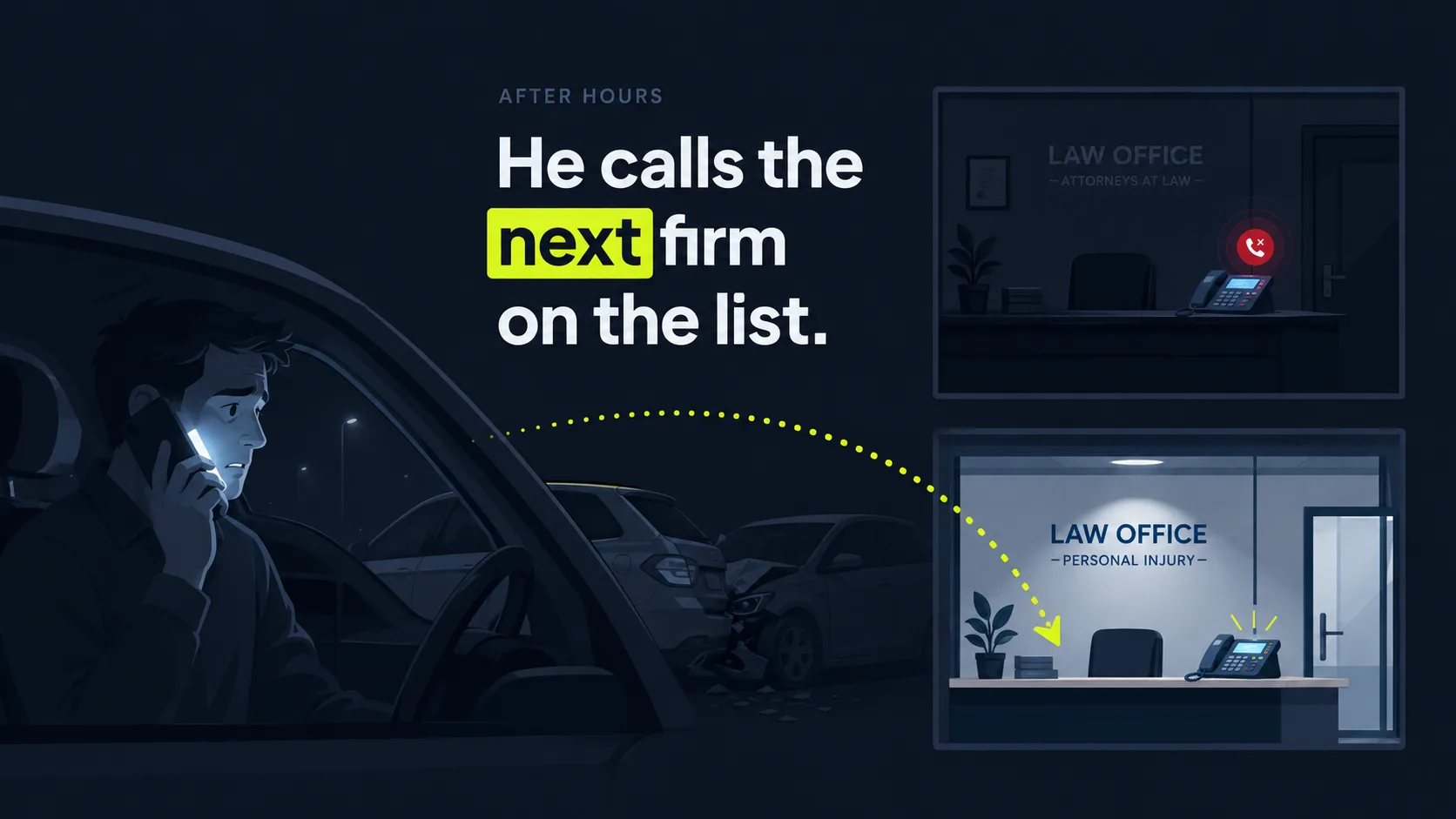
Picture the moment that costs you money. It is 6:40 p.m., the office is dark, and somewhere a man who just got rear-ended is scrolling his phone, dialing firm after firm. Yours rings four times and dies into voicemail. He hangs up and calls the next name on the list. You will never know he existed. That single ring, ignored, is the whole argument in miniature.
Here is the head-to-head, so you can match the model to your firm before reading the detail below.
| Factor | AI virtual receptionist | Live legal answering service |
|---|---|---|
| Answer speed | Instant, first ring, every call | Fast when staffed; queues at peak |
| After-hours / weekends | 24/7 at the same flat price | Often a surcharge or limited hours |
| Cost model | Flat monthly, no per-minute meter | Per-minute, ~$1.50-$5.00/min, per Ruby (2026) |
| Consult booking | Books straight into your calendar | Message-taking common; booking varies |
| Conflict pre-screen | Runs a scripted first-pass screen | Depends on training and script |
| Emotional / complex calls | Escalates to a human | Human judgment on the call |
| Consistency | Same script every time | Varies by agent and shift |
| Simultaneous calls | Handles many at once | Limited by staff on shift |
The pattern is simple. AI is strongest where volume, speed, and after-hours coverage decide the outcome. A live agent is strongest where a distressed caller or a tangled matter needs a human on the first call. The next sections break down each factor, and one of them quietly skews which calls your voicemail eats.
Citation capsule: A virtual receptionist for law firms, AI or live, exists to stop missed intake calls, and the gap is large: only 40% of firms answer the phone and 48% are effectively unreachable, per Clio's 2024 Legal Trends Report (2024). AI intake adds instant 24/7 answering and flat pricing; a live agent adds human judgment on hard calls.

You can also compare answering options across other industries.
How does AI client intake compare on qualifying the matter and booking the consult?
AI intake handles the structured part of a first call well: it captures contact details, identifies the matter type, runs a scripted screen, and books the consult. That structure matters because phone calls are the top-rated lead source for 66% of SMBs, ahead of forms, in-person, and email, per BIA/Kelsey (2014). A blown intake call is a high-intent client walking.
A good first call is a five-step relay, not a friendly chat. Each handoff has to be clean, because one dropped detail can mean a missed conflict, a wrong calendar slot, or a prospect who feels processed instead of heard. Here is the sequence an AI virtual receptionist runs, and where a live agent does the same work.
- Greet and capture contact details. Name, phone, email, and the best callback time, recorded the same way every time so nothing is lost to a hurried note.
- Identify and qualify the matter. The agent asks what the legal issue is, classifies it (family, personal injury, estate, criminal, business), and checks fit against the firm's practice areas and basic criteria.
- Run a first-pass screen. It collects the names of opposing or involved parties for a conflict check and flags anything that needs an attorney's eyes before a consult is offered.
- Book the consult. It offers open slots and writes the appointment into the firm's calendar, then confirms by text or email.
- Escalate when needed. A distraught caller, an active emergency, or an existing client gets routed to a person rather than forced through a script.
In our experience setting these up for service firms, the biggest win is not the booking, it is the consistency. A human front desk has good days and bad days, and the worst day is usually the busiest one. The new paralegal is covering two phones, a partner is barking for a file, and the intake for matter number 17 gets three scribbled words on a sticky note. An AI agent asks the same qualifying questions on call 3 and call 30, so the intake record is complete every time, which makes the attorney's prep faster. Complete prep buys you an attorney who walks into the consult already knowing the matter type, the parties, and the timeline. That is the gap between a confident sign-up and a cold re-interview.
Where AI is weaker is nuance. A caller who is grieving, scared, or describing a fact pattern that does not fit a tidy category is better served by a person. That is why the handoff, not the script, decides whether AI intake is good or merely cheap. It is also where the smartest firms route the calls that matter most.
Citation capsule: AI legal intake reliably captures contact details, classifies the matter, runs a first-pass conflict screen, and books the consult, since phone calls are the top-rated lead source for 66% of SMBs, per BIA/Kelsey (2014). Its weak spot is emotionally complex calls, which is why clean escalation to a human is essential.
The five-stage AI intake flow, at a glance:
| Stage | What happens | Handled by |
|---|---|---|
| 1. Greet | Capture name, phone, email, callback time | AI |
| 2. Qualify | Classify the matter, check practice-area fit | AI |
| 3. Screen | Collect party names for a first-pass conflict check | AI |
| 4. Book | Offer slots, write the consult to the calendar | AI |
| 5. Escalate | Route distressed, emergency, or existing-client calls | Human |
Source: SkoreFlow intake workflow.
See how the consultation booking voice agent runs your scripts and books consults.
Why does after-hours speed-to-answer win more legal clients?
Speed wins because legal callers rarely wait or call back, and the first responsive firm usually gets the client. Firms that contact a lead within five minutes are 21 times more likely to qualify it than firms that wait 30 minutes, and about 100 times more likely to make contact, per Harvard Business Review (2011). After hours, an AI agent answers in seconds. A voicemail rarely gets a callback.
The drop-off after a slow or missed answer is brutal. Fewer than 3% of callers pushed to voicemail leave a message, per Invoca (2024). So an unanswered intake call is almost never a delayed client, it is a lost one. Patience on hold is short too: 54% of callers hang up within eight minutes of waiting, per Nextiva (2025). Put real numbers on it. If your firm misses ten intake calls a week, roughly nine of those callers vanish without a trace, and many were dialing because they had nowhere else to turn.
The timing window is even tighter than five minutes suggests. Firms that respond within one hour are nearly 7 times more likely to qualify a lead than those who wait just an hour longer, and more than 60 times more likely than firms that wait a full day, per Harvard Business Review (2011). For a law firm, "we'll call you back Monday" is often a lost retainer worth thousands.
Here is the trap we promised to name. The intake calls you most want, the high-value, time-sensitive matters, are exactly the ones most likely to arrive after hours or during a court appearance, when no one is at the desk. A prospective client facing an arrest, an injury, or a filing deadline does not wait for business hours. So your voicemail is not eating a random sample of calls. It is skewed toward your best matters, not your worst. The calls you lose in your sleep are the ones you would have fought hardest to win awake.
This is the strongest argument for AI intake specifically. A live answering service can answer fast when staffed, but staffing nights, weekends, and lunch rushes is expensive and uneven. An AI agent answers the 11 p.m. call and the three calls that ring at once during a hearing, with no queue and no surcharge. It never sleeps, never takes lunch, and never picks the wrong line.
Citation capsule: Speed decides legal intake: firms contacting a lead within five minutes are 21 times more likely to qualify it than those waiting 30 minutes, per Harvard Business Review (2011). Because fewer than 3% of voicemail callers leave a message, per Invoca (2024), an unanswered after-hours intake call is usually a lost client, not a delayed one.

Read more on why being first to respond wins leads.
What does AI intake cost vs a per-minute legal answering service?
AI intake costs a flat monthly fee with no per-minute meter, while a live legal answering service bills by the minute, so the live bill climbs with every call. A per-minute service runs roughly $1.50 to $5.00 per receptionist-minute, per Ruby (2026) and AnswerConnect (2025). A flat AI plan holds steady whether intake calls trickle in or flood in.
A per-minute model charges you most on the exact months you are winning. A surge of intake calls is good news for your pipeline and a fatter invoice at the same time, so growth and cost rise together. The two billing models behave very differently as call volume grows. Here is how the costs stack up, using published rates.
| Cost line | AI virtual receptionist | Live per-minute legal answering service |
|---|---|---|
| Monthly base | Flat, ~$95-$300/mo, per Smith.ai (2026) / CloudTalk (2025) | Plan covers a minute bucket, ~$250-$1,725/mo, per Ruby (2026) |
| Per-minute charge | None on flat plans | $1.50-$5.00/min, per Ruby (2026) / AnswerConnect (2025) |
| Overage | Tier upgrade as you grow | $1.90-$2.30/min over your bucket, per Posh (2026) |
| After-hours / 24-7 | Same flat price | Sometimes a surcharge |
| Consult booking / calendar write | Usually included | Often message-taking only; booking extra |
| In-house alternative | n/a | Hiring: median $37,230/yr base wage, per BLS (2024) |
The contrast that matters: AI cost is mostly fixed, live cost is mostly variable. On a metered plan, a busy intake month is also an expensive one. A flat AI plan stays predictable, and an in-house receptionist still cannot answer two calls at once or staff midnight, no matter how good they are.
Citation capsule: A live per-minute legal answering service costs roughly $1.50 to $5.00 per receptionist-minute, per Ruby (2026) and AnswerConnect (2025), so the bill rises with call volume. A flat AI virtual receptionist holds at about $95 to $300 per month regardless of volume, per Smith.ai (2026) and CloudTalk (2025), and a hired receptionist's median base wage alone is $37,230 a year, per BLS (2024).
How the two models track as monthly receptionist-minutes rise (illustrative, using published rates):
| Receptionist minutes/month | Live per-minute service (at ~$3.45/min) | Flat AI plan |
|---|---|---|
| 50 min | ~$250/mo, per Ruby (2026) | ~$95/mo, per Smith.ai (2026) |
| 200 min | ~$720/mo, per Ruby (2026) | ~$270/mo, per Smith.ai (2026) |
| 500 min | ~$1,725/mo, per Ruby (2026) | ~$800/mo, per Smith.ai (2026) |
The live bill climbs with every minute, while the flat AI plan stays largely fixed as volume grows. At 500 minutes, the gap is roughly $900 a month, every month, for the same answered calls.
Estimate your intake break-even with the ROI calculator.
When is a live legal receptionist better, and when is AI intake better?
A live receptionist is better for emotionally charged or genuinely complex first calls, while AI intake is better for speed, coverage, and volume. The tension is real: 64% of customers would prefer companies didn't use AI in customer service, and the top concern is that it will get harder to reach a person, per Gartner (2024). The fix is not choosing one. It is using each where it is strong.
Choose a live legal receptionist when:
- Calls are emotionally heavy. Family law, criminal defense, and serious injury callers often need a calm human voice on the very first contact.
- Matters are tangled. Fact patterns that do not fit clean categories benefit from a person who can probe and adapt.
- Volume is low and personal. A boutique firm taking a few high-touch calls a day may prefer a human on every one.
- The brand is white-glove. If a hand-held experience is the firm's promise, a person reinforces it.
Choose AI intake when:
- After-hours and weekend calls matter. AI answers the 11 p.m. call instantly, every night, at no premium.
- Calls spike or overlap. AI handles many simultaneous intake calls with no queue and no hold.
- You want predictable cost. A flat plan beats a per-minute meter that punishes busy months.
- Consistency drives prep. A scripted, complete intake record every time speeds the attorney's review.
- You want a first-pass conflict screen. AI runs the same screening questions on every call without fatigue.
Back to that 64% who would rather not deal with AI. The smartest firms stop framing this as AI versus human and treat it as a routing problem. AI answers first, always, so no call is missed. It books the routine consults and runs the screen, then hands the emotional or complex calls to a person. That directly answers the Gartner concern: the goal is to make a human easier to reach, not harder, because AI catches the call that would otherwise hit voicemail at 9 p.m. and reach nobody at all. A scared caller routed to a live attorney in twenty seconds is better served than the same caller left to a recording.
Adoption is moving the same way. 85% of customer service leaders will explore or pilot customer-facing conversational AI in 2025, per Gartner (2024). The firms doing it well lead with AI for coverage and keep humans for judgment. The ones who do nothing keep losing the 9 p.m. call.
Citation capsule: Use a live legal receptionist for emotionally heavy or complex first calls, and AI intake for after-hours coverage, simultaneous calls, and predictable cost. Because 64% of customers prefer companies didn't use AI, with the top fear being harder access to a person, per Gartner (2024), the best setup leads with AI and hands sensitive calls to a human.
See how human handoff works inside the consultation booking voice agent.
How does SkoreFlow handle legal intake, conflict-aware routing, and consult booking?
SkoreFlow's Consultation Booking Voice Agent runs legal intake as a flat-fee AI agent that answers instantly, screens the matter, and books the consult, with a person one routing rule away. It books consults, it does not just take messages, the way an answering service like Ruby leaves you to call back. That matters because per-minute billing punishes you on your busiest intake weeks, when live rates of $1.50 to $5.00 a minute, per Ruby (2026) and AnswerConnect (2025), cost the most.
The agent is grounded in your firm's site, services, and intake script. It captures the caller's name and contact details, classifies the matter against your practice areas, collects the names of opposing or involved parties for a first-pass conflict-of-interest screen, answers common pre-consult questions, and writes a consult into your calendar. Anything that needs human judgment, a distraught caller, an active emergency, or an existing client, routes straight to your designated attorney or paralegal. That escalation path is the point, because 64% of customers would prefer companies didn't use AI in service, per Gartner (2024), so the human door always stays open.
Setup is fast and the offer is concrete. SkoreFlow gets the voice agent live in about 5 days, integrates with your calendar and scheduling system, and runs as a flat monthly plan from $497 to $1,497/mo depending on call volume and hours of coverage. The guarantee for this service is recover $3,000 in 30 days or your setup is refunded, so the risk of trying it sits with us, not your firm. Compliance is handled as TCPA-aware, with clear routing rules for sensitive calls. SkoreFlow's method is open, while your firm's numbers, clients, and matter data stay private. [CONFIRM: any signed BAA or formal confidentiality terms for legal data.]
Illustrative example (industry-based scenario, not a real client): Consider a small firm receiving around 40 new-matter calls a month, with many arriving after hours. Today most of those after-hours calls hit voicemail, and fewer than 3% of voicemail callers leave a message, per Invoca (2024). If the voice agent on a flat plan near $497/month captures even 20% more of those after-hours intakes and books the consults, that handful of recovered matters typically dwarfs the subscription, given that a single retained legal client is worth far more than a month of AI answering. The number to plug in is your own average matter value. Run that math once and the decision usually makes itself.
You keep your existing number and pay one predictable figure each month, whether you take 20 intake calls or 200. Want to see where your break-even lands? Run your own numbers in the calculator, or book a free consult audit and we will map what capturing those intake calls would be worth, in dollars, against your actual matter value. It is a 20-minute, no-pressure call, and you walk away with the gap whether or not you ever hire us.
Citation capsule: SkoreFlow's Consultation Booking Voice Agent runs legal intake as a flat-fee AI agent, from $497 to $1,497/mo and live in about 5 days, that captures the matter, runs a first-pass conflict screen, books the consult, and escalates sensitive calls to a person. The human door stays open because 64% of customers prefer companies didn't use AI in service, per Gartner (2024).
Estimate your intake savings and break-even with the ROI calculator.
The bottom line: lead with AI intake, keep a human close
The numbers point one way. Only 40% of law firms answer the phone and over 50% ignore client inquiries, per Clio (2024), and a missed intake call rarely calls back, with under 3% leaving voicemail, per Invoca (2024). An AI virtual receptionist closes that gap by answering instantly 24/7, screening the matter, and booking the consult at a flat fee, while a per-minute live service bills $1.50 to $5.00 a minute, per Ruby (2026).
Remember that man getting rear-ended at 6:40, dialing his way down the list? The firm he reaches first is the firm he hires. The best setup is not AI versus human, it is AI first with a human one step away. Let the agent catch every call, run the first-pass screen, and book the routine consults, then route the emotional or complex calls to a person, which directly answers the Gartner concern about reaching a human. Want to know what your missed intake calls are worth? Run the numbers in the calculator, or book a free consult audit and we will show you the gap. It is a 20-minute, no-pressure call, and the recover-$3,000-in-30-days-or-your-setup-is-refunded guarantee means the downside is ours.
Estimate your intake cost and break-even with the ROI calculator, or see how the consultation booking voice agent answers, screens, and books.
Written and reviewed by Maksim Skorokhod, Founder of SkoreFlow, who builds AI answering and voice automation for small service businesses and professional firms. Last reviewed: 2026-06-07.