What are the types of answering service?
There are three main types of answering service: a live phone operator, a full call center, and an AI voice agent. They differ in cost, capacity, and what they can actually do on a call. Whichever you pick, inbound calls are worth protecting. In one widely cited survey, 66% of SMBs rated phone calls a "good" or "excellent" lead source, the top-rated channel, per BIA/Kelsey (2014, older data). The right type depends on your call volume and whether you need booking, not just messages.
So which one fits a small shop? It comes down to one question: do you need a note taken, or a job put on the calendar? The three options break down like this:
- Live operator (virtual receptionist). A real person, usually offsite, answers in your business name, takes a message, and can transfer urgent calls. It's warm and flexible. But it's the priciest per minute and runs on someone else's staffing and hours.
- Call center. A larger team built for high call volume, often handling overflow, support tickets, and scripted intake at scale. Good for spikes and big operations. It's heavier, more expensive, and can feel impersonal for a small shop.
- AI voice agent. Software that answers in a natural voice, follows your script, captures details, and, in modern versions, books the appointment straight into your calendar. It runs 24/7, handles many calls at once, and costs far less per minute than a human.

Citation capsule: There are three main types of answering service, a live operator, a full call center, and an AI voice agent, and choosing well matters because inbound calls have long been a top-rated SMB lead source: in a 2014 BIA/Kelsey survey, 66% of small businesses rated phone calls a "good" or "excellent" source of leads, ahead of online forms and email, per BIA/Kelsey (2014).
A side-by-side comparison makes the tradeoffs clear:
| Type | Who answers | Can book appointments? | Hours | Relative cost |
|---|---|---|---|---|
| Live operator | A remote human receptionist | Sometimes, if set up | Limited to their shift coverage | Highest per minute |
| Call center | A large human team | Sometimes, scripted | Often extended or 24/7 | High, built for volume |
| AI voice agent | Software voice | Yes, into your calendar | 24/7, always on | Lowest per minute |
Notice the column that decides everything: "Can book appointments?" Hold that thought, because it's where the whole category just changed. Not sure how this differs from hiring help? See our breakdown of an answering service versus a virtual receptionist.
Why do businesses use an answering service?
Businesses use an answering service because plenty of inbound calls never reach a person, and an unanswered call usually means a lost job. The gap is real: among home-services firms, 27% of calls go unanswered, and fewer than 3% of callers pushed to voicemail leave a message, per Invoca (2024). An answering service closes that gap so calls turn into customers instead of dial tones.
Here's the math owners rarely run. Three reasons drive it, and each one quietly drains the same bank account.
Missed-call cost
Voicemail rarely saves a missed call. Among home-services businesses, 27% of calls go unanswered, and fewer than 3% of callers pushed to voicemail actually leave a message, per Invoca (2024). So a missed call isn't a delayed lead. It's usually a gone one. And speed compounds the loss. A classic study found firms that contact a web lead within 5 minutes are 21x more likely to qualify it than those waiting 30 minutes, per Harvard Business Review (2011). Newer data backs the pattern: lead-to-conversion rates run about 8x higher when a lead is engaged inside the first 5 minutes, per InsideSales/XANT (2021). Every minute the phone goes unanswered, the job gets harder to win.
After-hours coverage
A lot of demand arrives outside 9-to-5. In some verticals it's the majority: restaurants receive 51% of their calls after 5pm, and locksmiths get a large share before 9am or after 5pm, per BrightLocal (2019). Think about what that means for your shop. If your phone only works during business hours, you're handing away the half of callers who reach out on their own time, usually at the exact moment their problem feels urgent.
Overflow
Even staffed shops drop calls during rushes, when everyone's on a job or stuck on another line. An answering service catches the overflow so two simultaneous callers both get answered. And that matters because callers don't wait: over half hang up after eight minutes on hold, per Nextiva (2025). The second caller doesn't leave a message. They leave for someone who picks up.
Illustrative example (industry-based scenario, not a real client): Picture a plumbing shop fielding about 80 calls a week. If it misses 1 in 4, in line with the home-services unanswered rate above, that's roughly 20 booking chances slipping away weekly, and almost none come back by voicemail. We've used the published unanswered-call rate here, not a client's numbers, to keep the math honest.

Citation capsule: Businesses use an answering service because a meaningful share of inbound calls never reach a person. Among home-services firms, 27% of calls go unanswered, and fewer than 3% of callers pushed to voicemail leave a message, so voicemail recovers almost none of the missed opportunity, per Invoca (2024).
Want the play-by-play? Read how an answering service handles a call, step by step.
How did AI change the answering service?
AI changed the answering service from a message-taking desk into a booking engine. A modern AI voice agent doesn't just write down a name. It qualifies the caller and puts the appointment on your calendar. The shift is timely, because customer service leaders are moving fast. 85% of customer service leaders will explore or pilot customer-facing conversational GenAI in 2025, per Gartner (2024). That's the difference between recording a problem and solving it on the call.
Remember the booking column from the table earlier? This is where it pays off. The old model had a clear ceiling. A human operator or basic service could take a message, then someone on your team had to call back, which reopens the speed-to-lead gap. An AI voice agent collapses that loop: it answers instantly, handles the conversation, and books in real time, day or night.
Building AI answering for service shops, we've found the booking step is what owners feel first. A message in an inbox still depends on someone circling back before the lead cools. When the agent books the appointment on the call, the job is captured the moment the phone rings, not the next morning when half the callers have already dialed a competitor.
Now the honest catch most vendors skip: plenty of callers are wary of AI on the phone. 64% of customers would prefer companies didn't use AI in customer service, and the #1 concern is that it gets harder to reach a person, per Gartner (2024). So a good AI answering service has to sound natural and hand off to a human cleanly, or it trades one missed-call problem for a worse one.

Citation capsule: AI changed the answering service from message-taking to booking: a modern AI voice agent qualifies the caller and schedules the appointment on the call, not after a callback. The timing fits the market, since 85% of customer service leaders will explore or pilot customer-facing conversational GenAI in 2025, per Gartner (2024).
Who needs an answering service (and who doesn't)?
You need an answering service when missed or after-hours calls are quietly costing you jobs, and you can skip one when your existing setup already answers nearly every call live. The dividing line is real money: a U.S. receptionist's median wage is $17.90 an hour, or about $37,230 a year before benefits, per the U.S. Bureau of Labor Statistics (2024). If you can't justify that for full phone coverage, a service usually fills the gap for less.
Be honest with yourself for a second. Use this quick qualifier. You likely need one if several of these are true:
- You regularly miss calls because you're on a job, with a customer, or off the clock.
- A meaningful share of your calls land after hours or on weekends.
- A single new customer is worth enough that one or two recovered jobs covers the cost.
- You can't afford or justify a full-time front-desk hire.
- Two calls at once means one of them goes unanswered.
You probably don't need one if most of these hold:
- You already answer the vast majority of calls live, in person or with reliable staff.
- Your volume is very low and predictable, with little after-hours demand.
- Your business runs on scheduled, recurring contact rather than fresh inbound calls.
Here's what we've learned watching owners decide. The clearest signal isn't call volume, it's regret. When an owner can name the jobs they lost to a missed call last month, the math has already made the decision. When they can't, they probably don't need a service yet.
Citation capsule: You need an answering service when missed and after-hours calls are costing you jobs and full phone coverage isn't worth a dedicated hire, since a U.S. receptionist's median wage is $17.90 an hour, about $37,230 a year before benefits, per the U.S. Bureau of Labor Statistics (2024). You can skip one if you already answer nearly every call live.
Weighing the alternative? Compare answering services with hiring a virtual receptionist.
How does SkoreFlow approach answering services?
SkoreFlow books jobs, not messages. Its missed-call recovery voice agent answers in 0.4 seconds, filters spam, qualifies the caller, and books the estimate straight into your calendar, with a clean handoff to a human when needed. Demand favors this always-on answer. 75% of customers prefer or want a scheduled callback over waiting on hold, per Nextiva (2024), and an agent that picks up instantly removes the hold entirely.
The setup is built for small trades teams, not enterprise theater. The agent goes live in 48 hours and connects to the tools plumbers, HVAC techs, and electricians already run: ServiceTitan, Jobber, Housecall Pro, and Google Calendar. It's TCPA-aware, and your numbers, clients, and data stay private. The point is to answer more callers and book them, not wall them off from a person.
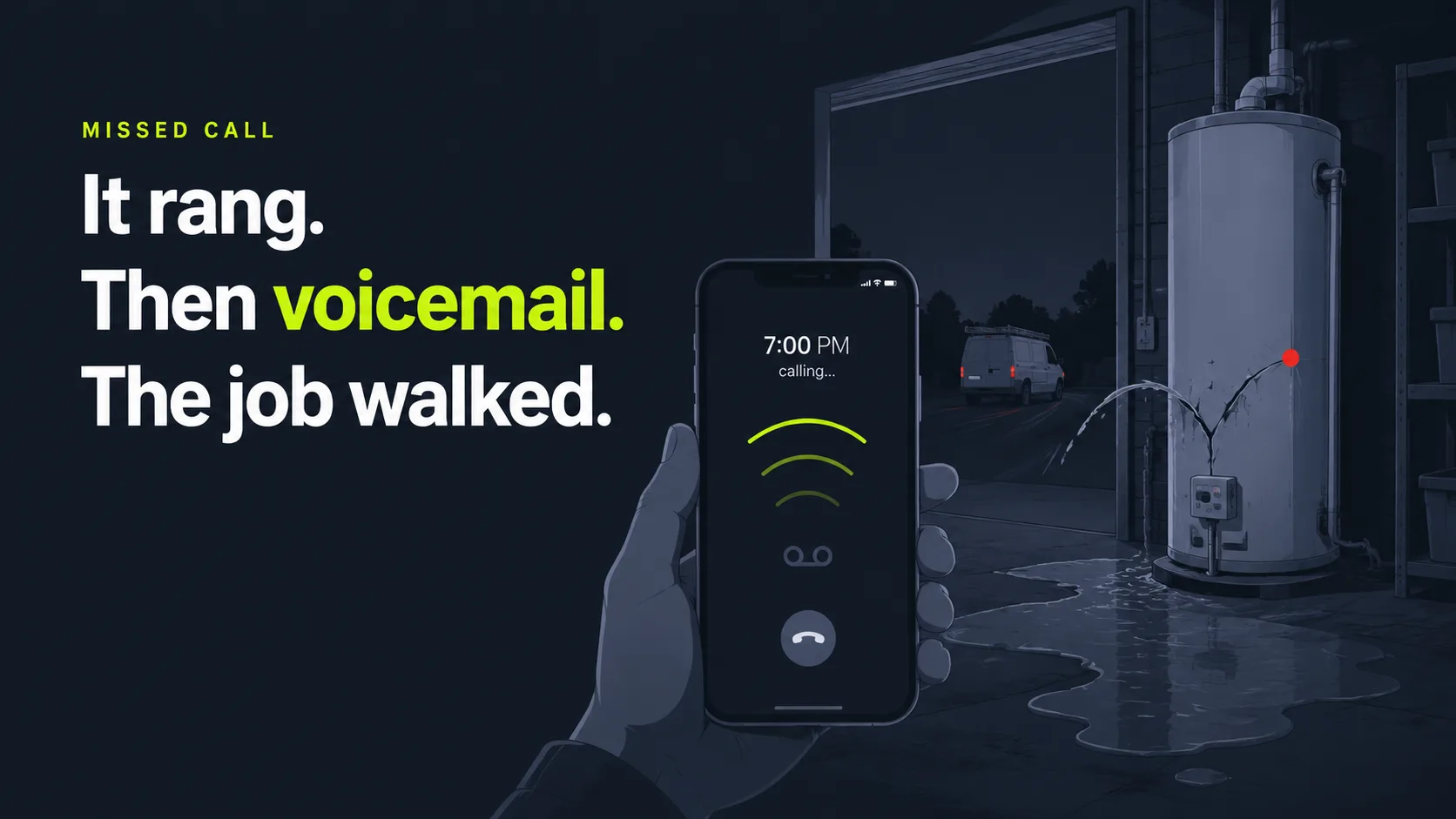
Here's the difference from a classic answering service like Ruby: those take a message and leave you to call back, which reopens the speed-to-lead gap every time. SkoreFlow qualifies and books on the call itself, so the job is captured while the caller is still on the line. Remember the 7pm water heater from the start of this guide? This is the version where that call gets booked instead of lost.
Plans run from $197 to $697 a month depending on call volume, and the agent is backed by a guarantee: 5 booked jobs in 30 days or your setup fee back.
Illustrative example (industry-based scenario, not a real client): Imagine a 6-tech HVAC shop whose crews are out most of the day. Using the home-services unanswered rate, a meaningful slice of its calls go to voicemail and vanish. A representative recovery scenario for a small trades shop runs near a 94% answer rate and roughly $14,200/month in recovered work. At the $1,205 average repair ticket from Housecall Pro (2025), even a few recovered bookings can cover the service many times over. These are representative industry figures, not measured client results.
Citation capsule: SkoreFlow treats the answering service as a booking engine: a 24/7 AI voice agent answers in 0.4s, qualifies callers, and books jobs into ServiceTitan, Jobber, or Housecall Pro, with a clean human handoff when needed. The approach fits caller behavior, since 75% of customers prefer or want a scheduled callback rather than waiting on hold, per Nextiva (2024).
See SkoreFlow's full missed-call recovery approach for trades, or run the numbers with the missed call revenue calculator.
The bottom line on answering services
The short version: an answering service exists because plenty of inbound calls never reach a person, and most callers won't leave a voicemail. Among home-services firms, 27% of calls go unanswered and fewer than 3% of voicemail-bound callers leave a message, per Invoca (2024). That unanswered phone is a quiet leak in nearly every service business. A good answering service plugs it, covering missed calls, after-hours demand, and overflow so jobs stop slipping away.
What's changed is what "answering" now means. The category moved from taking a message to booking the appointment on the call, which is where an AI voice agent earns its keep, if it sounds natural and hands off to a human when needed. So here's the question worth answering this week: how many jobs is your phone losing while you read this? Book a Free Call Audit, a no-pressure 20-minute call where we map where your phone is leaking jobs and what fixing it could return. No commitment, just the number.
Keep reading: how an answering service works, step by step, or see the full missed-call recovery service.
Written and reviewed by Maksim Skorokhod, Founder of SkoreFlow, who builds AI answering and voice automation for small service businesses. Last reviewed: 2026-06-07.