How an AI phone number answers and books a call
An AI phone number answers on the first ring, understands what the caller wants in plain language, and finishes the job end to end: answer, qualify, book, confirm. Speed is the whole game. Firms that contact a lead within five minutes are 21 times more likely to qualify it than those who wait 30 minutes, per Harvard Business Review (2011). An AI line responds in seconds, every time, even when you're elbow-deep in a job.
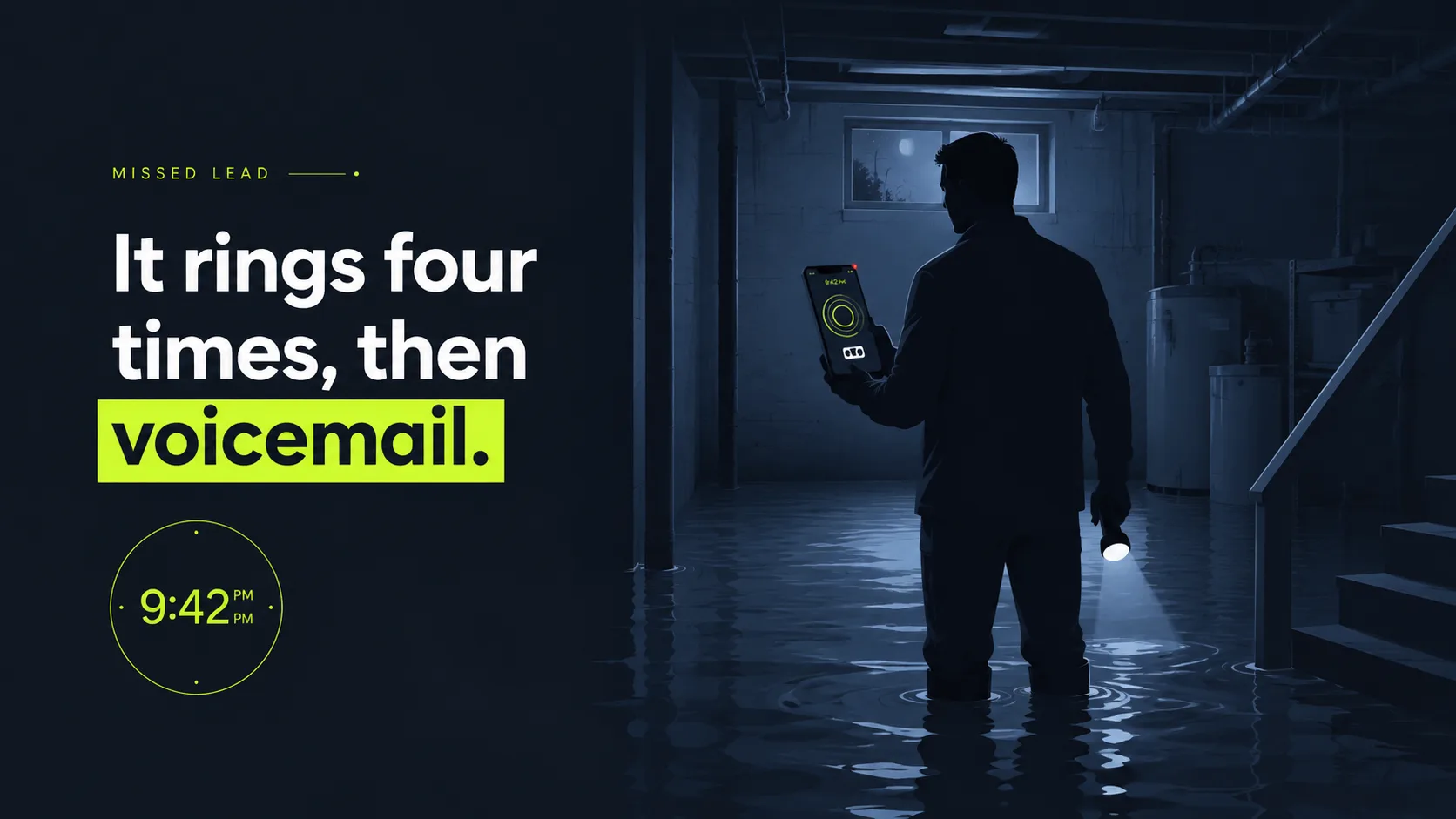
Picture the water-in-the-basement caller again. This time nobody scrambles. The agent picks up before the second ring, hears "my pipe burst," and starts moving. The call then runs through six steps, start to finish:
- Answers instantly. The AI voice agent picks up on the first or second ring, with no hold queue and no phone menu to wade through.
- Greets and listens. It greets the caller by your business name and asks how it can help, then understands the request in natural speech, not by pushing buttons.
- Answers questions. It handles the routine ones: hours, location, services, pricing ranges, "do you cover my area?"
- Qualifies the caller. It asks the right questions to capture the job type, urgency, name, number, and address, so a lead is never just a hang-up.
- Books the appointment. It checks your live calendar, offers open slots, books the one the caller picks, and sends a confirmation.
- Hands off when needed. Anything urgent, emotional, or high-stakes warm-transfers to a person, with the context already gathered.
So what does that actually buy you? The leap that makes 2026 different isn't that the agent talks well. It's that it acts. An old phone tree could read your hours out loud. It could never put a caller on the calendar. An AI phone number turns the conversation into a booked job before the caller hangs up, which is the difference between a line that informs and a line that earns. And that one difference (booking, not just talking) is why some AI lines pay for themselves and others gather dust. We'll come back to where that line lives.
Citation capsule: An AI phone number answers on the first ring, qualifies the caller in natural language, and books the appointment on a live calendar, then hands off to a person when needed. Speed drives the value: firms contacting a lead within five minutes are 21x more likely to qualify it than those waiting 30 minutes, per Harvard Business Review (2011).

Related reading: how an AI voice agent catches the calls you miss.
New number vs. porting: three setup options
You have three ways to put AI on a phone line, and not one of them forces you to reprint a single truck or business card. You can get a brand-new AI number, forward your existing number to the AI, or port (move) your existing number onto the AI platform. Each carries a tradeoff in setup speed and control. The right pick comes down to one question: how attached are you to the number people already dial?
Most owners assume it's an either-or. Keep my number, or get AI. It isn't. The three options below cover almost every small business. Read the watch-outs before you choose.
- Get a new AI number. Fastest to launch, often live the same day. Good for a dedicated booking line, a campaign-specific number, or a brand-new business. The downside: it's a number nobody knows yet, so you'll need to publish and promote it.
- Forward your existing number. Keep the number on your trucks, cards, and Google profile exactly as-is, and route calls (or just the ones you miss) to the AI. Easiest way to protect everything you've built. The catch: forwarding settings live with your current carrier, so you manage two pieces.
- Port your existing number. Move your current number onto the AI platform so the agent owns it directly. Cleanest long-term setup, with everything in one place. Porting usually takes a few business days and can't happen instantly, so plan a short overlap.
A quick comparison of the three, side by side:
| Option | Keep your number? | Setup speed | Best for |
|---|---|---|---|
| New AI number | No (added as a second line) | Same day to 1 day | New businesses, dedicated booking lines, campaigns |
| Forward existing | Yes, unchanged | 1 day, carrier settings | Keeping printed numbers; catching only missed/after-hours calls |
| Port existing | Yes, moved to platform | A few business days | One clean setup, no carrier juggling, long-term use |
In our experience, the setup that fits an established shop is also the least dramatic one: keep your existing number exactly where it is and forward only the calls you'd otherwise lose. Busy, no-answer, after-hours. Those route to the AI. Nothing on your trucks changes. The number on the door stays the number on the door. The AI just quietly catches the calls that used to vanish into voicemail.
Citation capsule: You can put AI on a phone line three ways: get a new AI number, forward your existing number, or port it onto the AI platform. Forwarding keeps your current number unchanged and routes only missed or after-hours calls to the AI, which matters because fewer than 3% of voicemail callers leave a message, per Invoca (2024).
Related reading: how to connect a SIP (Session Initiation Protocol) line to an AI voice agent.
Who needs an AI phone number?
An AI phone number helps any business that loses calls, but four groups feel the bleed most: solo operators, missed-call-heavy trades, after-hours businesses, and seasonal spikers. The common thread is high-intent callers slipping away. That hurts, because 66% of SMBs rate inbound phone calls a good or excellent lead source, the top channel, per BIA/Kelsey (2014). Your best leads call. They don't fill out forms.
Find yourself in the list below:
- Solo operators and one-person shops. When you're on a ladder, under a sink, or face to face with a paying customer, you can't answer. The AI does, so the call becomes a booked job instead of a voicemail nobody leaves.
- Missed-call-heavy trades. Plumbers, electricians, HVAC (heating, ventilation, and air conditioning) techs, roofers, and similar trades take calls while their hands are full. With 27% of service calls going unanswered, per Invoca (2024), the leakage adds up fast.
- After-hours businesses. A big share of demand shows up after the lights go off. Restaurants get 51% of their calls after 5pm, per the BrightLocal (2019) study of 45,264 listings. An AI line answers and books overnight and on weekends, when your competitors are asleep.
- Seasonal or campaign spikers. A heat wave, a storm, or a fresh ad can flood your line faster than you can pick up. The AI handles many calls at once, and patience runs thin: 54% of callers hang up after up to eight minutes on hold, per Nextiva (2024).
Put a dollar figure on it, though, because "you're losing calls" is easy to shrug off and a number isn't.
Illustrative example (industry-based scenario, not a real client): Picture a solo electrician who misses about 10 calls a week while on a job. Say 6 of those are real prospects, and he'd normally convert about 25% of the ones he reaches. That's roughly 1.5 booked jobs a week walking out the door, or about 78 a year. Do the math on a typical ticket and that's a second truck's worth of revenue lost to a ringing phone nobody answered. In a representative SkoreFlow trades scenario, an always-on AI number lifting answer rate toward 94% can recover on the order of $14,000 a month. These are illustrative benchmark figures, not a specific customer result, so run your own numbers with the calculator below.
Citation capsule: An AI phone number helps solo operators, missed-call-heavy trades, after-hours businesses, and seasonal spikers most. The stakes are real, since 66% of SMBs rate inbound phone calls a good or excellent lead source, the top channel, per BIA/Kelsey (2014), and 27% of service-business calls go unanswered, per Invoca (2024).

Try it yourself: estimate the value of the calls you currently miss with the missed call revenue calculator.
What does an AI phone number cost, and what are the limits?
An AI phone number typically costs $50-$300 per month for an AI plan, versus $300-$2,000+ for human answering, per CloudTalk (2025). Setup usually takes days, not weeks. The savings and the speed are real. So are the limits, and any honest answer names both: an AI line handles routine, high-volume calls well, and it should pass anything emotional or high-stakes to a person.
Line the options up and the pricing gap stops being abstract. AI receptionist software lists self-serve (do-it-yourself) plans from around $95/month, per Smith.ai (2026). A national live virtual receptionist provider, by contrast, lists plans from $250/month for 50 minutes up to $1,725/month for 500 minutes, per Ruby (2026), roughly $3.45-$5.00 per receptionist-minute. Hiring in-house is heavier still: the median US receptionist earns $37,230 a year before benefits and overhead, per the U.S. Bureau of Labor Statistics (2024). And a human still goes home at 5pm.
Now the honest limits, because an AI phone number is not a person and pretending otherwise backfires:
- Emotional or sensitive calls belong with a human. A good agent detects frustration and escalates rather than pushing through.
- Rare, complex requests outside its setup will stump it. That's exactly what the human handoff is for.
- Customer wariness is real. 64% of customers would prefer companies didn't use AI in customer service, per Gartner (2024), so the line must sound natural and offer an easy path to a person.
- Setup quality decides everything. A line that can't reach your calendar or a human is worse than voicemail.
Remember that line I said we'd come back to, the one between an AI line that pays off and one that disappoints? Here it is. Across the lines we configure, the most common expectation gap isn't capability, it's scope. Owners either want the AI to handle 100% of calls (it shouldn't, the rare and emotional ones need a person) or they limit it to a bare greeting (wasting most of its value). The sweet spot we land on again and again is roughly 70-85% of routine calls fully handled by the agent, with the rest warm-transferred. Set that expectation up front and the line earns its keep. Skip it and you've bought disappointment.
Citation capsule: An AI phone number typically costs $50-$300 per month versus $300-$2,000+ for human answering, per CloudTalk (2025), with AI receptionist plans from around $95/month, per Smith.ai (2026). It excels at routine calls and should escalate emotional or high-stakes ones, since 64% of customers would prefer companies didn't use AI in service, per Gartner (2024).
Here is the monthly cost gap, side by side:
| Answering option | Typical monthly cost | Source |
|---|---|---|
| AI phone line (AI plan) | $50 to $300 | CloudTalk (2025) |
| Live virtual receptionist plan | $250 (50 min) to $1,725 (500 min) | Ruby (2026) |
| Human answering (general range) | $300 to $2,000+ | CloudTalk (2025) |
| In-house receptionist (base wage) | about $3,103 ($37,230 a year), before benefits | U.S. Bureau of Labor Statistics (2024) |
Try it yourself: estimate your recovery with the missed-call revenue calculator.
How does SkoreFlow set up your AI phone number?
SkoreFlow sets up a done-for-you AI phone number tuned to your trade, so the agent answers in 0.4 seconds, filters spam, qualifies the caller, and books the estimate, then warm-transfers to a person when a call needs one. Unlike an answering service like Ruby, which takes a message and leaves you to call back, SkoreFlow books jobs, not messages. The build stays conservative on automation, because 64% of customers would prefer companies didn't use AI in customer service, per Gartner (2024). Naturalness and an easy human path come first.
Setup connects the agent to your calendar and field-service tools (ServiceTitan, Jobber, Housecall Pro, and Google Calendar), then maps which calls it resolves and which it escalates. Routine bookings and FAQ-style questions the agent handles itself. Anything urgent, emotional, or high-stakes warm-transfers to a person with the details already captured. The setup is TCPA-aware, and your numbers, clients, and data stay private. Most lines go live in 48 hours, with plans from $197/month, and we back it with a simple promise: 5 booked jobs in 30 days or your setup fee back. So the downside isn't "what if it doesn't work." The downside is the calls you keep missing while you decide.
Citation capsule: SkoreFlow sets up a done-for-you AI phone number tuned to each trade that answers in 0.4 seconds, qualifies, books the estimate, and warm-transfers to a person, integrating with ServiceTitan, Jobber, Housecall Pro, and Google Calendar. It books jobs, not messages, and goes live in 48 hours, backed by a 5-booked-jobs-in-30-days-or-refund guarantee.
For the full picture, see how SkoreFlow's missed-call recovery answers, qualifies, and books the job.
The bottom line: a number that never misses a call
An AI phone number earns its keep by catching the calls a busy crew can't: the second caller, the after-hours booking, the storm-day overflow, the homeowner standing in two inches of water at 9:42pm. That call used to hit voicemail and vanish. Now it becomes a booked job. And you don't have to choose between keeping your number and adding AI, you can forward, port, or add a fresh line. The math is hard to argue with when fewer than 3% of voicemail callers leave a message, per Invoca (2024).
Keep expectations honest. An AI line shines at routine, high-volume calls and should hand off anything emotional or high-stakes to a person, with an easy path to reach one. Done right, that balance turns missed calls into booked jobs without making callers feel stuck with a robot. Want to know what your missed and after-hours calls are actually worth? Run the numbers in the calculator, or book a free call audit: a 20-minute, no-pressure look at the calls slipping past you, and we'll map the right setup with you. Worst case, you learn exactly how much that ringing phone is costing you.
Next steps: estimate your recovery with the missed-call revenue calculator, or see how SkoreFlow's missed-call recovery answers, qualifies, and books the job.
Written by Maksim Skorokhod, Founder of SkoreFlow, who builds AI answering and voice automation for small service businesses. Last updated: 2026-06-07.
A note on the data: statistics are current as of June 2026. A few foundational figures are older but remain the most-cited benchmarks in their category: the Harvard Business Review speed-to-lead study (2011), BIA/Kelsey on phone calls as a lead source (2014), and the BrightLocal after-hours call study (2019). Pricing, adoption, and consumer-sentiment figures use 2024 to 2026 sources.