How did we rank the best answering services for small business?
We ranked services on four things that decide whether a small business keeps the work: price model, speed-to-answer, booking versus messaging, and integrations. Speed leads for a reason. Firms that respond to a lead within five minutes are 21 times more likely to qualify it than firms that wait 30 minutes, and roughly 100 times more likely to make contact, per Harvard Business Review (2011).
Read those odds again. Five minutes versus thirty isn't a small edge. It's the gap between a booked estimate and a dead lead. So we weighted the criteria the way the money actually flows. Here's exactly what each one measured, in order of weight.
- Price model. Flat monthly pricing versus per-minute metering. Per-minute plans punish you on your busiest days, when call volume, and your bill, both spike. We favored transparent, predictable pricing.
- Speed-to-answer. Does it pick up on the first ring, or can callers land in a hold queue? 75% of callers hang up after eight or more minutes on hold, per Nextiva (2025). Instant, parallel answering scored highest.
- Booking versus messaging. The single biggest divider. A service that books an appointment into your calendar is worth far more than one that takes a message for you to chase later.
- Integrations. Whether it writes the captured call into your CRM, scheduler, or field-service software automatically, instead of leaving you to re-key every detail by hand.
We did not score on brand or marketing. Pricing figures come only from each provider's public pages or published industry benchmarks, dated and linked, so you can verify them yourself.
Most "best answering service" lists rank on price alone, which we think is the wrong lens. A cheap service that only takes messages still loses the job, because almost nobody you fail to book calls back. In our experience, the booking-versus-messaging split predicts revenue impact better than the monthly price does. A slightly pricier service that books beats a cheap one that hands you a callback list. Hold that idea, because it decides every pick below.
Citation capsule: We ranked small-business answering services on price model, speed-to-answer, booking versus messaging, and integrations. Speed leads because firms responding within five minutes are 21 times more likely to qualify a lead than those waiting 30 minutes, per Harvard Business Review (2011), and 75% of callers hang up after eight minutes on hold, per Nextiva (2025).

Related reading: how missed calls cost local businesses revenue.
Comparison table: best answering services for small business at a glance
Here is the at-a-glance comparison of the main answering-service options for a small business, with public, dated pricing for each. The spread is wide. AI receptionist tiers start near $95/month, per Smith.ai (2026), while live human plans run from $250 to $1,725+/month at one national provider, per Ruby (2026). Read the table as a shortlist, then check the option-by-option notes below for the trade-offs.
| Service | Type | Starting price (public, dated) | Per-minute fees | Books appointments? | Best for |
|---|---|---|---|---|---|
| SkoreFlow | AI voice agent | Flat monthly, $197-$697/mo, no per-minute fees | No | Yes, books jobs into ServiceTitan, Jobber, Housecall Pro, Google Calendar | Best overall: booking jobs at a flat price |
| Smith.ai (AI Receptionist) | AI software | $95/mo Starter, per Smith.ai (2026) | No (call-based tiers) | Yes | Best AI on a budget |
| Ruby | Live virtual receptionist | $250/mo for 50 min, up to $1,725/mo for 500 min, per Ruby (2026) | Effective ~$3.45-$5.00/min | Limited; varies by brief | Best for a live human voice |
| Posh | Live virtual receptionist | $65/mo (0 min) to $1,900/mo (1,000 min), per Posh (2026) | $1.90-$2.30/min overage | Limited; varies by brief | Live coverage with metered minutes |
| AnswerConnect | Live answering service | ~$300-$500/mo at ~200-300 min, per AnswerConnect (2025) | ~$1.50-$1.75/min | Message-taking focus | 24/7 live message handling |
| Industry range | AI vs. human | AI ~$50-$300/mo; human $300-$2,000+/mo, per CloudTalk (2025) | Varies | Varies | Budgeting reference |
Citation capsule: Small-business answering service pricing ranges from AI receptionist tiers near $95/month, per Smith.ai (2026), to live virtual receptionist plans of $250-$1,725+/month, per Ruby (2026). Across the market, AI services run roughly $50-$300/month versus $300-$2,000+/month for human services, per CloudTalk (2025).
Starting monthly price by provider (lowest to highest entry price):
| Provider | Type | Starting monthly price | Source |
|---|---|---|---|
| Posh | Live | $65/mo (0 included minutes) | Posh (2026) |
| Smith.ai | AI | $95/mo (Starter) | Smith.ai (2026) |
| Ruby | Live | $250/mo (50 minutes) | Ruby (2026) |
| AnswerConnect | Live | ~$300/mo (~200-300 minutes) | AnswerConnect (2025) |
One number on that lowest-price table is a trap, and it's the cheapest one. Watch for it in the next section. SkoreFlow uses flat monthly pricing, $197-$697/mo depending on call volume, with no per-minute fees rather than a published per-minute entry tier.
For a deeper look, read our guide to AI answering for small business.
Option-by-option: the best answering services compared
Below is the detail behind the table: pros, cons, pricing model, and who each service fits. Pricing is taken from each provider's public pages, dated and linked, so treat it as a verified starting point rather than a quote. Across the category, live human plans cost roughly $3.45 to $5.00 per receptionist-minute, derived from Ruby's published 2026 plans, while AI tiers start far lower with no per-minute meter.
SkoreFlow (best overall: books jobs at a flat price)
SkoreFlow is an AI voice agent built to book jobs, not take messages. It answers in 0.4 seconds, filters spam, runs a structured script for your trade, qualifies the caller, and books the estimate into ServiceTitan, Jobber, Housecall Pro, or Google Calendar. That's the difference from a live service like Ruby, which takes a message and leaves you to call back. Pricing model: flat monthly, $197/mo Starter to $697/mo Enterprise, no per-minute fees, so your busy week doesn't inflate your bill. Setup: live in 48 hours, TCPA-aware. Guarantee: 5 booked jobs in 30 days or your setup fee back. Pros: instant 24/7 answering, unlimited simultaneous calls, books jobs into your field-service software, human escalation on demand. Cons: it's AI, so callers who insist on a human voice for everything are handed off rather than served start-to-finish by a person. Best for: home-service trades, plumbers, HVAC, electricians, inspectors, that want every call answered and booked at a predictable cost.
Smith.ai AI Receptionist (best AI on a budget)
Smith.ai offers an AI receptionist on month-to-month tiers. Pricing model: published plans of $95/mo (Starter, ~2 calls/day), $270/mo (Basic, ~5 calls/day), and $800/mo (Pro, ~15 calls/day), per Smith.ai (2026). Pros: transparent low entry price, AI scheduling, no per-minute metering. Cons: call-volume tiers mean a busy month can push you up a plan. Best for: very small shops with low daily call volume that want AI answering cheaply.
Ruby (best for a live human voice)
Ruby is a national live virtual receptionist service: real people answer your calls. Pricing model: $250/mo for 50 minutes, $395/mo for 100 minutes, $720/mo for 200 minutes, and $1,725/mo for 500 minutes, per Ruby (2026). That works out to roughly $3.45 to $5.00 per receptionist-minute. Pros: human warmth on every call, established brand. Cons: expensive per minute, capacity limited by staffed agents, message-taking leans heavier than direct booking. Best for: owners who want a person, not software, on the line and can absorb the per-minute cost.
Posh (live coverage with metered minutes)
Remember that $65/mo headline, the cheapest line on the table? Here's the catch. Posh is a live virtual receptionist provider, and that entry plan includes zero minutes. Pricing model: plans from $65/mo (0 included minutes) to $1,900/mo (1,000 minutes), with per-minute overage of $1.90-$2.30/min that decreases on higher tiers, per Posh (2026). So the cheap door opens straight onto the meter. Pros: wide plan range, lower per-minute overage than some live rivals, human answering. Cons: the metered model still spikes on heavy-call weeks. Best for: businesses that want live coverage and can predict their minute usage.
AnswerConnect (24/7 live message handling)
AnswerConnect is a national live answering service focused on round-the-clock human coverage. Pricing model: typical monthly cost around $300-$500 at roughly 200-300 minutes, with live per-minute rates near $1.50-$1.75/min, per AnswerConnect (2025). Pros: 24/7 live agents, established operations. Cons: message-taking orientation means callers often get a callback promise rather than a booked appointment. Best for: businesses wanting a human to capture every call after hours.
In our experience helping owners shortlist these, the per-minute meter is the part that ambushes people. A live plan looks affordable at the headline price. Then one busy week, say a July heat wave that has every AC unit in town failing at once, blows through the included minutes and the overage stacks fast. That's the exact week you most need every call answered. It's also the exact week metered pricing costs you most. Flat AI pricing kills that whiplash, which is why the booking-versus-messaging split from our criteria keeps tilting toward AI for high-volume trades.
Citation capsule: Among small-business answering services in 2026, Smith.ai's AI receptionist starts at $95/month with no per-minute fees, Ruby's live plans run $250-$1,725/month (roughly $3.45-$5.00 per receptionist-minute), and Posh's live plans range $65-$1,900/month with $1.90-$2.30/minute overage, per each provider's published pricing.
More detail: compare AI answering options for small business.
AI vs. traditional answering service: which type fits which small business?
The core trade-off is flat coverage versus a human voice. AI answers every call instantly at a predictable flat cost, while a traditional live service puts a person on the line at a premium with limited capacity, usually metered per minute. Both beat voicemail handily. The right pick depends on your call volume, your after-hours load, and whether you value cost and capacity or a human on every single call.
After-hours load alone pushes many businesses toward AI. Restaurants receive 51% of their calls after 5pm and locksmiths receive a large share before 9am or after 5pm, per BrightLocal (2019). Picture your phone lighting up at 9:14pm on a Saturday. A 24/7 AI agent covers that window without paying a person to sit through the night.
Consumer attitudes matter too, and they cut both ways. 64% of customers would prefer companies didn't use AI in customer service, per Gartner (2024), and the top concern is that AI makes it harder to reach a human. That's the case for AI that sounds natural and hands off to a person on request, not AI that traps callers in a loop.
| Factor | AI answering service | Traditional live answering service |
|---|---|---|
| Availability | 24/7, first-ring answer, no hold | Business hours or after-hours desk; possible hold queue |
| Peak-hour capacity | Unlimited simultaneous calls | Limited by staffed agents; callers hold or drop |
| Cost model | Flat monthly, no per-minute meter | Often per-minute metered; spikes on busy weeks |
| Starting price | From ~$95/mo, per Smith.ai (2026) | $250-$1,725+/mo at ~$3.45-$5.00/min, per Ruby (2026) |
| Booking | Books into your calendar/system | Often message-taking; booking varies by brief |
| Consistency | Same script every call | Varies by agent and shift |
| Human voice | AI voice; escalates to a person on request | Live person on every call |
| Best for | Volume, after-hours, tight margins, booking | Owners who want a human on every call |
Here's the reframe most owners miss. They treat this as AI or human. The sharper frame is AI plus human escalation. The AI catches the dozen calls a live desk would have dropped during a rush or overnight, books the routine ones, and routes the tricky judgment calls to a person. You stop trading coverage for judgment. And you stop paying per minute for the calls a script handles perfectly well.
Citation capsule: AI answering services answer every call 24/7 at a flat cost, while live services offer a human voice at a per-minute premium. With restaurants receiving 51% of calls after 5pm (BrightLocal, 2019) and 64% of customers preferring companies didn't use AI (Gartner, 2024), the best fit is often AI that sounds natural and escalates to a human on request.
Quick decision matrix: AI vs. live by your situation:
| If this describes you | Choose AI | Choose a live service |
|---|---|---|
| Call volume | High or spiky volume you can't cover | Low, steady volume a person can handle |
| After-hours load | Heavy nights and weekends | Mostly business-hours calls |
| Budget | Want a flat, predictable bill | Can absorb per-minute pricing |
| Booking need | Need calls booked into your calendar | Message-taking and callbacks are fine |
| Human voice | Comfortable with AI plus human handoff | Want a person on every single call |
Read the full breakdown: live vs AI answering for small business.
Where does SkoreFlow fit (flat pricing, books jobs, not just messages)?
SkoreFlow fits the home-service trade that wants every call answered and booked without per-minute surprises. It's an AI voice agent with flat monthly pricing ($197-$697/mo) that books jobs directly into ServiceTitan, Jobber, Housecall Pro, or Google Calendar, rather than leaving you a stack of messages to chase. That's the core split from a live service like Ruby: SkoreFlow books the job on the call, while an answering service takes a message and leaves you to call back. The difference is the whole game, because fewer than 3% of callers sent to voicemail leave a message, per Invoca (2024). A message you never get can't be returned.
The flat-price model is built for your busy weeks. Live services meter you per minute, so call spikes inflate the bill exactly when volume is highest. SkoreFlow's flat plan stays flat whether you take 50 calls or 500. It goes live in 48 hours, it's TCPA-aware, and it comes with a guarantee: 5 booked jobs in 30 days or your setup fee back. And because phone calls are the top-rated lead source for 66% of SMBs, ahead of forms, in-person, and email, per BIA/Kelsey (2014), answering and booking every one of those high-intent calls is where the return lives.
Put a dollar figure on that flooded kitchen from the top of the page, then multiply it across a year. Illustrative example (industry-based scenario, not a real client): picture a 2-person service shop missing 10 calls a week while out on jobs. Over a year that's roughly 520 missed calls. With only 37.8% of small-business calls answered live, per 411 Locals (2016), most of those simply vanish, because almost nobody leaves a voicemail. Hiring a receptionist instead means a median wage of $37,230/year before benefits, per the U.S. Bureau of Labor Statistics (2024), and one person still can't answer two calls at once or cover nights. In a representative trades scenario, an always-on agent lifts the answer rate toward 94% and recovers on the order of $14,200/month in jobs that would otherwise leak (representative benchmark, not a guaranteed result). Recovering even a handful of those 520 calls into booked jobs typically dwarfs a flat AI subscription. So the real cost was never the subscription. It was every flooded kitchen that called the next number down the list.
Run your own numbers with our Missed Call Revenue Calculator.
Citation capsule: SkoreFlow is a flat-priced AI voice agent ($197-$697/mo) that books jobs into ServiceTitan, Jobber, Housecall Pro, or Google Calendar rather than taking messages, which matters because fewer than 3% of callers sent to voicemail leave one, per Invoca (2024). Phone calls are the top-rated lead source for 66% of SMBs, per BIA/Kelsey (2014), so booking every call is where the ROI sits.

The bottom line: answer every call, book the job
The data points one way. Only about 37.8% of small-business calls are answered live, fewer than 3% of voicemail callers leave a message, and phone calls are the top-rated lead source for two-thirds of SMBs. The best answering service for your small business is the one that answers fast and books the job, not the one with the lowest sticker price that only takes messages.
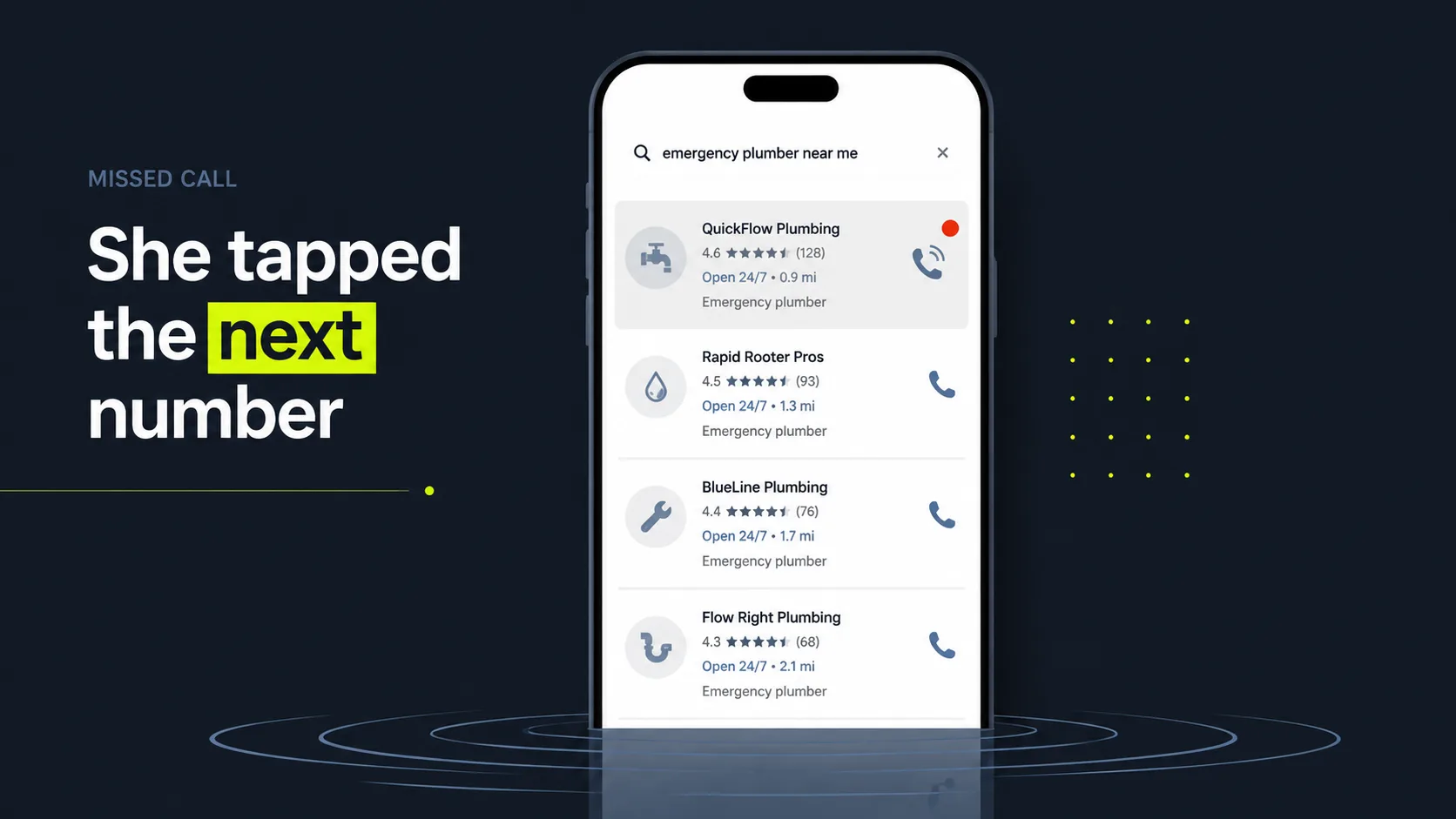
Go back to the flooded kitchen at 7:42. Somewhere right now, a homeowner is tapping the next number down because yours rang out. For most small businesses in 2026, the fix is a flat-priced AI voice agent that books jobs and escalates to a human when needed, with a live service like Ruby or Posh reserved for owners who want a person on every call. Want to see what your unanswered calls are actually costing? Book a free, no-pressure 20-minute call audit, and we'll map exactly where jobs are slipping and what capturing them would be worth. It takes 20 minutes, costs nothing, and the numbers are yours to keep either way.
Book a Free Call Audit or estimate lost revenue with the calculator.
Written and reviewed by Maksim Skorokhod, Founder of SkoreFlow, who builds AI answering and voice automation for small service businesses. Last reviewed: 2026-06-07.