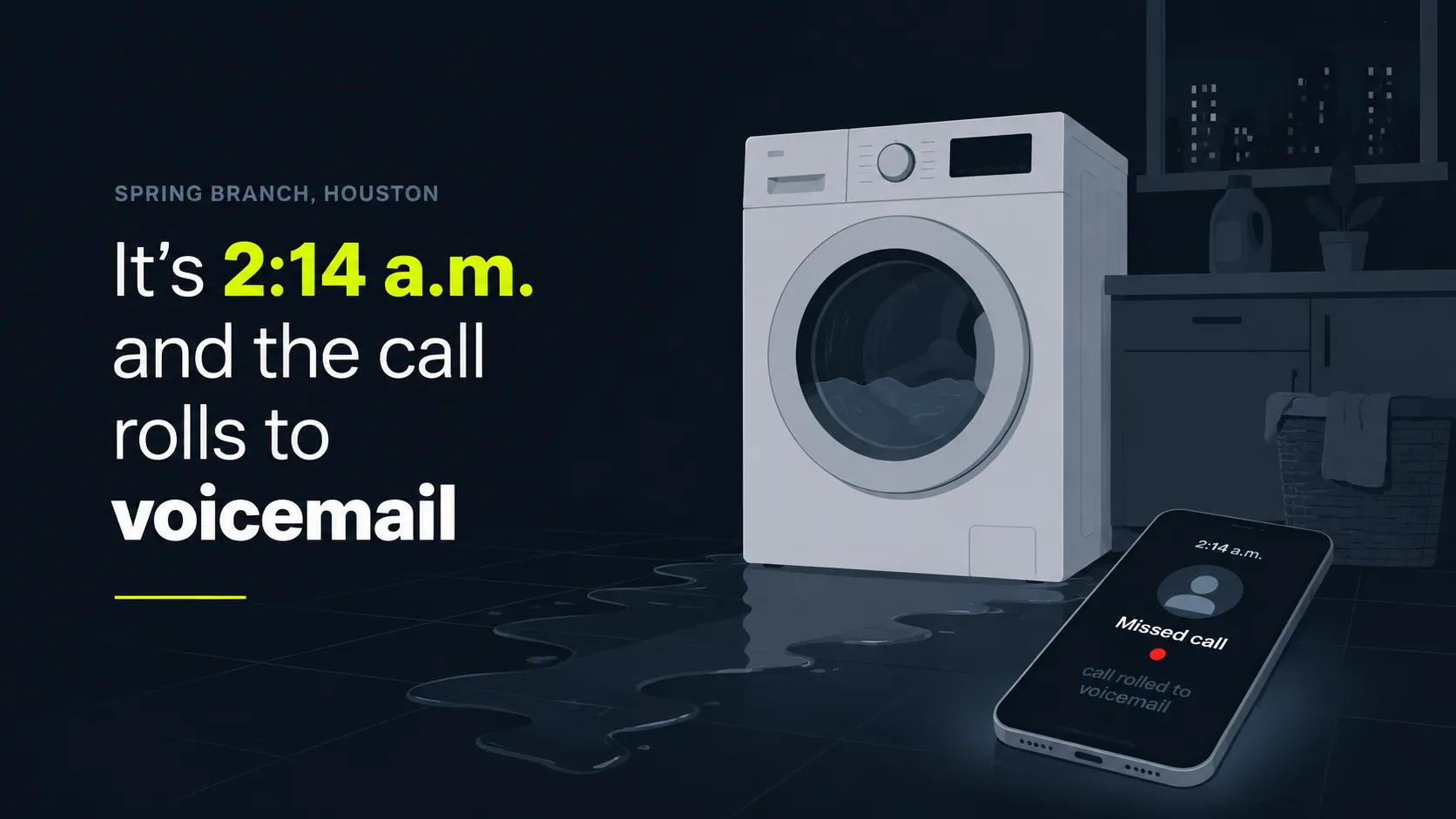
Why do Houston plumbers miss revenue calls?
Houston plumbers miss revenue calls because the phone rings hardest when the crew is already buried, and most callers won't try a second time. On average, small businesses answer only 37.8% of inbound calls with a live person, leaving roughly 62% unanswered, according to 411 Locals (2016). A missed emergency call in Houston isn't a delayed booking. It's usually a lost job.
Think about who is actually calling. Nobody phones a plumber to chat. They call because something is broken, often something spraying water, and they want it fixed now. That urgency is your advantage and your trap. The advantage: they're ready to book. The trap: if you don't answer, they don't wait. They move down the list while the panic is still hot.
The demand here doesn't keep office hours. Houston weather drives call spikes that land outside 9 to 5: a hard freeze cracks supply lines overnight, a storm floods a slab, a water heater quits on a Saturday. Across local businesses generally, 94% of Google Business Profile phone calls land Monday through Friday, but the after-hours share runs far higher in emergency trades, according to the BrightLocal Google My Business Insights Study (2019). Plumbing likely mirrors locksmiths, an emergency trade where 42% of calls arrive before 9 a.m. or after 5 p.m. in that same study. Treat that as a close analogy, not plumbing-specific data, but the after-hours pressure on any emergency trade is clear.
So what happens to the call you don't pick up? Most owners assume it lands safely in voicemail and they'll call back. It doesn't, and they won't. For home-services businesses, 27% of inbound calls go unanswered, and fewer than 3% of callers pushed to voicemail actually leave a message, according to Invoca (2024). A Houston homeowner standing in two inches of water isn't leaving a message and waiting by the phone. They tap the next listing and book there.
Speed decides who wins the job. Firms that respond within five minutes are 21 times more likely to qualify a lead than firms that wait 30 minutes, and roughly 100 times more likely to make contact, per Harvard Business Review (2011). When a panicked caller is dialing three Houston plumbers, the one that answers first books the work. Not the best-reviewed. Not the cheapest. The fastest.
Citation capsule: Only about 37.8% of small-business calls are answered live, per 411 Locals (2016), and 27% of home-services calls go unanswered with fewer than 3% leaving a voicemail, per Invoca (2024). Because firms responding within five minutes are 21x more likely to qualify a lead (Harvard Business Review, 2011), each missed after-hours call costs a Houston plumber a job to a faster shop.
Here's what we've seen in storm-prone markets: the worst call drops happen during the exact events that should be your biggest revenue days. A Houston freeze or a flooding rain doesn't politely call during business hours. It floods your line at midnight while your one on-call tech is already on a job. The shop that answers at that moment books the overflow the busy crew never even heard ringing. Which raises a fair question, the one every owner asks next: if I can't answer those calls, who can?
See how SkoreFlow's missed-call recovery books estimates for trades like plumbing, HVAC, and electrical, and what it takes to recover them.
How does it work? AI answers in your shop's voice and books the job
The AI voice agent answers on the first ring in your shop's voice and runs a structured script built for Houston plumbing, so it captures the same details your best dispatcher would, on every call, day or night. Because firms that respond within five minutes are 21 times more likely to qualify a lead than those waiting 30 minutes, per Harvard Business Review (2011), answering instantly is the single best move a plumbing shop can make.
Picture the same 2 a.m. call, handled right. The phone rings once. A calm voice using your shop's name answers, hears "water is pouring through my ceiling," flags it as an emergency, pins the Spring Branch address, and books the first open slot before the homeowner has time to dial anyone else. You wake up to a scheduled job, not a regret.
The call flow follows a consistent order:
- Greet in your shop's voice. The agent confirms your business name and asks what the caller needs (an emergency, a repair, a quote, or a question).
- Triage the urgency. It flags a burst pipe, an active leak, a sewer backup, or a dead water heater as an emergency versus a routine repair.
- Capture the service address. Street, unit, and Houston-area neighborhood or county, so the right tech gets routed to the right place.
- Capture the issue in the caller's words. The symptom, what's leaking, when it started, and any access notes, recorded for whoever rolls the truck.
- Answer routine questions instantly. Hours, service area, whether you handle a given job, and what to do right now (for example, where the main shut-off is) get answered with no hold.
- Check availability and book on Central Time. It offers open slots and schedules the job directly in ServiceTitan, Jobber, Housecall Pro, or Google Calendar, so the booking lands where your crew already works.
- Confirm and notify the crew. A clean summary of the address, issue, and urgency lands on your phone or in your software within seconds.
- Escalate when needed. A life-safety emergency, a commercial account, or anything outside the script gets routed to your on-call plumber per your rules.
In our experience setting up plumbing scripts, the quietest win is urgency triage paired with a clean address capture. When the agent separates "my faucet drips" from "water is pouring through my ceiling" and pins the exact Houston address before anyone calls back, your dispatcher stops guessing what to roll and when. Trucks get sent in priority order, and the genuine emergencies don't sit behind routine jobs. That one habit, sorting the gusher from the drip, is the difference between a frantic morning and a planned one.
Citation capsule: Firms that respond within five minutes are 21 times more likely to qualify a lead than those waiting 30 minutes, per Harvard Business Review (2011). A Houston plumbing agent that answers on the first ring triages urgency, captures the address and issue, and books the job on Central Time while the homeowner is still deciding which plumber to call.
| Response time | Relative odds of qualifying the lead |
|---|---|
| Within 5 minutes | 21x |
| After 30 minutes | 1x (baseline) |
Source: Harvard Business Review (2011)
Want the full picture? Read our complete plumber answering-service guide.
AI answering service vs Houston call centers and live virtual receptionists: which fits your shop?
The core trade-off is coverage versus headcount and cost: AI answers every Houston call instantly at a flat rate, while a live call center or virtual receptionist offers human voices at a premium, often metered per minute with limited after-hours capacity. Live virtual receptionist plans at one national provider run from $250/month for 50 minutes to $1,725/month for 500 minutes, per Ruby's pricing page (2026), which works out to roughly $3.45 to $5.00 per receptionist-minute.
All three beat voicemail. But "better than voicemail" is a low bar. What a Houston shop actually needs to know is which mix of cost, capacity, and after-hours coverage fits its call volume and emergency pattern. Here they are side by side.
| Factor | AI answering service for Houston plumbers | Houston live call center | Live virtual receptionist |
|---|---|---|---|
| Cost signal | AI receptionist tiers from ~$95/mo, per Smith.ai (2026); no per-minute fees | Often per-minute or per-call; varies widely | $250-$1,725+/mo at ~$3.45-$5.00/min, per Ruby (2026) |
| Speed to answer | First ring, no hold queue | May queue during call spikes | May queue; staffed agents on duty |
| After-hours coverage | 24/7 on Central Time, every day | Depends on the contract and staffing | Often business hours or an after-hours desk |
| Peak-spike capacity | Unlimited simultaneous calls during a storm or freeze | Limited by agents on shift; callers hold or drop | Limited by staffed receptionists |
| Job booking | Books directly into your calendar or dispatch | Usually takes a message for a callback | Books or messages, depends on plan |
| Local detail capture | Structured every call: address, issue, urgency | Varies by agent and briefing | Varies by agent and briefing |
| Consistency | Same triage and intake script every call | Varies by agent and shift | Varies by agent and shift |
| Best for | Busy crews, after-hours and emergency overflow, tight margins | Owners wanting a human desk with set hours | Owners wanting a human voice on routine calls |
One sharper distinction decides who books the freeze-night job. Traditional live receptionist services like Ruby take a message and leave you to call the homeowner back. By the time you do, they've already booked the plumber who picked up. A message is a promise to follow up. SkoreFlow's approach books the job on the call itself, so a freeze-night caller leaves the line with a scheduled estimate, not a sticky note someone might read in the morning.
Most Houston owners frame this as AI or human. We've found the better frame is AI plus human escalation. The AI catches the flood of freeze-night and weekend calls a live desk would have dropped or queued, then hands the genuine judgment calls, a commercial account or a life-safety situation, straight to your on-call plumber. You stop trading after-hours coverage for a human voice you can't staff at 2 a.m. You get both.
| Option | Pricing structure |
|---|---|
| AI receptionist (flat tier) | From ~$95/mo, no per-minute fees |
| Live virtual receptionist | $250-$1,725/mo, ~$3.45-$5.00 per minute |
Citation capsule: Live virtual receptionist plans cost roughly $3.45 to $5.00 per receptionist-minute, derived from Ruby's published 2026 pricing ($250/mo for 50 minutes to $1,725/mo for 500 minutes). AI answering tiers, starting near $95/month per Smith.ai (2026), let Houston plumbers cover every emergency and after-hours call for far less, with no per-minute fees.
What does it cost, and what is the ROI for a Houston plumbing shop?
Pricing spans a wide band, but the ROI math is simple: a handful of recovered jobs usually pays for months of coverage. Industry pricing for virtual receptionist services runs about $50-$300/month for AI and $300-$2,000+/month for human services, per CloudTalk (2025). SkoreFlow's missed-call recovery for trades sits inside that AI band, with plans from $197/month (Starter, up to 75 calls, $497 setup) to $397/month (Professional, up to 250 calls, $997 setup) and $697/month (Enterprise, unlimited, $1,497 setup). Against a single recovered water-heater replacement or after-hours emergency call, that monthly cost is a rounding error.
Do the math the way an owner would on a napkin. One missed water-heater replacement is hundreds of dollars of work, often more than a thousand. Miss two of those a month and you've lost more than the Professional plan costs all year. Now stack on the drain calls, the slab leaks, the freeze-night overflow. The cost of the service stops being the question. The cost of the calls you're already losing is the question.
The offer carries a results guarantee, not just a price. SkoreFlow's missed-call recovery promises 5 booked jobs in 30 days or your setup fee back, and it goes live in 48 hours, so a Houston shop sees recovered work fast rather than waiting on a long onboarding. You risk a setup fee you get back if it doesn't perform. The downside is capped. The upside is every after-hours job you've been quietly handing to the competition.
The return comes from the calls you currently lose. Recall the numbers: 27% of home-services calls go unanswered and fewer than 3% of voicemail callers leave a message, per Invoca (2024). Hiring a dedicated phone person instead means a median receptionist wage of $37,230 a year before benefits, per the U.S. Bureau of Labor Statistics (2024), and one person still can't answer the freeze-night rush at 2 a.m. The AI covers every Houston call around the clock for a fraction of that, and it never sleeps, never calls in sick, and never puts a panicked caller on hold.
Illustrative example (industry-based scenario, not a real client): Picture a 4-truck Houston plumbing shop missing about 12 calls a week while crews are on jobs and after hours. Over a year that's roughly 624 missed calls. The phone is a high-intent channel: 66% of small businesses rate inbound calls a good or excellent lead source, the top channel ahead of forms and email, per BIA/Kelsey (2014). In a US plumbing market worth $166.5 billion across roughly 127,324 businesses, per IBISWorld (2024), recovering even a few of those calls per week into booked jobs dwarfs an answering-service subscription. As a representative SkoreFlow benchmark scenario, a busy multi-truck trades shop that recovers its missed calls can lift its answer rate toward 94% and return on the order of $14,200 a month in otherwise-lost work. Treat that as an illustrative model, not a guaranteed or specific customer result. Run your own numbers with the calculator below.
Run the numbers yourself with our Missed Call Revenue Calculator.
Citation capsule: Virtual receptionist pricing runs about $50-$300/month for AI versus $300-$2,000+/month for human services, per CloudTalk (2025). With inbound calls rated the top lead source by 66% of small businesses (BIA/Kelsey, 2014) in a $166.5B US plumbing market (IBISWorld, 2024), recovering even a few missed Houston calls per week far outweighs the monthly cost.
| Line item | Estimate |
|---|---|
| AI answering service (annual) | ~$600-$3,600/yr ($50-$300/mo) |
| Missed calls for a 4-truck shop | ~12/week, ~624/year |
| Value of recovering even a few per week | Far exceeds the annual subscription |
What makes Houston different for a plumbing answering service?
Houston punishes plumbing shops with weather that arrives on no schedule, so the after-hours phone here is more revenue line than nuisance. Remember the locksmith pattern: 42% of emergency-trade calls land before 9 a.m. or after 5 p.m., per the BrightLocal Google My Business Insights Study (2019). In a metro where a single February freeze can crack supply lines across three counties in one night, that off-hours share is exactly when the money is on the table.
Think back to the 2 a.m. caller in Spring Branch. Multiply her by a few hundred on the worst freeze night of the year. A hard Texas freeze doesn't break one pipe. It breaks them across Harris, Fort Bend, and Montgomery counties at the same time, and every one of those homeowners is dialing at once. A single on-call tech with one phone physically cannot answer that surge. An AI agent can hold unlimited simultaneous calls, triage each one, and stack your schedule in booking order while your crew sleeps before the longest day of their year.
Local detail is the other Houston-specific edge. The agent works on Central Time and confirms the caller's neighborhood and county before booking, so a call from a flooded slab in Katy doesn't get routed like a routine drain in The Woodlands. It knows your service radius. It knows your hours. It captures the address in the caller's own words, the way a dispatcher who has worked your territory for ten years would. That local accuracy is what turns a chaotic storm night into a clean, sortable list of booked jobs.
Citation capsule: In emergency trades, 42% of calls arrive before 9 a.m. or after 5 p.m., per the BrightLocal Google My Business Insights Study (2019). For a Houston plumbing shop facing freeze and storm spikes across Harris, Fort Bend, and Montgomery counties, an AI agent that answers unlimited simultaneous after-hours calls on Central Time captures the surge a single on-call tech cannot.

Stop sending Houston jobs to voicemail
Go back to that laundry room in Spring Branch. The water is still rising, the phone is still ringing. The only thing that changes the ending is who picks up. The pattern in the data is hard to ignore: only about 37.8% of small-business calls are answered live, 27% of home-services calls go unanswered, and almost no one leaves a voicemail. A Houston answering service for plumbers closes that gap by answering every call 24/7 on Central Time, triaging urgency, capturing the address and issue, booking the job into your calendar, and texting back missed callers automatically.
You don't have to choose between turning jobs and answering the phone. Let the agent catch the freeze-night, storm, and weekend overflow across Harris, Fort Bend, and Montgomery counties, then route the commercial accounts and life-safety emergencies that need a human to your on-call crew. It goes live in 48 hours and is backed by a 5-booked-jobs-in-30-days-or-setup-refund guarantee, so the risk is on us, not you. Want to see what unanswered calls are costing you? Book a free, 20-minute call audit, no pressure, and we'll map where jobs are slipping and what capturing them would be worth.
Book a Free Call Audit, or estimate lost revenue with the Missed Call Revenue Calculator first.
Written and reviewed by Maksim Skorokhod, Founder of SkoreFlow, who builds AI answering and voice automation for small service businesses. Last reviewed: 2026-06-07. Questions? Visit our about page or contact us.