The call flow, step by step
An answering service handles a call through a repeatable sequence: the call forwards in, the agent greets the caller in your name, identifies why they called, qualifies the details, books or routes the request, and notifies your team. The reason this order matters is speed-to-answer. According to Invoca (2024), 27% of calls to home-services businesses go unanswered, and fewer than 3% of callers pushed to voicemail leave a message, so the call has to be caught and worked the first time.
Picture the loop as a relay. The baton is a worried caller, and every handoff has to be clean, or the runner drops out of the race. Every well-run service follows the same sequence, in this order.
- Forward. Your published business number forwards to the service, either always, only after hours, or only when you don't pick up within a set number of rings. You keep your number; the caller dials the same one as always.
- Greet. The agent or AI voice answers in your business name with the greeting you approved, so it sounds like your own front desk, not an outside call center.
- Find caller intent. The agent asks an open question (something like "How can I help?") and listens for why the person is calling: a new job, an existing appointment, a billing question, or an emergency.
- Qualify. Following your script, the agent collects the details you need: name, phone number, address or job type, the problem, and any qualifying questions you set, like service area or appointment preference.
- Book or route. If it's a bookable request, the agent schedules it straight into your calendar. If it needs you, the call is routed: warm-transferred to a person, flagged as urgent, or queued as a callback.
- Notify your team. The moment the call ends, your team gets the details by text, email, or a CRM entry, so the right person can act without replaying a voicemail.
That loop is short on purpose. So why does the order matter so much? Because the longer any step takes, the more likely the caller is gone. Harvard Business Review (2011) found firms that reach a lead within 5 minutes are 21 times more likely to qualify it, and roughly 100 times more likely to connect, than firms that wait 30 minutes. Twenty-five minutes is the gap between a booked job and a stranger who never calls back.
Now do the math on what slips through. Say your shop takes 30 calls a week and misses just a quarter of them, after hours and while your hands are full. That's 7 or 8 conversations gone, week after week. At a few hundred dollars a ticket, you're not losing calls. You're losing the down payment on a truck, every month, quietly, with nothing in the books to show it.

Citation capsule: Answering services exist because most calls go unworked otherwise. Invoca (2024) reports 27% of calls to home-services businesses are never answered, and under 3% of callers sent to voicemail leave a message, meaning a missed call is usually a lost job, not a delayed one.
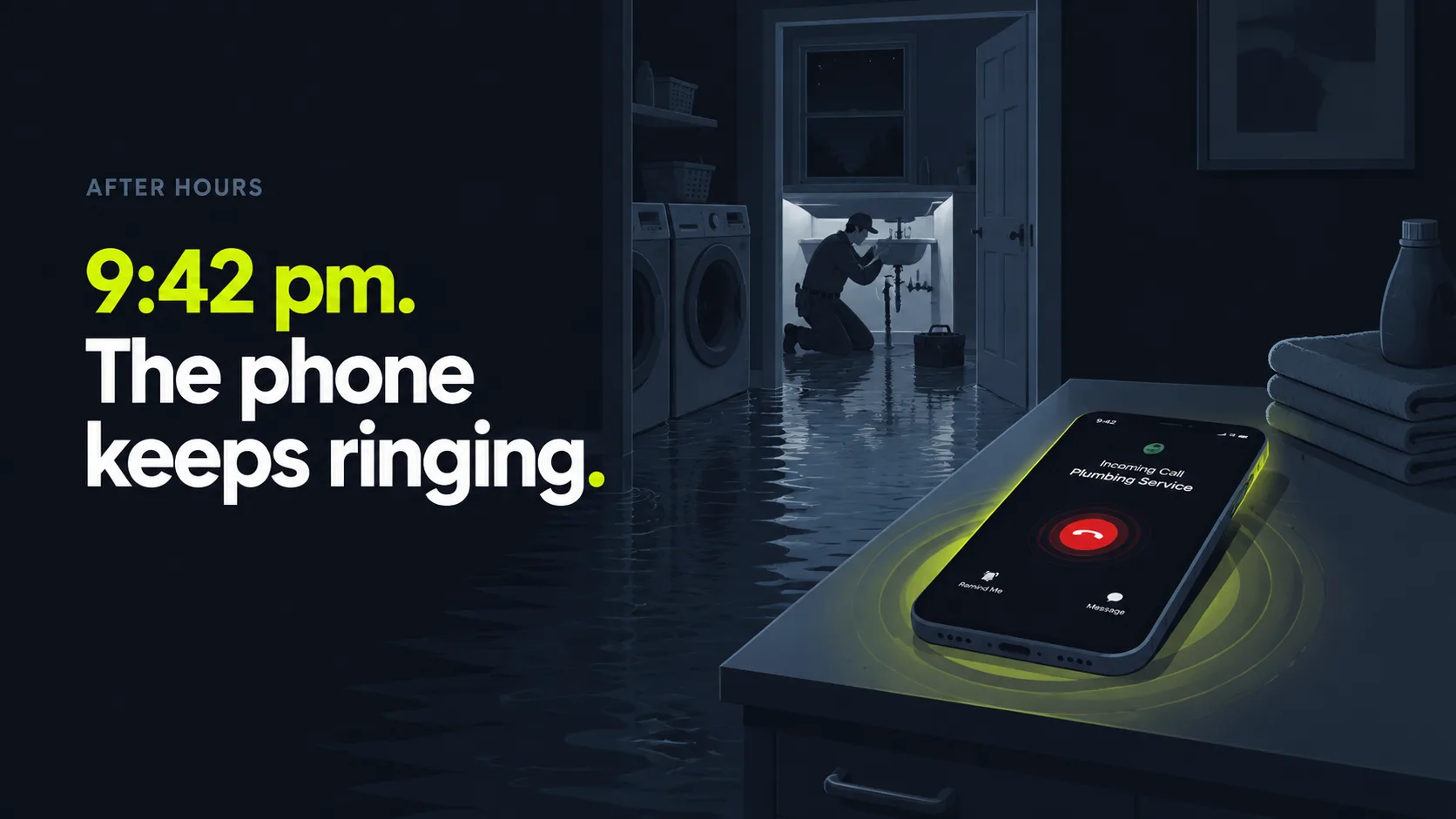
Illustrative example (industry-based scenario): Trace one after-hours call through this flow. A homeowner with a leaking water heater calls a 6-tech plumbing shop at 9:40 p.m. The line forwards to the service. An agent answers in the shop's name, hears the panic, learns it's an active leak, captures the address and the problem, books the first morning slot, and flags it urgent. The owner reads a text before he turns off the bedroom light, and sleeps fine. Run the same call without the service and it lands in voicemail that, per the data above, almost never gets a message, and almost never a callback. By breakfast the homeowner has called the next plumber on the list. For more on how callers get routed across receptionist types, see our guide to choosing a virtual receptionist.
What happens after the call?
After the call ends, the answering service turns the conversation into records your team can act on: a written transcript or summary, a calendar event for any booking, and a follow-up message sent to your staff or your CRM. This matters because voicemail loses the lead. Invoca (2024) found fewer than 3% of callers sent to voicemail leave a message, so the value is in capturing the details cleanly the first time, not in a recording nobody returns.
The call itself is over in a minute. What your business actually uses is the structured record it leaves behind, sitting in your phone before the caller has even hung up their jacket.
Transcript or call summary
The agent or AI produces a written record of the call: who called, their number, what they wanted, and what was promised. A live service types notes; an AI service generates a full transcript automatically. Either way, your team reads in seconds what used to take a voicemail playback, twice, with a pen, hoping the caller said their number slowly.
Calendar event
If the caller booked, the appointment lands directly on your calendar with the job type, time, address, and notes attached. No double entry, no "I'll call you back to confirm." The slot is held the moment the caller agrees to it, which is exactly the behavior callers now expect. A GetApp (2024) survey found nearly 70% of consumers would choose to book online or instantly when given the option, versus only 22% who'd choose to book by phone.
CRM or text follow-up
The final step pushes the record where your team already works: a text to the on-call tech, an email to the office, or a new lead in your CRM. Some services also send the caller a confirmation text. This closes the loop so nothing depends on someone remembering to check a voicemail box at 7 a.m. while pouring coffee.

Citation capsule: The after-call record exists to beat voicemail, not match it. Invoca (2024) found under 3% of callers sent to voicemail leave a message, so an answering service captures name, number, and intent during the call, then delivers it as a transcript, a calendar event, and a CRM or text alert.
Want to estimate the revenue tied to those recovered calls? Run the numbers with our missed-call revenue calculator. Most owners are surprised, and not in a good way, the first time they see the annual figure.
Live vs AI: where the process differs
The call flow is identical for both, but the engine differs: a live agent follows a written script and types what they hear, while an AI voice agent understands speech in real time and acts on it instantly. Consumer caution still shapes how AI is used. According to Gartner (2024), 64% of customers would prefer companies didn't use AI in customer service, which is why a clean path to a human stays essential in either model.
The split is less about the steps and more about how each step is handled. The table below shows how the same flow plays out two ways.
| Step in the flow | Live answering service | AI answering service |
|---|---|---|
| Greeting | Human reads your approved greeting | Voice agent speaks your greeting instantly, no hold |
| Understanding intent | Agent interprets, may ask to clarify | Real-time speech understanding, follows the conversation |
| Following your script | Reads and types from a script | Runs your script logic automatically |
| Hours covered | Limited by staffing and shift cost | 24/7 with no extra per-shift cost |
| Concurrent calls | One agent, one call | Many calls at once |
| Handoff to a human | Warm transfer to your team | Transfers or texts a human on trigger |
In our experience, the biggest practical difference shows up at 2 a.m. and during a storm rush. A live service queues calls behind whoever is on shift, so caller four hears hold music while your water-heater lead drips away. An AI agent answers every line at once and never sends a caller to hold. That matters, because patience is short: Nextiva (2025) found 54% of callers hang up after being on hold for up to eight minutes. Eight minutes. On a storm day, half the people trying to give you money won't wait that long.
So the question worth asking isn't "live or AI." It's "what happens to the caller you can't handle right now." A fixed script can capture a known request, but it can't reason through an odd one. The flip side of AI is trust: Gartner (2024) also found 53% of customers would consider switching to a competitor if they learned a company uses AI for service. We'll close that loop in the next section, because the design goal for both models is the same: answer instantly, and make reaching a person effortless when the caller needs one.
Citation capsule: Live and AI answering run the same call flow but differ at the engine. Gartner (2024) found 64% of customers would prefer companies didn't use AI in service, so the deciding factor is whether the service answers instantly and still offers an easy, fast handoff to a human.
To compare the receptionist types and pick one, see our guide on choosing a virtual receptionist.
Where is a human still needed?
A human is still needed whenever a call falls outside the script: a complex complaint, a sensitive judgment call, a negotiation, or anything the caller insists a person handle. That handoff is built into the model on purpose. Gartner (2024) reports the number-one consumer concern about AI in customer service is that it will get harder to reach a person, so a well-built service treats human handoff as a feature, not a fallback. That's the trust loop we opened above, and here's how a good build closes it.
There are clear moments where the flow should route to a real person rather than push through a script.
- Emergencies and urgent jobs. A burst pipe, a gas smell, or a no-heat call in January needs immediate human judgment and dispatch, not a queued message.
- Anything off-script. If a caller asks something the script doesn't cover, the agent should escalate rather than guess.
- High-stakes or emotional calls. Complaints, cancellations, and sensitive situations land better with a person who can adapt and de-escalate.
- Explicit requests. When a caller asks for a human, the service should connect them quickly. The fastest way to lose trust is to trap someone in a loop.
Why design it this way? Because the cost of getting it wrong isn't a bad call. It's a customer who's gone for good. Nextiva (2025) found that after a missed response window, 56% of customers immediately try another channel and 28% abandon the company entirely. More than a quarter don't call back, don't complain, don't give you a second chance. They just leave. Routing the right calls to a person keeps those people from walking out a door you didn't know was open.
Citation capsule: A human stays in the loop for anything off-script: emergencies, complaints, and explicit requests for a person. Gartner (2024) found the top consumer concern about AI in service is that reaching a human gets harder, so easy escalation is a core part of how the service should work.
How does SkoreFlow approach this?
SkoreFlow runs an AI voice agent through the same six-step flow above: it answers in 0.4 seconds in your business name, finds the caller's intent, qualifies them on your script, books the estimate into your calendar, and texts your team, with a built-in path to a human for anything urgent or off-script. The reason for that design is the patience gap. Nextiva (2025) found 54% of callers hang up after being on hold for up to eight minutes, so the agent never puts a caller on hold and answers concurrent calls at once.
The aim is simple. It books jobs, not messages. Unlike a service like Ruby that takes a message and leaves you to call back later, hoping the caller still cares, the agent qualifies and books the job on the call itself, while the homeowner is still standing in the water and ready to say yes. It plugs into the tools home-service trades already run, ServiceTitan, Jobber, Housecall Pro, and Google Calendar, and the setup is TCPA-aware. Most shops are live in 48 hours, with plans from $197 to $697 per month depending on call volume.
Here's the part that takes the risk off your shoulders. SkoreFlow backs the build with a guarantee: 5 booked jobs in 30 days or your setup fee is refunded. You don't have to believe the math, you just have to let it run for a month. And if you'd rather see what those missed calls are costing before you commit a dollar, you can Book a Free Call Audit, a 20-minute, no-pressure walkthrough of exactly where your calls are leaking and what they're worth. That's the whole loop, working whether it's noon or midnight, on the night you're under someone else's sink.