
Quick-verdict decision table: IVR vs AI voice agent
Here's the short version before the detail. According to Vonage, via SmallBizTrends (2019), 61% of consumers say IVR makes for a poor experience, while a conversational AI agent is designed to answer and book on the first call. The table below maps each system to the job it actually does well, so you can place your own business in seconds.
| Factor | IVR (phone menu) | AI voice agent |
|---|---|---|
| Core job | Routes and sorts calls | Answers, qualifies, and books |
| Caller experience | Press keys, navigate menus | Natural conversation |
| Captures a booking | No, transfers or takes a message | Yes, books on the call |
| After-hours coverage | Plays a message or voicemail | Answers and books 24/7 |
| Speed to answer | Instant menu, slow to a person | Instant, no menu |
| Cost per minute | Low (recording) but loses callers | Low, and converts callers |
| Best for | High-volume fixed routing | Lead capture and bookings |
Use this as a first cut. If your phone's job is to win work, the right column fits. If it's purely to sort thousands of calls into departments, the left column still earns its place. Which factor actually moves the money is the booking row, and the sections below back each one with data. For the mechanics, see how AI call handling works end to end.
What is an IVR and why do menus frustrate callers?
An IVR frustrates callers because it forces them to do the routing work, often through options that don't match why they called. According to Vonage, via SmallBizTrends (2019), 63% of consumers cite irrelevant menu options as the single most frustrating IVR issue, and 85% have abandoned at least one IVR call. The menu was designed for the business's convenience, not the caller's.
Here's the core mismatch. A menu and a caller want two different things. An IVR is a switchboard. Its job is to sort calls into buckets as cheaply as possible. But a caller doesn't want a bucket. They want an answer or an appointment, and they want it now. Every layer of "press 1, now press 4, now hold" stacks one more wall between the caller's intent and the outcome they came for. And adoption is still enormous, which is why the friction is everywhere. According to Unitel Voice (2025), 85.8% of Fortune 500 companies run an IVR or auto attendant.
Why menus lose callers in practice
Menus leak in a few predictable ways. The options rarely match the caller's exact need, so they guess or zero out. Each layer adds time, and patience is short. And the menu can't actually do anything: it forwards, or it takes a message. When the forwarded line is busy or after-hours, the caller hits voicemail. Almost nobody leaves one. According to Invoca (2024), fewer than 3% of callers pushed to voicemail actually leave a message.
In our experience setting up phones for service businesses, the menu depth is where owners bleed the most callers without ever seeing it happen. A two-layer menu looks organized on a whiteboard. On a live call, each "press a number" step is a doorway the caller can walk out of, and a chunk of them do. First-time callers leave fastest, because they don't even know which option fits their burst pipe or dead furnace. We've found that flattening to a single conversational answer, no menu at all, recovers calls that a tidy tree was quietly dropping.
Citation capsule: Phone menus frustrate callers by making them do the routing work through options that rarely fit their reason for calling. The Vonage IVR survey, via SmallBizTrends (2019), found 63% of consumers cite irrelevant menu options as their most frustrating IVR issue, and 85% have abandoned at least one call after hitting an IVR system.

Many service businesses solve this by getting a dedicated number an AI agent answers instead of a menu.
How do IVR and AI voice agent costs compare?
On raw per-minute cost both are cheap, but the real comparison is cost per captured customer, and that's where an AI agent pulls ahead. An IVR recording costs almost nothing to play, yet it loses callers. An AI agent costs a few dollars per session and converts them. For context on live alternatives, Ruby (2026) prices human virtual receptionists at roughly $3.45 to $5.00 per receptionist-minute.
An IVR's low sticker price hides a high abandonment cost. AI receptionist software sits far below live-human pricing while doing the one thing an IVR can't, which is finish the call. According to Smith.ai (2026), AI receptionist plans run from about $95/month (starter) to $800/month (pro, around 15 calls/day). Compare that to the in-house option. The U.S. Bureau of Labor Statistics puts the median receptionist wage at $17.90/hour, or about $37,230/year before benefits, per BLS (2024).
| Option | Typical cost | What you actually get |
|---|---|---|
| IVR menu | Very low (recording + minutes) | Routing only; loses callers to abandonment |
| AI voice agent | ~$95-$800/mo (Smith.ai, 2026) | 24/7 answering plus booking |
| Live virtual receptionist | ~$3.45-$5.00/min (Ruby, 2026) | Human answering, limited hours |
| In-house receptionist | ~$37,230/yr (BLS, 2024) | One person, business hours only |
Now think about it like an owner, not an accountant. The cheapest line item on your phone bill is often the most expensive part of your business. An IVR looks like a win because the recording is nearly free. But the number that matters isn't the per-minute rate. It's the per-lost-customer rate. A system that costs ten cents a call and drops a quarter of your callers is far pricier than one that costs a few dollars and books them. So stop pricing the menu. Price the jobs the menu throws away, which is almost always a much bigger figure than the bill.
Citation capsule: On per-minute price an IVR is cheaper than an AI agent, but the AI agent captures bookings the IVR loses. AI receptionist plans run roughly $95 to $800/month, per Smith.ai (2026), versus a live receptionist at about $3.45 to $5.00 per minute, per Ruby (2026), and an in-house hire at roughly $37,230/year, per BLS (2024).

Want a real number? Use the Missed Call Revenue Calculator to estimate what your missed and abandoned calls are worth.
Does it capture the booking or just route the call?
This is the dividing line, and it isn't close: an IVR routes, an AI voice agent books. A menu's only outputs are "transfer" or "leave a message," and neither captures the job when the line is busy or closed. An AI agent qualifies the caller and schedules the appointment on the spot, which matters because phone calls are high-intent. According to BIA/Kelsey (2014), 66% of SMBs rate inbound phone calls their best lead source, ahead of every other channel.
The booking gap compounds with how few callers will wait or call back. When an IVR forwards to a line nobody answers, the caller lands in voicemail, and most just leave. According to 411 Locals (2016), small businesses answer only 37.8% of inbound calls with a live person, with roughly 62% going unattended. An IVR doesn't fix that. It often feeds it. An AI agent closes it by answering and booking every time, no human needed for the routine call.
What "captures the booking" looks like
A booking-capable agent does four things an IVR can't. It asks why the caller is calling in plain language. It checks real-time availability. It confirms and writes the appointment to your calendar. And it can take details for a callback when a human is genuinely the right answer. Speed is the multiplier. According to Harvard Business Review (2011), contacting a lead within 5 minutes makes you about 21x more likely to qualify it than waiting 30 minutes. An instant-answer agent banks that edge on every call. A menu plus a callback throws it in the bin.
Citation capsule: The dividing line between the two systems is the booking. A menu can only transfer a call or take a message, while an AI voice agent qualifies the caller and schedules on the spot. That matters because inbound phone calls are SMBs' top-rated lead source, with 66% rating them good or excellent, per BIA/Kelsey (2014), ahead of forms, in-person, and email.

See exactly how an AI call center voice agent books and qualifies callers on the first call.
After-hours, speed-to-answer, and abandonment: how do they differ?
An IVR answers instantly but stalls there; an AI voice agent answers instantly and finishes the job, day or night. The two diverge most after hours and under impatience. According to Nextiva (2025), 75% of callers hang up after being on hold for eight or more minutes, and 56% immediately try another channel after a missed response window. A menu that ends in hold or voicemail walks straight into both behaviors.
After-hours is where the gap turns into lost revenue. A large share of service calls land outside 9-to-5, and an IVR's after-hours answer is a recording talking to an empty room. According to the BrightLocal Google My Business Insights Study (2019), based on 45,264 local businesses, restaurants receive 51% of their calls after 5pm, and other service verticals see heavy evening and weekend demand. An AI agent treats 8pm the same as 8am: it answers, qualifies, and books. The IVR, at best, invites a voicemail that, per Invoca (2024), fewer than 3% of callers will leave.
Where callers actually leak
Callers slip away at three distinct moments. After-hours, the IVR plays a message while the AI books the appointment. On hold or in a deep menu, the IVR loses the impatient caller while the AI never makes them wait. And on the callback gamble, the IVR hopes the caller tries again while the AI already captured them. Self-reported abandonment confirms the cost. According to the Vonage IVR survey, via SmallBizTrends (2019), consumers say they have abandoned an average of 27% of calls because they hit an IVR.
Across the phone setups we've built for service businesses, the after-hours window is where the IVR-versus-agent gap is most visible. Owners assume the bulk of calls land during staffed hours. Then they read the call logs and find a steady evening and weekend stream the old menu was quietly shunting to voicemail. The pattern is consistent: the calls were always arriving. The menu was just converting them into missed opportunities. Switching the after-hours answer from a recording to a booking agent is the single change that surfaces the most hidden revenue.
Citation capsule: Both systems answer instantly, but only the AI agent completes the call after hours and sidesteps the hold-and-voicemail trap. According to Nextiva (2025), 75% of callers hang up after eight or more minutes on hold and 56% immediately try another channel after a missed response window, behaviors a menu walks straight into.

Curious what those off-hours calls add up to? The Missed Call Revenue Calculator estimates your after-hours and abandoned-call recovery.
When is an IVR still the right call, and when does an AI agent win?
An IVR still earns its place in high-volume, fixed-routing environments; an AI voice agent wins almost everywhere lead capture and bookings matter. So ask one thing: is your phone's job to sort calls or to win work? For most small service businesses it's the latter, which is why the consumer signal points toward conversation. According to GetApp (2024), nearly 70% of consumers would choose to book a service online versus only 22% by phone, and an AI agent brings that self-serve ease to the call itself.
Use the two lists below to place your business. They're written as decision triggers, not vague pros and cons.
When an IVR is still the right call
- Very high call volume with simple, fixed routing. Large switchboards moving thousands of calls into a handful of departments.
- Strict, unchanging menu paths. When every caller genuinely needs one of three or four fixed destinations and nothing else.
- Compliance or legacy constraints. Regulated phone flows or systems that can't yet integrate a conversational layer.
- Pure transfer, no task. When the phone's only job is to forward to the right human and never to complete anything.
When an AI voice agent wins
- You want to book jobs, not just route calls. Any business where the call should end in an appointment or qualified lead.
- You miss calls after hours or while on jobs. Trades, clinics, and shops where the phone rings when nobody's free.
- Callers hate your current menu. If abandonment or complaints are showing up, conversation beats a tree.
- Each call is worth real money. High-ticket verticals where one captured job pays for the system many times over. According to Housecall Pro platform data (2025), drawn from roughly 2 million jobs and summarized by ACHR News, the average HVAC repair ticket (revenue per repair/service job) rose to about $1,205 in 2025, up from around $818 in 2021.
Now the honest objection, because it's a fair one: some callers are wary of AI on the phone. According to Gartner (2024), 64% of customers would prefer companies didn't use AI in customer service, and their top fear is that reaching a real person gets harder. But read that fear closely. The answer isn't to keep the menu. It's to deploy an agent that sounds natural and hands off to a human the moment someone asks. A phone menu is the exact experience that fear is really about. The menu is the thing people dread. The agent is the fix.
Citation capsule: An IVR fits high-volume, fixed-routing switchboards; an AI voice agent wins wherever bookings and lead capture matter. Consumer behavior favors conversation: according to GetApp (2024), nearly 70% of consumers would choose to book a service online versus only 22% by phone, and an AI agent brings that self-serve ease into the call.

For most small operators, the better move is to get an AI-answered phone number without changing your line.
How SkoreFlow replaces the menu with a conversation
SkoreFlow replaces a rigid IVR with a conversational voice agent that books jobs, not messages. It answers in 0.4 seconds, qualifies the caller, books the estimate, and hands off to a person when needed. No menu tree to navigate. No after-hours voicemail dead end. That's the line between SkoreFlow and an answering service like Ruby, which takes a message and leaves you to call back. It addresses why menus lose work head-on: according to the Vonage IVR survey, via SmallBizTrends (2019), 51% of consumers have abandoned a company because of its IVR.
Built for home-service trades like plumbers, HVAC techs, and electricians, the agent goes live in 48 hours and works with the tools you already run: ServiceTitan, Jobber, Housecall Pro, and Google Calendar. Setup keeps your existing number in nearly all cases, so callers reach the same line and simply get a conversation instead of a menu. The agent asks why the caller is calling, checks availability, and books, or warm-transfers to your team when a human is the right answer. That easy human path defuses the top AI objection, that reaching someone gets harder, per Gartner (2024). The service is TCPA-aware, plans run from $297/mo to $897/mo plus setup, and it's backed by a guarantee: 5 booked jobs in 30 days or your setup fee back.
Illustrative example (industry-based scenario, not a real client): Picture a service business taking about 1,000 calls a month behind an IVR with a 25% abandonment rate. That menu drops roughly 250 callers a month, the same range consumers self-report abandoning at IVRs, per the Vonage IVR survey, via SmallBizTrends (2019). Now do the math on the recovery. Convert even 30% of those rescued callers, about 75 jobs, at a representative ticket of $1,205 for an HVAC repair, per Housecall Pro platform data (2025). That models roughly $90,000 a month in revenue the menu was leaking, before a dollar of cost savings. Representative recovery benchmarks for trades land near a 94% answer rate and roughly $14,200 a month recovered. Plug your own call volume and ticket into the calculator to see your number, not ours.
Citation capsule: Instead of a menu tree, SkoreFlow puts a conversational AI voice agent on the line: it books jobs, not messages, answering, qualifying, booking, and handing off to a human on request, usually on your existing number. The case is direct. The Vonage IVR survey, via SmallBizTrends (2019), found 51% of consumers have abandoned a company over its IVR, and a conversation is what a menu can't offer.
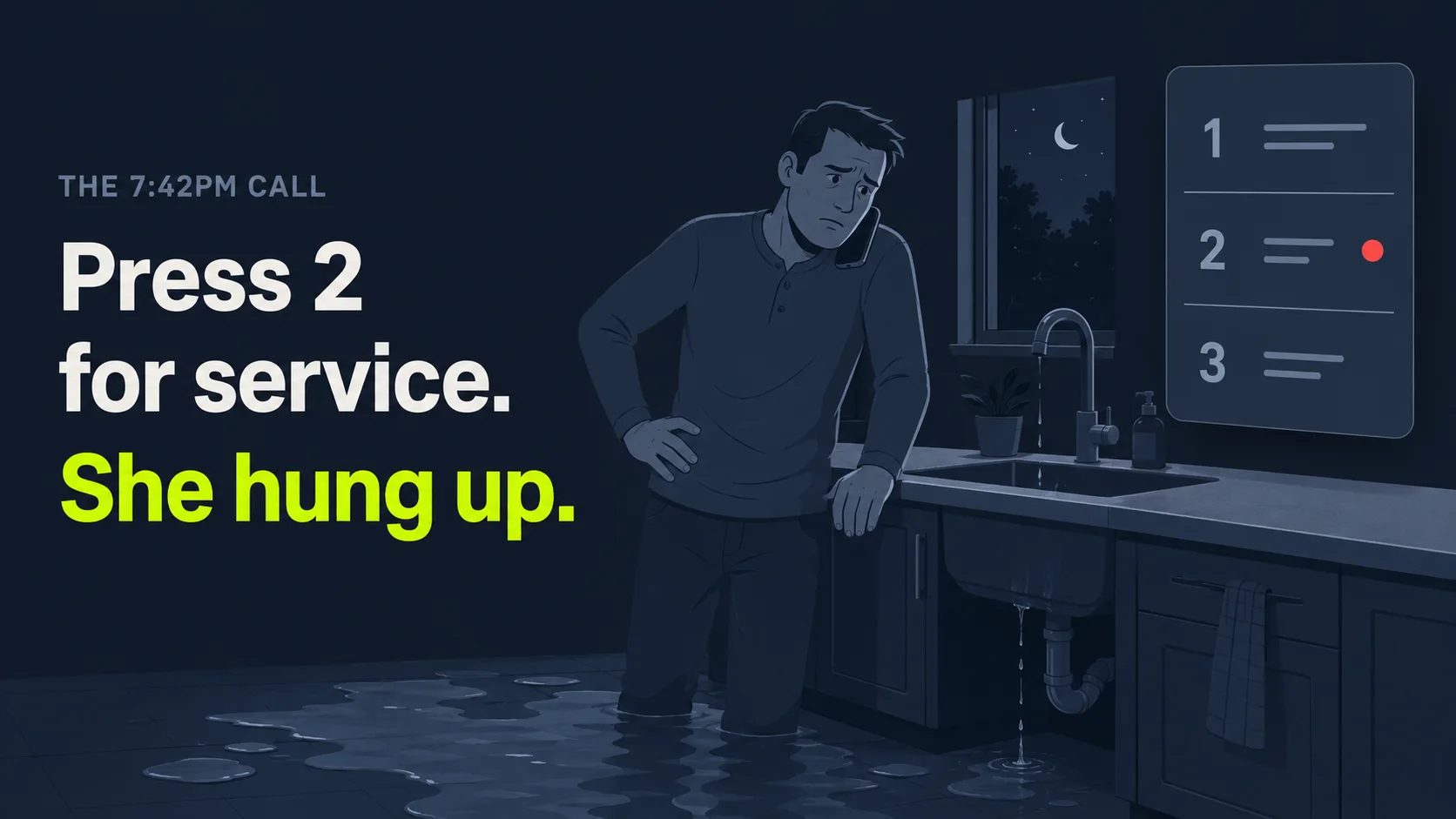
Take a closer look at how the call-recovery voice agent answers, books, and escalates calls, then book a free Call Audit, a 20-minute, no-pressure review of where your phone is leaking work. Remember the homeowner standing in the flooded kitchen at 7:42pm? On a SkoreFlow line, her call ends with a booked appointment, not a hang-up.