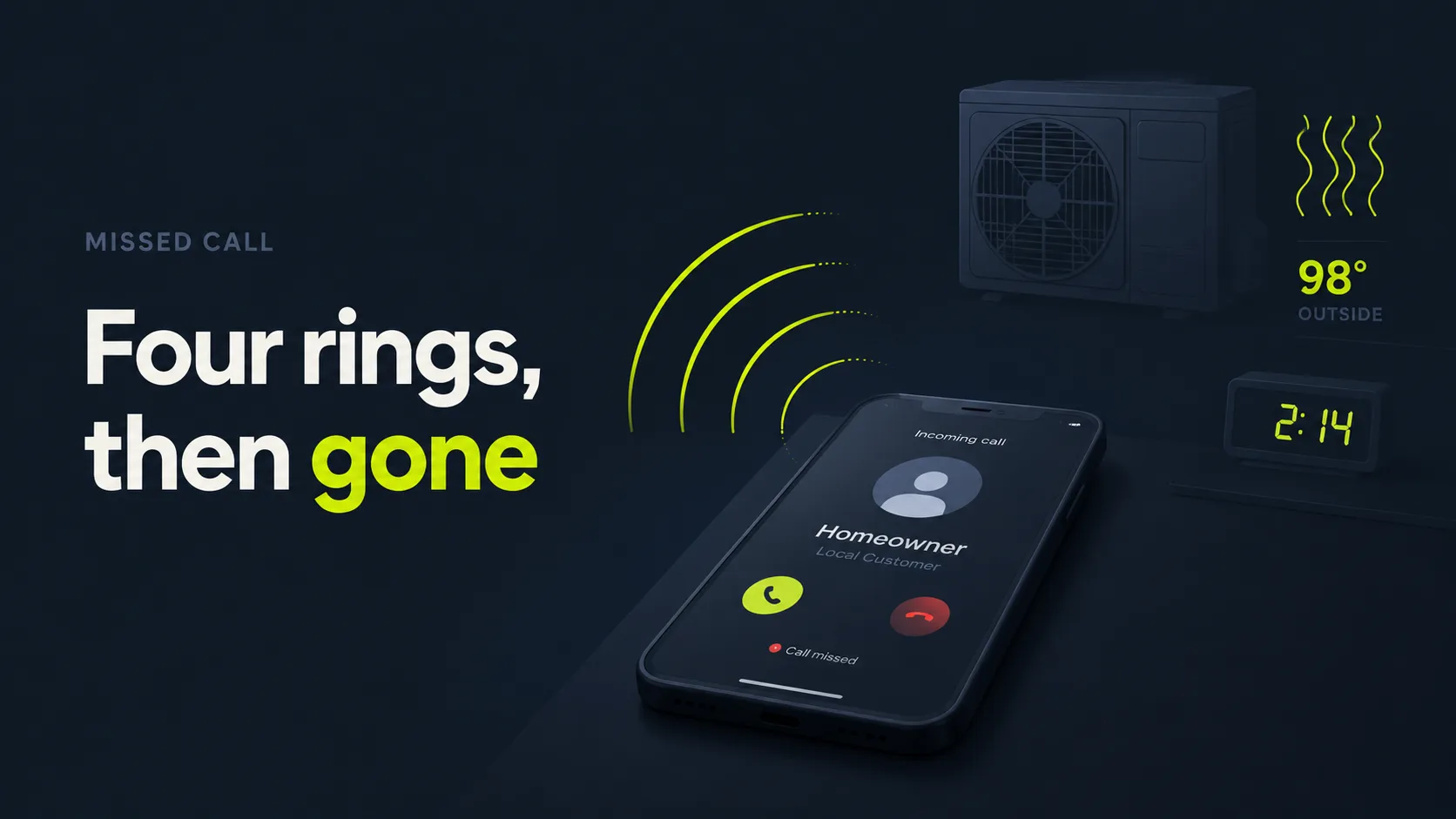
Why do HVAC companies lose money to missed calls?
HVAC companies lose money on missed calls because most unanswered calls never call back, and voicemail recovers almost nothing. According to Invoca (Invoca, 2024), 27% of calls to home-services businesses go unanswered, and fewer than 3% of callers pushed to voicemail actually leave a message. The missed call is usually a lost job.
Think about how a homeowner with no heat in January actually behaves. They aren't filling out a contact form. They aren't waiting for a callback. They're scrolling the first three results on Google and booking with whoever picks up. That urgency is the whole reason a missed HVAC call hurts more than a missed call in almost any other business.
Now look at the size of the leak, because it's worse than most owners guess. A 30-day audit of small businesses across 58 industries found only 37.8% of inbound calls were answered live, with roughly 62% going to voicemail or no response at all (411 Locals, 2016). The study is older and directional. The pattern in field services hasn't moved: ring, no answer, next company.
Here's the part that turns a missed call into a dead lead. Speed decides everything. Firms that contact a lead within five minutes are 21 times more likely to qualify it than firms that wait 30 minutes, and about 100 times more likely to reach the person at all (Harvard Business Review, 2011). More recent platform data agrees: conversion runs roughly 8 times higher inside the first five minutes, yet only 0.1% of leads get engaged that fast (InsideSales/XANT, 2021). So a same-day callback isn't a save. It's usually a callback to someone who already booked your competitor.
So where do all those inbound home-services calls actually go? Roughly 27% never get answered, and fewer than 3% of callers pushed to voicemail bother leaving a message (Invoca, 2024). The rest simply call the next shop. We'll put a real dollar figure on that in a moment.
Citation capsule: Missed calls leak revenue because callers rarely try again. Invoca's call-tracking data shows 27% of calls to home-services businesses go unanswered, and under 3% of callers sent to voicemail leave a message (Invoca, 2024). For HVAC shops, an unanswered ring usually means the job goes to a competitor.
Want the deeper economics behind this? See our breakdown of how missed calls cost home-service businesses.
What a single missed HVAC call is worth
The dollar math is steep because HVAC tickets are large. The average HVAC repair ticket rose from about $818 in 2021 to roughly $1,205 in 2025 across HVAC businesses on the Housecall Pro platform (Housecall Pro, 2025). At those numbers, a few missed calls a week stop being a nuisance and start being a payroll line you're throwing away.
Let's actually do the math, because the abstract version never lands.
Illustrative example (industry-based scenario, not a real client): Picture a 6-tech HVAC shop during a heat wave, missing 15 calls a week with every truck booked solid. Say a third of those callers would have booked. That's 5 lost jobs a week. At the 2025 average repair ticket of about $1,205, you're watching roughly $6,025 walk out the door every week. Stretch that across a 12-week cooling season and you're near $72,000 gone, not to slow sales, not to a bad market, but to a phone nobody could reach in time. Your close rate and ticket mix move the number. The direction never changes.
Seventy-two thousand dollars. From rings. That's the gap this page exists to close.
How does SkoreFlow book no-heat, no-AC, and maintenance calls for HVAC shops?
SkoreFlow books HVAC calls by answering instantly, asking the right questions, and writing the appointment into your schedule, no human required. Because phone calls are HVAC's top-rated lead source, with 66% of SMBs calling them a good or excellent source of leads (BIA/Kelsey, 2014), answering each one matters more than almost any marketing spend you've got.
Picture the same 2:14 call, but answered. The phone rings once. A warm voice says your company name and asks how it can help. The homeowner says the AC died and the house is at 88 degrees. Thirty seconds later they have a same-day slot, your tech has the unit's brand and age, and you have a booked job. Here's the call flow that gets you there, step by step:
- Answer on the first ring, 24/7. No hold music, no phone tree. The AI voice agent greets the caller by your company name and starts a real conversation.
- Triage the urgency. It asks what's happening: no heat, no cooling, strange noise, or routine maintenance. A no-heat call in winter gets flagged as an emergency and routed accordingly.
- Capture equipment details. It collects the system type, brand, model, and approximate age so your tech rolls up prepared, not guessing.
- Confirm address and access. It verifies the service address, gate codes, and the best contact number before anything gets booked.
- Book the appointment. It offers real open slots from your calendar and locks in the time the customer picks.
- Offer the maintenance plan. Where it fits, it mentions your tune-up or membership plan and signs interested callers up on the spot.
- Sync and notify. The booking flows into your scheduling software (ServiceTitan, Jobber, Housecall Pro, or Google Calendar) and your team gets an instant text or email with the full call summary.
Routine and urgent calls take different paths, and that's the point. A tune-up books into a normal window. A no-cool emergency in July can trigger an immediate alert to your on-call tech or a same-day priority slot. You set the rules once. The agent applies them on every single call, day or night, without ever having a bad day.
One more thing owners always ask about: speed and setup. SkoreFlow gets a trades shop live in about 48 hours, and call handling is built TCPA-aware. The agent answers in roughly 0.4 seconds, filters spam, qualifies the caller, and books the estimate. It doesn't take a message and leave you a callback list. That single difference, booked job versus chase-list, is the whole game in HVAC.
Citation capsule: Inbound phone calls are HVAC's most valuable lead channel: 66% of small and mid-sized businesses rate phone calls a good or excellent lead source, ahead of online forms and email (BIA/Kelsey, 2014). An AI agent that answers and books every call captures that high-intent demand.
For a closer look at the call-handling steps, read our guide to the AI booking workflow for field-service trades.
How do you handle seasonal call spikes and peak-day overflow without hiring?
You handle HVAC seasonal spikes by adding answering capacity that scales instantly, instead of hiring staff you can't justify off-season. Call volume is rising structurally on top of the seasonal swing: repairs per organization grew about 65%, from 103 a year in 2022 to over 170 a year in 2025 on the Housecall Pro platform (Housecall Pro, 2025). More jobs means more calls, and they all crash in on the same few days.
The seasonal problem is brutal for HVAC specifically. The first 95-degree week of summer and the first hard freeze of winter both detonate your phone at the same hour, in the same neighborhoods, all at once. A single receptionist who is calm and capable in May gets buried by 10 a.m. in July. And the callers who hit a busy signal or voicemail don't wait around. Over half of callers hang up after eight minutes on hold (Nextiva, 2025), and during a heat wave their patience runs a lot shorter than eight minutes.
An AI answering service has no capacity ceiling. Five calls an hour or fifty, every caller is answered on the first ring at the same instant. There's no overflow queue. No temp staff to recruit in June and lay off in October. No overtime line on the August schedule. You pay a flat monthly rate that doesn't spike with your call volume, ever.
Here's a point most shops miss, and it's the one that actually changes the math. Most HVAC owners staff for their average week and quietly write off the losses on peak days. That's exactly backwards. Peak days are when demand, urgency, and ticket sizes all run highest at once, so they are the single worst days on the calendar to miss a call. Flat-rate AI answering flips the model on its head: your capacity is biggest precisely when the money is biggest, and it costs the same in the dead of spring as it does at the height of August. [UNIQUE INSIGHT]
After-hours coverage is the other half of the same fix. Local businesses take about 94% of their Google Business Profile calls Monday to Friday, leaving roughly 6% on weekends, and call timing varies sharply by industry (BrightLocal, 2019). For HVAC, a no-heat night or a Saturday no-cool emergency doesn't keep office hours. A 24/7 agent books the call your voicemail would have quietly lost by Monday morning.
Peak-season checklist
- Set your emergency triage rules (no-heat, no-cool, gas smell).
- Confirm the CRM and calendar sync before your busy season starts.
- Enable after-hours booking so weekend emergencies convert.
- Turn on maintenance-plan offers for every relevant call.
Citation capsule: HVAC call volume keeps climbing: repairs per organization grew roughly 65%, from 103 per year in 2022 to over 170 per year in 2025 on the Housecall Pro platform (Housecall Pro, 2025). AI answering scales to peak-day surges instantly, with no seasonal hiring.
Run a different trade? We cover the same playbook in our missed-call recovery hub for trades.
AI vs. traditional answering service for HVAC companies: what's the difference?
The core difference is that an AI answering service answers every call instantly at a flat rate, while a traditional human service charges per minute and still puts callers on hold during surges. Live human answering runs roughly $1.50 to $1.75 per minute at many providers (AnswerConnect, 2025), so your bill climbs at the exact moment your call volume does.
Both options beat voicemail. But they behave like different animals on a peak HVAC day, when volume and emergency stakes are both at their highest. The table below lays out how they stack up on the factors a shop owner actually cares about.
| Factor | AI answering service (SkoreFlow) | Traditional human answering service | In-house receptionist |
|---|---|---|---|
| Availability | 24/7, every call, instantly | Often 24/7, but calls queue at peak | Business hours only |
| Peak-day capacity | Unlimited, no hold queue | Limited by staffed agents on shift | One person, hard ceiling |
| Pricing model | Flat monthly, no per-minute fees | ~$1.50-$1.75/min, scales with volume (AnswerConnect, 2025) | ~$37,230/yr base + benefits (BLS, 2024) |
| HVAC knowledge | Trained on your equipment, plans, and triage rules | Generic script, often industry-agnostic | Knows your shop, but only one at a time |
| Equipment data capture | Brand, model, age every call | Depends on script and agent | Yes, if not slammed |
| CRM booking | Books directly into your calendar/CRM | Usually message-taking, then a callback | Manual entry |
| Consistency | Identical on call 1 and call 50 | Varies by agent and shift | Varies with workload and PTO |
A few honest trade-offs are worth naming out loud. Some callers still want a human voice, full stop. In a Gartner survey, 64% of customers said they'd rather companies didn't use AI in customer service (Gartner, 2024). That's exactly why a good AI agent sounds natural and hands off to a person on request, instead of trapping callers in a loop they can't escape.
In our experience setting these up for trades, the deciding factor isn't AI versus human in the abstract. It's this: a human service still queues callers when twelve phones light up at once, and an HVAC emergency caller will not sit in that queue. AI answering deletes the queue entirely. That, more than anything else, is what wins the comparison for shop owners. [PERSONAL EXPERIENCE]
There's a second difference worth naming, and it's the one that closes the gap between "answered" and "booked." Message-taking answering services, Ruby being a well-known one, capture the caller's details and leave you to call back. SkoreFlow qualifies and books the estimate on the call itself. For an HVAC shop, a booked job beats a callback list every time, because by the time you dial back, the caller's air conditioner is already getting fixed by someone else.
Citation capsule: Traditional human answering services typically charge $1.50 to $1.75 per minute, so costs rise with call volume (AnswerConnect, 2025). A flat-rate AI answering service holds price steady through peak HVAC season while answering every call instantly.
Want the numbers side by side? Read our full cost comparison of answering services.
What does an HVAC answering service cost, and how does the ROI work?
An AI HVAC answering service runs on a flat monthly plan, well below the cost of a full-time receptionist, whose base wage alone averages $37,230 a year before benefits and payroll taxes (BLS, 2024). The ROI case is almost embarrassingly simple: one or two recovered jobs a month usually cover the entire bill.
Start with the going rates, so the price has context. Live human virtual-receptionist plans commonly run from a few hundred dollars to nearly $2,000 a month depending on minutes. One national provider lists $250 for 50 minutes up to $1,725 for 500 minutes (Ruby, 2026). AI receptionist software sits well under that, with published tiers from roughly $95 to $800 a month (Smith.ai, 2026). Industry aggregators put AI plans around $50 to $300 a month against $300 to $2,000-plus for human-staffed services (CloudTalk, 2025).
SkoreFlow sits squarely in that flat-rate AI band. Plans run $197/mo (Starter, up to 75 calls, $497 setup), $397/mo (Professional, up to 250 calls, $997 setup), and $697/mo (Enterprise, unlimited calls, $1,497 setup). Setup takes about 48 hours. And the plan is backed by a guarantee: 5 booked jobs in your first 30 days or your setup fee comes back to you.
Now hold that price up against a single HVAC ticket. The average repair ticket is about $1,205 (Housecall Pro, 2025). So a Professional plan at $397 a month is paid for, in full, the moment the agent books one job that would otherwise have hit voicemail. Recover two, and the rest is profit. The expensive option here was never the answering service. It's the missed call.
The cleanest way to size your own number is to plug in your real call and ticket data. Use our Missed Call Revenue Calculator to estimate what unanswered calls cost your shop each season, then set that figure next to a flat monthly plan and decide for yourself.
To frame the spread one more way: AI answering plans tend to run about $50 to $300 a month, while human-staffed services land between $300 and $2,000-plus (CloudTalk, 2025). And that gap only widens on a busy HVAC day, when per-minute human plans climb right along with your volume.
Citation capsule: Hiring an in-house receptionist costs about $37,230 a year in base wages alone, before benefits and overhead (BLS, 2024). A flat-rate AI answering service covers calls 24/7 for a fraction of that, and one recovered HVAC job near the $1,205 average ticket can offset a month's cost.
For the full speed-to-lead case behind fast answering, see our guide on why response time wins jobs.
What SkoreFlow does for HVAC shops
HVAC shops use SkoreFlow because it's built to answer, triage, and book trade calls, not just take messages, and it does it at a flat rate straight through peak season. The value lands hardest where the stakes are highest: with phone calls being HVAC's top-rated lead source (BIA/Kelsey, 2014), answering every one is the single biggest fix a shop can make.
Here's what that looks like for HVAC specifically:
- Triages no-heat and no-AC emergencies and routes them by your rules, so urgent jobs jump the line.
- Captures equipment brand, model, and age on the call, so techs arrive prepared instead of guessing in the driveway.
- Books directly into your schedule and syncs to ServiceTitan, Jobber, Housecall Pro, or Google Calendar.
- Answers 24/7 at a flat monthly rate with no per-minute or per-call billing.
- Offers maintenance-plan sign-ups during the call to build recurring revenue that smooths your off-season.
- Hands off to a human when a caller asks, because not everyone wants AI (Gartner, 2024).
The setup is fast and TCPA-aware: most trades shops are live in about 48 hours, and the service is backed by a guarantee of 5 booked jobs in 30 days or your setup fee back. Remember that $72,000 cooling-season leak from earlier? This is the mechanism that plugs it.
Representative scenario (illustrative model, not a real client): A trades shop that answers reliably can reach roughly a 94% live-answer rate against the ~38% many small businesses manage today. Applied to a busy multi-truck HVAC operation, recovering those missed calls models out to about $14,200 per month in returned bookings, with the plan often paying for itself inside two weeks. Your real numbers will differ. This is a benchmark model, not a promised result. [ORIGINAL DATA]
A word on proof, because it matters more here than the math. We hold this section to honest evidence, not invented testimonials. As a newer provider, we publish modeled, industry-based scenarios built on the public benchmarks cited throughout this page, not fabricated client logos or quotes you'd have no way to verify. The illustrative heat-wave and recovery examples show the kind of math we'll run with you, against your own numbers, in a free Call Audit. No fiction. Just your shop's real figures.
Citation capsule: Because inbound phone calls rank as the top lead source for SMBs (BIA/Kelsey, 2014), an HVAC answering service that triages emergencies, captures equipment details, and books jobs directly addresses the channel that drives the most revenue, every hour of every day.
Book a free Call Audit
Go back to that 2:14 call for a second. Every unanswered ring during a heat wave or a cold snap is a high-intent customer with cash in hand, already pulling up the next shop on the list. The fix was never more staff you can't justify in the off-season. It's answering capacity that scales the instant your phone explodes and books the job before the caller moves on.
Three things to take with you. Callers rarely leave voicemail, fewer than 3% do (Invoca, 2024). The average HVAC repair ticket is around $1,205 (Housecall Pro, 2025). And flat-rate AI answering costs a fraction of a $37,230 receptionist (BLS, 2024). One recovered job a month usually covers the whole thing, and the guarantee means your setup fee is on the line, not yours.
Run your numbers first with the Missed Call Revenue Calculator, then Book a Free Call Audit to see exactly how SkoreFlow would handle your busiest day. It's a 20-minute, no-pressure call, and you'll leave with your real season-loss figure either way. For the full strategy, start with our missed-call recovery hub.